

A bonus buy at an online casino is a feature that skips the base-game spins and takes you straight into the bonus round. Free spins and other bonus…
How to Win at Slots? Why Players Lose and How to Cut Losses

Many online slots have a higher return to player (RTP) than lotteries, pari-mutuel racing and many land-based slot machines, and their random number generators are tested by independent third parties. Even so, every slot has a house edge, so it is designed to reduce your balance over the long run.
What You Will Learn
- Losses tend to grow when players play low-RTP slots for long sessions on a small bankroll or chase losses by raising their bet size.
- To keep losses down, set a loss limit and a profit-lock level, keep a record of your wins and losses, and learn the characteristics of the slots you play.

This article takes about 12 minutes to read.
Contents
Show
Is It Really Impossible to Win at Online Casino Slots?
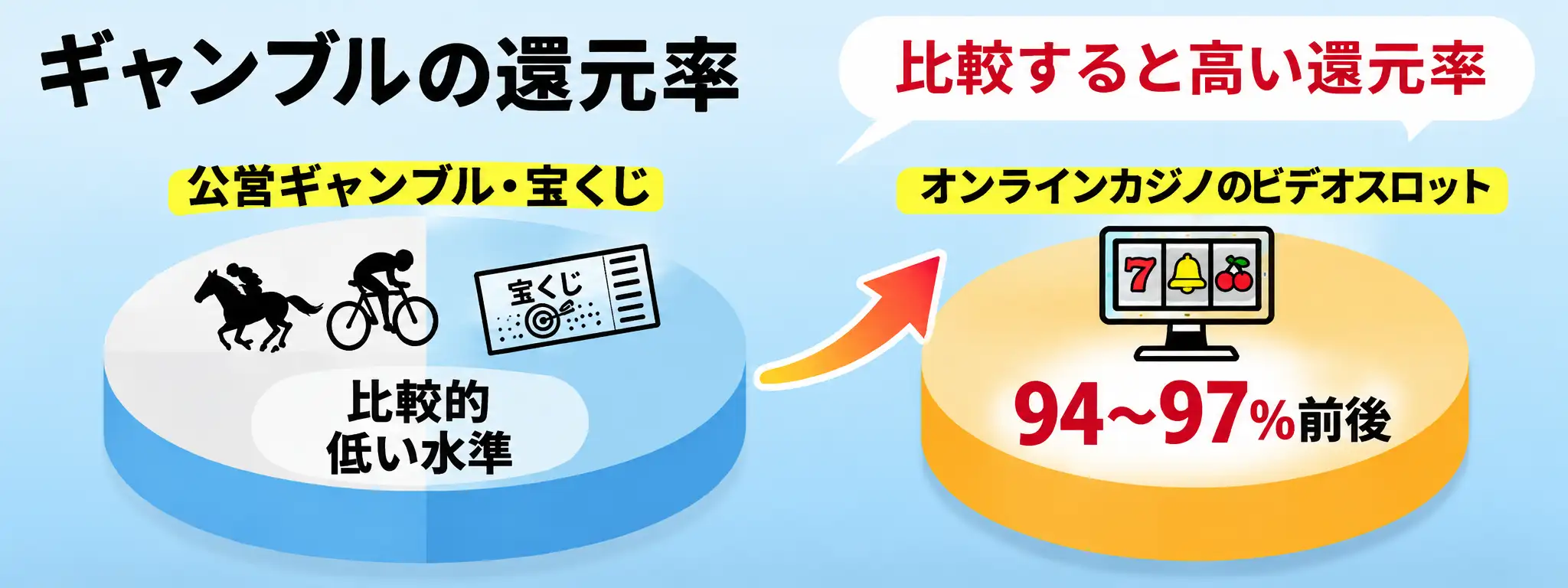
It is often said that online slots pay back more than many other forms of gambling.
Gambling games are compared by their RTP, the percentage of the money players wager that the operator pays back to them. The opposite figure, the percentage the operator keeps, is called the house edge, and that money funds the operator’s business.
Lotteries and pari-mutuel horse racing have relatively low RTPs because the operator keeps a large share. Online slots, by contrast, typically have an RTP of around 94–97%, which is higher than those forms of gambling and many land-based slot machines. Some table games, such as blackjack and baccarat, have an even lower house edge than slots.
Online casinos have no physical premises, so their costs for staff and rent are low, and because they draw players from around the world, they can operate with a house edge of just a few percent. Losses are therefore smaller than with lotteries or racing, but as long as there is a house edge, slots are still designed to reduce players’ balances over the long run.
Online Casinos Are Monitored by Their Licensing Authority Even After Being Licensed
Online casinos are required to hold a license. A license is a permit that authorizes a company to operate an online casino under conditions set by a national or regional regulator, and it is granted only after a formal review.
Operations continue to be monitored after the license is granted, and if cheating or other misconduct is found, the license can be revoked. This system makes fraud unlikely.
Four Reasons Players Tend to Lose at Online Casino Slots

Players whose losses grow too large tend to share certain habits.
A Small Bankroll Runs Out Before the Bonus Round
Most online slots follow the same pattern: your balance slowly declines during the base game, and larger payouts come in bonus rounds such as free spins. If your money runs out before you trigger a bonus round, the session ends before you ever reach the part of the game where the larger payouts are.
For this reason, deposit enough to have a reasonable chance of triggering a bonus round such as free spins. High-volatility (high-variance) slots have become more common in recent years, and many of them take a long time to trigger even one round of free spins. If you play these slots with a small amount, you are likely to run out of money before a bonus round comes. Leave yourself enough margin so that your bankroll lasts until a bonus round.
Choosing Slots with a Low RTP
Not all online casino slots have the same RTP. The lower a slot’s RTP, the more you lose for the same amount wagered. With progressive jackpot slots in particular, the displayed RTP includes the portion that goes toward the jackpot, so unless you hit the jackpot, the RTP from regular payouts alone is lower than the figure shown.
Be aware that the same slot can have a different RTP at different casinos. Typical RTP figures and how to check them are covered later in this article.
Playing for Too Long
The more you spin a slot, the closer your results get to its set RTP. This is known as convergence: there are short-term exceptions, but the more spins you play, the closer the results move toward the theoretical value.
This holds even for online slots with a high RTP and a low house edge. The house edge on each spin may be small, but the more you spin, the more you wager in total, and losses build up in line with the house edge. In other words, your theoretical loss grows in proportion to the total amount you wager.
We therefore recommend setting rules in advance, such as ending the session when you land a large payout in free spins, or setting a daily limit on the total number of spins or the total amount wagered. Switching to a different slot does not change the odds of the next spin. The only thing that helps is to stop spinning.
Chasing Losses in the Heat of the Moment
A typical losing pattern goes like this: you start out winning, then begin to lose, raise your bet size to win the money back, and finally lose your bankroll on large bets at live dealer games or slots.
Many players look back after losing their bankroll and wonder why they made that last bet. Raising your bets in the heat of the moment is what produces the biggest losses. Instead of relying on decisions made on the spot, you need rules set in advance that tell you when to stop.
Playing Styles That Tend to Lead to Bigger Losses

None of these styles is a problem if you play purely for entertainment, but players who want to keep their losses down should take a look at how they play.
Repeatedly Buying Bonus Rounds
A growing number of slots let you buy bonus rounds or free spins directly, a feature known as bonus buy. As a result, some players deposit and then buy bonus rounds on high-volatility slots again and again.
A slot that can turn $100 into $100,000 only works because many other players wagered money without ever reaching that payout. Buying a bonus round does not significantly raise the RTP; it only makes the swings in your results larger, so it is not suited to players who want to keep their losses down.
For the same amount wagered, live baccarat, which has a lower house edge, keeps losses smaller. Both, however, still lose money over the long run.
- Related Article
-

Playing Only One Slot
Playing only one slot is another style to be careful with. There is nothing wrong with having a favorite slot, and if you play purely for entertainment, you can keep playing it.
However, if you get into the habit of brushing off every loss with “at least I had fun,” you are more likely to stop managing your losses. Sticking to a single slot has real drawbacks: it is easy to keep playing after your balance falls back to your profit-lock level and give back your winnings.
Many casinos also run tournaments in which players compete against one another, but only certain slots are eligible, so if you always play the same slot, you may not be able to take part. Players who want to keep their losses down should make use of promotions as well.
Always Choosing High-Volatility Slots
Volatility is a measure of how widely your results swing. A high-volatility slot is one that pays out rarely, in both the base game and the bonus rounds, but pays large amounts when it does hit. It does not have a higher RTP, and it does not give you better odds.
Game providers release many high-volatility slots, so they are also the ones you are most likely to come across. Keep in mind, though, that only a very small share of players reach the very large payouts, and most players end up with less money than they started with.
Lowering Your Bet Does Not Win Back Earlier Losses
Lowering your bet size when your balance is falling is not a mistake in itself; it is sound bankroll management. The expected loss per spin falls by the same proportion, so a smaller bet does not make your expected losses any worse.
What you should understand is that it is not a way to recover losses you have already taken. For example, suppose you start with a $100 balance, bet $1 per spin and drop to $20. If you then lower your bet to $0.20, the same 100x win (100 times your stake) pays back only $20. To get back to your original $100, you would need to hit a higher multiplier or play many more spins.
If you lower your bet, do it to make your set bankroll last for the whole session, not to win back what you have lost.
Three Rules to Set Before and After You Play

What you do before and after a session does more to keep your losses down than anything you do while the reels are spinning.
Set a Loss Limit in Advance
Deciding in advance how much you are prepared to lose and stopping at that point – cutting your losses – does not improve your chances of winning, but it caps the amount you can lose in a single session. Doing it when your losses are mounting, however, is not easy.
That is why you should set a loss limit in advance. For example, decide to stop once you have lost a third of your balance, or to quit for the day if you have not triggered free spins within 100 spins, and always stick to that limit.
When you are ahead, it is just as important to set a profit-lock level: a point at which you stop playing so that you keep part of your winnings. One guideline is half of your peak profit. For example, if you deposit $100 and your balance grows to $300 (a $200 profit), stop playing if your balance falls back to $200, which locks in a $100 profit.
Track Your Play History with a Results Log
We recommend keeping a results log that records your daily wins and losses at online casinos. If you log your results every day and can see how much you are up or down over a month and over a year, you can avoid overspending. Knowing your results for the month also makes it easier to resist chasing losses in the heat of the moment after a small loss.
If you have time, note down why you lost after a losing session. Recording the causes in detail, such as failing to stick to your loss limit or getting too caught up in a promotion, will help you in future sessions.
Learn How a Slot Behaves Through Free Play or Small Bets
Before playing for larger amounts, it is also important to learn how a slot behaves by trying it in free play or with small bets. This does not mean looking for signs that free spins are about to arrive; no such signs exist, for reasons explained later.
What you should look at is how much the slot pays back during the base game, and whether its free spins pay moderate amounts consistently or produce many small payouts with an occasional very large one. With this information, you can estimate the swings in your results before you play. Knowing a slot’s volatility, however, does not change its RTP.
Five Practical Ways to Keep Your Losses Down

Finally, here are five points you can apply when you actually play. Unlike advice aimed at playing purely for entertainment, these points prioritize keeping your losses down.
Set Aside at Least 200 Times Your Bet in One Deposit
A session is easier to play out as planned when your bankroll has room to spare. Stopping at your loss limit and keeping your bet size constant both depend on having that margin. Depositing a reasonable amount at once gives you the margin you need to play this way.
As a guideline, deposit at least 200 times your bet per spin. If you want to play at $1 per spin, for example, have $200 or more ready. Be aware that with less than 100 times your bet, the session becomes very hard to manage.
Play Slots with a High RTP
Choosing slots with a high RTP is also important: the higher the RTP, the smaller your long-term losses. It is a theoretical value calculated over tens of thousands to millions of spins, however, and it does not guarantee short-term results.
Typical RTPs range from about 94% to 97%. As a rough guide, an RTP of 96% or more is on the high side, around 95% is standard, and a slot below 95% tends to produce larger losses. Most slots show their RTP in the game’s information or rules screen, so always check it before you play. It is safest to avoid slots where you cannot find it.
Set Your Bet Size by Bankroll Management, Not by Trying to Predict Streaks
Every online slot runs on a program called an RNG (random number generator), and each spin is an independent event whose result is generated at random in line with the slot’s set RTP. Past results have no effect on the next one, so there is no way to predict so-called hot or cold streaks in advance and time your play for a favorable moment.
Raising your bet because you feel a hot streak has arrived does not raise the expected value; it only makes your balance swing more. Keeping your bet size constant according to bankroll rules set in advance, rather than by how the game seems to be going, makes your losses easier to control.
The swings in results (volatility) differ greatly from game to game: a large payout may come within a short time, or a slot may go a long time without paying much. This is simply random variation, and trying to predict streaks does not give you an edge, so do not rely on it.
Play with a Non-Sticky Deposit Bonus
Playing carefully does not remove the house edge, so making use of casino bonuses is an effective way to reduce your actual losses.
The two types we recommend most are non-sticky deposit bonuses and no-deposit bonuses. A non-sticky deposit bonus is a promotion in which you receive bonus funds, kept separate from your real-money balance, when you deposit. If you lose your real money, you can keep playing with the bonus funds, so the bonus works like a safety net.
A no-deposit bonus (sometimes called a free bonus) is bonus money you receive when you sign up, which lets you try games without using your own money. Withdrawals usually come with wagering requirements, so check the terms before you use one.
Match Your Bet Size to Your Deposit
It is also important to set a bet size that suits your deposit. Raising or lowering your bet does not change the RTP, but it greatly changes how widely your results swing. If your bet is too high, your money is likely to run out before you land a large payout; if it is too low, the payout will be small even when you do. Decide before you play how much swing you are willing to accept relative to your bankroll.
As a guideline, apply the earlier rule in reverse: bet 1/200 of your deposit. If you deposit $100, a bet of about $0.50, and no more than about $1, is suitable.
When you play high-volatility slots, though, you can lower your bet further. Choose a bet size that fits the swings of the slot you are playing.
Summary: Sticking to Your Own Rules Is the Surest Way to Keep Losses Down
Online casino slots have a higher RTP than lotteries and pari-mutuel racing, but as long as there is a house edge, the odds favor the casino over the long run. If you play without setting any rules, your losses tend to grow. Slots also allow high maximum bets, so raising your bet in the heat of the moment can make your losses grow very quickly.
To keep those losses down, check how a slot behaves before you play, set a loss limit and a profit-lock level, and use casino bonuses to reduce your actual losses. Then play without making decisions on the spur of the moment. Sticking to the rules you have set for yourself is the surest way to keep your losses down.
Beginner's Guide to Online Slots
- Popular Online Slots Ranked
- How to Win at Slots
- Jackpot Slots Explained
- How Video Slots Work
- Bonus Buy Slots Explained
This site is for adults of legal gambling age (18+, or older where required) who live in countries or regions where online gambling is legal.
Use of this site is subject to our Terms and Conditions.
Gambling involves risk. Only bet what you can afford to lose, and do not use online gambling services where they are illegal.

Bell | Editor of Online Casino Winners Club. Since the site launched in 2003, Bell has written guides to casino game rules, tested betting systems and covered land-based casinos around the world, and still plays the games before writing about them. Bell's core advice: choose the bets with the lowest house edge, and decide in advance how much you are prepared to lose.