

The double-up feature is an option you can take after landing a winning hand. If you win, your payout is doubled, but if you lose, you forfeit the…
Jacks or Better Strategy Chart, Pay Table and How to Play

Jacks or Better, available at online casinos and in land-based casinos, is a simple form of video poker in which you are dealt five cards and can replace them once. A decision about a single card can change the result considerably, which gives the game real depth. On a full-pay machine (the “9/6” pay table, where a full house returns 9 times the bet and a flush returns 6 times the bet), optimal play with 5 coins (the maximum bet) gives a return to player (RTP) of about 99.54%.
What You Will Learn
- Basic strategy for Jacks or Better
- What “9/6” means on the pay table and how to identify a full-pay machine

This article takes about 11 minutes to read.
Contents
Show
Jacks or Better Basic Strategy
Basic strategy is a mathematically derived list of the best play for every possible hand: which of the five cards to keep and which to replace. Jacks or Better is often seen as a game of luck, but in fact there is a mathematically best play for every situation.
The names of the hands and the meaning of “9/6” are explained further down, in the sections on hand rankings and payouts, and on how to read a pay table and choose a machine.
Jacks or Better Basic Strategy Chart (16 Entries)
The priority chart below is what you use to make your decisions. Look at the five cards you were dealt, read the chart from the top, and hold the cards described in the first row that matches your hand. In the chart, “high card” means a J, Q, K or A, and “open-ended” means four cards in sequence that make a straight with a card at either end.
The color of each priority cell shows its band, and the badge in the notes column shows what the hold is aiming for. SF stands for straight flush.
Priority 1–4: Always holdPriority 5–9: Main source of payoutsPriority 10–15: Drawing handsPriority 16: Discard all
| Priority | Cards to Hold | Notes |
|---|---|---|
| 1 | Royal flush, straight flush, four of a kind | Made handThe hand is complete, so hold all five cards |
| 2 | 4 to a royal flush (four cards of the same suit) | Royal drawTakes priority over a made flush or straight |
| 3 | Full house, flush, straight, three of a kind | Made handHold as is (with three of a kind, draw the other two cards) |
| 4 | 4 to a straight flush (four cards of the same suit) | SF drawInside draws also qualify |
| 5 | Two pair | Pair handHold four cards and draw one |
| 6 | High pair (a pair of jacks or better) | Pair handThe Jacks or Better hand (a pair of jacks or higher) is already made |
| 7 | 3 to a royal flush (three cards of the same suit) | Royal drawIf you have a high pair, the high pair takes priority |
| 8 | 4 to a flush (four cards of the same suit) | Drawing handTakes priority over a low pair |
| 9 | Low pair (a pair of 10s or lower) | Pair handPays nothing on its own but is worth keeping |
| 10 | 4 to a straight (open-ended only) | Drawing handInside straight draws are not included here |
| 11 | Two high cards of the same suit | Drawing handHigh cards are J, Q, K and A |
| 12 | 3 to a straight flush (three cards of the same suit) | SF drawHold regardless of gaps or high cards |
| 13 | Two high cards of different suits | Drawing handWith three or more, hold the two lowest |
| 14 | 10 and J, 10 and Q, or 10 and K of the same suit | Drawing hand10 and A is not included |
| 15 | One high card | Drawing handWith more than one, entry 13 applies first |
| 16 | None of the above | Discard allDraw five new cards |
The priorities apply to a full-pay machine with a 9/6 pay table played with 5 coins (the maximum bet). On machines with a different pay table, some entries may change places.
If you hold according to these 16 entries and keep betting 5 coins (the maximum bet) on a 9/6 full-pay machine, the theoretical RTP is about 99.46%. That is 0.08 percentage points below the roughly 99.54% achieved with optimal strategy. The gap is very small, however, and closing it would mean memorizing many more entries, so in practice these 16 entries are enough.
Basic Rules of Jacks or Better
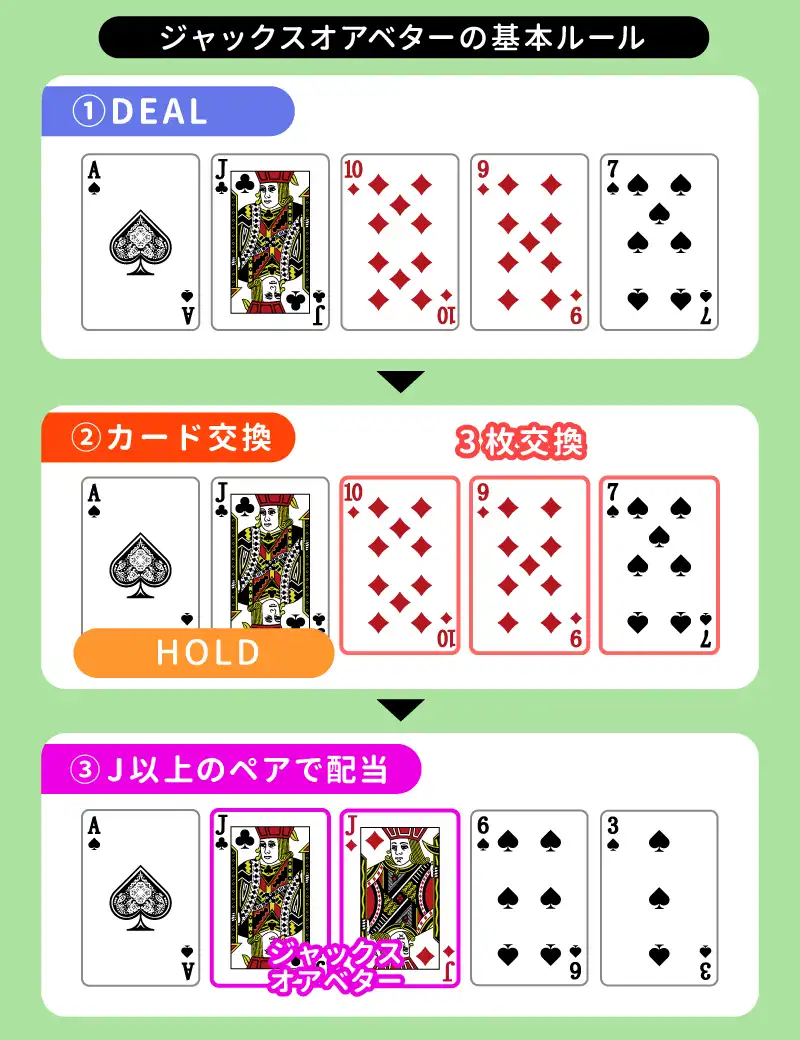
Jacks or Better is a type of video poker in which you are dealt five cards, draw replacements once, and try to make a winning hand. You do not play against other people, and payouts start at a pair of jacks or higher.
The rules are simple, so even players new to poker can start without difficulty.
The main difference from Texas Hold’em, a game it is often compared with, is that there are no opponents. For players who do not enjoy playing against other people, this solo format is part of the appeal.
| Feature | Jacks or Better | Texas Hold’em |
|---|---|---|
| Opponents | None (you play against the machine) | Several other players |
| Reading opponents | Not required | Central to the game |
| Best suited to | Players who want to play casually on their own | Players who enjoy competing against other people |
How to Play Jacks or Better
Now that you know the basic rules, this section walks through a round step by step, using screenshots from an actual game.
- The Five Steps of a Jacks or Better Round
-
- Choose your bet
- You are dealt five cards
- Choose the cards to hold
- Draw replacement cards
- Collect your payout or try the gamble feature
STEP1
Choose Your Bet
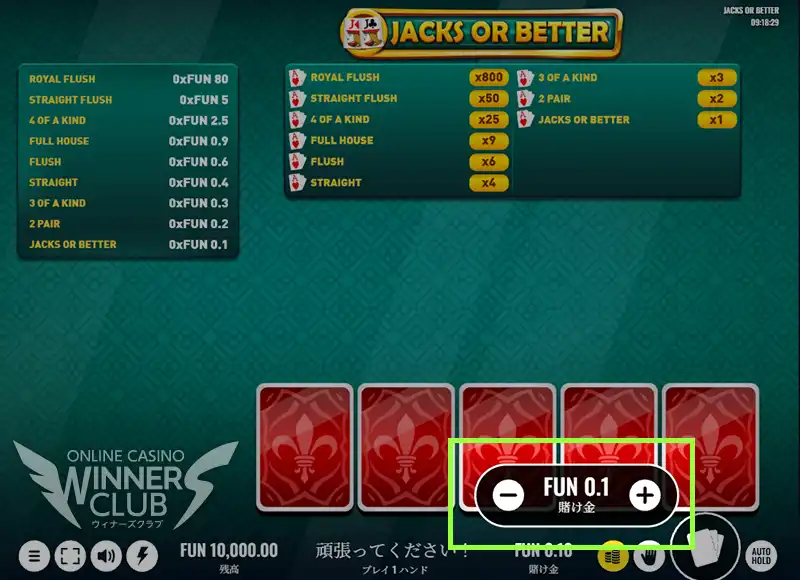
First, check the bet amount at the bottom of the screen. In this example it shows 0.10, which is the stake per hand. You can adjust the amount with the plus and minus buttons.
Once you have chosen your bet, press the Deal button and wait for the cards to be dealt. Nothing up to this point requires a real decision.
STEP2
You Are Dealt Five Cards
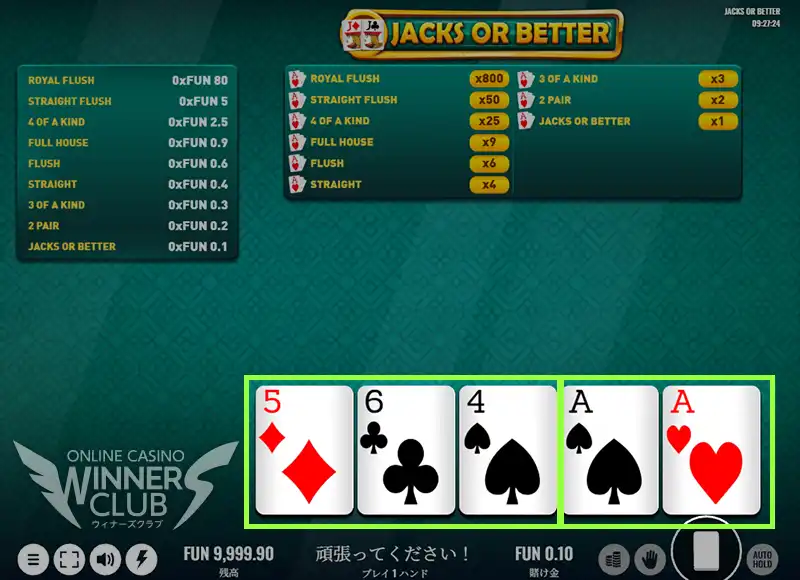
Once your bet is confirmed, five cards are dealt face up. This is where the real play begins.
Suppose you are dealt 5♦ 6♣ 4♠ A♠ A♥. Because the 4, 5 and 6 run in sequence, you may be tempted to go for a straight at first glance. Look more closely, though, and you will see that you also have a pair of aces. This is a typical hand that leaves beginners unsure which cards to keep.
STEP3
Choose the Cards to Hold
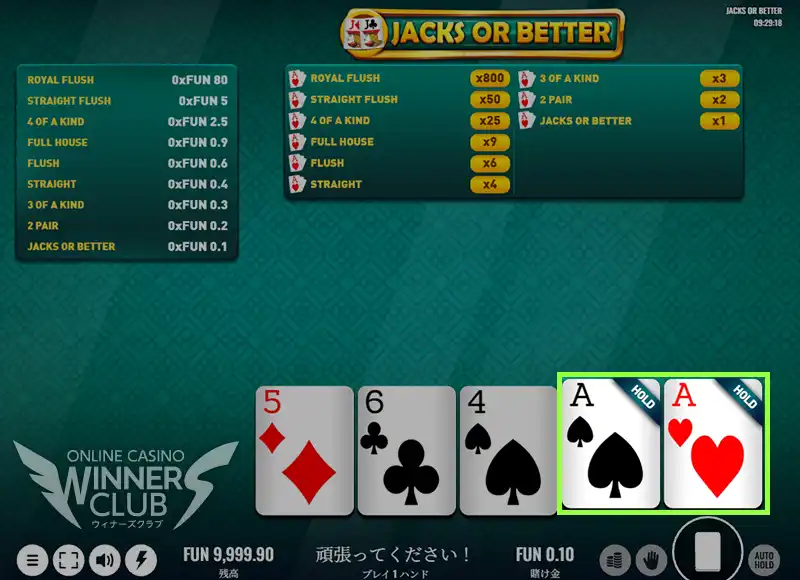
This is the most difficult step, and also the most interesting one. With this hand, the correct play is to hold the pair of aces.
Giving up a pair that already guarantees a payout for a straight that may never be completed is one of the most common mistakes. It is understandable to want to keep cards that are already in sequence, but resist the temptation and hold the pair of aces.
For specific guidance on which cards to hold, see the “Jacks or Better Basic Strategy” section at the top of this article.
Clicking a card you want to hold selects it and highlights it as held. When you have chosen the cards to hold, press the Draw button.
STEP4
Draw Replacement Cards
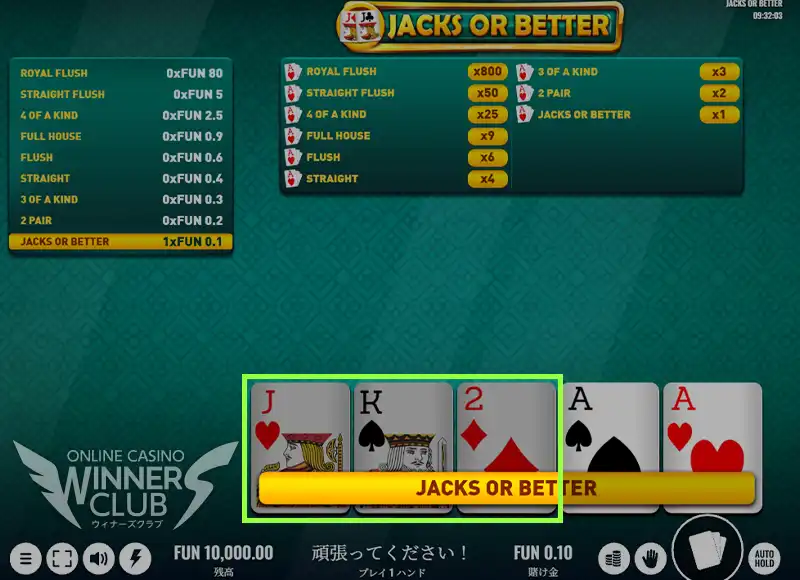
Only the cards you did not hold, in this case the 5, 6 and 4, are replaced with new cards.
In this example, the draw brought the J♥, K♠ and 2♦, giving a final hand of J♥ K♠ 2♦ A♠ A♥.
STEP5
Collect Your Payout or Try the Gamble Feature
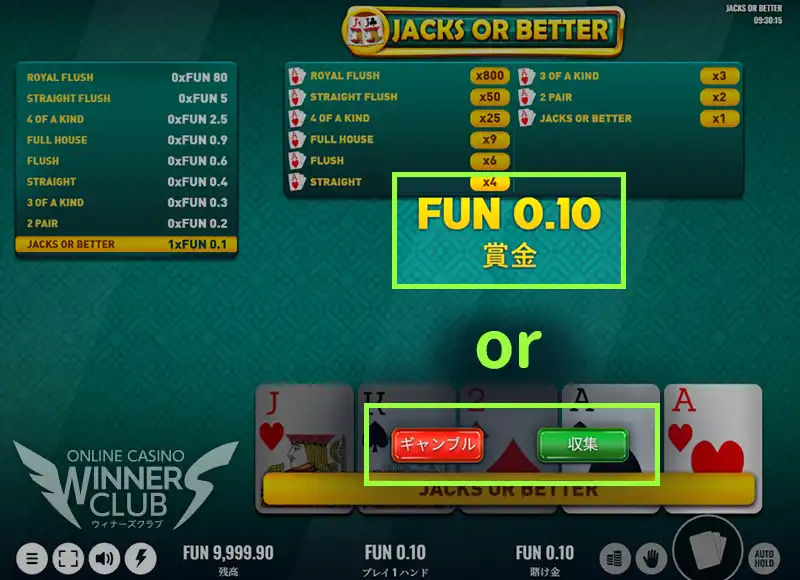
When you make a winning hand, the payout is displayed. Here the pair of aces makes the Jacks or Better hand, and the payout is 0.10.
At this point, many machines show a screen where you can choose between Gamble (double up) and Collect.
- Collect: take the payout as it stands
- Gamble (double up): stake the payout on a mini-game in which a win doubles it
The chance of winning the double-up (Gamble) feature depends on the machine but is generally around 1 in 2. Each round is independent, so the probability of a winning streak falls with every additional round. Keep in mind that a single loss costs you all of the winnings accumulated up to that point.
At first, we recommend choosing Collect so you get used to banking your payouts steadily. Once you are comfortable, you can try the double-up feature with amounts you can afford to lose.
- Related Article
-

Jacks or Better Hand Rankings and Pay Table
Once you are comfortable with the controls, the next thing to learn is the hands and what they pay. Knowing how the hands rank and what each one pays makes it easier to decide which cards to hold.
The list of hand names may look long at first, but it rests on a simple principle: the rarer the hand, the higher the payout.
Jacks or Better Hand Rankings at a Glance
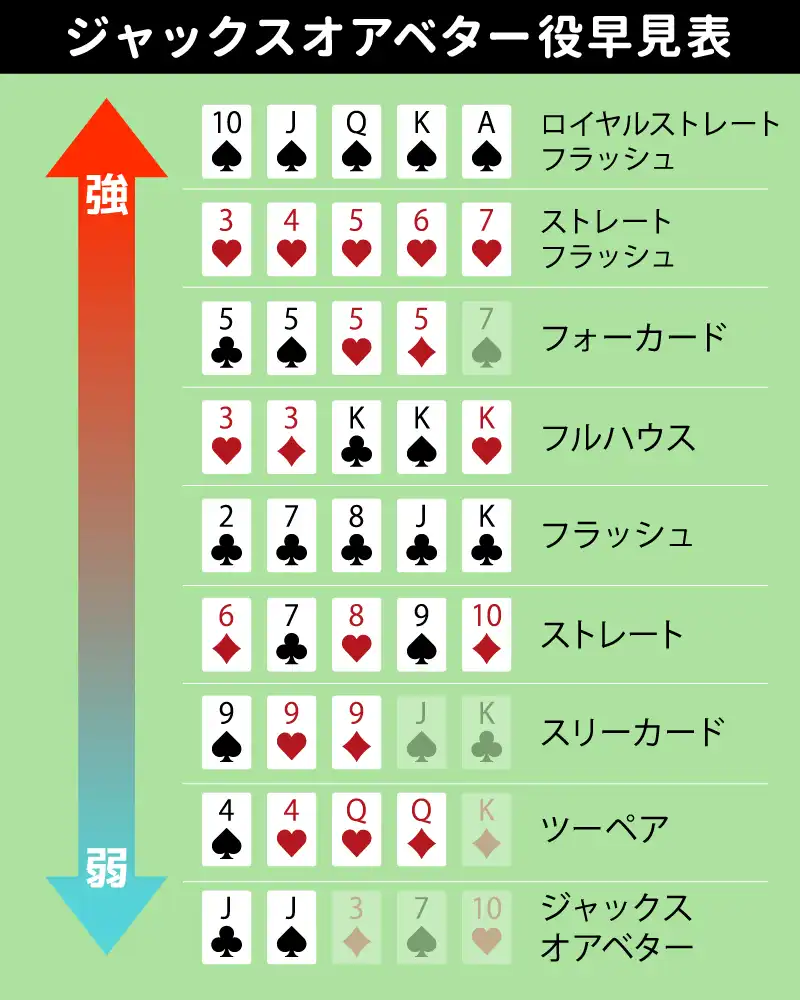
Pay Table by Hand
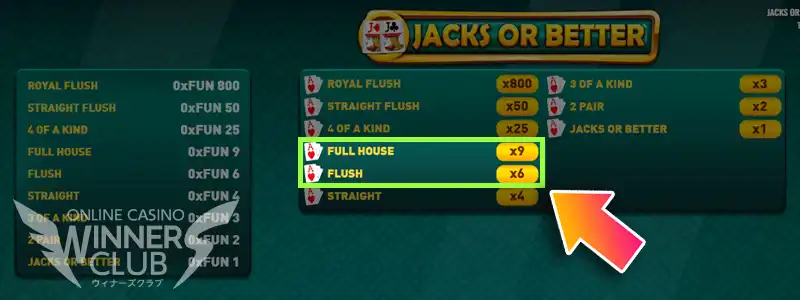
The table below shows the payout, the requirements and the approximate frequency of each hand, using the full-pay pay table of Jacks or Better by Platipus. Each payout is the amount returned per coin bet, so with 5 coins you receive five times the amount shown.
| Hand | Requirement | Payout per Coin | Frequency (Approx.) |
|---|---|---|---|
| Royal flush | A, K, Q, J and 10 of the same suit | 800x | About 1 in 40,000 |
| Straight flush | Five consecutive cards of the same suit | 50x | About 1 in 9,000 |
| Four of a kind | Four cards of the same rank | 25x | About 1 in 420 |
| Full house | Three of a kind plus a pair | 9x | About 1 in 87 |
| Flush | Five cards of the same suit, not necessarily in sequence | 6x | About 1 in 91 |
| Straight | Five consecutive cards of any suit | 4x | About 1 in 89 |
| Three of a kind | Three cards of the same rank | 3x | About 1 in 13 |
| Two pair | Two pairs of different ranks | 2x | About 1 in 8 |
| Jacks or Better | A pair of J, Q, K or A | 1x | About 1 in 5 |
Frequencies are theoretical values for optimal play with 5 coins (the maximum bet) and vary with the machine’s pay table. As the full house and flush show, a hand’s rank does not always match how often it occurs.
The highest and lowest hands occur at very different rates. A sensible approach is to treat the top hands as a bonus if they come along, and to see the lower hands as the realistic goal: winning them regularly is what keeps your balance from shrinking.
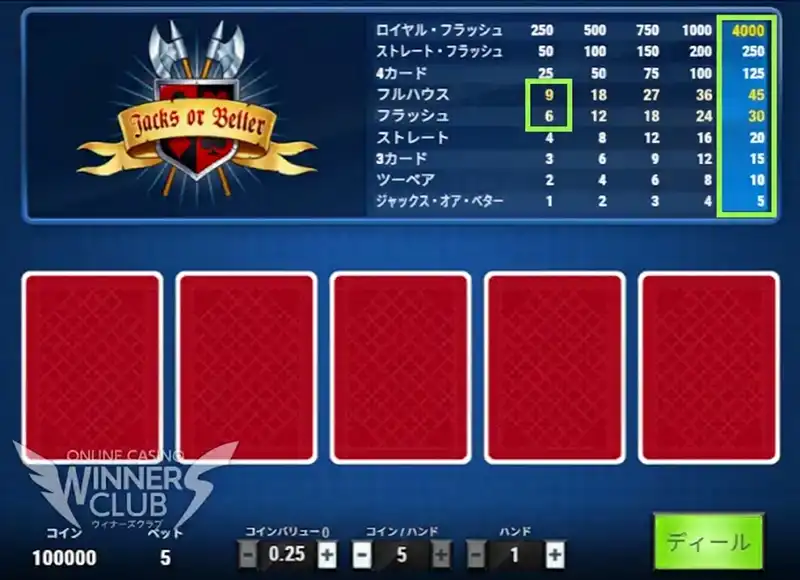
Note that the 800x for a royal flush applies to a 5-coin bet (the maximum bet). On many machines, the royal flush is the one hand whose payout does not scale in proportion when you bet fewer coins. Jacks or Better by Play’n GO, for example, pays as follows.
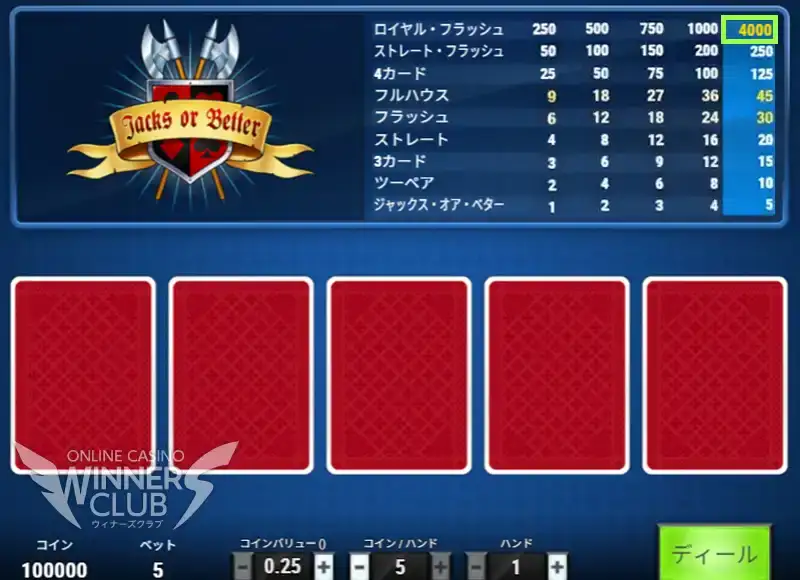
| Hand | 1 Coin | 2 Coins | 3 Coins | 4 Coins | 5 Coins |
|---|---|---|---|---|---|
| Royal flush | 250 | 500 | 750 | 1,000 | 4,000 |
Every other hand pays in proportion to the number of coins bet, but the royal flush alone jumps to 4,000 with the fifth coin (the maximum bet).
In short, if you are playing for a royal flush, always bet the maximum. To keep your stake down, lower the coin value instead.
How to Read a Pay Table and Choose a Machine
What “9/6” Means in Full-Pay Jacks or Better
If you read about Jacks or Better, you will often come across the advice to choose a 9/6 machine. “9/6” refers to the payouts per coin: 9x for a full house and 6x for a flush. As the table below shows, some machines pay 8x for a full house and 5x for a flush instead (8/5).
| Notation | Full House | Flush |
|---|---|---|
| 9/6 | 9x | 6x |
| 8/5 | 8x | 5x |
On some machines, the payouts for the other hands are almost identical and only these two differ. The higher the numbers, the higher the RTP, and 9/6, the highest level, is known as “full pay.” With optimal play and 5 coins (the maximum bet), full-pay Jacks or Better has an RTP of about 99.54%; with 1–4 coins, it drops to about 98.37%. An 8/5 machine returns only about 97.30% with optimal play and 5 coins. The difference between 9/6 and 8/5 is only one coin per coin bet on each of these two hands, which may seem trivial, but over the long run it has a significant effect on how much the player gets back.
Checklist for Spotting Full-Pay Machines
When choosing a machine, all you need to do is open the pay table and check the following.
- The full house pays 9x
- The flush pays 6x
- The royal flush pays 800x at the maximum bet (4,000 for a 5-coin bet)
If all three conditions are met, you can treat the machine as full pay. If any of these payouts is lower, the RTP is lower as well.
The pay table tells you what a machine is really worth. Simply getting into the habit of checking it before you play can change how much you lose over time, even between different versions of Jacks or Better.
Frequently Asked Questions About Jacks or Better
- What is the RTP of Jacks or Better?
-
On a full-pay machine with a 9/6 pay table, betting 5 coins (the maximum bet) and using optimal strategy, the RTP is about 99.54%. With 1–4 coins, it drops to about 98.37%. These are theoretical values, and short-term results will vary. Check the pay table before you play.
- How much money should a beginner set aside?
-
As a rough guide, a bankroll for one session should cover about 300–500 hands at the maximum bet. For example, if a 5-coin hand costs $1, that comes to about $300–$500. This figure is a guide for a longer session. In any case, start with small bets and only risk an amount you can afford to lose.
Summary: Choose a 9/6 Full-Pay Machine and Play Basic Strategy with 5 Coins
This article has covered basic strategy, which brings your results closer to the game’s theoretical RTP, along with the basic rules of Jacks or Better and how to read a pay table.
- Jacks or Better is a simple video poker game in which you are dealt five cards and draw once to make a hand, with no opponents to play against.
- The “9/6” on a pay table shows the payouts for a full house and a flush. The higher these numbers, the higher the machine’s RTP.
- Even with the same pay table, the way you play your hands determines how far you fall short of the theoretical RTP. Betting 5 coins and following basic strategy reduces those avoidable losses.
The controls are simple, but there are more decisions to learn than you might expect, and each one affects the result. How you handle the five cards in front of you, hand after hand, is what determines your results over the long term.
Video Poker Beginner's Guide
Types of Casino GamesThis site is for adults of legal gambling age (18+, or older where required) who live in countries or regions where online gambling is legal.
Use of this site is subject to our Terms and Conditions.
Gambling involves risk. Only bet what you can afford to lose, and do not use online gambling services where they are illegal.

Bell | Editor of Online Casino Winners Club. Since the site launched in 2003, Bell has written guides to casino game rules, tested betting systems and covered land-based casinos around the world, and still plays the games before writing about them. Bell's core advice: choose the bets with the lowest house edge, and decide in advance how much you are prepared to lose.