

"Why does a winning Banker bet pay 1 to 1 minus a commission, so that a $10 bet wins only $9.50?" "Is no-commission baccarat actually the better…
Baccarat Odds of Winning: Player, Banker and Tie Probabilities

Many baccarat strategies and “winning systems” are promoted, and it can be hard to know which one, if any, is worth using.
To judge whether a system holds up, the most important first step is to understand the probabilities (win rates) in baccarat. This page sets out the probability of each bet winning and how to approach the game in light of those numbers.
What You Will Learn
- In baccarat, the Player bet wins 44.62% of the time, the Banker bet wins 45.86% of the time, and a Tie occurs 9.52% of the time.
- The house edge is 1.24% on Player, 1.06% on Banker (1.46% in no-commission baccarat) and 14.36% on Tie.
- The bet with the lowest house edge is Banker in standard baccarat and Player in no-commission baccarat.

This article takes about 14 minutes to read.
Contents
Show
Do You Need to Understand Baccarat Probability?

Baccarat is a simple card game, and if you only want to enjoy it, you do not need to know the probabilities. Many players simply assume that Player and Banker each win roughly 50% of the time.
Knowing the probabilities does not change the win rates of the game itself, so it is reasonable to wonder whether learning them serves any purpose.
Understanding the probabilities in baccarat, however, lets you examine the strategies and winning systems circulating on social media and elsewhere online and judge whether they actually work.
If a system seems wrong but you cannot pinpoint why, this page will help you identify where it breaks down and protect yourself from unfounded claims.
A deeper understanding of the probabilities also lets you understand what is happening in each round and get more out of the game. Baccarat probability is knowledge worth having.
Baccarat Payouts by Bet

The first numbers to know in baccarat are the payouts for each winning bet. In this article, payouts are given as odds, with the amount won shown in a $10 example.
In baccarat, cards are dealt to two hands, Player and Banker, and you bet on which one will win. “Player” is simply the name of a bet and does not refer to you. Throughout this article, Player and Banker are capitalized when they refer to these hands and bets.
- Player: pays 1 to 1 (a $10 bet wins $10)
- Banker: pays 1 to 1 minus a 5% commission (a $10 bet wins $9.50)
- Tie: pays 8 to 1 (a $10 bet wins $80)
Winning Player and Banker bets are paid differently. The Banker bet wins slightly more often than the Player bet, so paying it at a full 1 to 1 would push its return to player (RTP) above 100%.
A Tie occurs very rarely, so it is paid at higher odds.
What Is the Commission?
The Banker bet is set up to win more often than the Player bet. As explained in a later section, the rules for when Banker draws a third card are more likely to lead to a win than the rules for Player.
Without an adjustment, the RTP of the Banker bet would exceed 100%, so a 5% commission is deducted from winning Banker bets. A winning $10 Banker bet therefore wins $9.50, and you get $19.50 back in total.
In no-commission baccarat, a winning Banker bet pays 1 to 1, the same as Player. When Banker wins with a total of 6, though, the bet pays only half (1 to 2, so a $10 bet wins $5), which raises the house edge on Banker from about 1.06% to about 1.46%.
Because a Banker win on 6 pays only half, the calculations of betting systems that assume a 1 to 1 payout no longer work out (a Player bet pays 1 to 1 in both versions).
- Related Article
-

Probability of a Player Win, Banker Win and Tie
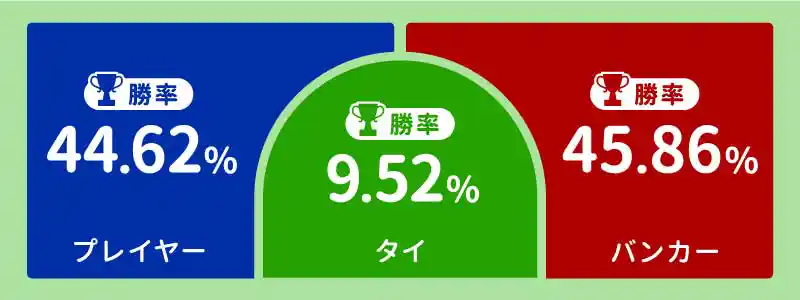
The probabilities of each result are 44.62% for Player, 45.86% for Banker and 9.52% for a Tie.
When the round is decided on the first two cards, Player and Banker have the same chance of winning. Banker’s third-card rule, however, is applied after Player has drawn, so Banker wins slightly more often.
These figures may seem surprisingly far below 50%, but that is because ties account for part of the total. Excluding ties, Player wins 49.32% and Banker 50.68% of the time.
The Probability of 10 Wins in a Row: 0.031% on Player, 0.041% on Banker
Betting systems that build profit during winning streaks, such as the Paroli system, only work if you reach the number of consecutive wins you set as your target. Knowing the probabilities is therefore essential for setting a realistic target.
The table below assumes that a Tie also ends a streak. With betting systems in which a Tie simply means the bet is placed again, the probability of a streak is considerably higher than shown in the table.
| Wins in a row | Probability of a Player streak | Probability of a Banker streak |
|---|---|---|
| 1 | 44.620% | 45.860% |
| 2 | 19.909% | 21.031% |
| 3 | 8.884% | 9.645% |
| 4 | 3.964% | 4.423% |
| 5 | 1.769% | 2.028% |
| 6 | 0.789% | 0.930% |
| 7 | 0.352% | 0.427% |
| 8 | 0.157% | 0.196% |
| 9 | 0.070% | 0.090% |
| 10 | 0.031% | 0.041% |
Note: Streak probabilities are shown to three decimal places so that the differences are visible.
If a Tie is treated as ending the streak, the probability of 10 Player wins in a row is 0.031%. The probability of 10 Banker wins in a row, 0.041%, is about 30% higher. The difference per round is only a little over 1 percentage point, yet over 10 consecutive wins the Banker figure ends up about 30% higher than the Player figure, which shows how quickly small differences compound over a streak.
A probability of 0.031% means about once in 3,200 attempts. Even if a Tie is treated as a reset and the bet is placed again, 10 wins in a row occur only about once in 1,200 attempts. A goal such as “lock in the Paroli profit after 10 straight wins” is best regarded as unrealistic.
Banker Has the Highest Probability of Winning
If you cannot decide which side to bet on, choosing Banker, with its slightly higher win rate, is one reasonable approach. It does not give you an edge, however; it only means your losses over the long run are smaller.
Probability of a Third Card Being Dealt in Baccarat
The probability that a third card is dealt is also worth knowing. Baccarat has detailed rules for drawing a third card. Player draws a third card whenever its first two cards total 5 or less. Whether Banker draws depends on its own hand and on Player’s third card. Both sets of rules are fixed, so neither the player nor the dealer makes any decision.
| Hand that draws a third card | Player wins | Banker wins | Tie | Total |
|---|---|---|---|---|
| Player only | 3.39% | 13.42% | 1.76% | 18.57% |
| Banker only | 8.61% | 2.26% | 0.90% | 11.77% |
| Both | 15.48% | 13.02% | 3.27% | 31.77% |
The table shows that when only Player draws a third card, Banker has usually stood on a strong hand, so Banker comes out ahead (13.42% vs. 3.39%). When only Banker draws, Player has usually stood on 6 or 7, so Player comes out ahead (8.61% vs. 2.26%). The three rows add up to 62.11%; the remaining 37.89% are rounds in which neither hand draws a third card.
Taken as a whole, the rules are set so that Banker wins a little over 1 percentage point more often.
- Related Article
-

Baccarat Probabilities and the House Edge
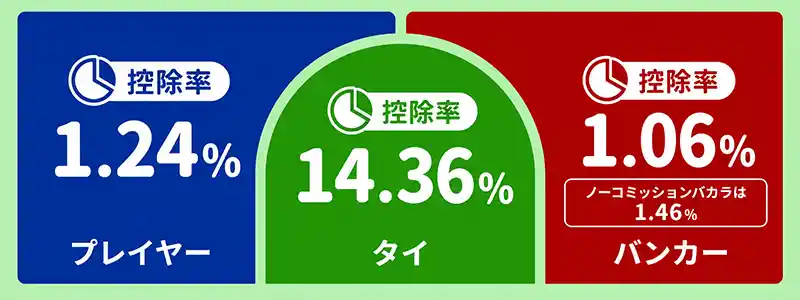
The most important figure to consider when deciding how to bet is the house edge. Put simply, the house edge is the casino’s share of the money wagered.
A bet with a low house edge leaves the casino a smaller share, so your losses are smaller. A low house edge is nevertheless an edge for the casino, and over the long run the result is still a loss.
Baccarat is known for having one of the lowest house edges among the games offered at online casinos. How low is it in practice?
The detailed calculations are shown below. The house edge on each bet is as follows.
- Player: 1.24%
- Banker: 1.06% (1.46% in no-commission baccarat)
- Tie: 14.36%
These figures show that Banker has a lower house edge than Player. Even though a winning Banker bet pays 1 to 1 minus a 5% commission, Banker still has the higher RTP.
In no-commission baccarat, Banker may look more attractive because no commission is charged, but in fact Player has the higher RTP.
The house edge on the Tie, about 14.36%, is far higher than on the other two bets, so it is a bet to avoid if you want to keep your losses down (see “(3) Given Its Win Rate, Avoid Betting on the Tie” below for details).
- Related Article
-

How to Calculate the House Edge
The house edge can be calculated as follows.
House edge (%) = 100 − (average amount returned ÷ bet × 100) (Formula A)
Player
Consider the average amount returned on a $100 bet on Player.
- Player wins 44.62% of the time, and a winning bet returns $200 in total, so
$200 × 0.4462 = $89.24 - A Tie occurs 9.52% of the time, and the $100 bet is returned, so
$100 × 0.0952 = $9.52 - The average amount returned is the sum of these two amounts:
$89.24 + $9.52 = $98.76
Applying Formula A gives
100 − (98.76 ÷ 100 × 100) = 1.24, so the house edge on Player is about 1.24%
Banker
Consider the average amount returned on a $100 bet on Banker.
- Banker wins 45.86% of the time, and a winning bet returns $195 in total, so
$195 × 0.4586 ≈ $89.43 - A Tie occurs 9.52% of the time, and the $100 bet is returned, so
$100 × 0.0952 = $9.52 - The average amount returned is the sum of these two amounts:
$89.43 + $9.52 = $98.95
Applying Formula A gives
100 − (98.95 ÷ 100 × 100) = 1.05, so the house edge on Banker is about 1.06%
Tie
Consider the average amount returned on a $100 bet on the Tie.
- A Tie occurs 9.52% of the time, and a winning bet returns $900 in total, so
$900 × 0.0952 = $85.68
Applying Formula A gives
100 − (85.68 ÷ 100 × 100) = 14.32, so the house edge on the Tie is about 14.36%
Note: These calculations use probabilities rounded to two decimal places, so the results differ slightly from the published figures, which are based on the exact probabilities (Banker 45.8597%, Tie 9.5156%). The figures given in the text are the exact values (a house edge of 1.06% and an RTP of 98.94% on Banker, and a house edge of 14.36% on the Tie).
Four Approaches to Baccarat Based on Probability

A popular idea in baccarat is that past results can be used to predict future ones. This section uses the probabilities covered so far to check whether that idea holds up. None of the approaches below raises your win rate or expected value. They are ways to understand probability correctly and to play within sensible limits.
- Understand the law of large numbers correctly
- The scoreboard is a record of the past and cannot predict the next result
- Given its win rate, avoid betting on the Tie
- Banker is the bet with the lowest house edge
- Related Article
-

(1) Understand the Law of Large Numbers Correctly
The law of large numbers is one of the basic principles of probability theory. It can be stated as follows.
If the probability of event A in a trial (the theoretical probability) is a, then the proportion of trials in which A actually occurs (the observed probability) comes closer to a as the number of trials increases.
For example, if Player and Banker were each set to win 50% of the time, the results would come closer to 50% over 100 or 1,000 rounds than over 10 rounds.
In our own test, we played 1,000 rounds of baccarat, excluding ties, and recorded the share of Player and Banker wins in the table below.
| Rounds | 10 | 100 | 500 | 1,000 | Theoretical rate |
|---|---|---|---|---|---|
| Player wins | 8 | 44 | 237 | 488 | – |
| Player win rate | 80.0% | 44.0% | 47.4% | 48.8% | 49.32% |
| Banker wins | 2 | 56 | 263 | 512 | – |
| Banker win rate | 20.0% | 56.0% | 52.6% | 51.2% | 50.68% |
As the number of rounds increases, the figures gradually approach the theoretical rates. This is called convergence.
A common misconception is that playing more rounds will let you win back your losses. The law of large numbers says only that, as the number of trials grows, the cumulative proportion of trials in which the event has occurred approaches the theoretical probability. It does not mean that the probability rises in later trials because it was low in earlier ones.
In our test, Player had won 8 rounds and Banker 2 after the first 10.
Banker’s probability of winning did not rise after that; it stayed at 50.68%. It is precisely because Banker always wins with a probability of 50.68% that the overall proportion approaches this rate as the number of rounds increases.
Whether the results so far have been low or high, keep in mind that the win rates for Player and Banker never change.
(2) The Scoreboard Is a Record of the Past and Cannot Predict the Next Result
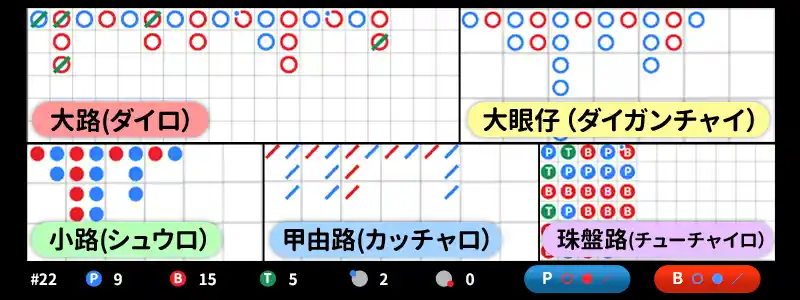
A scoreboard is a chart that records whether Player or Banker won each previous round. The most widely used is the Big Road, in which each consecutive win by Player or Banker extends a column of circles downward, so past streaks are easy to see.
As the convergence example above showed, there is no mathematical basis for predicting future results from past data. Probability simply does not work that way.
That said, when you cannot decide which side to bet on, a scoreboard gives you a quick overview of how the previous rounds have gone.
Using a scoreboard to choose your bet has one advantage: it makes it easier to apply the rules of a betting system consistently. It is, however, only one way of organizing your bets and enjoying the game. Following the “trends” does not raise your win rate or expected value.
(3) Given Its Win Rate, Avoid Betting on the Tie
The probability of a Tie is about 9.52%, less than 1 in 10. A winning Tie bet pays 8 to 1, so a $10 bet wins $80, which is low relative to how rarely a Tie occurs. The house edge is far higher at about 14.36%, so in standard baccarat, betting on the Tie only increases your losses.
However, in some live baccarat games, such as those from Evolution, multipliers are drawn at the start of each round. If the winning hand contains one of the drawn cards, the payout (including on the main bets) is multiplied, while the base payout on the Tie itself may be set lower than in standard baccarat. To fund these multipliers, a 20% fee is charged on every bet, so the RTP differs from that of standard baccarat.
The RTP when multipliers apply has to be checked in the provider’s official game rules, and we do not quote a figure for it on this site. If you want to keep your losses down, the Tie is a hard bet to justify.
(4) Banker Is the Bet with the Lowest House Edge
As shown above, Banker is the bet with the lowest house edge, with an RTP of about 98.94%. Looking at the house edge alone, betting on Banker every round is one reasonable guideline.
Because a winning Banker bet pays 1 to 1 minus a 5% commission (a $100 bet wins $95), betting systems built on a 1 to 1 payout are harder to use. The assumption that a win exactly recovers the previous loss no longer holds, so the amounts returned do not match the system’s calculations. Flat betting on Banker also takes away the fun of trying to predict each result, and over many rounds your return simply converges on the RTP, so many players find it dull.
You can make the game more interesting without lowering the RTP, for example by sitting out a round when you feel Player is due to win rather than betting against Banker.
Frequently Asked Questions About Baccarat Probability
- Does the number of decks affect the probabilities?
-
The number of decks makes a small difference in baccarat. For example, when baccarat is played with a single 52-card deck, the house edge on Banker falls to about 1.01%, and the house edge on Player rises to about 1.29%.
Each figure therefore moves by about 0.05 percentage points, and Banker still has the lower house edge.
However, most live baccarat is played with 6–8 decks, so the difference is not worth worrying about (less than 0.01 percentage points). Finding a casino with better terms is more effective than searching for live baccarat tables that use fewer decks.
- Which baccarat bet has the highest win rate?
-
Banker has the highest win rate per round (45.86%), and betting on Banker every round is also the way to keep losses down over the long run. In no-commission baccarat, the equivalent bet is Player.
Some players mix in the Tie or side bets such as Pairs, but these bets have a much higher house edge, and the more you bet on them, the larger your losses become.
If you come across sources that actively recommend the Tie or Pair bets, we suggest checking whether they give any basis for their RTP figures before you decide.
- Does the house edge affect the probabilities?
-
The house edge and the probabilities are closely related.
For example, leaving ties aside, it might seem natural for Player and Banker each to win 50% of the time on a bet that pays 1 to 1. Player’s win rate, however, is 49.32%. This shortfall below 50% translates into a house edge of about 1.24% (because the bet is returned on a Tie, the exact calculation follows the steps shown earlier in this article).
For more on the relationship between the house edge and the probabilities, see “Baccarat Probabilities and the House Edge” above.
Summary: Banker in Standard Baccarat and Player in No-Commission Baccarat Keep Losses Down
In baccarat, Banker wins slightly more often than Player and also has a slightly lower house edge.
In no-commission baccarat, however, Player has the lower house edge. If you follow the house edge, the bets that keep your losses down are Banker in standard baccarat and Player in no-commission baccarat.
The gap between 1.24% on Player and 1.06% on Banker is only 0.18 percentage points. Since cashback or rebate offers from casinos are typically only around 1% of the amount wagered, a 0.18-point gap is not a difference to ignore.
If you want to keep your losses down, these are the natural bets to choose.
Probability is not on the player’s side. Understanding it, however, will be useful every time you play baccarat. At the very least, it is worth remembering the exact win rates and RTPs.
This site is for adults of legal gambling age (18+, or older where required) who live in countries or regions where online gambling is legal.
Use of this site is subject to our Terms and Conditions.
Gambling involves risk. Only bet what you can afford to lose, and do not use online gambling services where they are illegal.

Bell | Editor of Online Casino Winners Club. Since the site launched in 2003, Bell has written guides to casino game rules, tested betting systems and covered land-based casinos around the world, and still plays the games before writing about them. Bell's core advice: choose the bets with the lowest house edge, and decide in advance how much you are prepared to lose.