

In sports betting, one technique is sometimes described as one you cannot lose with, at least in theory: arbitrage betting at bookmakers. Arbitrage…
Types of Sports Bets: Moneyline, Over/Under, Handicap and More

Bookmakers offer many different ways to bet. Beyond simply betting on which side will win, they offer a wide range of markets, from the result once a handicap is applied and the total number of goals scored to whether a red card will be shown and which country will win a tournament.
What You Will Learn
- How betting with a bookmaker works and the steps to place a bet
- The three basic markets: 1X2 (three-way)/moneyline, over/under (totals) and handicap bets

This article takes about 16 minutes to read.
Contents
Show
How to Get Started with a Bookmaker
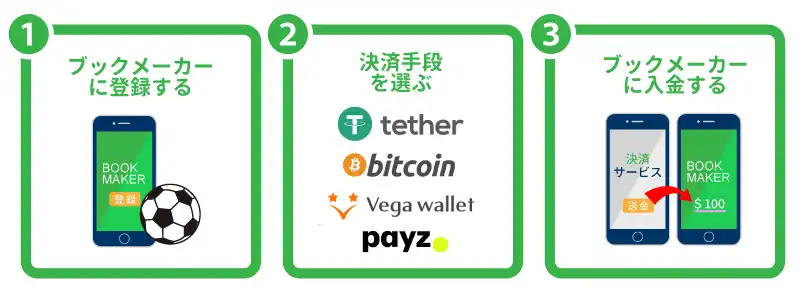
- Sign up with a bookmaker
- Choose a payment method for deposits and withdrawals (if you plan to use an e-wallet, open an account and add funds to it first)
- Deposit funds into your bookmaker account
When You Can Place Bets with a Bookmaker
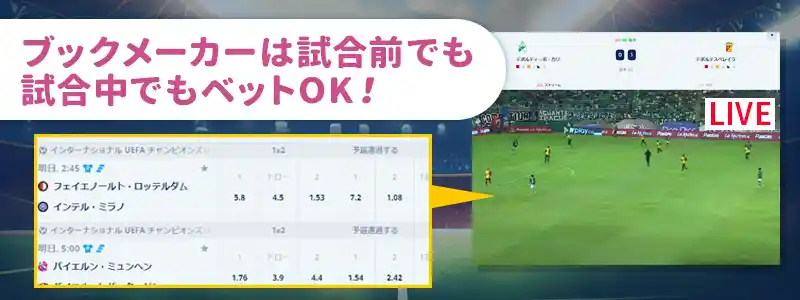
In pari-mutuel betting, as used in horse racing, betting closes a set time before the race, and you cannot place a bet once the race has started. With a bookmaker, by contrast, you can keep betting even while a match is in progress, right up until betting on that market closes. This is called live betting (also known as in-play betting).
A bookmaker pays out at the odds in effect at the moment you place your bet. In pari-mutuel betting, the pool is divided up after betting closes to determine the payouts. With a bookmaker, your payout stays the same even if the odds move after you bet. Locking in the odds does not, however, give you an advantage in itself.
All odds in this article are decimal odds (European format), which include the stake. In the US, the same price is usually shown as American odds; for example, decimal odds of 5.00 are +400. The odds when a market first opens for betting are called the opening odds, and the odds when betting closes are called the closing odds. The odds also change each time the score changes as the match goes on.
Every price a bookmaker offers already includes the bookmaker’s cut, known as the margin (also called the vig). Adding up the reciprocals of the odds for every possible outcome gives the overround, which at any single bookmaker is set above 100%. The reciprocal of the overround is the payout percentage (the share of all stakes paid back to bettors), and 100% minus the payout percentage is the margin. High odds mean a larger payout if your bet wins; they do not mean the bet favors you. If you keep betting without any analysis, your bankroll will shrink by the margin over the long run.
Some bettors place their bets before the match after thorough analysis, while others bet as they watch the match unfold, and there is no single best time to bet that suits everyone. If you are betting for the first time, placing your bet before kickoff makes it easier to focus on the match itself.
Basic Ways to Bet with a Bookmaker
Bookmaker bets follow a few basic patterns. Once you understand how each one works and how it is settled, you can bet the same way on any sport, although some sports also have bet types of their own.
The same bet type can go by different names depending on the bookmaker, so we also note the alternative names.
1X2 Bet / Moneyline (Picking the Winner)
The first bet we recommend when you start sports betting is the 1X2 bet or moneyline, a bet on the result of the match. Odds for it are offered in almost every sport, and since the bet wins if the side you back wins, it is easy to understand even for first-timers.
A 1X2 bet means picking one of three outcomes in a contest between two teams or two players: “1” for a home win, “2” for an away win and “X” for no winner (a draw). In other words, it is simply a bet on the match result with the draw included, which is why it is also called a three-way moneyline.
In sports with extra time, such as soccer, 1X2 bets are settled on the result at the end of regular time, which includes the first half, the second half and stoppage time. Extra time and penalty shootouts generally do not count. If the match goes to extra time, bets on the draw are usually settled as winners, but the details depend on each bookmaker’s rules.
The name depends on whether the sport has draws
A 1X2 bet and a moneyline are both bets on the result. In general, the main difference between them is whether you can bet on a draw.
A moneyline is a market on who wins, commonly used in sports where draws generally do not occur, such as tennis and boxing. In that case there are only two options, and you bet on which of the two teams or two players will win. In sports where draws can happen, a moneyline is sometimes offered as a three-way market that includes the draw.
1X2 bets are used in sports such as soccer, where league matches can end in a draw. You can bet on either side to win or on a draw. If the match ends in a draw, a bet on either side to win loses, and the stake is not returned.
Because a 1X2 bet asks you to pick one of three outcomes rather than one of two, the 1X2 odds on a team to win are higher than the two-way (draw no bet or moneyline) odds on the same team in the same match.
Over (Total Above the Line)
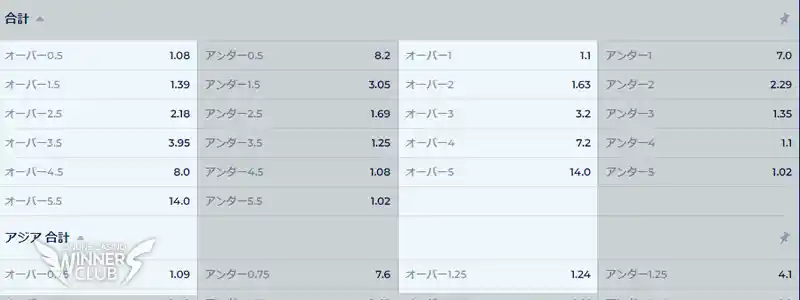
Over/under (totals) is another standard bet type available in almost every sport. A bet that the total score will finish above the line is the “over,” and a bet that it will finish below the line is the “under.”
In soccer and other sports decided by the score, an over bet wins if the total number of goals or points in the match is above the line.
For example, with over 1.5, the bet wins if the match has more than 1.5 goals in total: two or more goals wins, and one or fewer loses. Lines are usually set at half numbers such as 1.5 or 2.5 so that the bet always ends in a win or a loss.
Whole-number lines such as over 2 also exist. In that case, exactly two goals voids the bet and the stake is returned, three or more goals wins, and one or fewer loses.
Under (Total Below the Line)
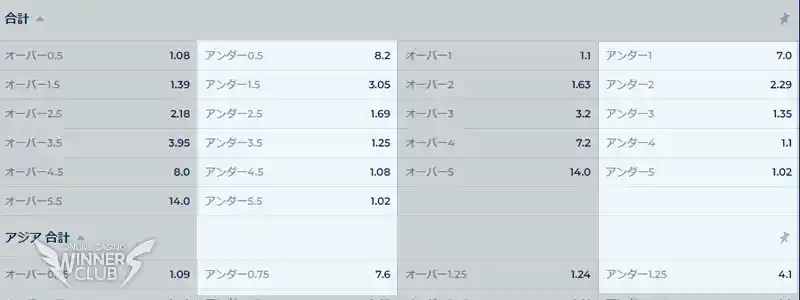
The under is the opposite of the over: the bet wins if total goals finish below the line.
For example, with under 2.5, the bet wins if the match has fewer than 2.5 goals in total: two or fewer wins, and three or more loses.
Over/under markets are not limited to goals. They often cover anything with a numerical result, such as the number of corners or cards (yellow and red) in soccer, or the number of touchdowns or field goals in American football.
There are also separate markets on the combined score of both teams, the home team’s score alone and the away team’s score alone, so a wide range of over/under bets is available.
Handicap (Predicting the Result with a Handicap Applied)
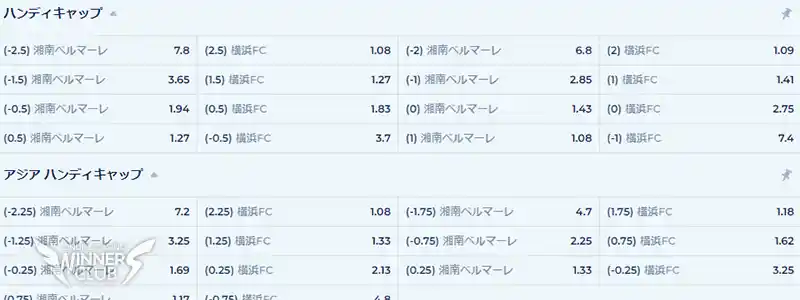
A handicap bet is settled after a handicap has been applied to the match result or another outcome. It works much like the point spread in US sports.
For example, if you bet on “B +1.5” in a match between Team A and Team B, the bet is settled with 1.5 goals added to Team B’s score. Even if Team A wins 1–0, adding 1.5 to Team B makes it 1–1.5, so the bet is settled as a win for Team B.
Conversely, if you bet on “A -1.5,” Team A effectively starts the match with the opponent 1.5 goals ahead, so Team A has to win by two goals or more for your bet to win.
Handicaps help even out matches between teams or players of different strength, so the match stays interesting whichever side you back. Depending on the handicap, the payout on a winning bet can also be larger, and it is one of the commonly used bet types.
Two Types of Handicap: European and Asian
There are two types of handicap: the European handicap and the Asian handicap.
A European handicap applies a handicap and then lets you bet on one of three outcomes: home win, draw or away win.
For example, if you bet on a European handicap of “A -1” in a match between Team A and Team B and Team A wins by one goal, the one-goal handicap is subtracted, the result becomes a draw, and your bet loses.
An Asian handicap uses handicaps in quarter-goal increments (0.25) to eliminate the draw. With lines such as 0.5, 1.5 and 2.5, there is no draw option, and once the handicap is applied one side always wins. With lines such as 0.25 and 0.75, the stake is split across two lines, so the result can be half a win and half a refund.
Asian handicaps can also use whole-number lines, in which case a draw after the handicap means the stake is returned and the bet is void. A draw is a losing result with a European handicap but a refund with an Asian handicap, so the risk is lower; in exchange, the odds on a winning bet are lower than with a European handicap.
How to Place a Bet with a Bookmaker
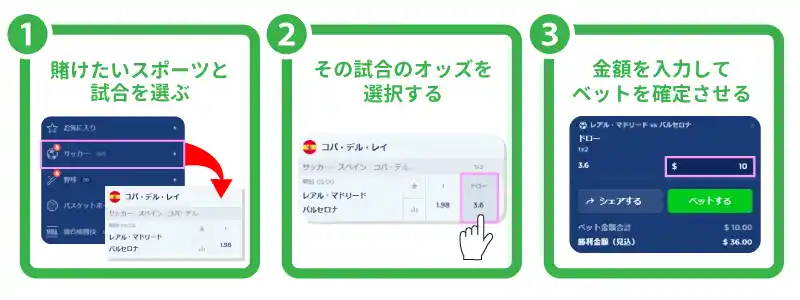
This walkthrough uses the betting screen of a typical sportsbook to show how to bet on the result of a soccer match.
- Three Steps to Placing a Bet with a Bookmaker
-
- Choose the sport and match you want to bet on
- Select the market and odds
- Enter your stake and confirm the bet
Step 1
Choose the Sport and Match You Want to Bet On
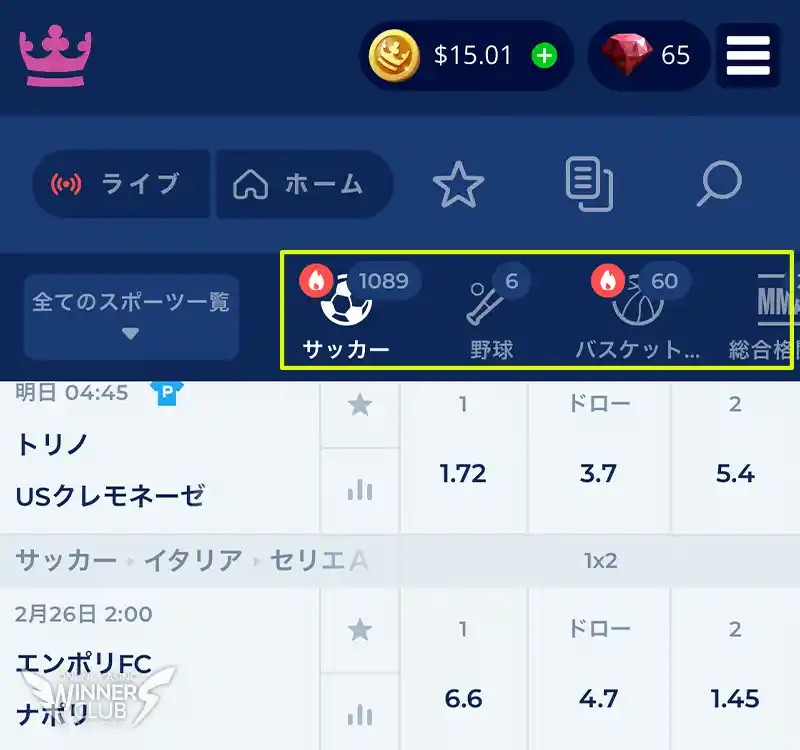
The sports betting screen lists sports such as soccer, baseball and basketball across the top. Start by choosing the sport you want to bet on.
In this example, we chose soccer. All the soccer matches currently open for betting are then displayed, and you choose the match you want to bet on. Here we select Bologna vs. Inter Milan in Italy’s Serie A.
If you already know which match you want, you can find it faster by tapping the search button (the magnifying glass) and entering the team name.
Step 2
Select the Market and Odds
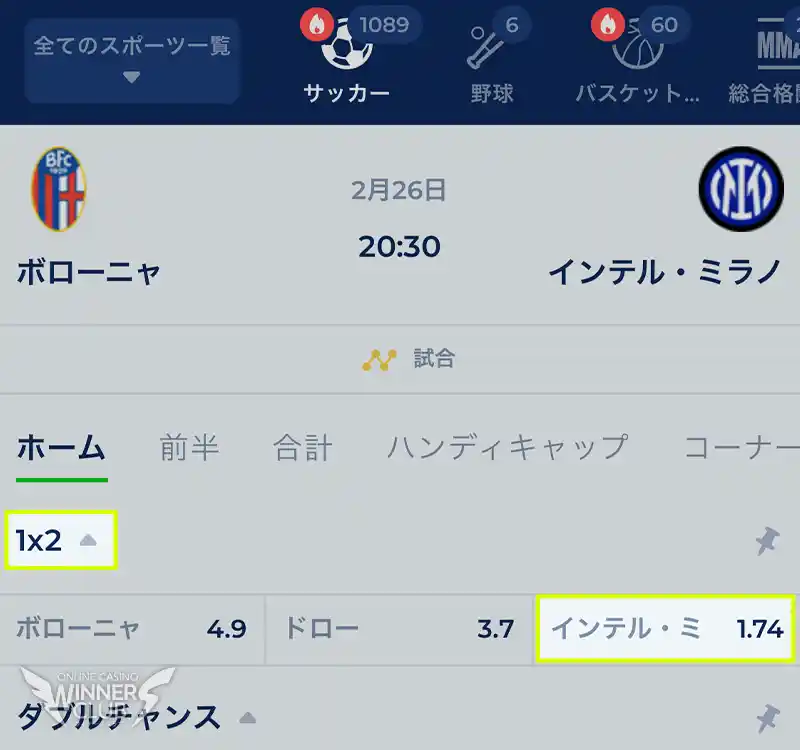
Even a single match offers many ways to bet. Each type of bet is called a market.
The bet on the result we want here is the 1X2 bet at the top of the list. Within it, select the odds for Inter Milan.
Step 3
Enter Your Stake and Confirm the Bet
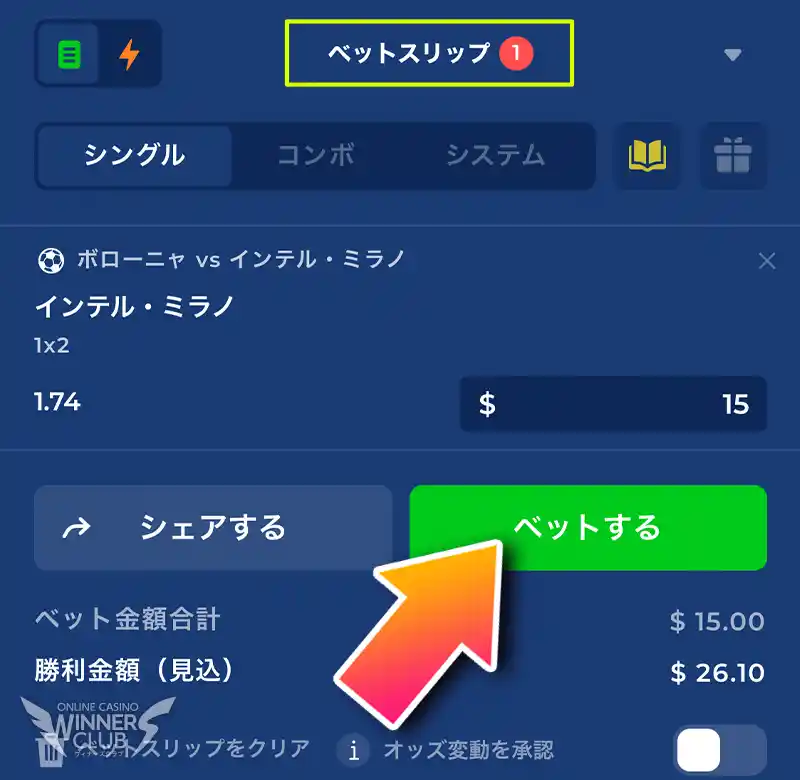
When you select the odds, a screen called the bet slip opens automatically. The bet slip shows the odds you are about to bet at. If everything is correct, enter the amount you want to bet.
The bet slip also shows your potential winnings if the bet wins. Check them, then tap “Place Bet” to confirm the bet.
All that remains is to wait for the match to end. If your bet wins, you receive the winnings; if it loses, the amount you bet is lost.
How to Bet on Parlays with a Bookmaker
One of the best-known bookmaker bet types is a parlay (also called an accumulator or multi). A parlay combines two or more selections into a single bet that pays out only if every selection wins. You can combine selections from several matches or even several sports. Each added selection makes the bet harder to win but raises the combined odds. Adding more selections does not make the bet any more favorable to you. Permutations and full cover bets are ways of placing several parlays at once.
Standard Parlay (Every Pick Must Win)
A standard parlay pays out only if every bet in the combination wins. This is the classic form of parlay.
The more selections you add, the harder the parlay is to win, but because the odds are multiplied together, a winning parlay can pay out a large amount.
For example, if you combine three selections, A at 2.00, B at 2.50 and C at 4.00, and all three win, the combined odds are 2.00 × 2.50 × 4.00 = 20.00. If even one selection loses, however, the parlay pays nothing.
A parlay can be made with as few as two selections, and some bookmakers accept more than 10. Bookmakers that offer a parlay (accumulator) boost also add a bonus multiplier based on the number of selections, provided each selection meets the minimum odds.
Permutation (Round Robin): Only Some Picks Must Win
A permutation, called a round robin in the US, is a bet that pays out if at least a set number of your match predictions are correct.
For example, when you bet on three matches, there are three ways to combine two of the three picks. Betting on all three of these combinations is called a permutation.
If all three picks win, all three combinations win, so the payout is larger. If only two picks win, part of the bet still pays out, so you lose less than you would if every pick lost. Whether the winnings exceed your total stake depends on the odds, however, so a profit is not guaranteed.
Full Cover Bet
A full cover bet combines a standard parlay with permutations.
When you bet on three matches, for example, you receive the payout on the standard parlay if all three picks win. If only two win, the permutation part still pays out, so your loss is smaller than if every pick loses. With three selections, this combination of three doubles and one treble is known in the UK as a Trixie. The number of bets in a full cover bet grows exponentially as you add selections, so keep a close eye on your total stake. A full cover bet changes only how your losses play out; it does not reduce the bookmaker’s margin over the long run.
Other Ways to Bet with a Bookmaker
The 1X2 bet or moneyline, over/under and handicap are the three basic markets that most bookmakers offer on almost every match. Once you are comfortable with them, take a look at the more specialized bet types below.
Double Chance
Double chance (DC) is a variation of the 1X2 bet on the result of a match, and it is offered on almost every soccer match.
A 1X2 bet is a bet on one of three outcomes: home win, draw or away win. With double chance, you choose two of these three outcomes. The options are:
- Home win or draw
- Away win or draw
- Home win or away win (wins as long as the match is not a draw)
A 1X2 bet wins on only one of the three outcomes, while a double chance bet wins on two of them, so it is more likely to win than a 1X2 bet. In exchange, the odds are lower than for a 1X2 bet.
Draw No Bet
Draw no bet is another variation of the 1X2 bet on the result of a match.
You can bet only on a home win or an away win. If the match ends in a draw, the bet is treated as “no bet” (void), and your stake is returned. With a 1X2 bet, a draw is a losing result, whereas draw no bet refunds the stake, so losses are less likely; in exchange, the odds are lower than for a 1X2 bet.
It works in essentially the same way as a moneyline. The difference is that a moneyline is generally used in sports without draws, while draw no bet is a market for matches that can end in a draw and refunds the stake if they do.
Yes/No Bets
Sports bets are generally placed on the score of a match, but some predictions cannot be expressed as a number. A yes/no bet asks whether a particular event will happen, and you predict either “yes” or “no.”
In soccer, for example, the markets are phrased as yes-or-no questions, such as “Will either team score in the first half?”, “Will the match go to a penalty shootout?” or “Will a red card be shown?”, and you answer Yes or No.
Unusual questions are common, and you may even see a market such as “Will it snow in London on Christmas Day this year?” With only two options, these bets are easy to try.
Odd/Even
An odd/even bet is a prediction of whether the figure you are betting on, such as the total score of a match, will be odd or even.
For total goals in soccer, for example, “Odd” wins if the combined score is an odd number such as 1, 3 or 5, and “Even” wins if it is an even number such as 0, 2 or 4.
In high-scoring sports such as basketball and American football, the result is essentially a matter of luck. This makes it a simple bet for first-timers, since no analysis is required.
Double Result (Half-Time/Full-Time)
A double result bet (also known as half-time/full-time) is a prediction of which team will be ahead at half-time and which team will win the match. It is mainly offered for games played in two halves, but it is also available in sports played in quarters, such as American football and basketball, where the half-time result is taken after the second quarter.
- At half-time: choose one of three outcomes, home win, draw or away win
- At full-time: choose one of three outcomes, home win, draw or away win
With three possible outcomes at half-time and three at full-time, you generally have to pick the correct one of nine combinations, which makes this a difficult market.
The combinations “home win, then away win” and “away win, then home win” are especially hard to hit, because the result has to be turned around during the match. In return, the odds on a winning bet are very high, so although the bet is difficult, it offers the chance of a large payout.
Winning Margin
A winning margin bet is a prediction of the difference in score at the end of the game. “Margin” here means the difference in score and is not the same as the bookmaker’s margin described earlier.
There are two formats: one in which you choose from set bands, such as a margin of 1–3, 4–6 or 7–9 points, and one in over/under form, such as whether the margin will be more or less than 10 points.
Winning margin bets also come in two types. In one, you must predict both the winner and the margin (“Who will win, and by how much?”). In the other, you only need the margin to be correct, regardless of who wins (“What will the difference in score be?”). Naturally, the odds are higher when you also have to predict the winner.
Outright (Futures): Picking the Champion
Ahead of a professional league season in sports such as soccer and baseball, or a tournament such as the World Cup or the Olympics, bookmakers open a market on the eventual winner, called an outright (known as a futures bet in the US). You predict the champion of the league or tournament (the winning team, player or country), and the bet wins if your pick finishes first.
Odds are usually published before the league or tournament begins, and they keep changing during the season as the situation develops.
As a rule, bookmaker bets are paid at the odds in effect when the bet was confirmed. Betting on your favorite team or player makes following the matches throughout the season more enjoyable.
Points to Keep in Mind When Betting with a Bookmaker

If you bet without checking the bookmaker’s rules carefully, misunderstandings can arise, such as a bet you expected to be refunded on a draw being settled as a loss. In the worst case, your account may be restricted for breaking the terms.
The Bookmaker May Restrict Betting
When you try to bet during a match, you may find that the bookmaker has restricted betting.
To take an extreme example, if Team A leads Team B by 10 goals in the first half of a soccer match, a comeback by Team B is all but impossible. With a Team A win practically certain, betting on “Team A to win” may be suspended or offered only at extremely low odds.
Keep in mind that betting may be restricted depending on how the match unfolds.
Check How Draws and Extra Time Are Settled
As explained above, how a draw is treated differs from market to market.
In soccer, match-result bets are usually settled on the result after 90 minutes (regular time plus stoppage time), not including extra time or penalties. When a match goes to extra time, some bookmakers settle on the result including extra time, while others settle the bet as a draw at the end of regular time. This varies by sport and by bookmaker.
It is therefore a good idea to check in advance how your bet will be settled if the match ends in a draw or goes to extra time.
Many Bookmakers Prohibit Arbitrage Betting
Arbitrage betting (sure bets) means exploiting differences in odds between bookmakers to bet on favorable terms, in theory securing a profit whatever the result.
Arbitrage was once fairly easy to do, even manually, but today many bookmakers prohibit it in their terms. Differences in odds between bookmakers have also become small and tend to disappear quickly, and if you are caught, your account may be frozen, so do not attempt arbitrage betting.
Likewise, betting on opposing outcomes of the same match and betting solely to clear a bonus’s wagering requirement breach the terms at many bookmakers. Both can lead to account restrictions or refused withdrawals, so avoid them.
- Related Article
-

Summary: Start with Match-Result Bets, Then Try Other Markets
Bookmakers offer many bet types besides bets on the match result, including handicaps, over/under and parlays.
Betting on your favorite team and following its matches is a good way to start, since you learn the rules while enjoying the games. The odds include the bookmaker’s margin, however, so if you keep betting without any analysis, you will lose money over the long run. Once you are comfortable with sports betting, analyze the strengths of both teams before you bet and try some of the more specialized bet types.
Beginner's Guide to Bookmakers
Types of Casino GamesThis site is for adults of legal gambling age (18+, or older where required) who live in countries or regions where online gambling is legal.
Use of this site is subject to our Terms and Conditions.
Gambling involves risk. Only bet what you can afford to lose, and do not use online gambling services where they are illegal.

Bell | Editor of Online Casino Winners Club. Since the site launched in 2003, Bell has written guides to casino game rules, tested betting systems and covered land-based casinos around the world, and still plays the games before writing about them. Bell's core advice: choose the bets with the lowest house edge, and decide in advance how much you are prepared to lose.