

Among the games available at online casinos, some of the most popular are online slots, also known as video slots. Online slots come in many…
Types of Casino Games: A Beginner's Guide to Rules and Odds

Many people are curious about casinos but feel unsure because they do not know what kinds of games there are or how they are played. Casino games come in many forms, from table games such as blackjack and baccarat to electronic games such as slots.
When you choose a game, how easy the rules are to follow is one factor. Understanding the house edge and the return to player (RTP) is another. This article covers the main games you can play at both land-based and online casinos.
What You Will Learn
- The five classic casino games are slot machines, baccarat, blackjack, roulette and video poker.
- There are a great many casino games: table games alone number in the dozens, and including slots, a single casino can offer thousands of titles.

This article takes about 22 minutes to read.
Contents
Show
What Are Casino Games?

The games on offer and their minimum bets vary widely from one casino to another. Some games can be played for small amounts, but betting limits cover a wide range, so it is a good idea to check them in advance.
Most casino games also have a house edge, a built-in feature of the game that tends to favor the casino over the long run.
The house edge is easiest to understand not as a fee taken from each bet, but as a mathematical difference created by the way the rules and payouts are designed. That is why it is safer to learn the basic rules and features before you start than to play without knowing how a game works.
You can win over a short session, of course, but games differ in the size of the theoretical loss and in how much strategy affects the result. Before you choose a game, set a limit on how much you bet per round and how long you play, so that any losses stay within the range you expected.
Types of Games Commonly Found in Casinos
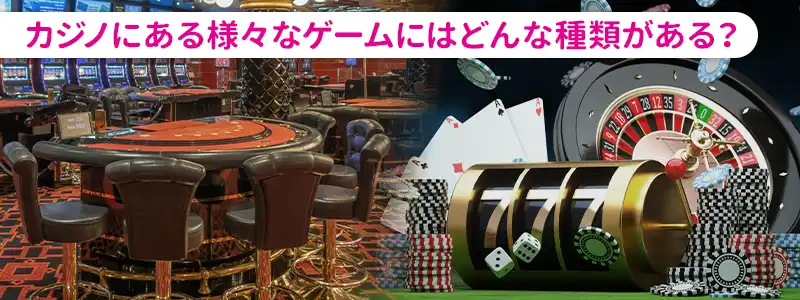
A casino floor offers a wide range of games. For beginners, the easiest way to get an overview is to divide them into table games and electronic games. Some formats, such as electronic table games, fall between the two. Starting with these two groups makes it easier to picture which way of playing suits you.
Comparing Table Games and Electronic Games
To help beginners choose, the table below compares the typical budget and pace of each type. The amounts are typical minimums at online casinos; at land-based casinos they vary widely from venue to venue.
| Game type | Minimum bet per round (approx.) | Pace of play | Best suited to |
|---|---|---|---|
| Table games | From about $5 | Depends on the table | Players who want to enjoy the casino atmosphere and the back-and-forth at the table |
| Electronic games and slots | From about $0.10 | Your own pace | Players who want to learn the rules while playing on a small budget |
Table Games Played with a Dealer and Other Players

Table games are played at a dedicated table, with a dealer running the game. You usually play alongside other players, so part of the appeal is the atmosphere at the table, not just the rules.
Some games call for decisions during play, while in others you simply choose where to bet and wait for the result. Well-known examples include the card games blackjack and baccarat and the dice games craps and Sic Bo.
Electronic Games You Can Play at Your Own Pace

Electronic games are played on a machine or terminal. Compared with table games, they are easy to start whenever you like and suit players who would rather play on their own without other players around. Machines and formats vary widely: some are played alone, while others, such as electronic table games, let several players take part in the same round.
5 Classic Casino Games That Are Easy for Beginners to Compare

This section covers five classic games that beginners can easily compare: slot machines, baccarat, blackjack, roulette and video poker.
Looking at how easy the rules are, whether you can play at your own pace and how many decisions the game asks of you makes it easier to find a game that suits you. Each of the five games is explained in detail later in this article. The star ratings in this article are on a five-point scale, assigned by this site based on how few rules there are to learn and how easy the game is to follow.
| Game | Ease of entry for beginners |
What decides the outcome | Style of play |
|---|---|---|---|
| Slot machines | Mostly luck | Easy to play at your own pace, with a wide range of features from machine to machine |
|
| Baccarat | Mostly luck | The rules are a little complex, but you can enjoy it without memorizing them |
|
| Blackjack | Decisions have a clear effect | You decide whether to draw a card or stand as you play |
|
| Roulette | Mostly luck | Bets are easy to choose from the layout, so the game is intuitive |
|
| Video poker | Both luck and decisions | You choose which cards to hold to aim for a winning hand |
A good way in is to get used to the atmosphere with a simple game first and then move on to games with more decisions once you feel comfortable.
How to Read the House Edge and RTP in Table Games and Electronic Games
When you compare games, two figures are worth knowing: the house edge and RTP. The house edge represents the casino’s share, which comes from the way the rules and payouts are designed.
RTP is a guide to how much a game is designed to return to players over the long run, and it is the counterpart of the house edge.
For example, in a game with a house edge of 2%, $1,000 in total bets placed over the long run means a theoretical average loss of about $20.
This figure does not describe the result of any single round. The same applies to RTP: a game listed with an RTP of 96% does not promise to return 96% of your money in one session. The figure should be read as a long-term average over a very large number of rounds.
For table games, the house edge is the usual point of comparison. For example, the main baccarat bets have a house edge in the 1% range, while roulette has a house edge of 2.70% for European roulette and 5.26% for American roulette.
Blackjack can have a relatively low house edge, but differences in the rules have a large effect, so the house edge varies from one blackjack table to another. Rather than treating it as a single number, check the number of decks and the payout for a blackjack.
Electronic games such as slots, by contrast, usually make the RTP easy to find. As a beginner, you do not need to choose on the number alone; it is enough to consider it alongside how easy the game is to play and how simple the rules are.
How to Play the 5 Classic Casino Games and What Sets Them Apart
This section looks at each of the five games listed above in turn: slot machines, baccarat, blackjack, roulette and video poker.
All five are classic casino games, but each is played and approached differently. Comparing them by how easy the rules are and how many decisions you want to make yourself makes it easier to choose.
- Slot machines: the classic electronic game, playable at your own pace on a small budget
- Baccarat: the rules are a little complex, but you can enjoy it without memorizing them
- Blackjack: a classic game where knowing the rules and making good decisions affect the result
- Roulette: a classic game where it pays to know the difference between American and European
- Video poker: an electronic game you play alone, choosing which cards to hold
Slot Machines: The Classic Electronic Game, Playable at Your Own Pace on a Small Budget

A slot machine is a gaming machine on which you set your bet, spin the reels and receive a payout based on the symbols that line up. Because it asks for almost no decisions, there are few rules to learn, and slots are a common choice for a first game.
The range of machines is very wide, from simple three-reel machines to video slots with animated features and free spins, and machines with a progressive jackpot that keeps growing until someone wins it.
As a beginner, deciding in advance how much to bet per spin and how long to play helps you enjoy the game without overextending yourself.
- Related Article
-

Baccarat: The Rules Are a Little Complex, but You Can Enjoy It Without Memorizing Them

Baccarat is a game in which you bet on whether the Player hand or the Banker hand will win, or whether the round will end in a tie. The drawing rules are a little complex, but the dealer applies them automatically, so you do not need to know them to play. Once you know how hand totals are worked out, even a beginner can enjoy the game.
Note that “Player” is simply the name of one of the two hands, not you; this article refers to them as the Player hand and the Banker hand.
Even though the cards are drawn automatically, you still have to choose where to bet, and the theoretical loss depends on that choice.
Baccarat is sometimes described as a 50-50 game, but that is not accurate, because rounds can also end in a tie. Under standard 8-deck rules, the Banker hand wins about 45.86% of the time, the Player hand about 44.62% and the Tie about 9.52%.
The betting options themselves are fairly simple, so beginners can follow the game easily.
When a Banker bet wins, a 5% commission is usually deducted, so a winning Banker bet pays 0.95 to 1 (19 to 20): a $10 bet wins $9.50. Even with the lower payout, the Banker bet usually has a slightly lower house edge than the Player bet.
The Tie bet, on the other hand, pays more but has a much higher house edge, so beginners will find it simpler to focus on the Player bet or the Banker bet.
Under standard 8-deck rules, the Banker bet has a house edge of about 1.06% (RTP about 98.94%), the Player bet about 1.24% (about 98.76%) and the Tie about 14.36% (about 85.64%). The gap between the Banker and Player bets is small, but setting the numbers side by side shows that the Tie alone carries a far higher house edge.
- Related Article
-

Blackjack: A Classic Game Where Knowing the Rules and Making Good Decisions Affect the Result
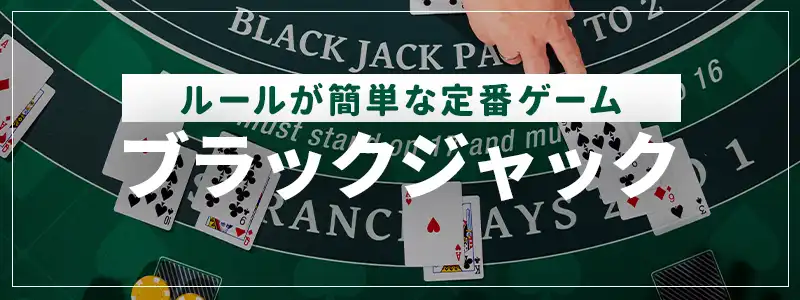
Blackjack is a classic card game in which you try to make a better hand than the dealer without going over 21. Because you choose whether to hit or stand, it is known as a casino game where your own decisions affect the outcome.
Part of its appeal is that the more rules you learn, the easier the game becomes to follow, and knowing basic strategy helps you avoid needless mistakes. Basic strategy is a way to keep the theoretical loss low; it does not guarantee a win.
At a table with 8 decks where the dealer stands on soft 17 (a 17 that counts an ace as 11), playing according to basic strategy gives blackjack a house edge of about 0.5% (0.4–0.7% depending on the rules), or an RTP of around 99.5%. This figure applies to tables with favorable double-down and split rules. At tables where a blackjack pays 6 to 5 instead of 3 to 2, the house edge rises by about 1.4 percentage points to about 1.9%, and the RTP falls into the 98% range.
Beginners should start by learning the basic patterns of decision-making rather than playing on instinct alone. You do not need to be perfect from the start; simply understanding when to hit and when to stand makes the game much easier to play.
- Related Article
-

Roulette: A Classic Game Where It Pays to Know the Difference Between American and European
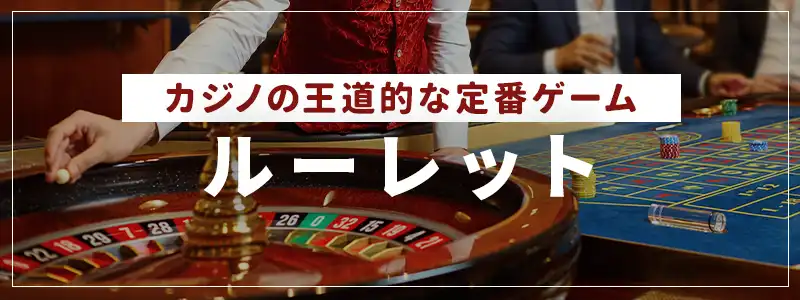
In roulette, you bet on which number or color the ball will land on after it is spun around the wheel. You can bet on a single number or choose simpler bets such as red/black or odd/even, and the game is easy to pick up just by looking at it.
What beginners should know, however, is the difference between American (double-zero) and European (single-zero) roulette. The American wheel has the numbers 1–36 plus 0 and 00, while the European wheel has 1–36 plus 0.
The difference looks small, but European roulette generally has the lower house edge and is usually considered the better choice.
European roulette has a house edge of 2.70% (RTP 97.30%) and American roulette 5.26% (RTP 94.74%). These figures are the same wherever you bet, except for the five-number bet on American roulette and, at tables with la partage or en prison rules, the even-money bets. For the same bet, the theoretical loss on American roulette is roughly twice as large.
So if you are choosing roulette for the first time, start by checking whether the table is single-zero European roulette. Bets such as red/black may look likely to win, but because of the zero, the probability of winning is 48.65% on European roulette and 47.37% on American roulette. Knowing these differences changes how you look at the game.
- Related Article
-
Video Poker: An Electronic Game You Play Alone, Choosing Which Cards to Hold
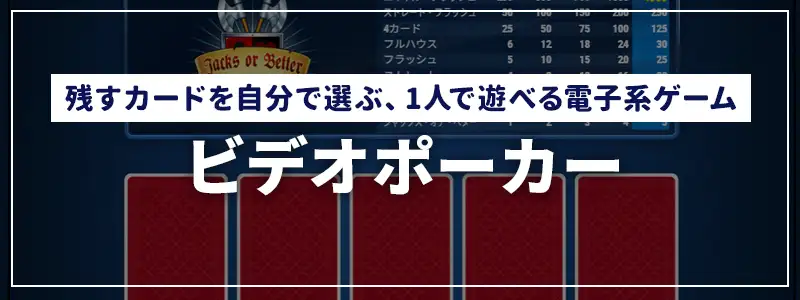
In video poker, you are dealt five cards, choose which ones to hold, draw replacements for the rest and are paid according to the final poker hand. There is no dealer and there are no other players; you play alone at the screen.
Payouts follow the ranking of poker hands and are listed in each machine’s pay table. Many machines, such as Jacks or Better, set a clear minimum winning hand (in this case a pair of jacks), so once you know the hand rankings, you can play.
What sets video poker apart from slots, even though both are electronic games, is the decision about which cards to hold. Even with the same five cards dealt, the theoretical expected value depends on which cards you keep.
As with other electronic games, the RTP is easy to find, and depending on the machine and pay table, some games reach the 99% range. This is a long-term theoretical figure based on a very large number of hands, however, and a high RTP does not mean you are more likely to win. Machines with the same name can have different pay tables and therefore different figures, so checking the pay table before you play makes it easier to choose.
- Related Article
-

Table Games Played with Playing Cards

Besides baccarat and blackjack, which were covered above as classic games, casinos offer many other table games played with playing cards. This section covers four of them with simple rules that beginners can pick up easily.
Hi-Lo

- Ease of play
- Strategy
- RTP
- About 96% (varies by game)
- Live version available
- Yes
Hi-Lo (also called high-low) is a card game played with two playing cards. You predict whether the second card will be Hi (higher) or Lo (lower) than the first card, the base card. The game is simple, but it still rewards thinking about your next move.
For example, if the base card is a 3, the usual choice is Hi. Choosing Lo wins only if the next card is a 2, but a win returns 11.56 times your stake. The more likely a bet is to win, the smaller the payout, and vice versa. The game lets you choose between steadier results and a chance at a bigger payout.
- Related Article
-

Dragon Tiger

- Ease of play
- Strategy
- RTP
- 96.3%
- Live version available
- Yes
Dragon Tiger is a simplified version of baccarat. One card is dealt to each of two hands, Dragon and Tiger, and the hand with the higher card wins.
Baccarat uses up to six cards, while Dragon Tiger uses only two. That simplicity is part of its appeal, and the game is popular with beginners and experienced players alike.
- Related Article
-

Red Dog

- Ease of play
- Strategy
- RTP
- 96.8–97.3% (depending on the number of decks)
- Live version available
- No
Red Dog (also known as acey-deucey or in-between) is a table game said to have originated in the United States.
The dealer draws two cards and places them in order from low to high. A third card is then dealt, and the player wins if its rank falls between the first two. For example, if the dealer draws a 3 and a 10, the player wins if the third card is any card from 4 to 9.
The fewer ranks there are between the first two cards, the higher the payout, and three cards of the same rank pay out at a high rate. If the first two cards are consecutive, or if they are a pair and the third card does not match, the hand is a push and your bet is returned. It is a card game with more depth than it first appears.
- Related Article
-

Casino War

- Ease of play
- Strategy
- RTP
- 97.1%
- Live version available
- No
Casino War is a simple table game in which you play head-to-head against the dealer.
The dealer and the player each receive one card, and the higher card wins. If the two cards are of the same rank, the result is a tie, and you choose either to surrender and get half your bet back, or to go to war by placing an additional bet equal to your original one.
If you go to war and win, you are paid on the additional bet, and if the war ends in another tie, it usually counts as a win, with some casinos also paying a bonus equal to your original bet. How ties are paid in detail varies by casino and software, so check the table rules before you play.
- Related Article
-

Table Games Played with Dice

At online casinos, table games played with dice are popular alongside card games. Many of them use more than one die, and some, such as craps, do not settle the bet on a single roll, so they can feel a little harder than card games.
Craps

- Ease of play
- Strategy
- RTP
- 98.6%
- Live version available
- Yes
Craps has some of the most complicated rules of any casino dice game.
Its appeal lies in the shared excitement among players who bet on the same outcome, and it is known as one of the liveliest dice games in land-based casinos. This section explains how to play using the most basic bet, the pass line.
In craps, a player called the shooter throws two dice. If the total on the first roll, the come-out roll, is 7 or 11, the pass line wins at once; if it is 2, 3 or 12, it loses. Any other total becomes the point, and from then on you win if the point is rolled before a 7 and lose if a 7 comes first.
What makes craps distinctive is that the conditions for winning change as the round progresses. The rules take some time to learn, but once you understand them, every roll of the dice draws you in.
- Related Article
-

Bac Bo

- Ease of play
- Strategy
- RTP
- 98.87% (Player and Banker bets)
- Live version available
- Yes
Bac Bo is a table game that Evolution (formerly Evolution Gaming) developed as an original live game that combines baccarat and Sic Bo.
The rules follow baccarat: there are two dice for the Player hand and two for the Banker hand. The hand with the higher total wins, and you bet on which one it will be.
The Tie bet, which predicts a tie, pays differently depending on the total, and a tie on 2 (double 1s) or 12 (double 6s) pays the most. Because the game carries baccarat’s bets straight over to dice, it is easy to pick up if you already know baccarat.
- Related Article
-

Sports Betting and Bookmakers: Bet on Matches Around the World

| Ease of play | Strategy | RTP | Live version available |
|---|---|---|---|
| Depends on the odds offered | Yes |
Sports betting means predicting the results of real sporting events and betting on them. A company that sets odds and accepts bets is called a bookmaker (or sportsbook), and many online casinos offer sports betting alongside their casino games.
Bookmakers cover popular sports such as baseball, soccer and basketball, as well as indoor games such as darts and snooker, and esports.
Some bookmakers also offer markets on events outside sports, such as the weather at Christmas, the next presidential election or the Academy Award winners. The sports and leagues covered vary by bookmaker, so checking what each one offers in advance makes it easier to choose.
The odds a bookmaker offers include its own share, known as the bookmaker’s margin (also called the vig). It is the equivalent of the house edge in casino games, and as with casino games, betting without any analysis will lose money over the long run. Sports betting laws and minimum ages (18 or 21) differ by country and, in the US, by state, so check the rules where you live.
- Related Article
-

Live Game Shows Available at Live Casinos

A live casino streams a dealer running the game in real time with real cards, dice and other equipment, and you place your bets while watching the video. Each game, such as live baccarat or live roulette, has its own tables.
Evolution, which produces many live games, has also released new games that go beyond traditional table games. These games stand out for a sense of scale and immediacy that only live games can offer.
Dream Catcher

- Ease of play
- Strategy
- RTP
- 90.57–96.58% (depending on the bet)
- Live version available
- Yes
Dream Catcher is the game that led to Monopoly Live and Crazy Time, both of which are covered below.
Evolution’s live game shows effectively started with this game. A large money wheel is divided into segments showing six numbers, 1, 2, 5, 10, 20 and 40, along with 2x and 7x segments. Players predict where the wheel will stop next and bet on the numbers.
The wheel is then spun, and players who bet on the winning segment are paid at odds equal to its number. A win on 1 pays 1 to 1 (a $10 bet wins $10), and a win on 40 pays 40 to 1 (a $10 bet wins $400). If the wheel stops on 2x or 7x, a multiplier is added to the payout on the next spin.
The game is very simple, yet easy to get absorbed in.
- Related Article
-

Monopoly Live

- Ease of play
- Strategy
- RTP
- 91.30–96.23% (depending on the bet)
- Live version available
- Yes
Monopoly Live is a live game that combines the board game Monopoly with Dream Catcher, the wheel game introduced above.
A large money wheel is spun, and if it stops on a number such as 1 or 10, players who bet on that number are paid at the corresponding odds. If it stops on a 2 Rolls or 4 Rolls segment, the bonus game is triggered.
In the bonus game, Mr. Monopoly moves around a 3D Monopoly board shown in AR (augmented reality), and you win the payout marked on the square where he stops. Very high multipliers have been recorded in the past, and the bonus tends to generate plenty of excitement.
- Related Article
-

Crazy Time

- Ease of play
- Strategy
- RTP
- 94.33–96.08% (depending on the bet)
- Live version available
- Yes
Crazy Time is a live game with the same money wheel format as Monopoly Live. If the wheel stops on a segment such as Pachinko or Crazy Time, a bonus game is triggered.
Bonus games with high multipliers come up about once every six spins on average, which has made the game very popular, and a payout of 25,000x has been recorded in a bonus game. It is a casino game that appeals to a wide range of players, from beginners to high rollers.
- Related Article
-

Crazy Coin Flip

- Ease of play
- Strategy
- RTP
- 95.06–96.05% (depending on the mode)
- Live version available
- Yes
Crazy Coin Flip is a live game based on Coin Flip, one of the Crazy Time bonus games.
When three scatter symbols (marked CRAZY COIN FLIP) land on the game’s slot reels, you qualify for the coin flip, and in the Top-Up round you can add top-up bets until betting closes. Some symbols also add a bonus multiplier to the Coin Flip payout, and landing them can lead to a large payout.
The result is decided by a single coin toss: the payout depends on whether the red or the blue side comes up. It is a simple either-or game, but the tension while waiting for the result has made it popular.
- Related Article
-

Mega Ball

- Ease of play
- Strategy
- RTP
- 95.05–95.40%
- Live version available
- Yes
Mega Ball is a bingo game with a maximum payout of 1,000,000x.
Players buy bingo cards for between $0.10 and $100 each. After betting closes, 21 balls are drawn, and the payout depends on how many lines each card completes. One line pays 1x and two lines pay 5x, rising to 10,000x for six or more lines.
The last ball drawn, the Mega Ball, is assigned a multiplier between 5x and 100x in advance, and the multiplier applies if that ball completes a line. A 100x multiplier combined with a 10,000x payout gives a theoretical maximum of 1,000,000x. This is extremely rare, however, and the game’s usual appeal is that you can join for a small amount per card.
- Related Article
-

Cash or Crash

- Ease of play
- Strategy
- RTP
- 99.59% (with optimal cash-out timing)
- Live version available
- Yes
Cash or Crash is a live game in which your decision on when to stop determines the result. The draw machine holds 20 green and gold balls in total and 8 red balls. One ball is drawn at a time, and the payout rises as long as green or gold balls come out.
If a red ball is drawn, however, your winnings drop to zero. You can cash out (end the game at that point) after each ball, so the key decision is when to cash out.
If all 20 balls are drawn, the payout reaches up to 50,000x if the Golden Ball shield is still intact (18,000x if it is not). Playing to the end is a poor choice in terms of expected value, though, and the game is normally about deciding whether to cash out while green and gold balls keep coming.
- Related Article
-

Deal or No Deal

- Ease of play
- Strategy
- RTP
- 95.42%
- Live version available
- Yes
Deal or No Deal is a casino game based on the TV game show of the same name, which began in the Netherlands and became a hit in the US and many other countries. Players who get through the qualifying round choose one of 16 briefcases, each holding a prize.
As the game progresses, the 15 briefcases that were not chosen are opened one at a time, narrowing down the prizes that could be left in yours. Based on the remaining amounts, the Banker makes an offer, and you choose either to accept it (Deal) or to keep playing for the prize in your own briefcase (No Deal).
Choosing No Deal gives you a chance at a high payout, but if your own briefcase holds a small prize, taking the deal can end up paying you a larger amount. It is a popular live game in which your choices shape the outcome.
- Related Article
-

Frequently Asked Questions About Types of Casino Games
- Which table games are easiest to join as a beginner?
-
Baccarat and roulette are relatively easy to join. In both games, you take part by placing chips on the area you want to bet on, so you hardly need to say anything at the table and you can join in while watching how the game flows.
Blackjack is not hard to join either. Players often indicate hit or stand with hand gestures, so learning the basic flow of a round is enough to take part comfortably.
Baccarat and roulette are the easier first step, but blackjack is also a good option once you know the basic moves.
- Do online casinos and land-based casinos offer different types of games?
-
The core lineup is the same. Standard games such as baccarat, blackjack, roulette and slots are available at both.
The differences lie in the other games. Online casinos often let you play live game shows such as Crazy Time and Monopoly Live, as well as sports betting with a bookmaker, from the same account. At a land-based casino, the atmosphere of the table and the interaction with the dealer are at the heart of the experience.
Minimum bets also tend to be lower online. One way to choose is to play online if you want to try games with small amounts, and to visit a land-based casino if you want to enjoy the atmosphere in person.
- How much money should a beginner budget?
-
There is no single right budget. The amount you actually need depends largely on the table minimums at the casino you visit and how long you want to play. Table minimums vary by venue and time of day, and some casinos have tables with minimums from around $5 up to high-limit tables.
Rather than assuming a fixed amount, it is more practical to look at the table minimums on the day and set a limit you can afford. If you want to start small, choose low-stakes electronic games or games you can join with relatively small bets.
Summary: Choose the Type of Casino Game That Suits You
For beginners, the easiest way to get an overview of casino games is to divide them into two main groups: table games and electronic games. When choosing a game, look at more than how easy the rules are. It also helps to know that the house edge and return to player (RTP) are guides to long-term trends, not short-term results.
If you want to start with a game that is easy to follow, baccarat and roulette are good options. If you enjoy making decisions, try blackjack or video poker. If you would rather get used to the atmosphere at your own pace, slots and other electronic games are a good fit.
Do not choose on the size of the payouts alone. Compare how each game is played and how the bets work, and pick the type that suits you.
This site is for adults of legal gambling age (18+, or older where required) who live in countries or regions where online gambling is legal.
Use of this site is subject to our Terms and Conditions.
Gambling involves risk. Only bet what you can afford to lose, and do not use online gambling services where they are illegal.

Bell | Editor of Online Casino Winners Club. Since the site launched in 2003, Bell has written guides to casino game rules, tested betting systems and covered land-based casinos around the world, and still plays the games before writing about them. Bell's core advice: choose the bets with the lowest house edge, and decide in advance how much you are prepared to lose.