

The Monte Carlo system is a betting system that uses a sequence of numbers to decide how much to bet. Its name is said to come from Monte Carlo in…
Betting Systems Explained: 12 Casino Methods and How They Work

Many of the methods that are called casino “strategies” or “sure ways to win” are in fact betting systems, and some players use them as a structured way to manage their bankroll.
A betting system can change only the size of the swings in your results (the variance) and the shape of the distribution of wins and losses. It does not change the house edge or your overall expected value; the house edge is the casino’s built-in share of every bet.
What You Will Learn
- No betting system changes the house edge or the return to player (RTP).
- The only things that change are the size of the swings in your results (the variance) and the shape of the distribution of wins and losses.

This article takes about 15 minutes to read.
Contents
Show
What Is a Betting System and What Are Its Benefits?

If you play table games, you may hear names such as the Martingale system, the Paroli system (also called the reverse Martingale), the 1-2-3-5 system (also called the Goodman system) and the Monte Carlo system. All of them are betting systems.
A betting system is a bankroll management method used in table games such as roulette and baccarat. It raises and lowers your bet according to a fixed set of rules.
Flat betting, in which you always bet the same amount, also counts as a betting system, even though the bet never goes up or down.
You may wonder whether setting rules for how you bet makes any difference. It does help you manage your bankroll and keep your play under control, in two ways:
- Because you bet according to rules, you are less likely to make emotional decisions after a loss.
- Because your bets rise and fall according to fixed rules, it is easier to avoid heavy losses from unplanned betting.
Types of Betting Systems and How to Use Them
There are many kinds of betting systems.
Some have been in use for a long time, while others have become known only in recent years. Each system suits different games, so the more systems you know, the easier it is to choose one that fits the way you play.
The sections below explain how each of the following 12 systems works and which games suit it.
| System | After a Win | After a Loss | Suitable Payouts |
|---|---|---|---|
| Monte Carlo system | Cross off both ends of the sequence | Add to the sequence | 1 to 1, 2 to 1 |
| Martingale system | Return to 1 unit | Double the bet | 1 to 1 |
| Paroli system | Bet the full return (stake plus winnings) | Return to 1 unit | 1 to 1, 2 to 1 |
| D’Alembert system | Lower by 1 unit | Raise by 1 unit | 1 to 1 |
| Winners Method | Cross off from the sequence | Add to the sequence | 1 to 1 |
| 1-2-3-5 system (Goodman system) | Raise through 1, 2, 3, 5 units | Return to 1 unit | 1 to 1 |
| Oscar’s Grind | Raise by 1 unit | Keep the same bet | 1 to 1 |
| 1-3-2-6 system | Raise through 1, 3, 2, 6 units | Return to 1 unit | 1 to 1 |
| 31 system | Follow a fixed sequence of 9 bets | 1 to 1 | |
| 10% system | Always 10% of your balance | 1 to 1 | |
| Labouchère system | Cross off both ends of the sequence | Add to the sequence | 1 to 1 |
| Cocomo system | Return to 1 unit | Sum of the previous two bets | 2 to 1 only |
* “Suitable Payouts” gives the odds of the bets each system suits: 1 to 1 (even money, such as red/black in roulette, where a $10 bet wins $10) and 2 to 1 (such as a dozen bet, where a $10 bet wins $20). In the “After a Win” and “After a Loss” columns, “double” refers to the size of your bet.
Monte Carlo System
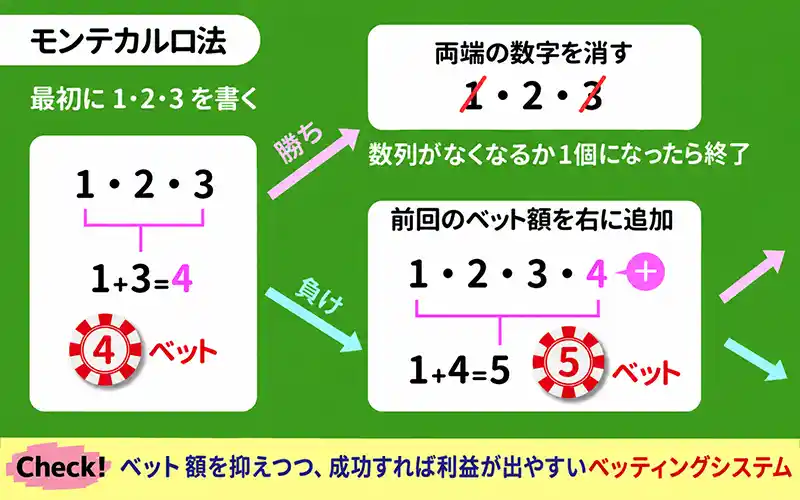
The Monte Carlo system uses a sequence of numbers to decide the bet size, adding numbers to the sequence or crossing them off after each win or loss. Following the steps can be enjoyable, but the procedure is complicated and takes time to get used to.
Games Suited to the Monte Carlo System
Baccarat (Player bet), roulette (red/black, odd/even, high/low, dozen and column bets), Sic Bo (Big/Small) and similar bets
- Related Article
-

Martingale System
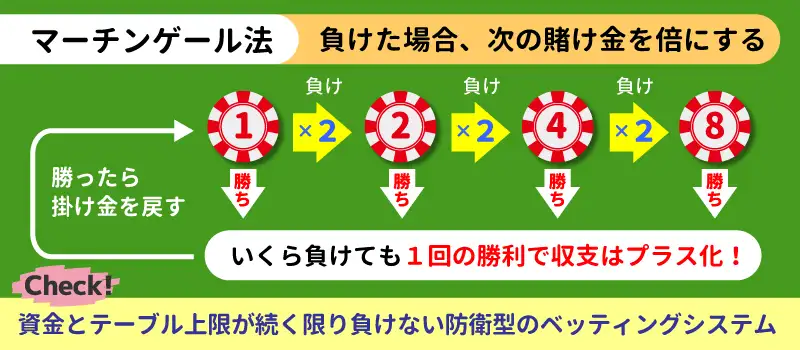
The Martingale system doubles your bet after every loss. As long as you stay within your bankroll and the table limit, a single win recovers all previous losses and leaves a profit. During a losing streak, however, the bet grows rapidly, and you could lose your entire bankroll.
Games Suited to the Martingale System
Baccarat (Player bet), roulette (red/black, odd/even, high/low), Sic Bo (Big/Small) and similar bets
- Related Article
-

Paroli System
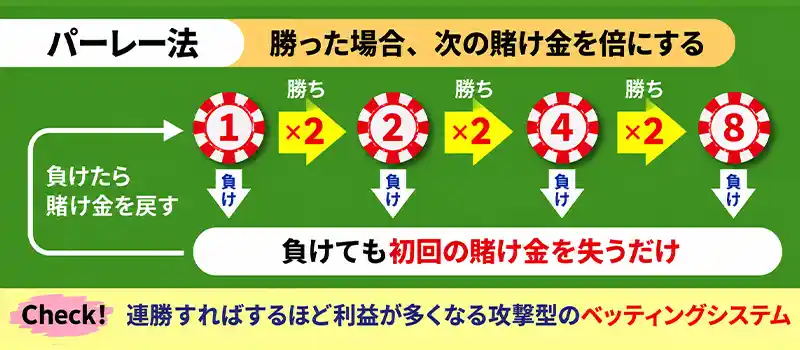
The Paroli system doubles your bet after every win. A winning streak makes your profit grow quickly, but the single loss that ends the streak wipes out everything built up until then, so the probability that a cycle ends in profit is low.
Games Suited to the Paroli System
Baccarat (Player bet), roulette (red/black, odd/even, high/low, dozen and column bets), Sic Bo (Big/Small) and similar bets. * On a bet that pays 2 to 1, you triple your bet after a win. Such a bet wins only about one time in three, so winning streaks are even harder to achieve.
- Related Article
-

D’Alembert System
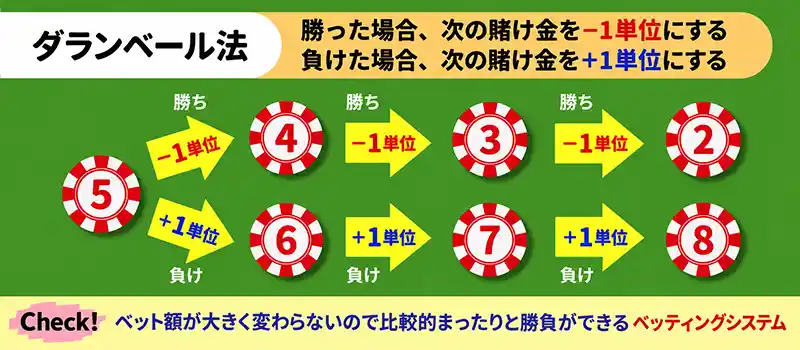
The D’Alembert system, sometimes called the pyramid system, lowers your bet by one unit after a win and raises it by one unit after a loss. Because each increase is small, a losing streak is less likely to cause a heavy loss, and if you finish with equal numbers of wins and losses, the arithmetic leaves you with a profit. As long as there is a house edge, though, losses will still outnumber wins over the long run.
Recovering from a losing streak also takes time, and a winning streak does not produce large wins.
Games Suited to the D’Alembert System
Baccarat (Player bet), roulette (red/black, odd/even, high/low), Sic Bo (Big/Small) and similar bets
- Related Article
-

Winners Method
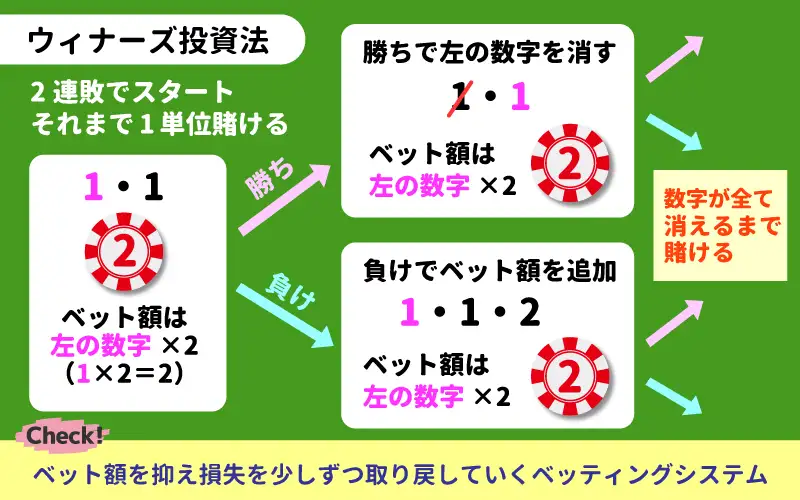
The Winners Method tracks your bets in a written sequence, adding a number after a loss and crossing one off after a win, and raises the bet gradually to recover losses a little at a time, so the bet does not rise sharply even during a losing streak. Its drawbacks are that the bet keeps rising when wins and losses alternate and that you need to keep a written record of the sequence.
Games Suited to the Winners Method
Baccarat (Player bet), roulette (red/black, odd/even, high/low), Sic Bo (Big/Small) and similar bets
- Related Article
-

1-2-3-5 System (Goodman System)
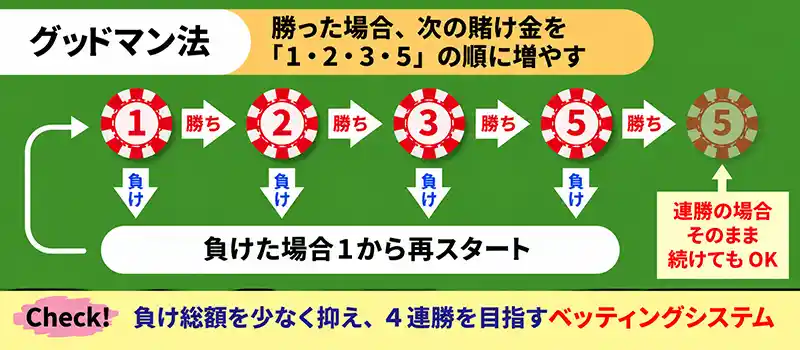
The 1-2-3-5 system raises the bet through 1, 2, 3 and 5 units with each consecutive win and returns to 1 unit after a loss. It is also known as the Goodman system.
Four wins in a row produce a profit of 11 units, and because the bet returns to 1 unit after a loss, each loss stays small even during a losing streak. On the other hand, if winning streaks do not last, losses tend to build up.
Games Suited to the 1-2-3-5 System (Goodman System)
Baccarat (Player bet), roulette (red/black, odd/even, high/low), Sic Bo (Big/Small) and similar bets
- Related Article
-

Oscar’s Grind
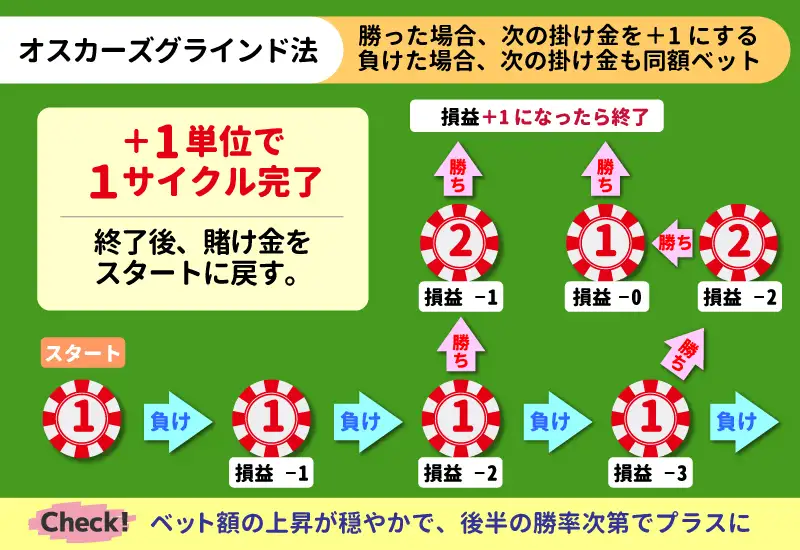
Oscar’s Grind keeps the bet the same after a loss and raises it by one unit after a win, and you stop once your cumulative result reaches +1 unit.
The bet rises gradually, so large losses are less likely. A cycle is complete when the cumulative result reaches +1 unit, which can happen even when you have lost more bets than you have won. If wins do not come in succession, however, locking in the profit can take a long time.
Games Suited to Oscar’s Grind
Baccarat (Player bet), roulette (red/black, odd/even, high/low), Sic Bo (Big/Small) and similar bets
- Related Article
-

1-3-2-6 System
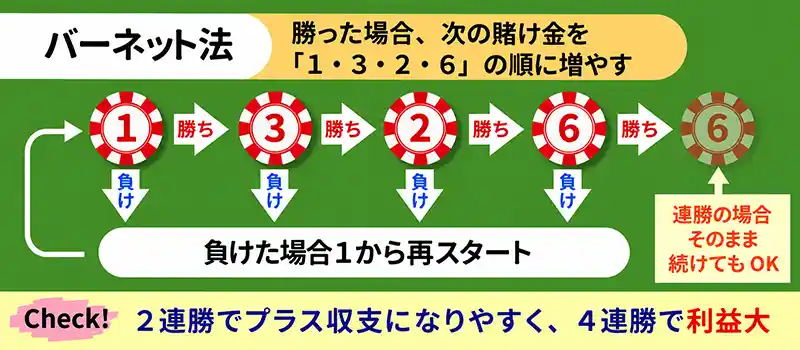
The 1-3-2-6 system raises the bet through 1, 3, 2 and 6 units with each consecutive win and returns to 1 unit after a loss. Four wins in a row produce a profit of 12 units, and because the bet returns to 1 unit after a loss, each loss stays small. If you lose after three wins in a row, however, the cycle breaks even.
Games Suited to the 1-3-2-6 System
Baccarat (Player bet), roulette (red/black, odd/even, high/low), Sic Bo (Big/Small) and similar bets
- Related Article
-

31 System
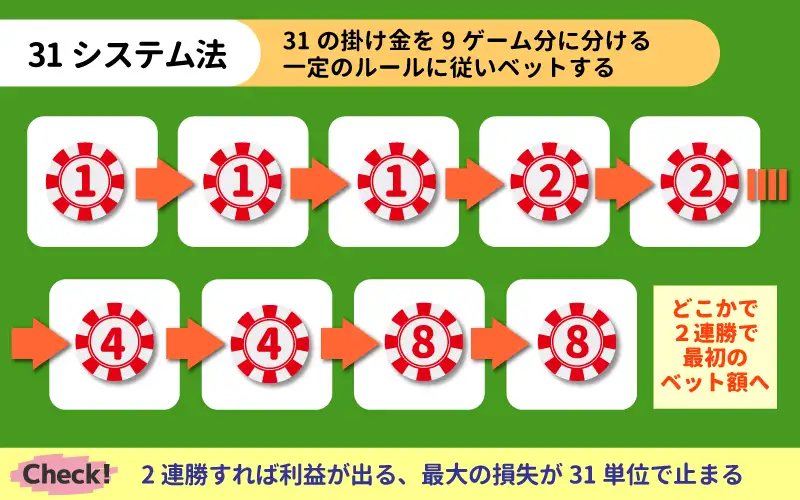
The 31 system follows a preset sequence of nine bets (1, 1, 1, 2, 2, 4, 4, 8 and 8 units), and two wins in a row at any point produce a profit.
Its advantages are that two consecutive wins are enough for a profit and that even nine losses in a row cost no more than 31 units, so the maximum loss is known in advance. On the other hand, the procedure is somewhat complicated, and alternating wins and losses tend to leave you behind.
Games Suited to the 31 System
Baccarat (Player bet), roulette (red/black, odd/even, high/low), Sic Bo (Big/Small) and similar bets
- Related Article
-

10% System
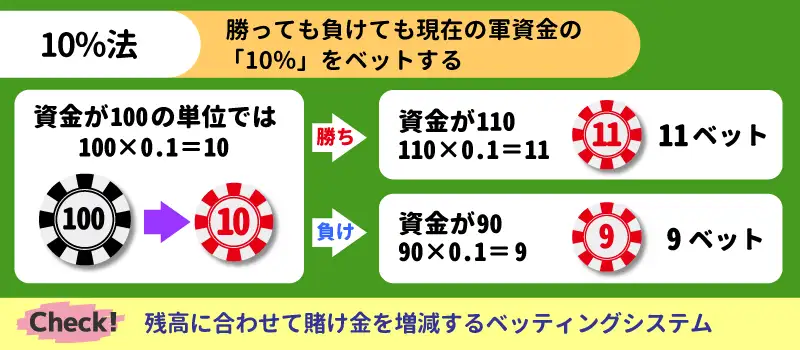
The 10% system (a form of percentage betting) always bets 10% of your current bankroll. It is easy to follow: the bet grows during a winning streak and shrinks during a losing streak. The risk is that after a losing streak, only a winning streak can recover the losses, and alternating wins and losses tend to leave you behind.
Games Suited to the 10% System
The system can be used on any bet that wins about 50% of the time, such as baccarat (Player bet), roulette (red/black, odd/even, high/low), Sic Bo (Big/Small) and similar bets.
- Related Article
-

Labouchère System
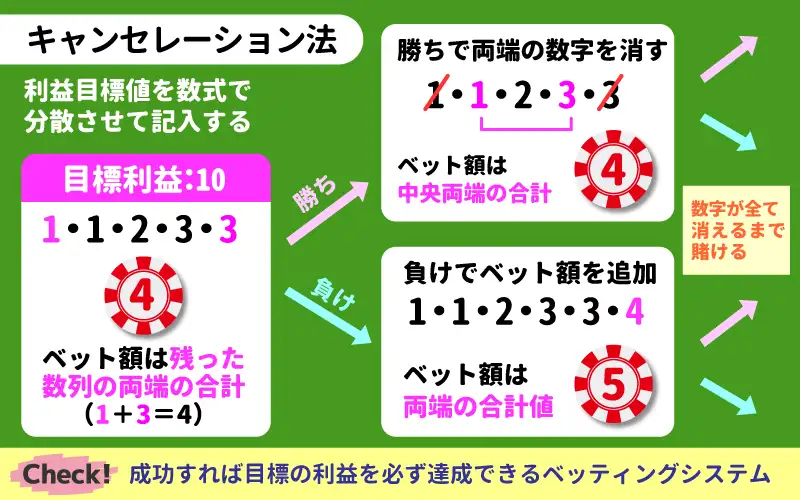
The Labouchère system (also called the cancellation system or split martingale) raises and lowers the bet using a sequence of numbers. After a win you cross off both ends of the sequence, after a loss you add a number to it, and a cycle succeeds once every number has been crossed off. Like the Monte Carlo system, it is based on a sequence, but the procedure is complicated.
The bet rises relatively slowly, and completing a cycle earns the profit target you set at the start. During a losing streak, however, the sequence grows longer and the bets get larger.
Games Suited to the Labouchère System
Baccarat (Player bet), roulette (red/black, odd/even, high/low), Sic Bo (Big/Small) and similar bets
- Related Article
-

Cocomo System
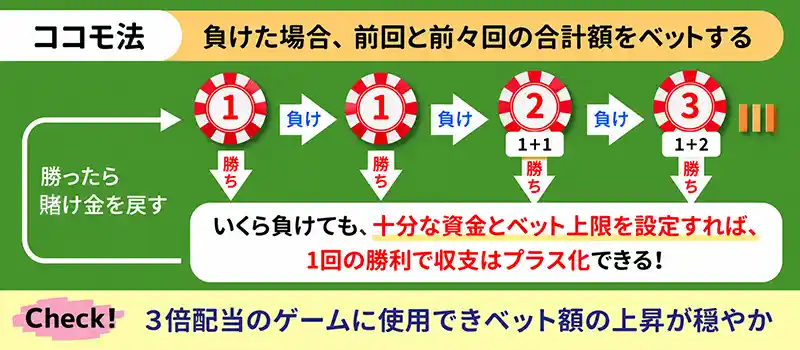
The Cocomo system starts with a bet of 1 unit and bets the same amount on the second round. After that, each loss is followed by a bet equal to the sum of the previous two bets, and the bet resets after a win. As long as you stay within your bankroll and the table limit, a single win produces a profit, and the bet rises more slowly than with the Martingale system.
Because the system requires a bet that pays 2 to 1, though, losses come more often, and a long losing streak carries a large risk.
Games Suited to the Cocomo System
Roulette (dozen and column bets) and similar bets. * The system works only on bets that pay 2 to 1.
- Related Article
-

The 12 systems covered here are only a sample. Many other bankroll management methods exist, ranging from those that keep the swings in losses small to those aimed at large payouts on a single round.
Understanding the Risks of Betting Systems

A betting system is not a guaranteed way to win.
A betting system is a way of betting that reflects how you want to play at the casino. You might aim for a large profit at a low probability, or you might avoid heavy losses and accept smaller profits in exchange for a lower chance of losing. Compared with flat betting, a betting system lets you control that approach yourself.
If you do not understand this, a loss can leave you thinking, “I followed the system, so why did I lose?” That reaction can lead to larger losses than you would have had by betting normally.
The RTP Does Not Change: Why Betting Systems Are Called “Strategies”
Betting systems get called “strategies” because a method that sets rules for your bets is confused with a method that raises the RTP itself. No method of the second kind exists.
However you vary your bet according to fixed rules, the game’s RTP and expected value stay the same. No system on its own reduces the number of losses or lowers the house edge you face. Nor does any system make your disadvantage smaller than flat betting does.
Some systems are said to win every time in theory, but that holds only under two assumptions that cannot exist in reality: unlimited money and unlimited time. Real players have limited bankrolls and limited time, and as long as there is a house edge, the overall expected value never becomes positive.
Deciding in advance how your bets will move still has a purpose. It lets you set an approach as a rule beforehand, such as “today I will play fewer rounds and accept bigger swings” or “I will play more rounds and prioritize a lower chance of losing,” rather than deciding on the spot. A betting system is a way of choosing which of three things to prioritize: a lower chance of losing (the success rate of one cycle), the profit when you win, or the loss when you lose. No system delivers all three at once, so you need to choose the one that fits the situation.
Every system also has its advantages and disadvantages, and no system makes more money than the others.
Doubling-Up Systems Always Stop at the Table Limit or Your Bankroll
Whatever the theory says, systems that raise the bet after a loss run into two practical limits beyond which they cannot continue: the table limit and your own bankroll.
With the Martingale system and a unit of $10, the total amount bet after n losses in a row is 2 to the power of n, minus 1, in units. After 8 losses in a row, you have bet $2,550 in total, and the next bet is $2,560. After 10 losses in a row, the total is $10,230, and the next bet is $10,240. At a table with a $1,000 maximum bet, you cannot place the next bet after 7 losses in a row, and the $1,270 bet up to that point remains as a loss.
On red in European roulette, the probability of losing a single spin is 19 in 37, or about 51.35%. The probability of 10 losses in a row is about 0.13%, roughly once in every 780 tries. For a player who plays 100 rounds a day, the probability of a streak of 10 or more losses on any given day is about 5.6%, and over 10 days, or 1,000 rounds, it rises to about 46%. A low probability is not the same as something that never happens.
Casino Games That Suit Betting Systems

Betting systems are designed for bets on table games such as roulette and baccarat. They are not suited to slots, sports betting and similar forms of gambling.
The easiest bets to calculate and manage are bets that pay 1 to 1, which win about half the time.
In roulette, these are red/black, odd/even and high/low, and you can use any of them to run a betting system.
In baccarat, the Player bet pays 1 to 1, so a $10 bet wins $10, which makes the calculations simple. A winning Banker bet has a 5% commission deducted and pays 0.95 to 1 (19 to 20), so a $10 bet wins $9.50. With doubling-up systems, this means that a win does not always fully recover your earlier losses. In no-commission baccarat, a Banker win on 6 pays half (1 to 2, so a $10 bet wins $5), which raises the house edge on the Banker bet from about 1.06% to about 1.46%. If you use a betting system in baccarat, choose the Player bet (proportional systems such as the 10% system are the exception).
Blackjack has a low house edge when played with the right strategy, but the amount you have at stake changes with the actions you take, so it is not suited to betting systems (proportional systems such as the 10% system are the exception).
Other options include the come and don’t come bets in craps and the Big/Small bets in Sic Bo. Choose bets that always pay 1 to 1.
The Monte Carlo system can also be used on bets that pay 2 to 1. With either 1 to 1 or 2 to 1 bets, crossing off the entire sequence leaves you with a profit (if you stop with one number still left, you may not come out ahead). The Cocomo system, by contrast, works only on bets that pay 2 to 1, such as the dozen bet and the column bet in roulette.
Common Categories of Betting Systems
There are many betting systems, but by how they move the bet, they fall into three broad groups: flat betting, positive progression and negative progression. Proportional systems such as the 10% system, which always bet a fixed share of your balance, do not fit any of the three.
Flat Betting

Flat betting is a betting system in which the bet always stays the same. It is often combined with other systems. For example, you might switch to flat betting while riding a streak in baccarat by betting on the same side hand after hand.
Because the bet never changes, flat betting produces the smallest swings in results of any approach. If you tend to raise your bet as soon as losses start to pile up, start by making a conscious effort to use flat betting.
Positive Progression Systems

A positive progression system raises the bet after a win and lowers it (or keeps it the same) after a loss. The probability that a cycle ends in profit is lower, but during a winning streak these systems can grow your profit much faster than flat betting.
The following systems are classed as positive progression systems.
Negative Progression Systems

A negative progression system is designed to win back losses with later wins, for example by raising the bet after a loss and lowering it after a win. Winning streaks bring smaller profits, but these systems raise the probability that a cycle ends in profit, so short sessions are less likely to end in a loss. A long losing streak, however, causes a larger loss than flat betting would. Only the success rate of each cycle goes up; the long-term overall expected value stays the same.
The following systems are classed as negative progression systems.
Frequently Asked Questions About Betting Systems
- Which betting systems are easiest for beginners?
-
The betting systems that beginners find easiest to use are the Martingale system and the Paroli system.
The Martingale system simply doubles the bet after a loss, and the Paroli system simply doubles the bet after a win. Both procedures are simple, so beginners can follow them without difficulty.
A simple procedure is not the same as low risk, however. With the Martingale system in particular, the bet doubles with every loss during a losing streak, and you can no longer continue once you reach the table limit or run out of bankroll. Before you use it, decide on the size of one unit and how many losses in a row you are prepared to accept.
- What betting systems can I use in roulette?
-
Roulette offers many ways to bet, which makes it easy to combine with betting systems.
Unlike the side bets in baccarat and blackjack, European roulette has the same RTP whichever bet you place. Choosing a bet other than red/black does not raise the house edge, so you have a wide choice in how you balance the chance of winning against the payout.
- Can a betting system make anyone a winner?
-
No. A betting system does not let just anyone win.
A betting system changes only the balance between your chance of avoiding a loss and the size of your winnings; the RTP stays the same. As long as there is a house edge, no method can guarantee a profit in the long run.
Summary: Betting Systems Set How You Use Your Bankroll Without Changing the RTP
A betting system is not a way to change the house edge or the RTP. All it can change is the size of the swings in your results (the variance) and the shape of the distribution of wins and losses.
If you prioritize avoiding losses, each loss is larger when it comes; if you aim for large profits, the success rate of each cycle falls. Gaining one thing means giving up another, and no system delivers all of them at once.
Doubling-up systems always come to a stop at the table limit or the limit of your bankroll. Before you use one, decide on the size of one unit and how many losses in a row you are prepared to accept, and try it only with money you can afford to lose.
Beginner's Guide to Betting Systems
- Martingale Strategy Explained
- D'Alembert Betting System
- Paroli Betting System
- Labouchère Betting System
- Percentage Betting (10% System)
- Oscar's Grind Betting System
- 1-3-2-6 Betting System
- 1-2-3-5 Betting System
- Monte Carlo Betting System
- Cocomo Betting System
This site is for adults of legal gambling age (18+, or older where required) who live in countries or regions where online gambling is legal.
Use of this site is subject to our Terms and Conditions.
Gambling involves risk. Only bet what you can afford to lose, and do not use online gambling services where they are illegal.

Bell | Editor of Online Casino Winners Club. Since the site launched in 2003, Bell has written guides to casino game rules, tested betting systems and covered land-based casinos around the world, and still plays the games before writing about them. Bell's core advice: choose the bets with the lowest house edge, and decide in advance how much you are prepared to lose.