

1-3-2-6 Betting System: How to Bet, Pros, Cons and Variations

The 1-3-2-6 system is a betting system named after the sequence it follows: with each consecutive win, your bet moves from 1 unit to 3, then 2, then 6.
What You Will Learn
- Your bet follows the sequence 1-3-2-6 with each consecutive win, and four wins in a row produce a profit of 12 units.
- The bet changes only after a win and never increases after a loss, so losses grow slowly during a losing streak.

This article takes about 11 minutes to read.
What Is the 1-3-2-6 System?
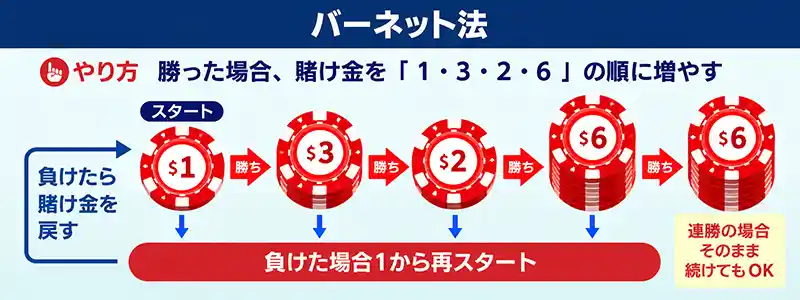
The 1-3-2-6 system is a betting system that can be used with table games and live dealer games at online casinos. A betting system is a money management method that raises and lowers your bet to control how much your bankroll swings. This one takes its name from how the bet changes with each consecutive win: 1 unit, then 3, then 2, then 6.
The unit can also be much larger – for example $100, giving bets of $100, $300, $200 and $600 – which is why high rollers use the system too.
Casino Games That Work Well with the 1-3-2-6 System
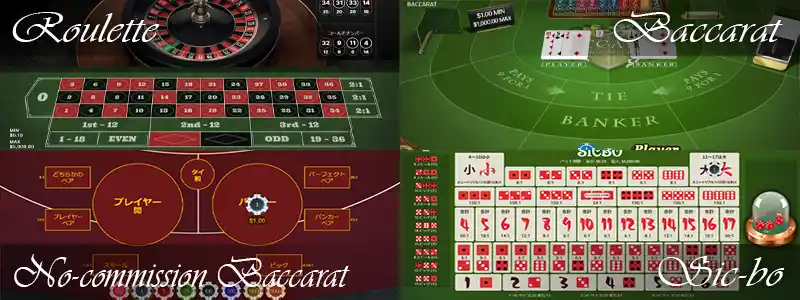
The 1-3-2-6 system is designed for bets that win about 50% of the time and pay 1 to 1, so a $10 bet wins $10. The following casino games fit that description.
Games Where It Works Without Adjustment
- Roulette bets such as red/black, odd/even and high/low, which would win exactly half the time if it were not for the 0
- The Player bet in baccarat
- Big/Small in Sic Bo
Games You Can Use It With Under Certain Conditions
- The Banker bet in no-commission baccarat (a Banker win on 6 pays half, 1 to 2, so a $10 bet wins $5, and the sequence’s math breaks down for that round only)
Games Where It Is Best Avoided
- Blackjack (the game includes doubling down and splitting, which require an additional bet, and declining them raises the house edge considerably)
- The Banker bet in standard baccarat (it pays 0.95 to 1 (19 to 20), so a $10 bet wins $9.50; four wins in a row fall short of 12 units, and a loss after three wins leaves you behind)
- The “1” segment in money wheel games such as Crazy Time (it wins far less than half the time, and multipliers and bonus rounds mean the payout is not consistent)
How to Bet with the 1-3-2-6 System
Unlike the Martingale system or the Paroli system (also called the reverse Martingale), the 1-3-2-6 system moves your bet both up and down, so if you apply it incorrectly, you may not make the profit you expect. Learn the rules before you use it in real play.
The system works in the following steps.
- Decide on your unit size and the game you will play
- After a win, move through the sequence
- After a loss, reset your bet and start a new cycle
Step (1): Decide on Your Unit Size and the Game You Will Play

First, decide how much one unit is worth. Here, “one unit” means your first bet. Choose an amount your bankroll can comfortably support. This article uses a unit of $1 in all examples.
Next, choose a game from those listed above under “Casino Games That Work Well with the 1-3-2-6 System” and place your first bet of 1 unit.
Step (2): After a Win, Move Through the Sequence

If you win, raise your bet to $3 and bet again. If you win that bet too, bet $2, and if you win once more, bet $6. In other words, your bet goes $1, then $3, then $2, then $6 as long as you keep winning.
If you win the 6-unit ($6) bet and complete four wins in a row, the system has succeeded. The cycle ends there with a profit of 1 + 3 + 2 + 6 = 12 units. Reset your bet and start the next cycle at 1 unit.
Some players keep betting $6 until they lose, but in that case a single loss costs 6 of the 12 units already won. Ending the cycle as the steps describe makes it easier to keep track of the result of each cycle.
Step (3): After a Loss, Reset Your Bet and Start a New Cycle
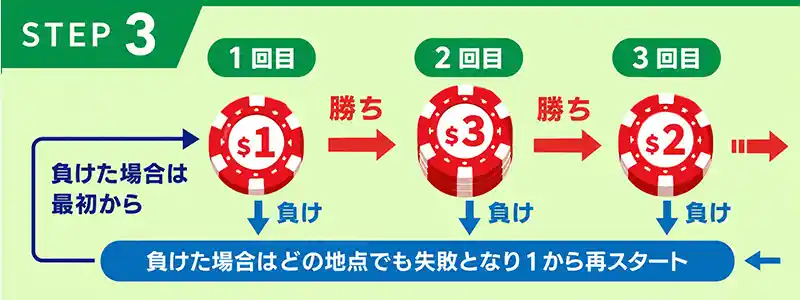
If you lose before reaching four wins in a row, the cycle counts as a failure, even if you are still ahead, as when you lose after two wins. Return your bet to $1 and start the next cycle.
Simulation Results for the 1-3-2-6 System
In this simulation, we place the Player bet in baccarat, and the results come in the following order: loss, loss, win, loss, win, win, loss, win, win, win, win.
| Round | Bet | Result | Win/loss | Running total | Next action |
|---|---|---|---|---|---|
| 1 | $1 | Loss | −$1 | −$1 | Loss, so the bet stays at $1 |
| 2 | $1 | Loss | −$1 | −$2 | Loss, so the bet stays at $1 |
| 3 | $1 | Win | $1 | −$1 | Win, so raise the bet to $3 |
| 4 | $3 | Loss | −$3 | −$4 | Loss, so return the bet to $1 |
| 5 | $1 | Win | $1 | −$3 | Win, so raise the bet to $3 |
| 6 | $3 | Win | $3 | $0 | Two wins in a row, so lower the bet to $2 |
| 7 | $2 | Loss | −$2 | −$2 | Loss, so return the bet to $1 |
| 8 | $1 | Win | $1 | −$1 | Win, so raise the bet to $3 |
| 9 | $3 | Win | $3 | $2 | Two wins in a row, so lower the bet to $2 |
| 10 | $2 | Win | $2 | $4 | Three wins in a row, so raise the bet to $6 |
| 11 | $6 | Win | $6 | $10 | Four wins in a row, so the cycle ends |
With 7 wins and 4 losses, the result was a profit of 10 units.
First, look at rounds 1–2 and rounds 3–4. The first two bets both lost, for a total of −$2. The next two produced one win and one loss, yet they also came to −$2. After the first win you bet $3, so losing that bet leaves you $2 down, the same as two losses in a row.
Next, rounds 5–7 went win, win, loss. Taken on their own, these three bets come to +$2 (the running total in the table is −$2). Once you have won twice in a row, the cycle can no longer end in a loss: losing the fourth bet, with a fourth straight win at stake, leaves you even, and losing the third bet, with a third straight win at stake, leaves you 2 units ahead. This is why a cycle can sometimes end in profit even without four wins in a row.
Finally, four wins in a row completed the cycle, for a total profit of 10 units. The next round starts again with a $1 bet.
Losses Grow When Wins and Losses Alternate
With the 1-3-2-6 system, you always lose money unless you win at least twice in a row. A losing streak naturally keeps you behind, but the system has another drawback: you also lose when wins and losses alternate.
As an example, here is a simulation of 5 wins and 5 losses in which wins and losses alternated throughout.
| Round | Bet | Result | Win/loss | Running total |
|---|---|---|---|---|
| 1 | $1 | Win | $1 | $1 |
| 2 | $3 | Loss | −$3 | −$2 |
| 3 | $1 | Win | $1 | −$1 |
| 4 | $3 | Loss | −$3 | −$4 |
| 5 | $1 | Win | $1 | −$3 |
| 6 | $3 | Loss | −$3 | −$6 |
| 7 | $1 | Win | $1 | −$5 |
| 8 | $3 | Loss | −$3 | −$8 |
| 9 | $1 | Win | $1 | −$7 |
| 10 | $3 | Loss | −$3 | −$10 |
Wins and losses were even, yet the result was a loss of $10.
Because a $1 bet is followed by a $3 bet, winning $1 and then losing $3 leaves you $2 down overall. Keep in mind that one win followed by one loss costs the same as two losses in a row.
Pros and Cons of the 1-3-2-6 System
The 1-3-2-6 system rests on two rules: raise your bet only after a win, and end the cycle after four wins in a row. Its pros and cons are two sides of the same coin.
- The cycle ends after four wins in a row: you have a clear point at which to lock in profit, but the profit per cycle is capped at 12 units
- The bet returns to 1 unit after a loss: losses do not snowball during a losing streak, but a cycle pays off only if you complete four wins in a row
- The second bet rises to 3 units: once you win twice in a row you cannot finish the cycle behind, but one win and one loss costs 2 units, the same as two losses in a row
The way losses grow during a losing streak differs sharply from the Martingale system. With the Martingale system, 10 losses in a row cost 1,023 units, while with the 1-3-2-6 system, 10 losses in a row cost only 10 units. The Paroli system also builds profit on winning streaks, but a single loss at any point in the cycle leaves you behind. With the 1-3-2-6 system, you can no longer be behind once you have won twice in a row.
On the other hand, the profit from one cycle is capped at 1 + 3 + 2 + 6 = 12 units. The Paroli system produces 1,023 units of profit after 10 wins in a row, but the 1-3-2-6 system ends after four wins, so it is not built for large profits in a single cycle. The bar for success is also higher than with the Martingale and Cocomo systems, which put you ahead with a single win, or the 31 system, which completes after two wins in a row.
The simulation table in the previous section shows how one win and one loss costs the same as two losses in a row.
Variations on the 1-3-2-6 System
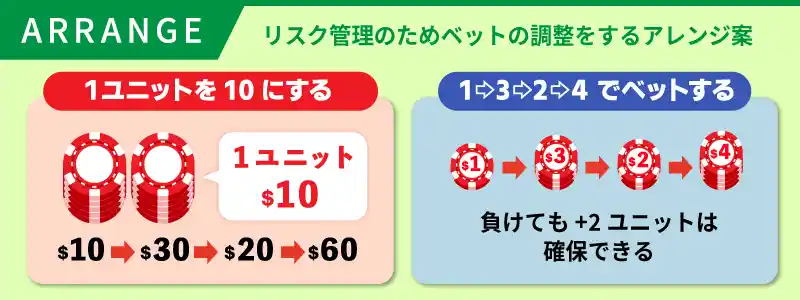
The 1-3-2-6 system places bets in the order 1, 3, 2, 6. Changing this sequence or the size of one unit changes how profits and losses play out over a cycle. Here are two examples.
Set One Unit at $10
If you start at $10 and win four times in a row, your profit is $120. You can change the unit size between cycles, so adjust it as your bankroll rises or falls.
Bet in the Order 1-3-2-4
Losing the bet that follows three straight wins leaves you even. Some players therefore make the last bet 4 units, so that they are still 2 units ahead if it loses. The profit from four wins in a row then drops from 12 units to 10, so this version gives up some upside in exchange for fewer cycles that end with nothing.
The 1-3-2-6 System vs. the 1-2-3-5 System (Goodman System)

A betting system very similar to the 1-3-2-6 system is the 1-2-3-5 system (also called the Goodman system). It gets its name from the way the bet changes with each consecutive win, in the order 1, 2, 3, 5.
With the 1-2-3-5 system, a 1-unit bet is followed by a 2-unit bet, so losing at that point leaves you only 1 unit down. As a result, when you fail to win twice in a row, your bankroll falls more slowly than with the 1-3-2-6 system.
The profit from four wins in a row is also smaller: 1 + 2 + 3 + 5 = 11 units, compared with 12 units for the 1-3-2-6 system. Because both losses and profits grow more slowly, the 1-2-3-5 system is a betting system with smaller swings in your bankroll than the 1-3-2-6 system.
What to Do When You Keep Losing with the 1-3-2-6 System
The 1-3-2-6 system earns 12 units when you win four times in a row, but you may find yourself already down 12 units or more after a run of losses. This section explains what you can do in that situation.
Set a Stop-Loss Limit in Advance
The 1-3-2-6 system gives you a clear point at which to lock in profit, but it sets no stop-loss limit at all.
Decide beforehand how far you will let your bankroll fall before you stop, and quit as soon as you reach that level. Another option is to deposit only the amount you plan to play with.
Try a Different Betting System or Game
The 1-3-2-6 system needs four wins in a row, so if you are struggling to make a profit with it, consider trying other betting systems.
The Martingale and Cocomo systems, which recover the losses of a cycle with a single win
The 31 system, which completes a cycle once you win twice in a row
The Monte Carlo system, which ends a cycle once you have worked through a number sequence
The Paroli system, for when the 12 units from four straight wins are not enough to recover your losses
Another option is to switch games, for example from baccarat to roulette. Keep in mind, however, that no matter which game you choose, the house edge does not go away.
The 1-3-2-6 System Does Not Change the Expected Value or the House Edge
As this article has shown, the 1-3-2-6 system raises the bet only after a win and goes back to one unit after a loss. Changing how you size your bets, however, has no effect on the expected value or the house edge of the game itself.
Because each individual bet has a negative expected value, the total stays negative no matter how many bets you add together. All the 1-3-2-6 system can change is how widely your bankroll swings (the variance) and the shape of the distribution of results.
The 1-3-2-6 system reshapes your results so that a losing streak costs only one unit per loss, but you make no substantial profit unless you win four times in a row. If wins and losses keep alternating, each win and loss costs as much as two losses in a row, so your losses build up just as fast as they would during a losing streak.
Because the bet goes up during a winning streak, you also cannot place the fourth bet if it would exceed the table limit (the maximum you can bet on a single round). The larger your unit, the sooner you reach that limit, so check the table limit before you play.
Setting a stop-loss limit or a profit-lock level does not change the expected value either. These are money management rules that cap how much you put in play in a single session. The same is true when you change the order of the bets, as in the variations above: only the way profits and losses play out changes.
Summary: The 1-3-2-6 System Keeps Your Bet at One Unit During a Losing Streak and Does Not Change the Expected Value
The 1-3-2-6 system is a betting system that changes the bet with each consecutive win, as its name suggests. A cycle simply ends after four wins in a row, and the point at which you lock in profit is clearly defined, so it is straightforward to follow, even for first-time users.
Because the bet does not increase during a losing streak, each loss stays small. On the other hand, a cycle always ends after four straight wins, so the only way to increase the profit from one cycle is to raise your starting bet.
Compared with the similar 1-2-3-5 system, you lose more until you win twice in a row, and you usually earn more once you put together two or more wins in a row (+2 vs 0 units after win-win-loss, 12 vs 11 units after four straight wins). A loss after exactly three wins, however, leaves you even, while the 1-2-3-5 system would still be 1 unit ahead. Think of it as a betting system that makes your bankroll swing more than the 1-2-3-5 system does.
- Martingale Strategy Explained
- D'Alembert Betting System
- Paroli Betting System
- Labouchère Betting System
- Percentage Betting (10% System)
- Oscar's Grind Betting System
- 1-3-2-6 Betting System
- 1-2-3-5 Betting System
- Monte Carlo Betting System
- Cocomo Betting System
This site is for adults of legal gambling age (18+, or older where required) who live in countries or regions where online gambling is legal.
Use of this site is subject to our Terms and Conditions.
Gambling involves risk. Only bet what you can afford to lose, and do not use online gambling services where they are illegal.

Bell | Editor of Online Casino Winners Club. Since the site launched in 2003, Bell has written guides to casino game rules, tested betting systems and covered land-based casinos around the world, and still plays the games before writing about them. Bell's core advice: choose the bets with the lowest house edge, and decide in advance how much you are prepared to lose.