

Many of the methods that are called casino "strategies" or "sure ways to win" are in fact betting systems, and some players use them as a structured…
Sic Bo Rules, Bets, Payouts and House Edge Explained

Sic Bo (also called tai sai or dai siu) is a game in which players bet on the outcome of three dice. The rules are simple, yet the game offers a wide range of bets, with payouts from 1 to 1 up to 150 to 1. It is played mainly in casinos in Asia.
What You Will Learn
- Sic Bo is a game in which you predict the results of three dice.
- The return to player (RTP) ranges from 58.33% to 97.22% depending on the bet, and the high-paying bets carry a higher house edge.

This article takes about 12 minutes to read.
Contents
Show
What Is Sic Bo? Basic Rules and How to Play
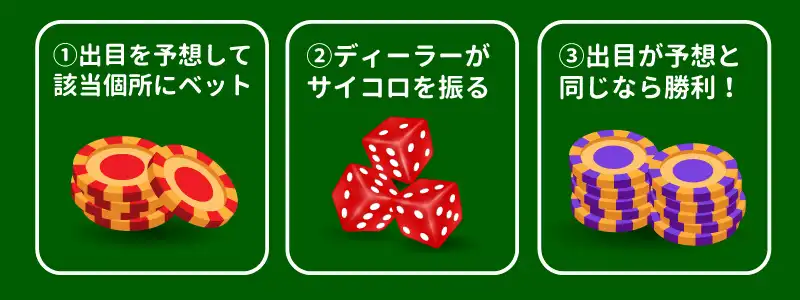
Sic Bo, also called tai sai or dai siu (“big and small”), is a casino game played with three dice.
Players bet on the results of the three dice, and the range of bets is wide. For example, you can bet that the total will be 11 or more (Big), that the total will be even, that at least one die will show a 1, or that all three dice will show the same number.
Each roll is an independent event, so past results cannot be used to predict the next one.
The less likely a bet is to win, the more it pays. For example, a bet that the total will be 4–10 (Small) pays 1 to 1, so a $10 bet wins $10, while a bet on a triple 1 (all three dice showing 1) pays 150 to 1, so a $10 bet wins $1,500.
Key Features of Sic Bo
- The rules are simple, so even first-time players can easily follow the game.
- There are eight types of bets, so experienced players also find plenty of variety.
- Payouts range from 1 to 1 up to 150 to 1, and the house edge varies widely from bet to bet.
The RTP ranges from 58.33% to 97.22% depending on the bet, and Big/Small and Odd/Even are the bets that lose the least over time.
How a Round of Sic Bo Is Played
A round of Sic Bo follows the four steps below. We explain them using screenshots from Evolution’s Super Sic Bo.
Step 2 applies only to Super Sic Bo. We use this game as the example because its high-paying bets have a higher RTP than those at a standard table, and many casinos offer it.
STEP1
Place Your Bets
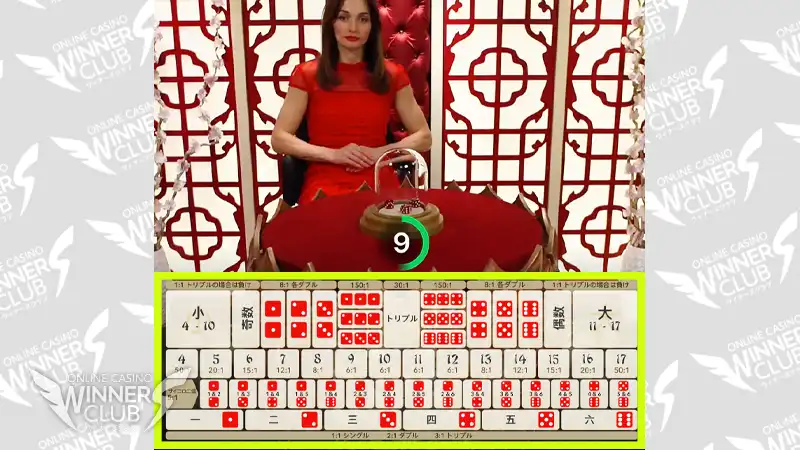
Predict the result of the dice and place your bets. There are many types of bets, such as Big/Small, Odd/Even, Specific Double and Specific Triple, and the less likely a bet is to win, the more it pays.
STEP2
Multipliers Are Applied to Bet Areas
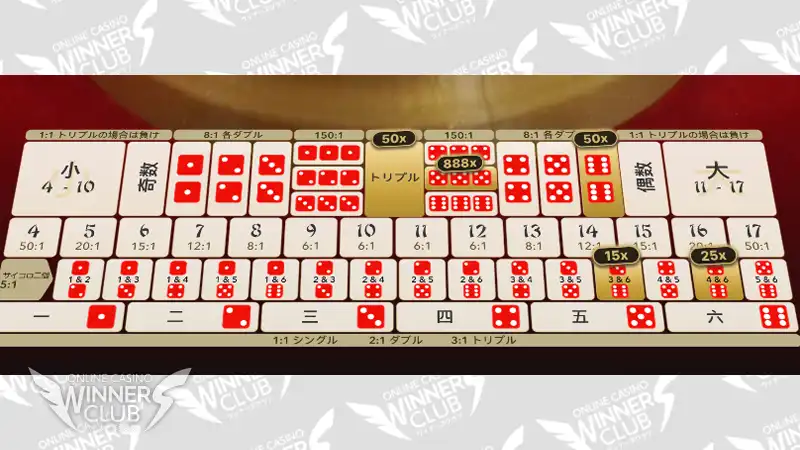
In Super Sic Bo, a random draw for multipliers takes place before the dice are rolled. Bet areas selected in the draw pay more than usual if they win.
For example, a triple 1, which normally pays 150 to 1, can pay up to 1,000 to 1 when it receives a multiplier. The base RTP of the Specific Triple bet is 69.91%, but with these multipliers factored in, it rises to about 95%.
STEP3
The Dice Are Rolled

The dealer switches on the dice shaker, and the dice tumble inside it. The dealer never touches the dice, so the result cannot be influenced.
STEP4
Winning Bets Are Paid
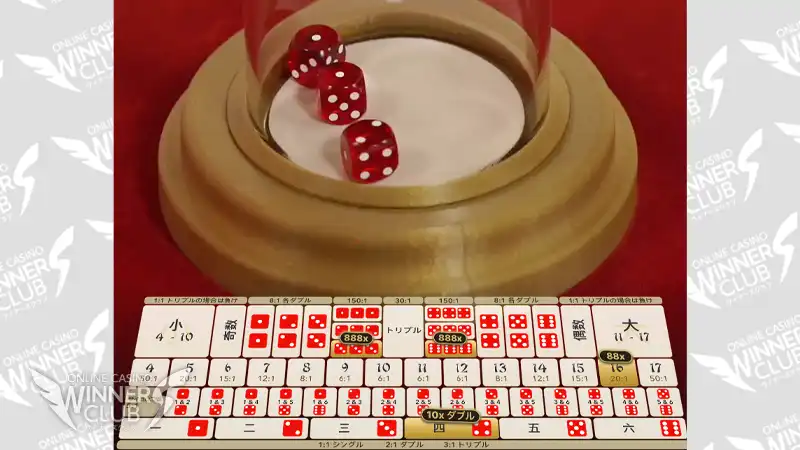
The result is final once the dice have come to a complete stop. If your bet matches the result, it is paid at the odds for that bet area.
How to Bet in Sic Bo
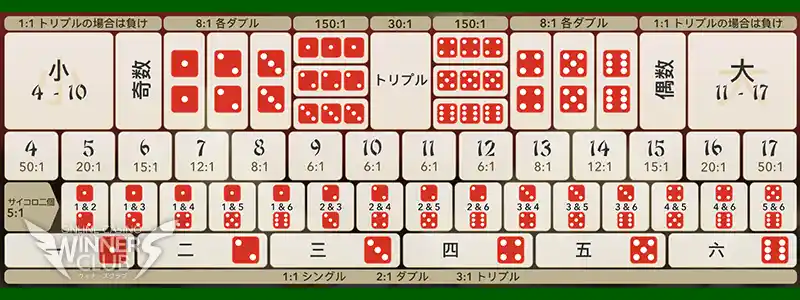
The most popular bet, Big/Small, pays 1 to 1, so a $10 bet wins $10. That makes it a common choice for first-time players and for players using a betting system. If you want larger payouts, the Specific Triple and Total bets are available.
Big/Small: Pays 1 to 1
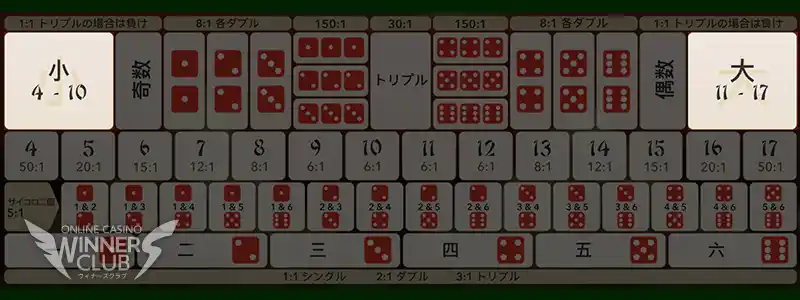
Big/Small is a bet on the total of the three dice: Big wins if the total is 11 or more, and Small wins if it is 10 or less.
Example: If the dice show 4, 3 and 5, the total is 12, so Big wins.
However, if all three dice show the same number (any triple), both Big and Small lose.
Example: If the dice show 2, 2 and 2, the total is 6, but because the result is a triple, both Big and Small lose.
Big and Small have the same probability of winning.
Odd/Even: Pays 1 to 1
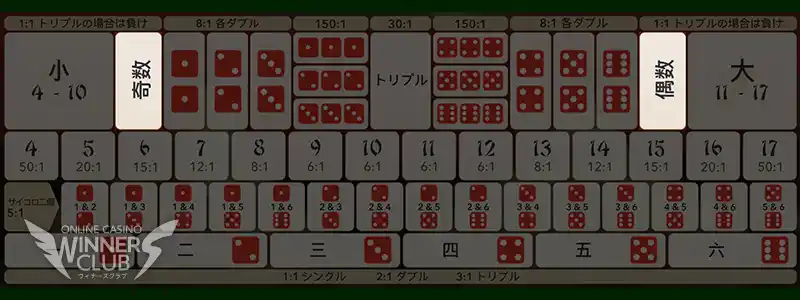
Odd/Even is a bet on whether the total of the three dice will be odd or even.
Example: If the dice show 4, 3 and 5, the total is 12, so Even wins.
However, if all three dice show the same number (any triple), both Odd and Even lose.
Example: If the dice show 2, 2 and 2, the total is 6, but because the result is a triple, both Odd and Even lose.
Odd and Even have the same probability of winning.
Single Number: Pays 1 to 1, 2 to 1 or 3 to 1
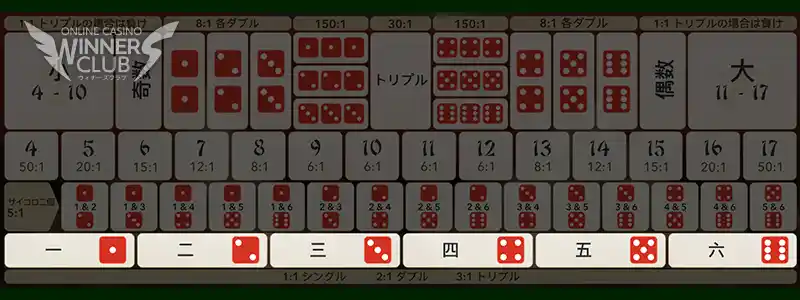
The Single Number bet (single die bet) wins if the number you choose appears on at least one of the three dice.
One matching die is enough to win, and the payout rises with each additional match: 1 to 1 for one die, 2 to 1 for two dice and 3 to 1 for all three.
Two-Dice Combination: Pays 5 to 1
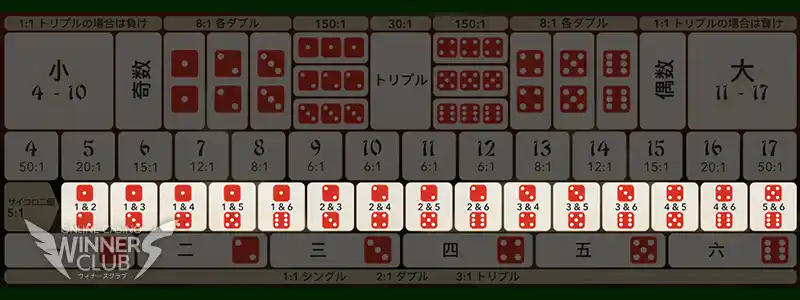
The Two-Dice Combination bet (also called a combination bet) is placed on two different numbers and wins if both numbers appear among the three dice.
Example A: You choose 1 and 2, and the dice show 1, 2 and 2. Both numbers appear, so the bet wins.
Example B: You choose 1 and 2, and the dice show 1, 1 and 6. The 2 does not appear, so the bet loses.
Specific Double: Pays 8 to 1
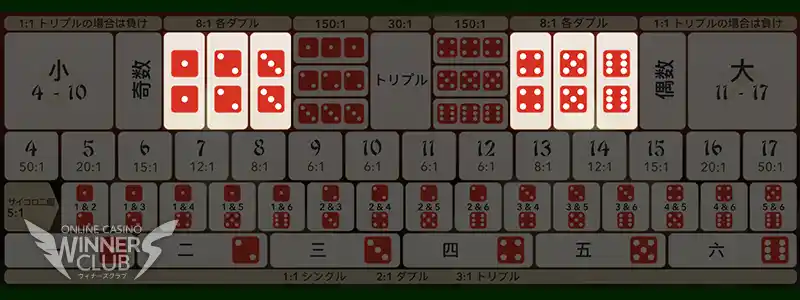
The Specific Double bet is placed on one number and wins if that number appears on two or more of the three dice (including all three).
Specific Triple: Pays 150 to 1
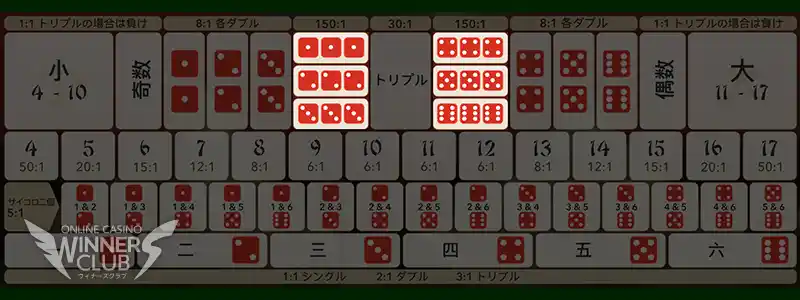
The Specific Triple bet is placed on one number and wins if all three dice show that number.
Any Triple: Pays 30 to 1
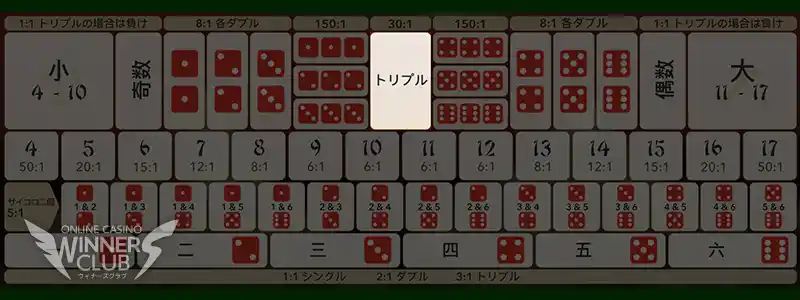
The Any Triple bet wins if all three dice show the same number, whatever that number is.
Total: Six Payout Levels Depending on the Total (Up to 50 to 1)
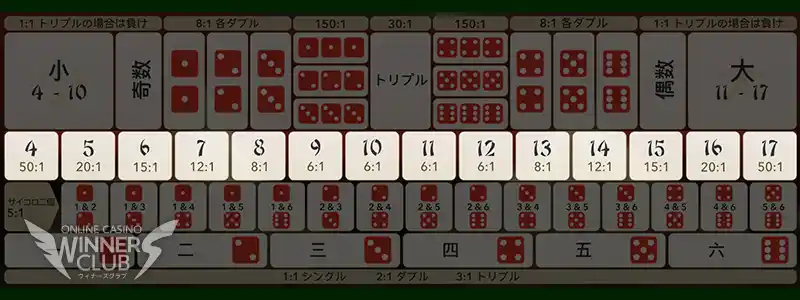
The Total bet is a prediction of the exact total of the three dice. Depending on the total, it pays 6 to 1, 8 to 1, 12 to 1, 15 to 1, 20 to 1 or 50 to 1.
Example: A bet on a total of 12 wins whether the dice show 2, 4 and 6, or 3, 4 and 5, or 1, 5 and 6.
The farther the total is from the middle, in either direction, the harder it is to hit, and the higher the payout.
Sic Bo Payouts and Probabilities
The table below shows the payouts and probabilities for each Sic Bo bet. Payouts vary by table and by game, so check the pay table of the game you play.
Sic Bo probabilities and pay table
| Bet | Details | Payout | Probability |
|---|---|---|---|
| Big/Small | Big (11–17) / Small (4–10) | 1 to 1 | 48.61% |
| Odd/Even | Whether the total is odd or even | 1 to 1 | 48.61% |
| Total | 4 or 17 | 50 to 1 | 1.39% |
| 5 or 16 | 20 to 1 | 2.78% | |
| 6 or 15 | 15 to 1 | 4.63% | |
| 7 or 14 | 12 to 1 | 6.94% | |
| 8 or 13 | 8 to 1 | 9.72% | |
| 9 or 12 | 6 to 1 | 11.57% | |
| 10 or 11 | 6 to 1 | 12.50% | |
| Single Number | The number appears on one of the three dice | 1 to 1 | 34.72% |
| The number appears on two of the three dice | 2 to 1 | 6.94% | |
| The number appears on all three dice | 3 to 1 | 0.46% | |
| Specific Double | The chosen number on two of the three dice | 8 to 1 | 7.41% |
| Specific Triple | All three dice show the chosen number | 150 to 1 | 0.46% |
| Any Triple | All three dice show the same number (any number) | 30 to 1 | 2.78% |
| Two-Dice Combination | A combination of two chosen numbers | 5 to 1 | 13.89% |
Each Sic Bo bet has a fixed payout, ranging from 1 to 1 up to 150 to 1, and the higher the payout, the lower the probability of winning. As the next section shows, the house edge varies widely from bet to bet.
Sic Bo RTP and House Edge
RTP of Super Sic Bo (Evolution)
| Return to player (RTP) | House edge |
|---|---|
| 95.02%–97.22% | 2.78%–4.98% |
RTP by bet (Super Sic Bo base payouts, excluding multipliers)
| Bet | Return to player (RTP) | House edge |
|---|---|---|
| Big/Small / Odd/Even | 97.22% | 2.78% |
| Single Number | 92.13% | 7.87% |
| Two-Dice Combination | 83.33% | 16.67% |
| Any Triple | 86.11% | 13.89% |
| Specific Triple | 69.91% | 30.09% |
| Specific Double | 66.67% | 33.33% |
| Total | 58.33%–90.28% | 9.72%–41.67% |
As the table shows, the 1 to 1 bets (Big/Small and Odd/Even) have the lowest house edge, while the other bets have higher house edges. The house edge does not, however, rise in proportion to the payout. High-paying bets simply pay more when they win; they do not offer a lower house edge.
Looking only at the base payouts, without the multipliers, the bets other than Big/Small and Odd/Even have a much lower RTP. Some fall below 70%, such as the Specific Double (66.67%) and the Total bets on 5 or 16 (58.33%), so if you want to keep your losses down, stick mainly to Big/Small and Odd/Even.
Evolution’s Super Sic Bo, by contrast, has a built-in feature that randomly raises the payouts on low-RTP bet areas.
As a result, every bet in Super Sic Bo has an RTP of 95% or higher (a house edge of 4.98% or less) by design. This keeps losses on high-paying bets lower than at a standard table, but as long as the RTP is below 100%, you will still lose money in the long run.
Evolution’s Super Sic Bo has an RTP of 95.02%–97.22%
Betting Systems for Sic Bo

There is no guaranteed way to win at Sic Bo. The most popular bets, Big/Small and Odd/Even, win 48.61% of the time and pay 1 to 1, which makes them convenient bets for trying a betting system. A betting system, however, is only a set of rules for raising and lowering your bet, and it does not change the house edge.
No betting system guarantees a win or changes the overall house edge, but a system can make it easier to control how quickly your bankroll goes down. Choose one that suits your playing style.
- Related Article
-

Martingale System

The Martingale system is the best-known betting system. It is very simple to use: double your bet after a loss, and return to your original bet after a win.
Simulation of the Martingale system in Sic Bo
| Round | Result | Bet | Balance |
|---|---|---|---|
| 1 | Loss | $10 | −$10 |
| 2 | Loss | $20 | −$30 |
| 3 | Win | $40 | $10 |
| 4 | Win | $10 | $20 |
| 5 | Loss | $10 | $10 |
| 6 | Win | $20 | $30 |
| 7 | Win | $10 | $40 |
The Martingale is widely used because the steps are simple and a single win recovers all your previous losses. Each win, however, earns only the amount of your first bet, while a losing streak doubles your bet again and again. Once you reach the table maximum or run out of funds, you are left with a large loss.
Paroli System

The Paroli system, also called the reverse Martingale, works the opposite way from the Martingale system: double your bet after a win, and return to your original bet after a loss.
Simulation of the Paroli system in Sic Bo
| Round | Result | Bet | Balance |
|---|---|---|---|
| 1 | Loss | $10 | −$10 |
| 2 | Loss | $10 | −$20 |
| 3 | Win | $10 | −$10 |
| 4 | Loss | $20 | −$30 |
| 5 | Win | $10 | −$20 |
| 6 | Win | $20 | $0 |
| 7 | Win | $40 | $40 |
With this system, a single loss partway through a winning streak wipes out all the profit from that streak, so sessions end in profit less often. The probability of winning each round does not change, but the return is larger when you reach your target streak and take your profit.
The Winners Method
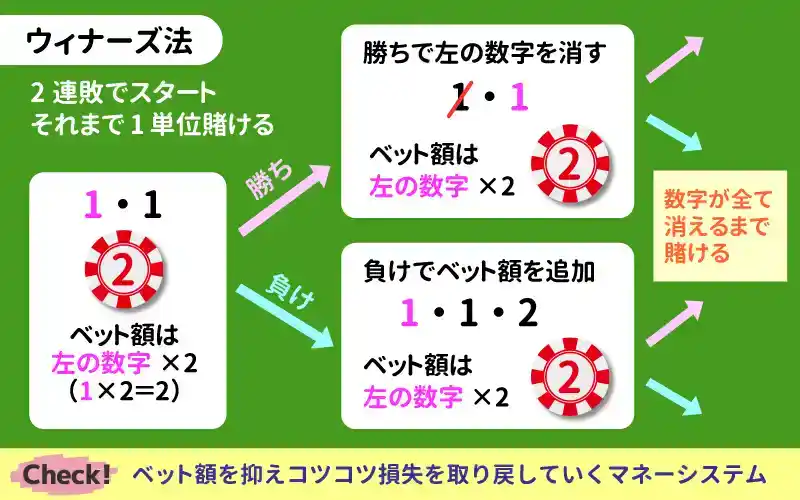
The Winners Method is a system that raises and lowers your bet using a number sequence.
After two losses in a row, start the sequence 1, 1 and bet twice the leftmost number in the sequence. After a win, cross out the leftmost number; after a loss, add the amount you just bet to the right end of the sequence.
Repeat these steps until no numbers are left, at which point the Winners Method ends.
Because the method is designed to start recovering right after a losing streak, your bets grow more slowly than with the Martingale system. If wins and losses keep alternating, however, the leftmost number keeps rising and your bets get larger even while the sequence stays short, and a losing streak makes the sequence longer, so consider cutting your losses once the sequence reaches about seven numbers. This system does not change the house edge either.
Three Sic Bo Games to Play at Online Casinos
Sic Bo is a table game played around the world, especially in Asia, and online casinos offer it in both live dealer and RNG (software-based) versions.
Super Sic Bo | Evolution
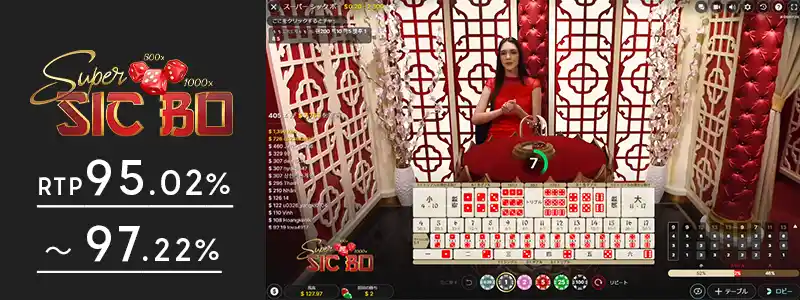
Evolution is a provider that offers a wide range of live games, and many online casinos carry its titles.
Evolution has several Sic Bo games, and the most widely offered is Super Sic Bo, which lowers the base payouts and gives the difference back through multipliers drawn each round.

In Lightning Dice, where you can bet only on the Total, multipliers raise the payouts on randomly drawn totals. This design reduces the imbalance of a standard Total bet, where the RTP varies widely from one total to another.

Sic Bo Deluxe | Playtech

Playtech’s Sic Bo Deluxe plays almost the same way as Evolution’s Super Sic Bo.
As the dice are shaken, bet areas that receive a multiplier to boost their payouts are chosen at random. When the Specific Triple, normally paying 150 to 1, is chosen as a multiplier bet, it pays up to 1,000 to 1.
Because Big and Small win so often, they are never chosen as multiplier bets.
Sic Bo | OneTouch
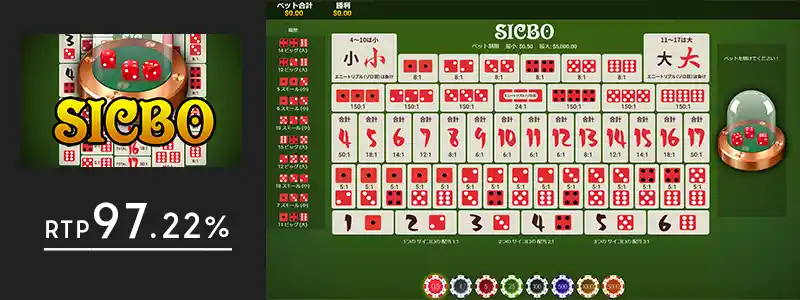
The Sic Bo game from OneTouch is an RNG version.
OneTouch’s Sic Bo sets lower payouts on some high-paying bets: the Any Triple, for example, pays 24 to 1, giving an RTP of about 69.44%. There is also no feature like Evolution’s that boosts payouts in certain situations, so the high-paying bets have an RTP equal to or lower than the figures shown earlier.
The 1 to 1 bets, such as Big/Small and Odd/Even, have the same RTP as in other games. This makes the game a good fit if you want to try Sic Bo for the first time, or if you plan to bet only on Big/Small with a betting system.
Frequently Asked Questions About Sic Bo
- What is Sic Bo?
-
Sic Bo is a casino game in which three dice are rolled and players bet on the result of the roll.
The most basic bet is Big/Small: you predict that the total of the three dice will be 11–17 (Big) or 4–10 (Small). If all three dice show the same number (a triple), however, both Big and Small lose regardless of the total.
- What return can I expect from Sic Bo?
-
The return to player (RTP) in Sic Bo depends on the bet. Big/Small and Odd/Even have the highest RTP, at about 97.22%. The other bets have much lower RTPs, but Evolution’s Super Sic Bo includes randomly drawn multipliers, so every bet is designed to have an overall RTP of 95% or higher. In every case, though, the RTP is below 100%, so you will lose money in the long run.
Summary: Big/Small Has the Lowest House Edge, and High-Paying Bets Generally Carry a Higher House Edge
Sic Bo is a table game played with three dice, in which you predict the outcome and place chips on the betting areas. There are many ways to bet, such as a total of 11 or more, at least one die showing a 1, or all three dice showing a 6, and the harder a bet is to win, the more it pays. Payouts and the house edge do not rise in proportion, however, and the lowest house edge is on the 1 to 1 bets (Big/Small and Odd/Even).
Big/Small, the most popular bet, pays 1 to 1, which makes it easy to combine with a betting system. Its house edge is about 2.78%, the lowest of any bet in Sic Bo.
In recent years, live games such as Super Sic Bo, in which payouts jump under certain conditions, have also become available. Sic Bo is a dice game with a long history, simple rules and a wide choice of bets.
Beginner's Guide to Dice Games
Types of Casino GamesThis site is for adults of legal gambling age (18+, or older where required) who live in countries or regions where online gambling is legal.
Use of this site is subject to our Terms and Conditions.
Gambling involves risk. Only bet what you can afford to lose, and do not use online gambling services where they are illegal.

Bell | Editor of Online Casino Winners Club. Since the site launched in 2003, Bell has written guides to casino game rules, tested betting systems and covered land-based casinos around the world, and still plays the games before writing about them. Bell's core advice: choose the bets with the lowest house edge, and decide in advance how much you are prepared to lose.