

Blackjack uses many terms that rarely come up in other games. You can enjoy the game without knowing them, but articles that explain strategy, such as…
Blackjack Rules: How to Play, Card Values and Key Actions

Blackjack is one of the most popular card games in casinos. Many players know the name but assume the rules are complicated. The basic rules are simple, though, and beginners can learn them quickly and start playing right away.
Blackjack also has one of the highest return to player (RTP) rates of any casino game. With 8 decks, the dealer standing on soft 17 (a 17 that counts an ace as 11), and blackjack paying 3 to 2, a player who follows basic strategy faces a house edge of about 0.5%, which corresponds to an RTP of around 99.5%.
What You Will Learn
- Blackjack is a card game played against the dealer, with the goal of reaching a total of 21.
- A blackjack (natural), a total of 21 with the first two cards, pays 3 to 2: a $10 bet wins $15.
- Beginners should first learn the main player actions, then move on to basic strategy once they are comfortable.
- Played correctly, blackjack has an RTP of over 99%, among the highest of any casino game.

This article takes about 17 minutes to read.
Contents
Show
What Is Casino Blackjack?

Blackjack is a casino card game played with a standard deck of playing cards. The basic rule is simple: the player and the dealer (the casino employee who deals the cards) each try to make a hand closer to 21 than the other without going over, and the closer hand wins.
Blackjack is popular in land-based casinos around the world, from Las Vegas to Macau, and is also widely played at online casinos. Live blackjack, in which you play against a real dealer over a live video stream, is especially popular because it offers the atmosphere of a land-based casino.
Basic Rules of Blackjack
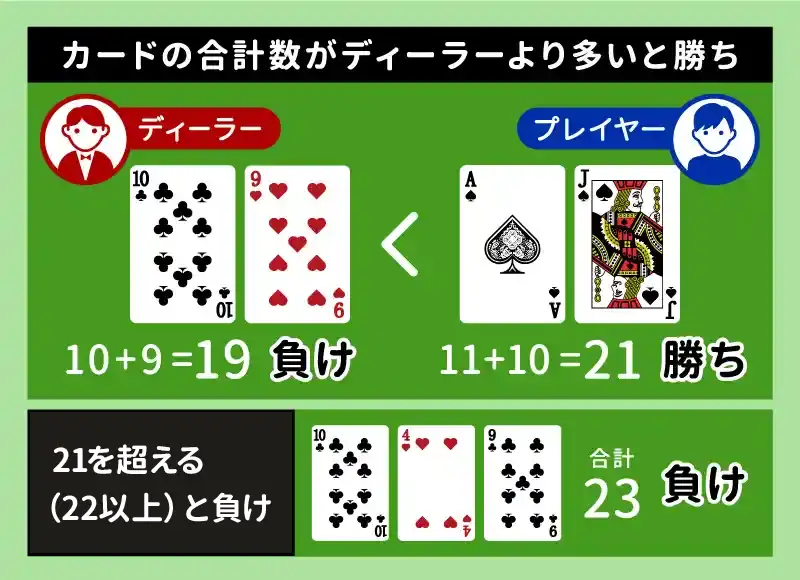
The player and the dealer are each dealt two cards to start. A hand that totals 22 or more is a bust and loses automatically, so the goal is to finish closer to 21 than the dealer without going over.
While trying to anticipate the dealer’s hand, the player decides whether to draw more cards, increase the bet and so on.
Blackjack is played with standard playing cards with the jokers removed. A set of 52 cards counts as one deck, and most blackjack games shuffle 6–8 decks together. Live blackjack at online casinos uses 8 decks as standard.
The Blackjack Table and Equipment
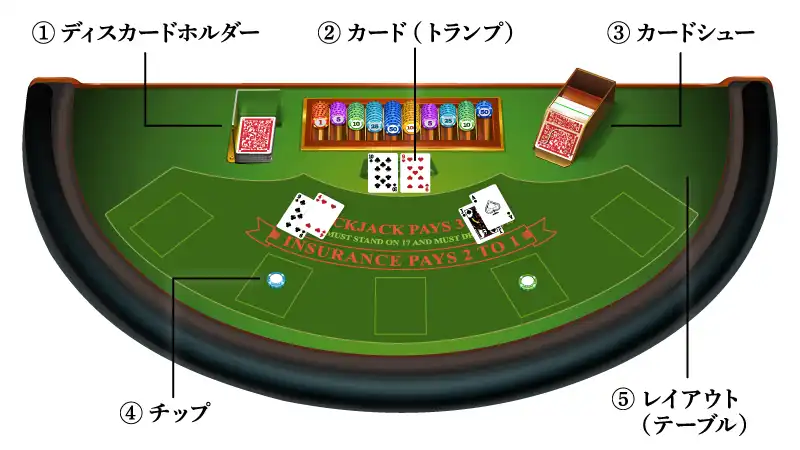
Most of this equipment is either self-explanatory or not needed to play, but knowing what is on the table will help you understand blackjack better.
The table has five main items: the discard tray, the cards, the shoe, the chips and the layout. The person who runs the game is called the dealer.
| Item | Description |
|---|---|
| (1) Discard tray | A holder for used cards. Many discard trays are transparent, so used cards can be checked on the spot, which helps prevent cheating and makes it easier to keep track of the game. |
| (2) Cards | The playing cards that decide the outcome of each round. One deck is a set of 52 cards with the jokers removed. |
| (3) Shoe | A device that holds several decks of cards and lets the dealer deal them smoothly. |
| (4) Chips | Tokens that represent cash value, bought from and cashed in at the casino. They are used to place bets and collect payouts, and their color and size indicate their value. |
| (5) Layout | The printed surface of the blackjack table. The table is usually semicircular, with the dealer facing the players, and the layout marks the betting areas and the places for the cards so the game runs smoothly. |
Card Values
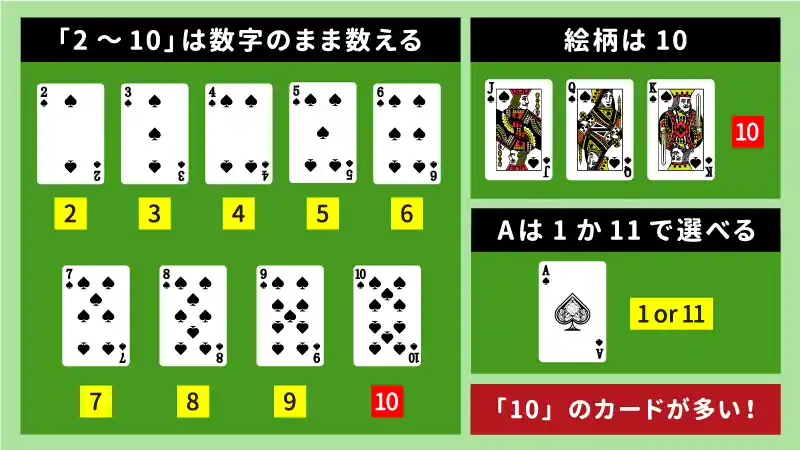
Cards in blackjack are scored a little differently from other card games. Cards 2–10 count at face value, while face cards and aces count as follows.
- An ace (A) counts as 1 or 11
- Face cards (J, Q, K) count as 10
An ace counts as whichever value is better for the hand. For example, A and 6 can be counted as 11 + 6 = 17, but with A, 6 and 8, counting the ace as 11 would bust the hand, so the total is 1 + 6 + 8 = 15.
Because face cards count as 10, a large share of the cards are 10-value cards, which is worth keeping in mind.
Examples of Hand Totals
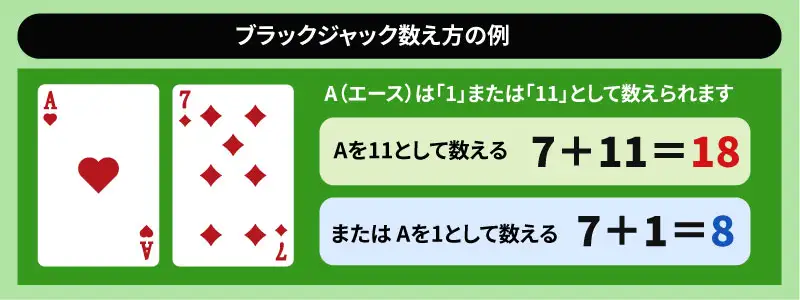
- Example (1): A 4 and a 7 total 4 + 7 = 11
- Example (2): A 7 and an A total 7 + 11 = 18 (or 7 + 1 = 8)
- Example (3): A J and a K total 10 + 10 = 20
What Is a Natural Blackjack? The Best Hand: 21 on the First Two Cards
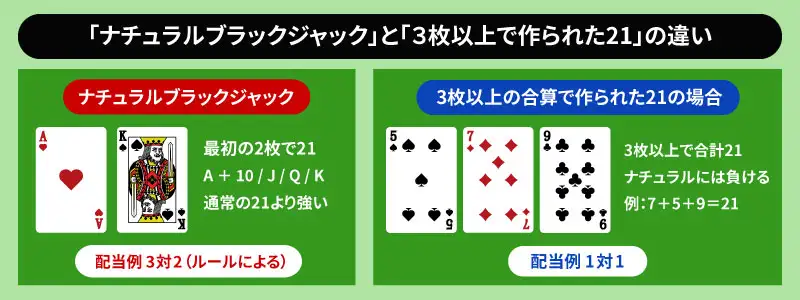
A natural blackjack is a hand that totals 21 with just the first two cards dealt. It consists of an ace and one 10-value card (10, J, Q or K) and is also simply called a “blackjack” or a “natural.” A natural blackjack pays 3 to 2, so a $10 bet wins $15.
By contrast, a total of 21 made with three or more cards (for example, 7 + 7 + 7) is not a natural blackjack and is treated as an ordinary 21.
When the dealer’s upcard is an ace or a 10-value card (10, J, Q or K), the dealer may first peek at the face-down card, called the hole card, to check for a natural blackjack. When the upcard is an ace, players can also take insurance, which is explained later. Payouts and other rule details vary by casino, so check the house rules before you play.
The Dealer Draws Until the Total Is 17 or More
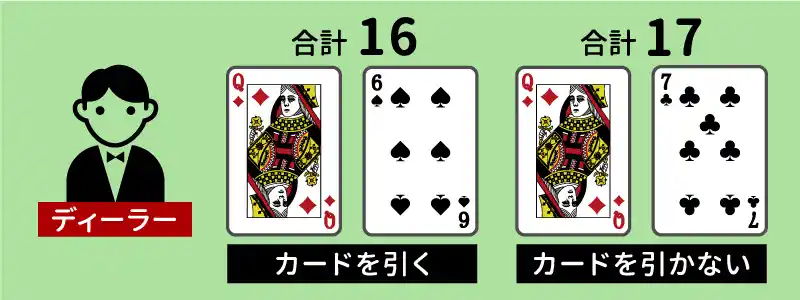
Players decide for themselves whether to draw a card, but the dealer generally follows a fixed rule: keep drawing on a total of 16 or less and stop once the total reaches 17 or more.
This means the dealer always ends with 17–21 or busts, so players need to judge whether the dealer is likely to bust or what total the dealer is likely to reach.
What the dealer does on a soft 17, such as A + 6, depends on the table. Under S17 the dealer stands on soft 17, and under H17 the dealer hits. Most major live tables at online casinos use S17. The rule is shown in the table rules, so check it before you sit down. Some basic strategy decisions differ between S17 and H17.
Basic Blackjack Terms Used in the Casino
Strategy articles are hard to follow if you do not know the basic blackjack terms, so we recommend learning them first.
Hand
A hand is the set of cards a player holds. Deciding whether to add more cards to your hand is the main decision that shapes the outcome in blackjack.
Upcard
The upcard is the first of the two cards dealt to the dealer. It is dealt face up for everyone to see.
The dealer’s second card, the hole card, is face down. Players therefore use the upcard to anticipate the dealer’s hand and decide whether to draw another card or stand with what they have.
Suit
The suit is one of the four symbols on playing cards: spades (♠), hearts (♥), diamonds (♦) and clubs (♣).
The term comes up mainly with side bets such as Perfect Pairs and 21+3, whose winning combinations depend partly on suit.
- Related Article
-
How a Round of Blackjack Is Played
This walkthrough uses the two most basic actions, hit and stand. Players have other options as well, and these are covered together in “Main Blackjack Actions” below.
- The Four Steps of a Blackjack Round
-
- Place your bet
- Choose “Hit” to draw another card
- Choose “Stand” when your hand total is close to 21
- Collect your payout if you beat the dealer
STEP1
Place Your Bet
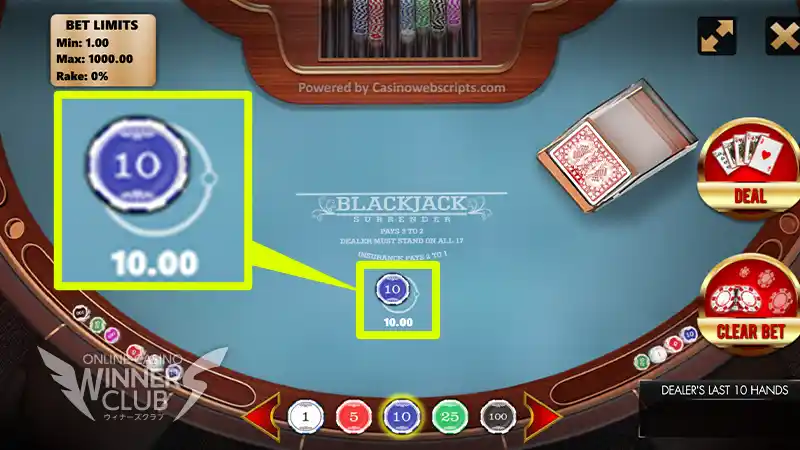
Blackjack offers two kinds of bets: the main bet, placed on the main contest in which you and the dealer compare totals, and side bets, which are settled independently of that contest.
Side bets are optional, but a main bet is always required. You cannot place side bets on their own.
Place your chips while betting is open. Once your bet is accepted, the round begins.
STEP2
Choose “Hit” to Draw Another Card
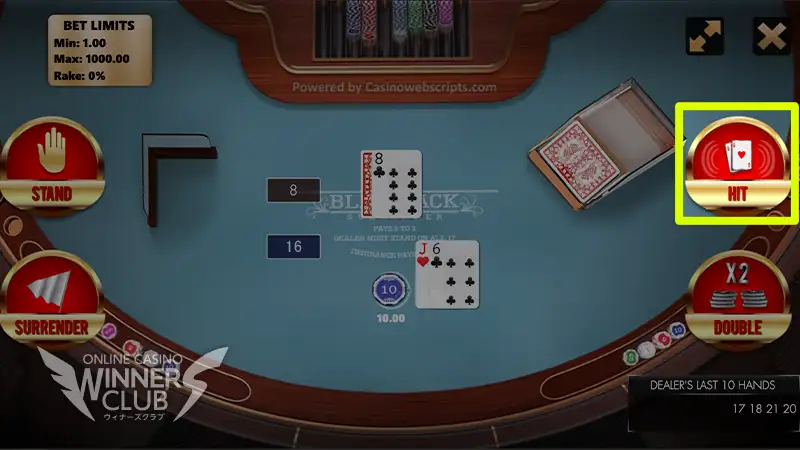
Once bets are confirmed, the player and the dealer each receive two cards. Both of the player’s cards are dealt face up. Only the dealer’s first card, the upcard, is face up, and the second card, the hole card, is face down. The player then begins to act.
The screen shows buttons such as Hit and Stand. Choose Hit to receive one more card.
STEP3
Choose “Stand” When Your Hand Total Is Close to 21
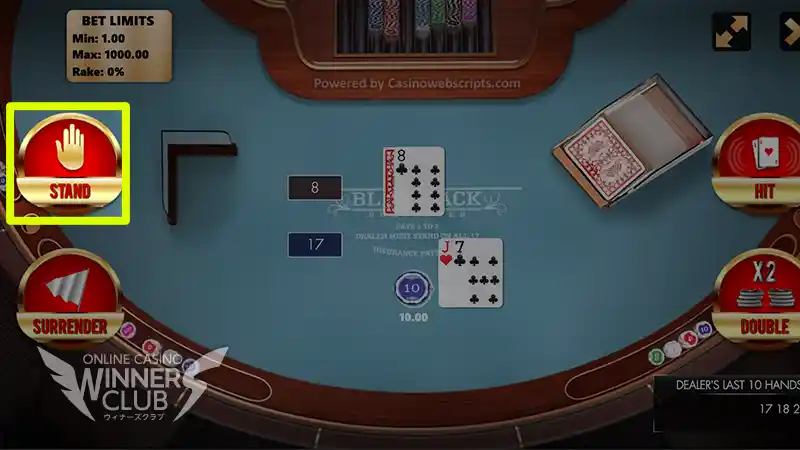
If you think your hand will beat the dealer’s, or that another card is likely to bust you, choose Stand on the screen. Your total is then fixed, and the round is played out with that hand.
The dealer then draws according to the rule described above. Once the dealer has finished drawing, both hands are final.
STEP4
Collect Your Payout If You Beat the Dealer
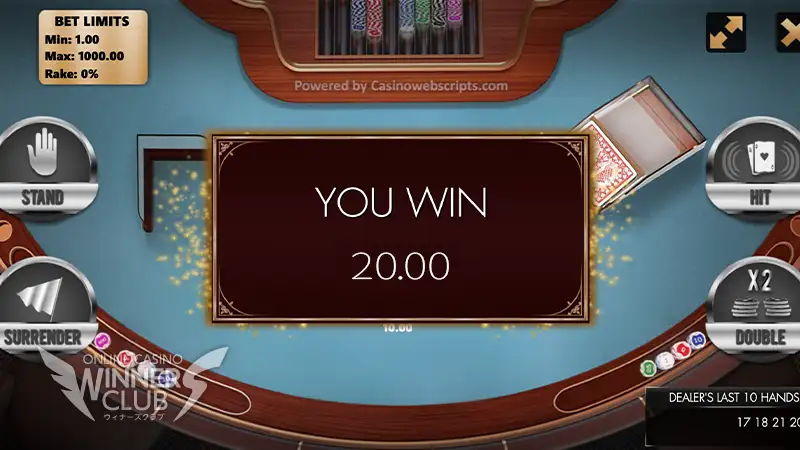
The player’s and the dealer’s hands are compared. If the player’s total is higher, the player wins and is paid 1 to 1, so a $10 bet wins $10. A winning blackjack, or natural, which is 21 made with the first two cards, usually pays 3 to 2, so a $10 bet wins $15.
Casino payouts are written as odds, such as 1 to 1 or 3 to 2, which state the amount won relative to the bet. At a land-based casino, the winnings are paid in chips and your original bet stays on the table, while at an online casino the bet and the winnings are both credited to your balance. In this article, payouts are given as odds, with the amount won shown in an example: at 1 to 1, a $10 bet wins $10, and you get $20 back in total.
If the dealer busts, you win regardless of your own total. If you bust, however, you lose your bet regardless of what the dealer’s hand turns out to be.
If the player’s and the dealer’s totals are equal, the hand is a push and your bet is returned.
Winning side bets are also paid at this point.
Blackjack is always a one-on-one contest between you and the dealer. Other players’ hands and results have no effect on yours.
Main Blackjack Actions
Players can make several decisions about their hand, and these decisions are called actions.
Of the five actions covered here, hit/stand, double down, split and insurance are available at almost every table.
Hit / Stand
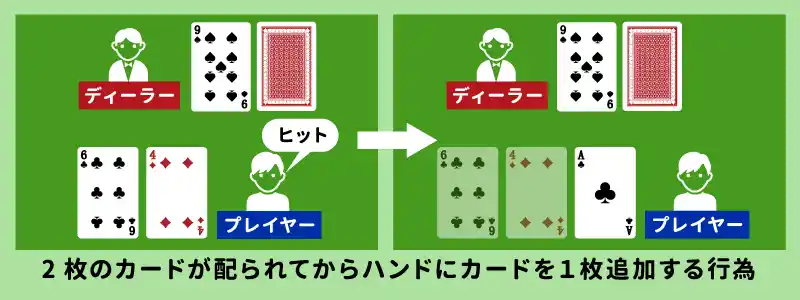
To hit means to draw another card. When your turn comes, you ask for a hit to receive one more card. To stand is the opposite: you take no more cards and keep your hand as it is. Standing is also called staying.
You can hit as many times as you like as long as your hand totals 20 or less.
Double Down
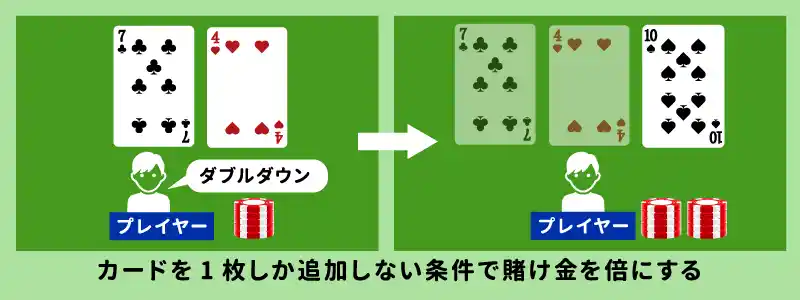
To double down means to double your bet on the condition that you receive only one more card. You cannot draw any further cards, but in a favorable situation this action doubles your winnings if the hand wins. Keep in mind that you also lose twice as much if the hand loses.
When you can double down depends on the table. Many tables allow it on any first two cards, regardless of the total, while others restrict it to totals of 9, 10 or 11. Check the rules shown at the table before you sit down.
In either case, doubling down works best when one more card is likely to put you in a strong position.
Split
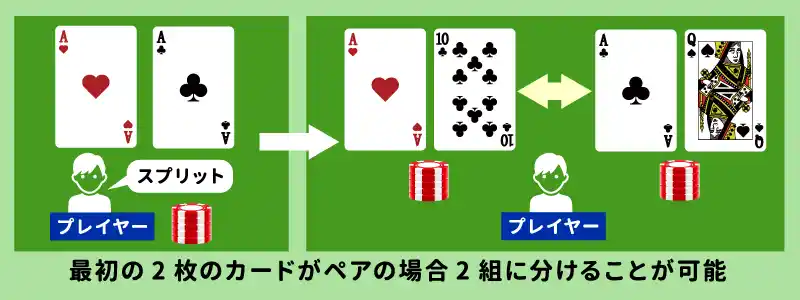
To split means to separate your first two cards into two hands when they are of the same rank (the suits may differ). Each hand needs a bet equal to the original, so your total bet doubles. Some tables also allow you to split any two 10-value cards, such as a 10 and a K, even though their ranks differ; the conditions vary by table. Two 10-value cards make 20, which is a strong hand, so standing is the correct play even where splitting them is allowed.
When the dealer looks likely to bust, splitting is a chance to double your winnings, and it also lets you break up a weak hand and build two new ones. In an unfavorable situation, however, it doubles your losses as well, so you need to choose the right moments to split.
Insurance
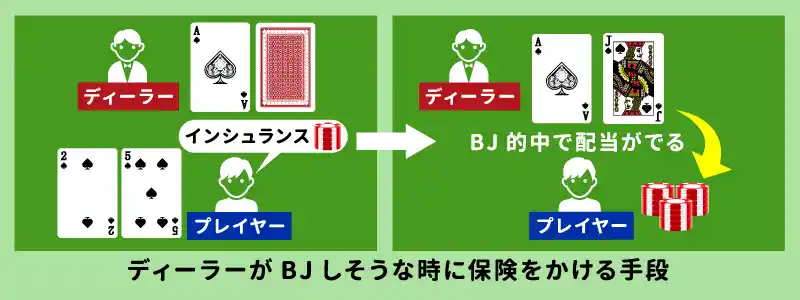
Insurance is a bet you can place when the dealer’s upcard is an ace.
You bet half of your original bet as insurance. If the dealer has a natural blackjack (21 on the first two cards, such as A + J), the insurance bet pays 2 to 1, so with a $10 main bet, a $5 insurance bet wins $10.
If the dealer does not have a natural blackjack, you lose the insurance bet, and play continues on the main bet.
When the dealer has a natural blackjack, your main bet loses unless you also have one. If you took insurance, the insurance payout exactly offsets the loss on the main bet, so you break even. This may look like a good deal, but the expected value is clearly negative, so as a rule we recommend not taking insurance.
Surrender
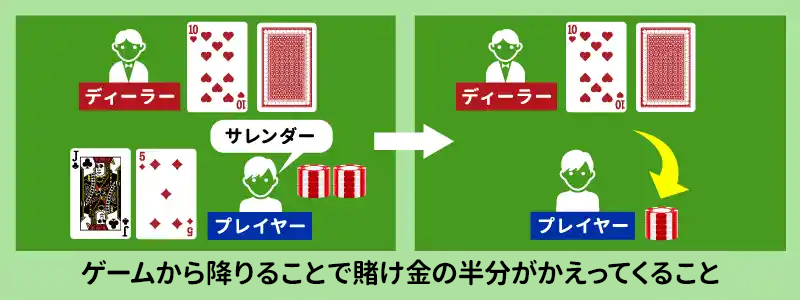
To surrender means to give up the hand when you judge that it cannot beat the dealer. You concede the round and take no further part in it, but half of your bet is returned. Surrender is not available once you have hit or split.
Surrender cuts your loss in half, but it is only correct in the situations where basic strategy calls for it. In those situations it has a higher expected value than hitting or standing, but surrendering on a hunch increases your losses.
There are two types of surrender, and the hands you should surrender differ between them. Early surrender lets you give up your hand before the dealer checks for blackjack, while late surrender lets you do so only after the check. Early surrender is rarely offered at major tables today, even in land-based casinos, and the version you will actually see is late surrender.
Blackjack Side Bets
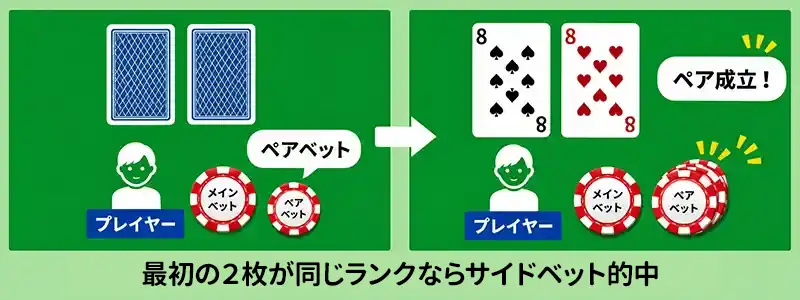
Some blackjack games offer side bets in addition to the main bet.
The main bet is the contest over whether the player or the dealer gets closer to 21. Side bets are separate from it and let you bet on outcomes unrelated to whether you win or lose the hand, such as the ranks and suits of the cards dealt to you or the card on which the dealer busts.
There are many kinds of side bets, and you can choose whichever you like. You can also place several side bets at the same time.
A side bet can only be placed alongside a main bet.
Some side bets return more than 100 times your stake when a specific winning combination appears, but they win correspondingly less often. Compared with the main bet, which tends to produce steadier results, side bets are high-risk, high-reward wagers, and their house edge is higher than the main bet’s. Payouts vary widely from game to game, so check the pay table at the table.
- Related Article
-
How to Avoid Unnecessary Losses in Blackjack
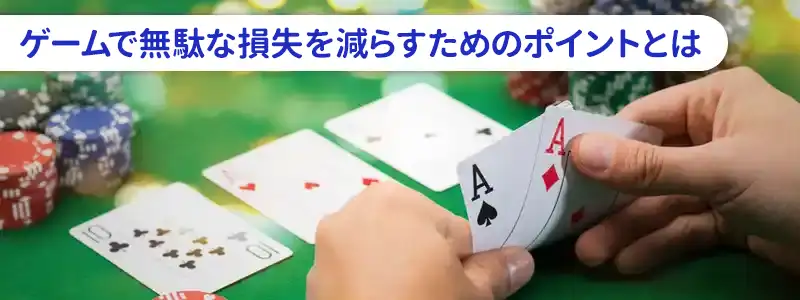
In roulette or baccarat, the player places a bet and then simply watches the result. Blackjack is different: you choose your own actions, and those choices determine how low you can keep the house edge.
The game itself is easy to play, but if you want the best possible results, there are a few points to keep in mind.
None of them guarantees a win. They are principles for avoiding unnecessary losses.
- Related Article
-

Play According to Basic Strategy
The chart below shows the hard-hand section of the standard chart (8 decks, dealer stands on soft 17, double down allowed on any first two cards, no doubling after splitting, no surrender).
- HHit
- SStand
- DDouble down
| Player | Dealer’s upcard | |||||||||
|---|---|---|---|---|---|---|---|---|---|---|
| 2 | 3 | 4 | 5 | 6 | 7 | 8 | 9 | 10 | A | |
| 5–8 | H | H | H | H | H | H | H | H | H | H |
| 9 | H | D | D | D | D | H | H | H | H | H |
| 10 | D | D | D | D | D | D | D | D | H | H |
| 11 | D | D | D | D | D | D | D | D | D | H |
| 12 | H | H | S | S | S | H | H | H | H | H |
| 13 | S | S | S | S | S | H | H | H | H | H |
| 14 | S | S | S | S | S | H | H | H | H | H |
| 15 | S | S | S | S | S | H | H | H | H | H |
| 16 | S | S | S | S | S | H | H | H | H | H |
| 17–20 | S | S | S | S | S | S | S | S | S | S |
Basic strategy is a set of decisions, derived from probability calculations, that tells you which action (hit, stand, double down, split and so on) keeps the house edge as low as possible.
The correct action depends on your hand and the dealer’s upcard. A table that sets out the correct action for each combination of hand and upcard is called a strategy chart. By following a strategy chart, you can choose the action with the highest expected value in every situation.
For this reason, we recommend making your decisions according to basic strategy from the start. Beginners can keep a strategy chart next to their computer or phone while playing and check their hand and the dealer’s upcard against it before choosing the best action.
- Related Article
-

Do Not Take Insurance: A Bet with Low RTP
As a rule, you should not take insurance. The reason is that the insurance bet on its own has a low RTP.
When the dealer’s upcard is an ace, the probability that the hole card is a 10-value card is about 30.8% in an 8-deck game. Insurance pays 2 to 1, so a winning insurance bet wins twice the amount bet. The expected value of a $1 insurance bet is 0.3084 × 2 − 0.6916 × 1, or about −$0.075. Over 100 bets, that works out to an average loss of around $7.50.
Even when insurance wins, it does no more than offset the loss on the main bet; it never puts you ahead. Keep in mind that insurance is a separate bet, independent of the main bet, and that it has a negative expected value on its own.
History and Origins of Blackjack
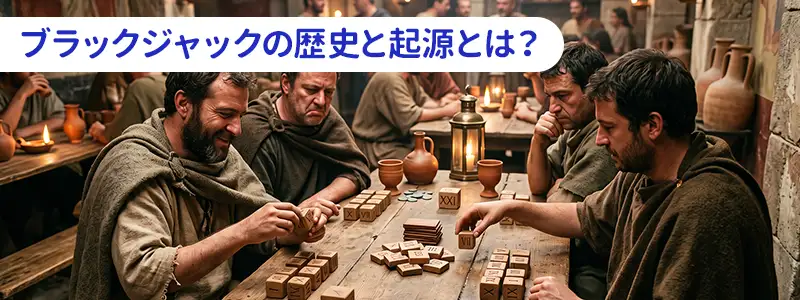
There are several theories about the origins of blackjack, but none of them is definitive. One theory holds that a similar game, played with wooden blocks, existed in ancient Rome.
The short story “Rinconete and Cortadillo” by Miguel de Cervantes, the author of Don Quixote, suggests that blackjack was originally a game called “21” and was played in Spain around the 16th and 17th centuries.
The title characters, Rinconete and Cortadillo, are portrayed in the story as young men who cheat at “21.”
The game of “21” became popular in France in the early 18th century and was later brought to America by French immigrants.
It eventually spread across the United States, and the name “blackjack” became established in the early 20th century.
The name is said to come from a bonus payout once given to players whose hand consisted of the ace of spades and a black jack (the jack of spades or the jack of clubs).
Frequently Asked Questions About Blackjack Rules
- How many cards are used in blackjack?
-
The total number of cards used in blackjack varies from table to table.
Blackjack is played with standard 52-card decks with the jokers removed. The number of decks depends on the table, but most games use 6–8 decks. Single-deck blackjack uses just one deck.
In an 8-deck game, for example, the total number of cards is 52 × 8 = 416.
In practice, however, only part of the shoe is usually dealt. As fewer cards remain, it becomes easier to predict which ranks are left, so the cards are reshuffled once a certain portion has been dealt and the rest are never played.
- How can I win at blackjack?
-
What sets blackjack apart from many casino games is that the player’s own decisions affect the outcome.
A realistic goal is not to win but to keep the house edge as low as possible, and the first step toward that is basic strategy.
We recommend practicing in this order: start with RNG (computer-dealt, non-live) blackjack, where you can play at your own pace with a strategy chart in front of you, and move on to live blackjack, which has a time limit for each decision, once the decisions come easily.
- The dealer seems to win too often. Is the game rigged?
-
Many players feel at times that the dealer seems to win too often. When the dealer draws a 2, 9, 4 and 6 to make 21, for example, you may think it would have been easier to accept if the dealer had simply had blackjack from the start. However, the structure of blackjack makes it very difficult to rig the game in the dealer’s favor.
Suppose someone arranged the cards to favor the dealer. Players are free to hit or stand as they choose, but the dealer’s actions are fixed in advance: hit on 16 or less, stand on 17 or more.
As a result, an arrangement intended to favor the dealer could end up working against the dealer, depending on the players’ choices. Deliberately creating a favorable sequence of cards is difficult in itself.
- Is it safe to play blackjack at an online casino?
-
The key indicator of whether an online casino is safe to play at is its license. A license is a permit that authorizes a company to operate a casino or supply games under certain conditions. Licenses are issued by national and regional regulators such as the UK Gambling Commission (UKGC) and the Malta Gaming Authority (MGA).
There are two types of licenses: those held by the operators that run casinos and those held by the providers that develop and supply the games. For greater peace of mind, check the licenses of both the casino and the game provider.
An operator without a verifiable license has not had its player protection and fund management systems checked by an independent third party. You would also have nowhere to turn if a dispute arose, so always confirm that a license is in place before you play.
Summary: Blackjack Rules Are Simpler Than They Look
Blackjack is one of the most popular table games at online casinos, and its rules are easy for beginners to understand: the hand whose total is closest to 21 without going over wins.
Players choose their actions to give their hand the best possible chance and are paid when they beat the dealer.
Part of the appeal of blackjack is that your own decisions affect the outcome. At a table with 8 decks, a dealer who stands on soft 17 and blackjack paying 3 to 2, following basic strategy brings the house edge down to about 0.5%, which corresponds to an RTP of around 99.5%.
This site is for adults of legal gambling age (18+, or older where required) who live in countries or regions where online gambling is legal.
Use of this site is subject to our Terms and Conditions.
Gambling involves risk. Only bet what you can afford to lose, and do not use online gambling services where they are illegal.

Bell | Editor of Online Casino Winners Club. Since the site launched in 2003, Bell has written guides to casino game rules, tested betting systems and covered land-based casinos around the world, and still plays the games before writing about them. Bell's core advice: choose the bets with the lowest house edge, and decide in advance how much you are prepared to lose.