

Basic strategy is the first thing to learn if you want to play blackjack well. What You Will Learn Basic strategy is the fundamental way to play every…
When to Surrender in Blackjack: Late vs. Early Surrender Charts

Much of the appeal of blackjack lies in the range of actions players can choose from. Surrender is one of the less familiar actions, but it is the only one that lets you give up the hand and cut your loss in half.
To surrender means to concede: you accept the loss of the round, and in return you get half of your bet back. It is a way to limit your losses when the dealer’s upcard is strong and your hand is likely to lose.
What You Will Learn
- In blackjack, the action called “surrender” means conceding the hand.
- There are two types of surrender: late surrender and early surrender.

This article takes about 13 minutes to read.
Contents
Show
What Is Surrender in Blackjack?
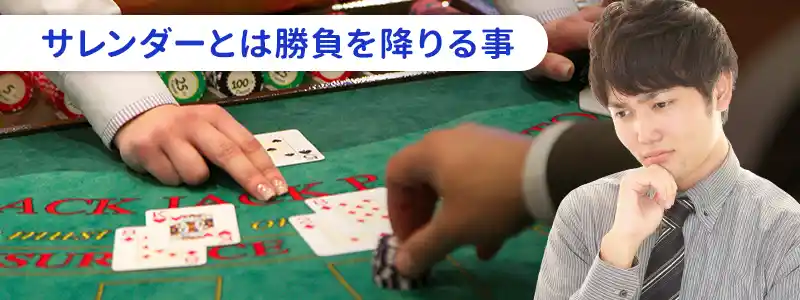
Surrender is the action of giving up the hand when you judge that your first two cards are weak against the dealer’s upcard and have little chance of winning.
Once you surrender, you take no further part in the round, and half of your bet is returned to you.
Used in the right situations, surrender cuts your loss in half on hands that are unlikely to win, which keeps you from losing more than necessary.
Surrender is only available before you have taken any other action. Once you have chosen to hit, stand, double down or split, you can no longer surrender.
Among live blackjack games, one table that offers surrender (late surrender) is Ezugi’s VIP Blackjack with Surrender. Live blackjack from Evolution, a provider with a large number of tables, does not offer surrender, so check the table rules before you sit down.
Late Surrender Chart and When to Use It
The chart below assumes 8 decks, a dealer who stands on soft 17 (S17; a soft 17 is a 17 that counts an ace as 11), double down allowed on any first two cards, doubling after a split allowed (DAS), and late surrender available.
- HHit
- SStand
- DDouble down
- DsDouble down (stand if not allowed)
- PSplit
- RSurrender
| Player | Dealer’s upcard | |||||||||
|---|---|---|---|---|---|---|---|---|---|---|
| 2 | 3 | 4 | 5 | 6 | 7 | 8 | 9 | 10 | A | |
| 5–7 | H | H | H | H | H | H | H | H | H | H |
| 8 | H | H | H | H | H | H | H | H | H | H |
| 9 | H | D | D | D | D | H | H | H | H | H |
| 10 | D | D | D | D | D | D | D | D | H | H |
| 11 | D | D | D | D | D | D | D | D | D | H |
| 12 | H | H | S | S | S | H | H | H | H | H |
| 13 | S | S | S | S | S | H | H | H | H | H |
| 14 | S | S | S | S | S | H | H | H | H | H |
| 15 | S | S | S | S | S | H | H | H | R | H |
| 16 | S | S | S | S | S | H | H | R | R | R |
| 17 | S | S | S | S | S | S | S | S | S | S |
| 18–20 | S | S | S | S | S | S | S | S | S | S |
| A,2 | H | H | H | D | D | H | H | H | H | H |
| A,3 | H | H | H | D | D | H | H | H | H | H |
| A,4 | H | H | D | D | D | H | H | H | H | H |
| A,5 | H | H | D | D | D | H | H | H | H | H |
| A,6 | H | D | D | D | D | H | H | H | H | H |
| A,7 | S | Ds | Ds | Ds | Ds | S | S | H | H | H |
| A,8 | S | S | S | S | S | S | S | S | S | S |
| A,9 | S | S | S | S | S | S | S | S | S | S |
| 2,2 | P | P | P | P | P | P | H | H | H | H |
| 3,3 | P | P | P | P | P | P | H | H | H | H |
| 4,4 | H | H | H | P | P | H | H | H | H | H |
| 5,5 | D | D | D | D | D | D | D | D | H | H |
| 6,6 | P | P | P | P | P | H | H | H | H | H |
| 7,7 | P | P | P | P | P | P | H | H | H | H |
| 8,8 | P | P | P | P | P | P | P | P | P | P |
| 9,9 | P | P | P | P | P | S | P | P | S | S |
| 10,10 | S | S | S | S | S | S | S | S | S | S |
| A,A | P | P | P | P | P | P | P | P | P | P |
Surrender looks useful because it lets you walk away from hands with little chance of winning and get half your bet back. In practice, though, there are fairly few situations that call for surrender. In most situations, playing the hand out has a higher expected value than surrendering.
Calculating the expected value of every decision while you play is not realistic. This is where basic strategy helps, because it shows the best action at a glance. According to basic strategy, at a table with late surrender where the dealer stands on soft 17 (S17), you should surrender in the following four situations. At tables with early surrender, covered later, the hands you should surrender are different.
- Your hand totals 15 and the dealer’s upcard is a 10
- Your hand totals 16 and the dealer’s upcard is a 9
- Your hand totals 16 and the dealer’s upcard is a 10
- Your hand totals 16 and the dealer’s upcard is an A
These four apply to S17 tables. At H17 tables, where the dealer hits soft 17, three more surrender situations are added: 15 against an ace, 17 against an ace, and 8,8 against an ace.
As a rule of thumb, surrender is better when your chance of winning is below 25%.
If you play the hand out, a win pays 1 to 1, so a $10 bet returns $20 in total; a loss returns nothing; and a push returns your $10 bet. If you surrender, you always get $5 back.
Ignoring pushes for simplicity, the amount you can expect back per dollar bet is 2 × (chance of winning) when you play the hand and 0.5 when you surrender, so surrender comes out ahead
when your chance of winning is below 25%.
In practice, the chance of a push also plays a part, so this is only a rough guide. For accurate decisions, follow the surrender situations recommended by basic strategy above.
Your Hand Is 15 and the Dealer’s Upcard Is 10
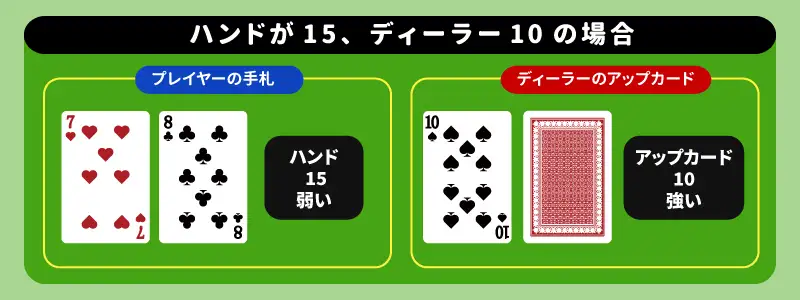
A hard 15 is a weak hand. The dealer must hit on 16 or less and stand on 17 or more (except at H17 tables, where the dealer hits soft 17), so if you stand on 15, you win only when the dealer busts.
Hitting is no better, because drawing to a 15 busts you about 53.85% of the time. Either way, the hand is hard to win.
When the dealer’s upcard is a 10-value card (10, J, Q or K), your chance of winning is very low, so surrender.
According to basic strategy, standing has a higher expected value against a dealer upcard of 2–6, and hitting does against a 7, 8, 9 or ace.
Your Hand Is 16 and the Dealer’s Upcard Is 9, 10 or A
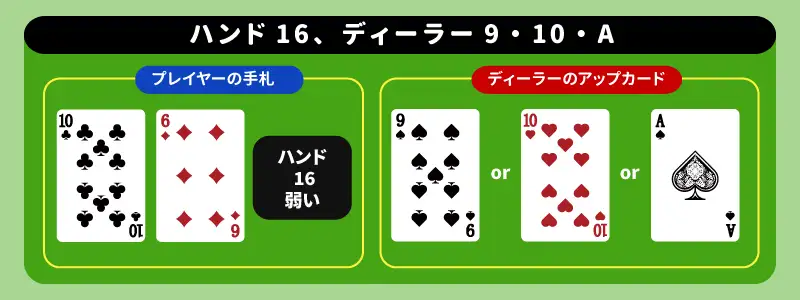
A hard 16 (a total of 16 with no ace, or with any ace counted as 1) is one of the worst hands in blackjack. If you stand, you win only when the dealer busts.
Hitting is no better: drawing to a 16 busts you about 61.54% of the time.
For this reason, surrender when the dealer shows a 9, a 10-value card or an ace. Against an upcard of 2–6, standing has a higher expected value, and against a 7 or 8, hitting does.
A pair of 8s is handled differently, even though it also totals 16. Under most rule sets, splitting 8,8 has a higher expected value, so as a rule you split rather than surrender. The exceptions are H17 tables with late surrender and tables with early surrender; at both, you surrender 8,8 against an ace.
Depending on the table rules, a different action may be best, so check the basic strategy chart for the table you are playing at.
- Related Article
-

Early Surrender Chart and When to Use It
The chart below assumes 8 decks, a dealer who stands on soft 17 (S17), double down allowed on any first two cards, no doubling after a split (no DAS), and early surrender available against an ace only.
- HHit
- SStand
- DDouble down
- DsDouble down (stand if not allowed)
- PSplit
- RSurrender
- RsSurrender (stand if not allowed)
| Player | Dealer’s upcard | |||||||||
|---|---|---|---|---|---|---|---|---|---|---|
| 2 | 3 | 4 | 5 | 6 | 7 | 8 | 9 | 10 | A | |
| 5–7 | H | H | H | H | H | H | H | H | H | R |
| 8 | H | H | H | H | H | H | H | H | H | H |
| 9 | H | D | D | D | D | H | H | H | H | H |
| 10 | D | D | D | D | D | D | D | D | H | H |
| 11 | D | D | D | D | D | D | D | D | D | H |
| 12 | H | H | S | S | S | H | H | H | H | R |
| 13 | S | S | S | S | S | H | H | H | H | R |
| 14 | S | S | S | S | S | H | H | H | H | R |
| 15 | S | S | S | S | S | H | H | H | H | R |
| 16 | S | S | S | S | S | H | H | H | H | R |
| 17 | S | S | S | S | S | S | S | S | S | Rs |
| 18–20 | S | S | S | S | S | S | S | S | S | S |
| A,2 | H | H | H | D | D | H | H | H | H | H |
| A,3 | H | H | H | D | D | H | H | H | H | H |
| A,4 | H | H | D | D | D | H | H | H | H | H |
| A,5 | H | H | D | D | D | H | H | H | H | H |
| A,6 | H | D | D | D | D | H | H | H | H | H |
| A,7 | S | Ds | Ds | Ds | Ds | S | S | H | H | H |
| A,8 | S | S | S | S | S | S | S | S | S | S |
| A,9 | S | S | S | S | S | S | S | S | S | S |
| 2,2 | H | H | P | P | P | P | H | H | H | H |
| 3,3 | H | H | P | P | P | P | H | H | H | R |
| 4,4 | H | H | H | H | H | H | H | H | H | H |
| 5,5 | D | D | D | D | D | D | D | D | H | H |
| 6,6 | H | P | P | P | P | H | H | H | H | R |
| 7,7 | P | P | P | P | P | P | H | H | H | R |
| 8,8 | P | P | P | P | P | P | P | P | P | R |
| 9,9 | P | P | P | P | P | S | P | P | S | S |
| 10,10 | S | S | S | S | S | S | S | S | S | S |
| A,A | P | P | P | P | P | P | P | P | P | P |
When early surrender is available against an ace, these are the hands you should surrender.
| Your hand | Against a dealer ace |
|---|---|
| Hard 5, 6, 7 | Surrender |
| Hard 12–17 | Surrender |
| 3,3 / 6,6 / 7,7 / 8,8 | Surrender |
| All other hands | Play according to the chart |
At most tables that offer early surrender, you can surrender only when the dealer’s upcard is an ace.
This means you cannot surrender 15 against a 10, or 16 against a 9 or 10. When the upcard is an ace, on the other hand, the range of hands where surrendering limits your losses extends well beyond the four late-surrender situations.
Soft hands are never surrendered, whatever the combination. A pair of 8s is normally split, but when the dealer shows an ace and early surrender is available, surrendering 8,8 loses less.
Types of Blackjack Surrender and Their Rules
Blackjack surrender comes in two types, late surrender and early surrender, which differ in when you are allowed to surrender. The hands you should surrender depend on which type your table offers.
At land-based casinos and online tables alike, a table offering “surrender” almost always means late surrender. Early surrender is rare and is offered at only a limited number of tables.
The type of surrender also affects how much it lowers the house edge.
The difference between the two types comes down to when you can surrender relative to the dealer’s check for a natural blackjack. After the first cards are dealt, if the dealer’s upcard is an ace, the dealer peeks at the face-down card, called the hole card, to see whether the two cards make a natural blackjack. At some tables the dealer also peeks when the upcard is a 10-value card; at others the dealer does not.
If the dealer has a natural blackjack, it is turned over immediately and all players lose the round, unless a player also has a natural blackjack, in which case that hand is a push.
Late Surrender
With late surrender, the dealer first checks for a natural blackjack, and you can surrender only if the dealer does not have one.
As explained above, the dealer reveals a natural blackjack as soon as the check is made.
If the dealer does have a natural blackjack, you cannot surrender, and there is no way to get any of your bet back.
Early Surrender
With early surrender, you can surrender before the dealer checks for a natural blackjack. Even when the dealer’s upcard is an ace and a natural blackjack is still possible, you can surrender and keep half of your bet before the hand is resolved.
Few tables offer early surrender at all, and those that do almost always allow it only when the dealer’s upcard is an ace. We have not found the full version, which also allows surrender against a 10-value card, at any of the major live tables.
When you compare tables with the same number of decks and the same soft 17 rule, early surrender lowers the house edge by more than late surrender does.
How Much Does Surrender Lower the House Edge?
| Type of surrender | When you can surrender | Reduction in house edge |
|---|---|---|
| Late surrender | After the dealer checks for a natural blackjack. At land-based casinos and online tables, almost every table that offers “surrender” uses this type. | About 0.08 percentage points |
| Early surrender (against an ace only) | Only when the dealer’s upcard is an ace | About 0.39 percentage points |
| Early surrender (full version) | When the dealer’s upcard is either an ace or a 10-value card | About 0.63 percentage points |
All figures in the table assume 8 decks and S17. The reduction from late surrender does not depend on whether doubling after a split (DAS) is allowed or on how many times you can split, and at H17 tables, where the dealer hits soft 17, it rises to about 0.09 percentage points.
With early surrender, you get half of your bet back even when the dealer has a natural blackjack, which greatly reduces your losses.
How to Surrender in Blackjack
How you declare surrender differs between land-based casinos and online casinos.
At a Land-Based Casino
At a land-based casino, for example in Las Vegas or Atlantic City, you surrender simply by saying “surrender” to the dealer. Some casinos also accept a hand signal.
Extend your index finger and draw a short horizontal line on the felt behind your bet. The dealer will take this as a surrender and return half of your bet.
At an Online Casino
At an online casino, a Surrender button appears among the action options, and you surrender by clicking or tapping it.
The Surrender button appears only at tables that offer surrender. If it is not shown, surrender is not available at that table.
Surrendering in Blackjack Step by Step
The steps below show how surrender works at an online casino. You tap a button, just as you would to hit or stand. Keep in mind, though, that once you take any other action on a hand, you can no longer surrender it.
STEP1
Place Your Bet
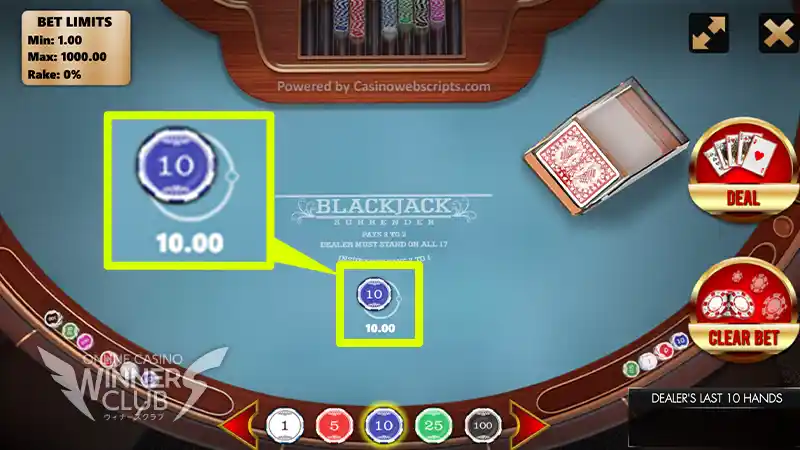
First, place your blackjack bet as usual.
STEP2
Choose “Surrender” When the Chart Calls for It
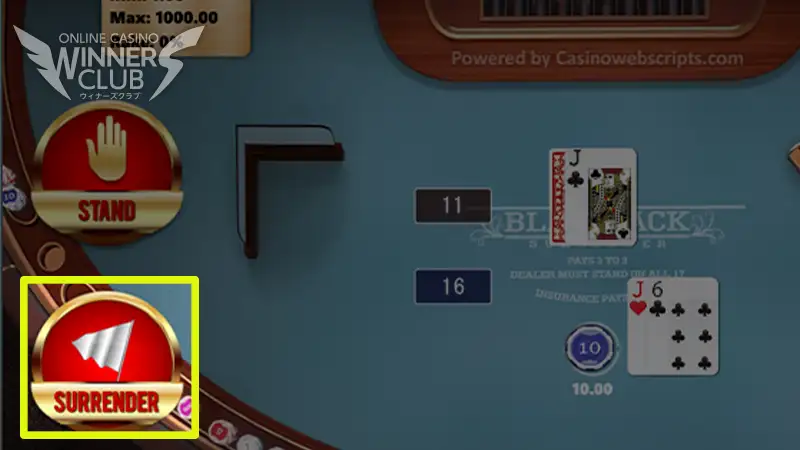
You and the dealer are each dealt two cards. If basic strategy calls for surrender with your hand against the dealer’s upcard, click or tap the Surrender button to concede the hand.
STEP3
Half of Your Bet Is Returned
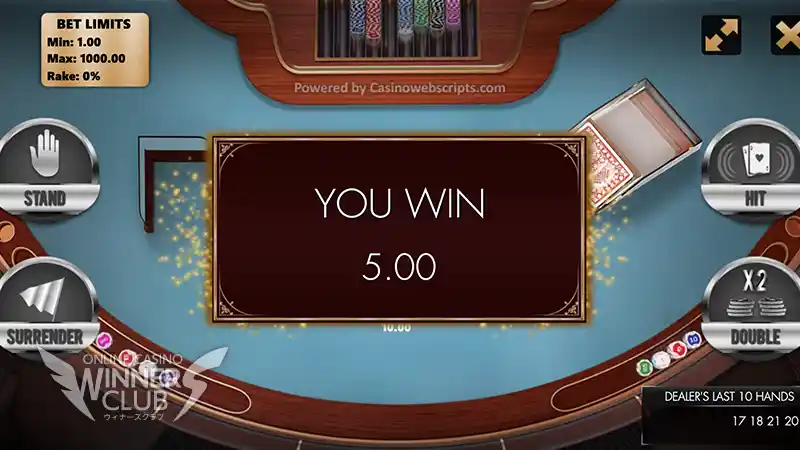
When you surrender, the hand is settled as a loss at that point and half of your bet is returned. In software (RNG) blackjack, the game moves straight on to the next round. In live blackjack, you wait while the other players act.
Even if the dealer then busts, you receive no payout, because you have already given up the hand.
Frequently Asked Questions About Blackjack Surrender
- What effect does surrender have over the long run?
-
As long as you surrender only in the situations basic strategy identifies for your table, it reduces your losses over the long run. In those hands, you keep half of your bet instead of losing all of it. If you surrender often in situations where it is not correct, however, you give up hands you could have won, and your losses increase.
Summary: When to Surrender Depends on the Table
Surrender is one of blackjack’s less common actions. You concede the hand to the dealer, and in exchange, half of your bet is returned.
Surrender may look useful whenever your chances of winning are low, but it has the higher expected value in surprisingly few situations. At a table with late surrender where the dealer stands on soft 17 (S17), there are only four such situations: a hand of 15 against a dealer 10, and a hand of 16 against a 9, 10 or ace. H17 tables add three more. At early surrender tables, you can surrender only against an ace, but the range of hands you should surrender against an ace is wider.
Many hands feel like long shots, but in most of them, playing on has a higher expected value than surrendering. First check which type of surrender your table offers, and surrender only the hands that basic strategy for that table recommends. This keeps unnecessary losses to a minimum.
This site is for adults of legal gambling age (18+, or older where required) who live in countries or regions where online gambling is legal.
Use of this site is subject to our Terms and Conditions.
Gambling involves risk. Only bet what you can afford to lose, and do not use online gambling services where they are illegal.

Bell | Editor of Online Casino Winners Club. Since the site launched in 2003, Bell has written guides to casino game rules, tested betting systems and covered land-based casinos around the world, and still plays the games before writing about them. Bell's core advice: choose the bets with the lowest house edge, and decide in advance how much you are prepared to lose.