

Basic strategy is the first thing to learn if you want to play blackjack well. What You Will Learn Basic strategy is the fundamental way to play every…
How to Win at Blackjack: Why No System Always Wins

It is tempting to hope that blackjack has some secret trick that guarantees a win. Casinos are businesses, however, and no magic system lets anyone win 100% of the time.
At the same time, blackjack stands out among casino games as one in which players can make reasoned decisions. It is not purely a game of chance: the player’s choices directly affect the expected value, the average result you can expect over time.
That is why setting aside gut feelings and the fear of busting (going over 21) pays off. By following basic strategy, a set of mathematically derived decisions, you can keep the house edge, the casino’s built-in share of every bet, low.
What You Will Learn
- The mathematical reason no blackjack system can guarantee a win
- How to use basic strategy to keep emotions out of your decisions
- The hard realities of card counting, often called the most powerful technique

This article takes about 17 minutes to read.
Contents
Show
Is There a Way to Win at Blackjack 100% of the Time?
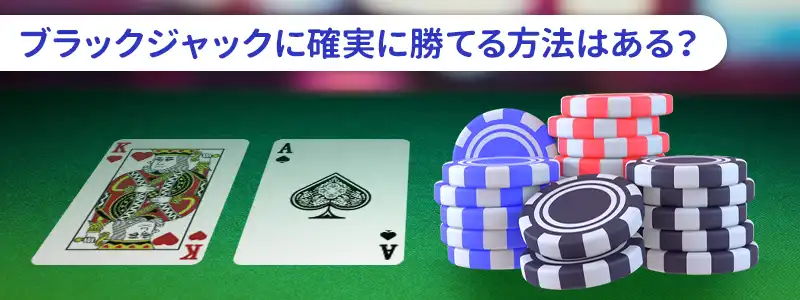
When losses pile up and your bankroll shrinks, it is natural to start searching desperately for a winning system. Almost everyone new to casinos thinks, “I want a sure way to win” or “I want to win my losses back.”
However, no system can guarantee a win at blackjack every time.
Casinos operate as businesses, so there is no magic method that lets players keep making money without risk. Accepting this is the first step toward keeping your overall losses under control.
The Trap of “Guaranteed Win” Claims Online
Online and on social media, you will find plenty of attractive claims, such as “Earn thousands of dollars from blackjack every month, guaranteed” or “A betting system (a set of rules for sizing your bets) that never loses.”
Do not be taken in by promises like these. The reason is simple: if a method that won 100% of the time really existed, the person who found it would keep using it quietly rather than telling anyone.
Players keep losing money by falling into traps like the following.
- Buying expensive strategy products: Paying hundreds or even thousands of dollars for something sold as an “AI prediction tool that beats the casino” or a “top-secret winning formula.”
- Blindly trusting risky betting systems: Mistaking systems such as the Martingale, in which you double your bet after every loss, for a method that always wins.
Betting systems are sometimes used to control how bet sizes rise and fall, but they are never a winning strategy. Changing how you bet only changes the swings in your results; the game’s expected value and house edge stay the same. Casinos also set table limits (maximum bets), so any method that keeps raising the bet, like the Martingale, will eventually hit a ceiling.
The Law of Large Numbers and the House Edge Determine Long-Term Results
Two mathematical principles make it clear that no guaranteed winning method exists: the house edge and the law of large numbers.
The house edge is the average loss expressed as a percentage of the initial bet. In a game with a house edge of 1%, for example, the average loss over the long run approaches about 1% of the amount bet.
The law of large numbers is a mathematical theorem stating that the more times you play, the closer your actual average result comes to the theoretical expected value.
Over a short session (anywhere from a few hands to a few dozen), a player can easily get lucky, win a long streak and come out further ahead than the odds would suggest. As you play 1,000 or 10,000 hands, however, luck plays a smaller role, and your average result tends to settle toward the small loss predicted by the house edge.
This does not mean that every player is certain to end up behind. Taken as a whole, though, gambling is set up so that the casino earns a steady profit.
This may sound discouraging, but there is more to the story. Blackjack is an unusual game in which, in theory, the edge can tip toward the player, but only when the conditions for card counting are met: a shoe of real cards with favorable rules, the cards being dealt deep enough into the shoe before a reshuffle (sufficient penetration), and precise bet sizing. Basic strategy alone can reduce the house edge, but it cannot give the player an advantage.
Why Blackjack Has One of the Lowest House Edges

No strategy wins 100% of the time, but blackjack has one of the lowest house edges of any major table game.
Its main appeal is that, unlike games of pure chance, it can be played on a sound mathematical basis.
How Rule Selection and Correct Play Bring You Close to the Theoretical RTP
The main reason blackjack is considered a low-loss game is that its return to player (RTP), the percentage of the money bet that is paid back to players, is among the highest of any casino game. A high RTP does not mean you are more likely to win. It is a measure of how small your losses are over the long run.
This does not happen automatically with careless play. Only when you choose a table with favorable rules and follow basic strategy consistently can you approach the game’s theoretical RTP of about 99.3–99.6% (a house edge of 0.43–0.72%). Even then, the house keeps a small edge over the long run.
A comparison with the RTP of other popular casino games shows how high this figure is.
| Game | Typical RTP |
|---|---|
| Slots | About 85–98% (varies widely by game) |
| Roulette (European) | 97.30% |
| Baccarat | About 98.94% (betting on Banker) |
| Blackjack | About 99.4–99.6% (favorable rules, using basic strategy) |
Although blackjack can come close to its theoretical RTP, the figure varies considerably with the rules at the table where you sit down. A natural blackjack (an ace plus a 10-value card: 10, J, Q or K), for example, normally pays 3 to 2, but some tables pay only 6 to 5. At 3 to 2 a $10 bet wins $15, while at 6 to 5 it wins only $12. This difference alone raises the house edge by about 1.39 percentage points and lowers the RTP by the same amount.
Many beginners sit down at a 6 to 5 table without checking the rules, simply because it has open seats, and find that their bankroll slowly shrinks as they win some hands and lose others.
Other details, such as whether the dealer hits or stands on soft 17 (a 17 that counts an ace as 11), also have a direct effect on long-term results.
In other words, rather than playing at random, choosing a table with favorable rules and following basic strategy consistently are the prerequisites for approaching the theoretical RTP.
Your Decisions Shape the Expected Value
What sets blackjack apart from baccarat, roulette and slots is that your own actions directly affect the game’s expected value.
With slots or roulette, once you place your bet you simply wait for the result. In blackjack, you look at the cards you have been dealt and then decide for yourself whether to hit (take another card) or stand (keep your current hand).
This ability to influence the game through your own decisions is what makes it possible to improve long-term results. Short-term wins and losses come down to luck, but the more correct decisions you make, the smaller your long-term losses become.
For example, with a hand totaling 16 against a dealer’s upcard (the dealer’s face-up card) of 7, the fear of busting makes it tempting to stand, but the mathematically correct play is different. What separates beginners from experienced players is the ability to keep choosing the logically correct action without being swayed by emotion or intuition.
Depending on the situation, in favorable spots you can also take more aggressive actions that raise your expected value, such as doubling down (doubling your bet in exchange for exactly one more card) or splitting (dividing two cards of the same rank into two separate hands; some tables also allow splitting any two 10-value cards).
Use Basic Strategy to Choose the Action with the Highest Expected Value

Many players find expected value and probability intimidating, especially if math is not their strong suit. Few people could work through complex calculations in an instant at a casino table.
You do not have to. For each set of rules, there is a set of mathematically derived decisions called basic strategy, usually presented as a quick-reference chart that lists the best action, calculated from expected value, for every situation.
- Related Article
-

Always Play According to Basic Strategy
The key to losing less at blackjack is to always choose the action that gives the best long-term average result.
For every combination of your first two cards and the dealer’s upcard, the mathematically correct action, meaning the one with the highest expected value, has already been calculated. This includes actions that increase your bet, such as doubling down.
Imagine, for example, that you hold a hard 16 such as 10 + 6 (but not a pair of 8s) and the dealer shows a 10. It is a difficult spot: if you hit, you are likely to bust, and if you stand, you will probably lose anyway.
Even here, probability gives a clear correct answer, and that answer depends on the rules.
If the table allows surrender (giving up the hand)
Basic strategy says to surrender and take back half your bet.
If the table does not allow surrender
Hitting is the better play. Compared with standing and waiting to lose, hitting produces a slightly smaller average loss over the long run.
The correct action also depends on how the hand is made up. A pair of 8s also totals 16, for example, but the best play with that hand is to split it into two hands.
Consistently choosing the action with the highest expected value is not about reacting to each win or loss. It is a steady process of cutting out unnecessary losses.
How to Read a Basic Strategy Chart
A basic strategy chart is a table that sets out the correct action, based on expected value, for every possible hand.
The chart has a simple structure. The rows show your hand total and the columns show the dealer’s upcard. You just follow the letter in the cell where the two meet.
The chart below shows the hard-hand section of the standard chart (8 decks, dealer stands on soft 17, double down allowed on any first two cards, no doubling after splitting, no surrender).
- HHit
- SStand
- DDouble down
| Player | Dealer’s upcard | |||||||||
|---|---|---|---|---|---|---|---|---|---|---|
| 2 | 3 | 4 | 5 | 6 | 7 | 8 | 9 | 10 | A | |
| 5–8 | H | H | H | H | H | H | H | H | H | H |
| 9 | H | D | D | D | D | H | H | H | H | H |
| 10 | D | D | D | D | D | D | D | D | H | H |
| 11 | D | D | D | D | D | D | D | D | D | H |
| 12 | H | H | S | S | S | H | H | H | H | H |
| 13 | S | S | S | S | S | H | H | H | H | H |
| 14 | S | S | S | S | S | H | H | H | H | H |
| 15 | S | S | S | S | S | H | H | H | H | H |
| 16 | S | S | S | S | S | H | H | H | H | H |
| 17–20 | S | S | S | S | S | S | S | S | S | S |
For example, the cell where a player hand of 10 meets a dealer’s upcard of 6 shows “D” (double down). The dealer holds a weak card (6) that often leads to a bust, so doubling your bet and playing aggressively has the highest expected value.
At a table with favorable rules, comparing your hand with the dealer’s card and choosing each action as the chart directs lets you play logically and keep the house edge low.
The Hard Reality of Card Counting, Often Called the Most Powerful Strategy

Films such as Rain Man and 21 show people with exceptional memory and math skills taking large sums from casinos. Watching them, you may have wondered whether mastering card counting would let you win every time.
Card counting is a powerful strategy in theory, but in today’s land-based and online casinos it is not a magic method for easy money. Reality is far less generous than the movies.
How Card Counting Works and the Best-Known Method
Card counting does not mean memorizing every card. It is a technique in which you assign a point value to each card and keep a running tally to estimate which cards remain in the shoe to be dealt.
Under the rules of blackjack, the more 10-value cards and aces remain in the shoe, the more favorable the situation is for the player. Natural blackjacks, which pay 3 to 2, become more likely, and double downs succeed more often.
Insurance (an optional bet offered when the dealer shows an ace, that the dealer has a blackjack) has a negative expected value of about −7.5% under standard 8-deck conditions, so as a rule you should not take it. The exception is when your count shows that a large enough number of 10-value cards remain, in which case insurance can work in your favor.
The best-known method, the Hi-Lo system, assigns points to the cards as follows, and you add and subtract them in your head as the cards are dealt.
- Counted as +1: 2, 3, 4, 5 and 6 (low cards)
- Counted as 0: 7, 8 and 9 (neutral cards)
- Counted as −1: 10, J, Q, K and A (high cards)
This running total is called the running count. Dividing it by the number of decks remaining in the shoe gives the true count; a high positive true count is a strong sign that many favorable cards remain.
Raising your bet at this point can, in theory, cancel out the casino’s house edge. This works only when all three conditions are met: a shoe of real cards with favorable rules, cards dealt deep enough into the shoe before a reshuffle, and precise bet sizing. When they are, the player gains a slight edge. Few casino games share this feature, and it is why blackjack is said to be a game that can be beaten in theory, provided the conditions are right.
That said, this is purely theoretical. Keeping an accurate count amid the noise and distractions of a real casino requires a great deal of practice and concentration, and, as explained below, the conditions needed for a player edge are rarely met today.
Casino Countermeasures That Make Card Counting Less Effective
Card counting depends on dealt cards staying out of the shoe, so that the makeup of the remaining cards becomes uneven. Modern casinos have changed how they operate to undermine this. The main countermeasures are as follows.
- Continuous shuffling machines (CSMs): Used cards are returned to the machine and reshuffled after each round, so no imbalance in the remaining cards builds up. Any advantage from counting is almost entirely lost.
- More decks and shallower penetration: Penetration is the proportion of the shoe dealt before the cards are reshuffled. Using 6–8 decks and reshuffling after about half the shoe is common, which reduces the number of situations in which the count turns in the player’s favor.
- Monitoring of bet sizes: Raising and lowering bets sharply in line with the count is easy to spot. Casinos can restrict how a suspected counter bets or bar them from the premises.
- How online casinos operate: Many live blackjack tables reshuffle after every round or early in the shoe. Software-based blackjack, which uses a random number generator (RNG), shuffles the virtual deck for every hand, so counting cannot work at all.
Counting cards in your head is not illegal in itself. Casinos, however, are private businesses and have the right to decide who may play and on what terms. Keep in mind that being legal does not mean you will be left alone.
In short, card counting is sound in theory, but in today’s environment it is unlikely to improve the results of an ordinary player. If it is worth learning, it is less as a way to win than as a way to understand the probability structure of blackjack.
- Related Article
-
Bankroll Management Matters More Than Any Winning System

Even if you learn the mathematics of blackjack, there is one thing no casino game lets you avoid: downswings, or losing streaks caused by temporary bad luck. Flawless basic strategy does not prevent them, and your bankroll can easily shrink in the short term.
This is where bankroll management comes in. It is your last line of defense for staying in the game at a casino.
Why Bankroll Management Lowers Your Risk of Ruin
Managing your bankroll, the total amount of money you set aside only for gambling, is the foundation for keeping your risk of going broke as low as possible.
As a rough figure, a player who follows basic strategy wins about 42% of hands, loses about 49% and pushes (ties) about 8.5%, so losses are slightly more frequent than wins (the figures vary with the rules and the number of decks, and they do not add up to 100% because of rounding). Results in blackjack are not extremely lopsided, but some variance is unavoidable, and if you play long enough you may run into a downswing of around 10 losses in a row.
To avoid going broke, set a clear bankroll made up only of money you can afford to lose without any effect on your daily life, and play strictly within that amount.
Choosing a Bet Size You Can Sustain
So how much should you bet on each hand? Your base bet (one unit) should depend on how long you plan to play and how much risk of ruin you are willing to accept, but one conservative guideline is around 1% of your total bankroll.
The reason is simple: it keeps an ordinary losing streak from wiping out your funds. Assuming you have set aside a bankroll of $1,000 for a casino visit, the table below shows how the risk changes with your bet size.
| Bankroll | Bet per hand (share of bankroll) | Losses in a row until broke | Risk level |
|---|---|---|---|
| $1,000 | $100 (10%) | 10 | High risk (cannot withstand a losing streak) |
| $1,000 | $50 (5%) | 20 | Medium risk (dangerous when results swing widely) |
| $1,000 | $10 (1%) | 100 | Low risk (better able to withstand losing streaks) |
Note: This is a simple calculation that assumes every hand loses. In practice, some wins come in between, so your bankroll will not run out after exactly this number of hands.
If you bet $100 a hand, just 10 losses in a row will leave you with nothing. If you keep your bet at a conservative $10 (1%), however, you can absorb a temporary downswing much more easily.
Rather than raising your bets on impulse, make it a habit to decide on the day’s unit size, based on your bankroll, before you sit down at the table.
Set a Clear Stop-Loss Limit to Keep Your Emotions in Check
The hardest and most important part of bankroll management is to decide on a stop-loss limit in advance and stick to it without exception.
The biggest cause of growing gambling losses is not the dealer but your own frustration. When losses pile up, it becomes tempting to make irrational decisions, such as placing a large bet to win everything back at once. In poker and other games, this state is called tilt.
Once you are on tilt, even the basic strategy you had followed carefully falls apart, and the game turns into pure gambling on luck. One effective way to prevent tilt is to set hard limits in advance, such as the following.
- A daily loss limit: Decide on your own limit in advance, such as “If I lose 20% of my bankroll (for example, $200), I stop for the day,” and make no exceptions.
- Cash only: Leave your credit and debit cards in the hotel safe or somewhere similar, and bring only your preset budget to the table.
Almost everyone feels the pull of “one more win and I’ll be even” at some point. It is not easy, but the self-discipline to leave the table when your preset rule tells you to helps keep your losses under control over the long run.
Frequently Asked Questions About How to Win at Blackjack
- Is there a system that guarantees a win at blackjack?
-
No method lets anyone win 100% of the time. Blackjack is, however, one of the few casino games in which the player’s choices affect the expected value. At a table with favorable rules, playing according to basic strategy brings the house edge down to roughly the minimum those rules allow, which is below 1%. It is more realistic to treat basic strategy as a way to cut unnecessary losses than as a way to win.
- Can I use free games to practice basic strategy?
-
Free smartphone apps and browser games are a very effective way to learn basic strategy.
When real money is at stake in a casino, pressure tends to cloud logical judgment. Even if you know that hitting is the correct play in a given spot, the fear of losing your chips can easily make you stand on instinct.
Several free blackjack apps are designed specifically for practice. They check whether each action matches basic strategy and warn you immediately when you make a mistake. Open one whenever you have a few spare minutes and practice choosing the correct action automatically, at no risk, in difficult spots such as a player 16 against a dealer’s upcard of 10. Repeated practice of this kind makes your decisions steadier when you play for real.
Once you understand the basic strategy chart, start with free games rather than going straight to real-money play. Over time, choosing the correct action will become second nature.
Summary: Learn a Logical Way to Play Instead of Searching for a Winning System
No system lets anyone win 100% of the time at blackjack. Every casino game has a house edge, and the longer you play, the closer your average results come to what that house edge predicts.
Avoid buying dubious strategy products sold online, and do not put blind faith in betting systems. Card counting works in theory, but casino countermeasures such as continuous shuffling machines (CSMs) have made it far less practical, and it is not a realistic strategy for ordinary players.
None of this is a reason to give up. Blackjack is one of the few games in which your own logical choices can keep the house edge very low.
Two rules sum up how to keep your expected long-term losses down and play sensibly.
- Follow basic strategy consistently: Set aside instinct and emotion, and always choose the action with the highest expected value for the combination of your hand and the dealer’s card.
- Manage your bankroll strictly: Use only money you can afford to lose without affecting your daily life, and stick to the loss limit you set in advance to avoid tilt.
Start by practicing basic strategy, and when you play for real, consider bringing a printed strategy card (the basic strategy chart condensed onto a single card; some casinos allow them at the table, but policies vary from venue to venue). Playing calmly and logically, without getting swept up in the ups and downs of gambling, is the most realistic way to limit your losses and get the most enjoyment out of blackjack.
If you find that you cannot keep to the rules you set, or cannot control how much money or time you spend, you should stop playing. Many countries have helplines and counseling services for gambling problems, as well as self-help groups and support organizations. Rather than dealing with it alone, consider contacting one of them.
This site is for adults of legal gambling age (18+, or older where required) who live in countries or regions where online gambling is legal.
Use of this site is subject to our Terms and Conditions.
Gambling involves risk. Only bet what you can afford to lose, and do not use online gambling services where they are illegal.

Bell | Editor of Online Casino Winners Club. Since the site launched in 2003, Bell has written guides to casino game rules, tested betting systems and covered land-based casinos around the world, and still plays the games before writing about them. Bell's core advice: choose the bets with the lowest house edge, and decide in advance how much you are prepared to lose.