

Basic strategy is the first thing to learn if you want to play blackjack well. What You Will Learn Basic strategy is the fundamental way to play every…
When to Split in Blackjack: Basic Rules and Key Conditions

A split is an action you can take when your first two cards are a pair (two cards of the same rank): you separate them and play each card as its own hand. Depending on when you use it, splitting can work in your favor or against you.
What You Will Learn
- Used in the right situations, splitting raises your expected value.
- Splitting requires an additional bet equal to your original bet, so your total stake doubles.
- A 21 made with an ace and a 10-value card after a split does not count as a natural blackjack.

This article takes about 12 minutes to read.
Contents
Show
What Is a Split in Blackjack?
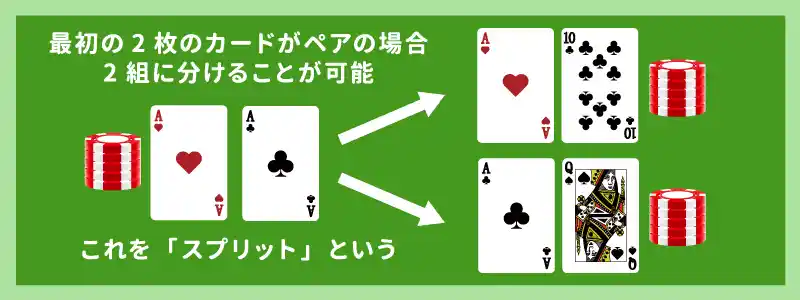
In blackjack, a split is an action you can take when your first two cards are a pair of the same rank, such as 3,3 or A,A. You separate the pair and play the two cards as two independent hands.
The second hand needs a bet equal to the bet on your original hand, so you need twice your original bet in total.
If you do not have enough chips to cover the additional bet, you cannot split. At an online casino, the Split button is unavailable when your balance is too low. The additional bet cannot be smaller than the original one either, so if you plan to split, make sure you have funds equal to twice your initial bet before the hand begins.
How play continues after a split, and what happens when another pair forms (resplitting), are covered in the next subsection and in the “Points to Keep in Mind” section later in this article.
Basic Split Rules and How to Split
The fundamental rule is that you can split only when your first two cards are a pair (two cards of the same rank). Some tables also let you split any two 10-value cards (10, J, Q, K), even if their ranks differ.
The basic steps for splitting are as follows.
- Your first two cards are a pair (the same rank)
- Choose Split and place an additional bet equal to your original bet
- Each of the new hands receives one more card
- Play each hand as usual, choosing to hit, stand and so on
Splitting lets you turn a weak hand, such as 7,7 (a total of 14), into two playable hands. When the dealer’s upcard (the face-up card) is a weak 2–6, splitting also gives you a chance to win with each of the two hands.
Some pairs, however, should be played as a single hand rather than split, so splitting is not always the right choice.
When to Split in Blackjack

Basic strategy calls for splitting the two pairs below no matter what the dealer’s upcard is. Splitting them tends to have the higher expected value, so as a rule you should split. The pair of 8s has a small exception under certain table rules, which is explained in that subsection.
A Pair of Aces
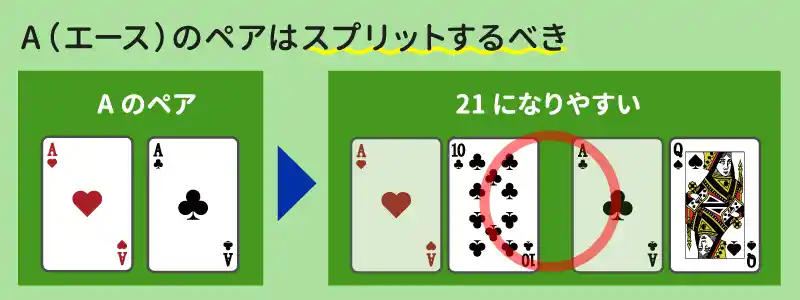
With a pair of aces (A,A), splitting has the higher expected value whatever the dealer’s upcard.
Split aces come with special rules: each hand receives only one more card, and if that card is a 10-value card (10, J, Q or K), the hand does not count as a natural blackjack.
Splitting is still the better play for a simple reason: drawing a 10-value card gives you 21.
Because 10, J, Q and K all count as 10 in blackjack, 10-value cards are the most likely cards to be drawn. An ace plus a 10-value card for a total of 21 is therefore a common result, and a hand of 21 cannot lose unless the dealer has a natural blackjack.
Being limited to one card per hand is a drawback, but it also means that neither hand can bust. If you play A,A as a single hand without splitting, it is only a soft 12, with one ace counted as 11 and the other as 1, and you would need to draw several cards to get close to 21. Splitting the pair into two hands gives a higher expected value.
A Pair of 8s
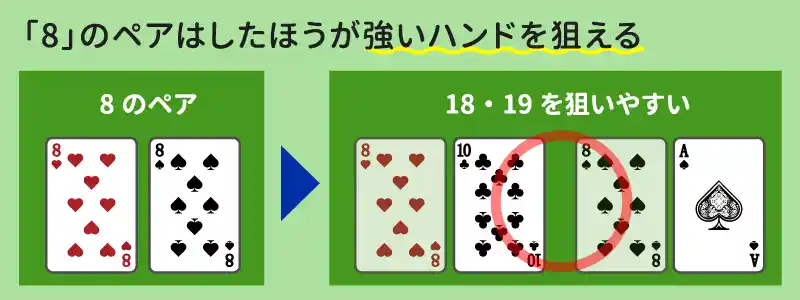
With a pair of 8s (8,8), splitting also has the higher expected value.
The reason is that 8,8 played as one hand wins very rarely.
Without a split, your hand totals 16, so you lose unless the dealer busts. The dealer must hit on 16 or less, so a dealer who does not bust always finishes on 17–21. A 16 can therefore win only when the dealer busts. If you hit instead, your chance of busting is about 61.5%. Whether you stand or hit, you are at a disadvantage, which makes hard 16 (a 16 with no ace counted as 11) a difficult hand to play.
After a split, drawing a 10-value card or an ace gives you 18 or 19, respectively, and even other cards are likely to leave you with a better hand than 16.
Splitting 8s therefore lets you avoid a weak hand while aiming for 18 or 19.
With late surrender at tables where the dealer hits soft 17 (a 17 that counts an ace as 11), or with early surrender, surrendering is the best play, but only when the dealer’s upcard is an ace. If your table offers surrender, check the relevant entry in the strategy chart.
Pairs You Should Not Split in Blackjack

You should avoid splitting the two hands described below, whatever the dealer’s upcard.
Splitting these hands makes it more likely that you end up in a worse position than before the split.
A Pair of 10-Value Cards
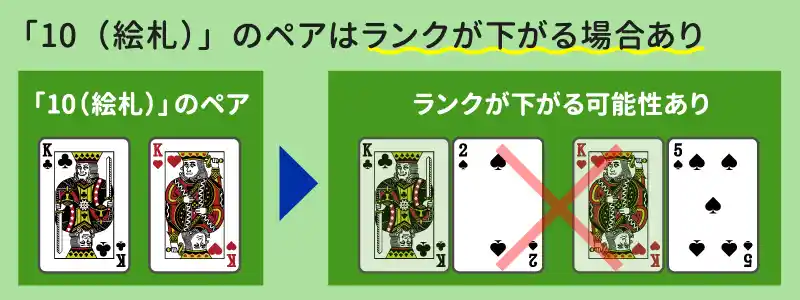
When your hand is a pair of 10-value cards, such as 10,10 or K,K, it totals 20, a strong hand that loses only to a 21. There is no reason to split it.
If you split, drawing any card from 2 to 9 leaves you with a weaker hand, so splitting actually lowers your expected value. Even though 10-value cards are the most likely cards to be drawn, the cards from 2 to 9 together make up a larger share of the deck, so the chance of drawing a 10-value card on both hands is low.
Playing the pair as a single hand therefore gives a higher expected value than splitting it.
A Pair of 5s
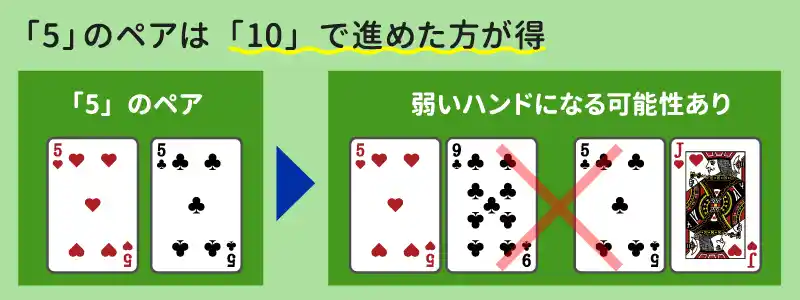
A pair of 5s (5,5) totals 10. Drawing a 10-value card gives you 20 and drawing an ace gives you 21, so one more card can easily make a strong hand.
If you split, however, drawing a 10-value card leaves you with a weak 15. Rather than splitting and creating weak hands, you get a higher expected value by playing the pair as a single hand totaling 10.
The correct play with a pair of 5s is therefore not to split but to double down (or hit when the upcard is a 10-value card or an ace). Both are aggressive plays, but with 5s, choose doubling down over splitting.
How to Use Basic Strategy When You Are Unsure About Splitting
The chart below shows the pair section of the standard chart (8 decks, dealer stands on soft 17, double down allowed on any first two cards, no doubling after splitting, no surrender).
- HHit
- SStand
- DDouble down
- DsDouble down (stand if not allowed)
- PSplit
| Pair | Dealer’s upcard | |||||||||
|---|---|---|---|---|---|---|---|---|---|---|
| 2 | 3 | 4 | 5 | 6 | 7 | 8 | 9 | 10 | A | |
| 2,2 | H | H | P | P | P | P | H | H | H | H |
| 3,3 | H | H | P | P | P | P | H | H | H | H |
| 4,4 | H | H | H | H | H | H | H | H | H | H |
| 5,5 | D | D | D | D | D | D | D | D | H | H |
| 6,6 | H | P | P | P | P | H | H | H | H | H |
| 7,7 | P | P | P | P | P | P | H | H | H | H |
| 8,8 | P | P | P | P | P | P | P | P | P | P |
| 9,9 | P | P | P | P | P | S | P | P | S | S |
| 10,10 | S | S | S | S | S | S | S | S | S | S |
| A,A | P | P | P | P | P | P | P | P | P | P |
So far we have covered pairs of 5s, 8s, 10-value cards and aces. For the other pairs, there is no single rule that applies in every case, and the best action depends on the dealer’s upcard.
This is where basic strategy comes in.
Basic strategy sets out the action with the highest expected value for each combination of player hand and dealer upcard. A table that lists these actions is called a basic strategy chart, or simply a strategy chart.
- Related Article
-

Decide on Other Pairs Based on the Dealer’s Upcard
When your hand is a pair, check the split section of the strategy chart. The full chart appears in the related article linked above. Every action explained so far is listed there: for example, you never split 10,10 and always stand, and you always split A,A (at tables where the dealer takes a hole card).
The chart also gives the action with the highest expected value for each of the remaining pairs. With a pair of 6s, for example, you split against an upcard of 3–6 (2–6 at tables that allow doubling after splitting, or DAS) and hit against 7 or higher. With a pair of 9s, you split against 2–6, 8 or 9 and stand against 7, 10 or an ace.
The most reliable way to decide whether to split is therefore to follow the strategy chart.
5 Points to Keep in Mind When Splitting in Blackjack

The basic rules for splitting in blackjack are as described above, but splitting often comes with more detailed conditions. If you do not know them, they can cost you money.
The rules below are the most common ones in blackjack, but conditions can differ from table to table. We recommend checking the rules of your table before you play.
- Split Aces Receive Only One Card Each
- You May Not Be Able to Double Down After Splitting
- Resplitting Is Often Limited
- A 21 After a Split Does Not Count as Blackjack
- Rules for Splitting 10-Value Cards Vary by Table
Split Aces Receive Only One Card Each
When you split a pair of aces (A,A), each hand is dealt one card, and at that point you must stand. Even if you receive a 2 or a 3, you cannot hit.
Neither hand can bust, but the rule also means a hand may stop at a total you would normally try to improve. The reasons splitting aces is still the better play are explained earlier in “A Pair of Aces.”
You May Not Be Able to Double Down After Splitting
Some tables do not allow you to double down on hands that result from a split.
To double down means to double your bet in exchange for receiving exactly one more card, and the smaller the player’s disadvantage in a given situation, the higher the expected value of doubling down.
Many tables do not allow doubling down after a split (DAS). Evolution, for example, a major live casino provider with a large number of blackjack tables, does not allow it. At a table without DAS, the house edge increases by 0.14 percentage points.
Resplitting Is Often Limited
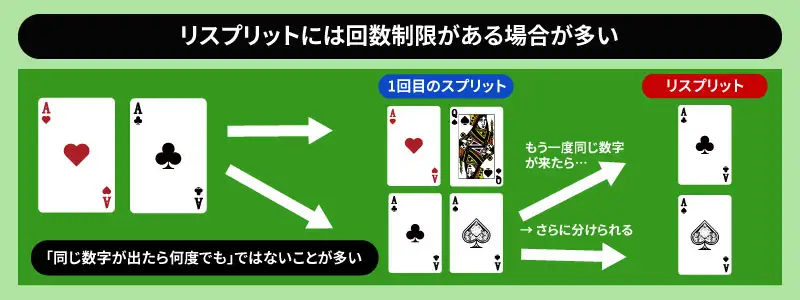
A split hand may receive another card of the same rank. Splitting again at this point is called resplitting. At land-based casinos in particular, the number of hands you can split into is usually capped. The standard limit is up to 4 hands, and tables with a lower limit have a higher house edge.
Suppose, for example, that you split a pair of 8s (8,8) and one of the hands receives another 8, forming a new pair of 8s. If you resplit, you will be playing three hands.
Evolution’s live blackjack does not allow resplitting, so you can split only once, for a total of 2 hands. When you can split into only 2 hands, the house edge increases by 0.10 percentage points. Some tables also have specific restrictions, such as allowing resplits of any pair except aces.
A 21 After a Split Does Not Count as Blackjack
If a split hand ends up as an ace plus a 10-value card, it is not a natural blackjack and counts only as an ordinary 21.
You therefore do not receive the natural blackjack payout of 3 to 2 (a $10 bet wins $15). The hand is paid 1 to 1 like any other win, so a $10 bet wins $10. If the dealer has a natural blackjack, you lose; if the dealer has a 21 that is not a natural, the hand is a push.
Rules for Splitting 10-Value Cards Vary by Table
Some tables let you split any two cards among 10, J, Q and K even if their ranks differ, while others allow a split only when both cards are the same rank, such as 10,10 or Q,Q.
Under the second rule, you cannot split combinations such as J,Q or 10,K. Of the rules covered here, this is the one that differs most from table to table.
Even where the rules allow it, there is no need to split a strong hand totaling 20. The reasons are explained earlier in “A Pair of 10-Value Cards.”
Advantages and Disadvantages of Splitting in Blackjack
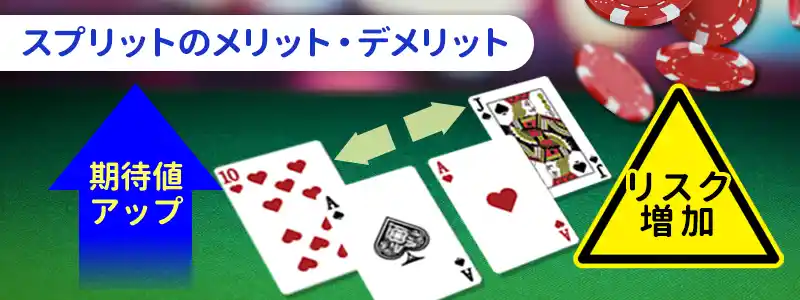
Here is a summary of the advantages and disadvantages of splitting.
Splitting has two advantages. A hand that rarely wins on its own, such as 8,8, can be turned into two hands with a real chance of winning, and a hand that can easily approach 21, such as A,A, gives you two chances to win. You choose whether to split, so there is no need to split outside favorable situations.
The disadvantage is that your total bet effectively doubles, so you also lose twice as much if both hands lose. The higher expected value described above always comes with this larger potential loss.
Frequently Asked Questions About Splitting in Blackjack
- Which pairs should I split?
-
As a general rule, at tables where the dealer takes a hole card, you should always split a pair of aces or a pair of 8s. Splitting aces makes it easier to build hands close to 21, and splitting 8s is an effective way out of a weak total of 16.
Pairs of 10-value cards, on the other hand, should not be split. They already make a strong total of 20 that is likely to win.
- What happens if I get a blackjack after splitting?
-
If a split hand ends up as an ace plus a 10-value card, it is not considered a natural blackjack and is treated as an ordinary 21. Some casinos may handle this differently, but this is the standard rule.
- Do split rules differ between online and land-based casinos?
-
In both cases, the rules vary from table to table. At online casinos, whether you can double down after splitting, how many times you can resplit and the conditions for splitting 10-value cards all depend on the provider and the table. Evolution’s live blackjack does not allow resplitting, so you can split only once, for a total of 2 hands, and doubling down after a split is not allowed either. Rules at land-based casinos also vary from one casino to another, so it is important to check the rules of your table before you play.
Summary: Split According to Basic Strategy
Splitting lets you play the two cards of a pair as two separate hands, and it is one of the most important actions in blackjack.
Used well, splitting turns a weak hand into two hands that can compete. Because your total bet doubles, though, your wins and your losses both become larger. Keep both sides of this trade-off in mind whenever you split.
For this reason, it is best to split according to basic strategy. A strategy chart tells you exactly when to split, which is the most reliable way to get the most out of this play. Splitting and basic strategy only optimize your decision in each situation. They do not remove the house edge built into blackjack itself.
If the larger stakes concern you, lower the size of each bet so that you can split comfortably whenever the situation calls for it. Deciding your bet size first and then splitting according to basic strategy is the most direct way to avoid unnecessary losses.
This site is for adults of legal gambling age (18+, or older where required) who live in countries or regions where online gambling is legal.
Use of this site is subject to our Terms and Conditions.
Gambling involves risk. Only bet what you can afford to lose, and do not use online gambling services where they are illegal.

Bell | Editor of Online Casino Winners Club. Since the site launched in 2003, Bell has written guides to casino game rules, tested betting systems and covered land-based casinos around the world, and still plays the games before writing about them. Bell's core advice: choose the bets with the lowest house edge, and decide in advance how much you are prepared to lose.