

Have you ever heard it said that card counting in blackjack is the most powerful strategy in the casino? Card counting, or simply counting, means…
Blackjack Insurance Odds and Expected Value: Is It Worth It?

Insurance in blackjack is a bet you can place when the dealer’s upcard is an ace. You put up half of your original bet (or, at some tables, any amount up to half), and if the dealer has a blackjack, the insurance payout offsets the loss on your main bet.
At first glance, insurance looks like an effective way to hedge your risk. Once you work out the probability, the expected value and the return to player (RTP), however, it turns out to be a bet that loses money in the long run.
What You Will Learn
- Insurance wins about 30.8% of the time, a little less than one in three.
- Even when insurance wins, you only break even. It never puts you ahead.

This article takes about 10 minutes to read.
Contents
Show
What Is Insurance in Blackjack?
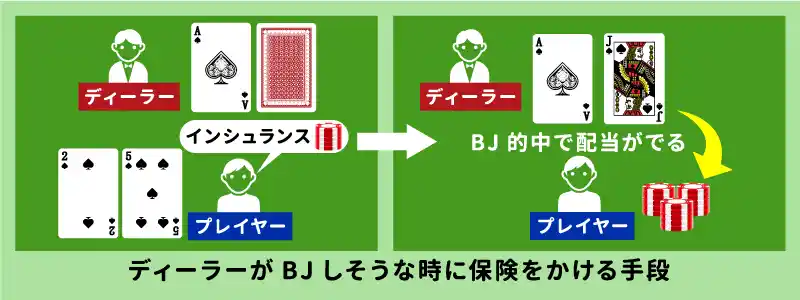
How Insurance Works and What It Pays
Insurance is a bet in blackjack that, as its name suggests, works like an insurance policy against a dealer blackjack.
You can take it only when the dealer’s upcard is an ace. The upcard is the dealer’s face-up card. Insurance protects you against the risk that the hole card (the dealer’s second card, dealt face down) gives the dealer a blackjack (an ace plus a 10-value card, for a total of 21).
- When the dealer’s upcard is an ace, players are offered the option of taking insurance.
- Players can place an additional insurance bet of up to half of their original bet.
- If the dealer has blackjack (an ace plus a 10-value card): the original bet loses, but the insurance bet pays 2 to 1, so a $5 insurance bet wins $10.
- If the dealer does not have blackjack: the insurance bet loses, and play continues as normal.
| Item | Details |
|---|---|
| Original bet | $10 |
| Insurance bet (half) | $5 |
| Payout if the dealer has blackjack | Pays 2 to 1: the $5 bet wins $10, and $15 is returned in total |
| If the dealer does not have blackjack | The $5 insurance bet loses, and play continues as normal |
On its own, the bet looks like a sensible way to cancel out a loss to a dealer blackjack.
Whether it actually benefits the player, however, cannot be judged without calculating how often insurance wins and whether its expected value is positive or negative.
Calculating the Probability and Expected Value of Insurance
The Probability That Insurance Wins
Insurance wins when the dealer’s hole card is a 10, J, Q or K, that is, a 10-value card.
A deck of playing cards has 13 ranks (A, 2–9, 10, J, Q and K), and four of them (10, J, Q and K) are 10-value cards. In the 8-deck game (416 cards) that is standard for live blackjack at online casinos, there are 128 10-value cards. Because the dealer’s ace upcard has already been dealt, the probability is calculated over the remaining 415 cards.
Probability of winning = 128/415 ≈ 30.8%
In other words, insurance wins about once in every 3.2 attempts and loses roughly 70% of the time.
The probability varies slightly with the number of decks and the cards already dealt. With 6 decks it is 96/311, or about 30.9%, and with a single deck it is 16/51, or about 31.4%. You may also see the explanation that 4 of the 13 ranks are 10-value cards, so the probability is 4/13 = 30.77%. This is an approximation that assumes an infinite number of decks, and it differs slightly from the 30.84% for 8 decks.
The Expected Value Formula and Result
Next, we use this figure to find the expected value (EV). Expected value measures the average gain or loss per bet if you repeat the same action over the long run.
Expected value E = (probability of winning × amount won) + (probability of losing × amount lost)
Insurance pays 2 to 1, so a win earns twice the amount bet, and a loss costs the amount bet. Applying the probability calculated above (128/415 ≈ 30.8%) gives the following result.
Expected value E = (0.3084 × +2) + (0.6916 × −1)
= 0.6168 − 0.6916
= about −0.075 (−7.5%)
The expected value of insurance comes out at about −7.5%. This means that for every $100 you bet on insurance, you lose about $7.50 on average over the long run. In other words, the insurance bet carries a house edge of about 7.5%.
Many players assume that insurance can at worst break even, since a win cancels out the loss on the main bet. The numbers show, however, that it is clearly a bet that favors the house.
How Much Insurance Costs in Terms of RTP and House Edge
The negative expected value can also be expressed as return to player (RTP). RTP shows the percentage of the total amount wagered that is paid back to players.
| Bet type | Approximate RTP |
|---|---|
| Blackjack main bet (with basic strategy, under typical rules) |
Around 99.5% (99.4–99.6% depending on the rules) |
| Insurance alone | About 92.5% |
On its own, insurance has an RTP of about 92.5%, 7 percentage points lower than the roughly 99.5% RTP of the main bet at the same table. In terms of house edge, the main bet is about 0.5% and insurance about 7.5%, so the same $1 bet loses roughly 15 times as much over the long run when it is placed on insurance.
Insurance Profit and Loss in Four Scenarios

To put the expected value calculated above (about −7.5%) into concrete dollar amounts, we look at the profit and loss in the four scenarios that can actually occur.
The examples assume an original bet of $10 and an insurance bet of $5, half of the original bet.
| Scenario | Result with insurance | Result without insurance |
|---|---|---|
| (1) Insurance wins, main bet loses | $0 | −$10 |
| (2) Insurance loses, main bet wins | +$5 | +$10 |
| (3) Insurance loses, main bet loses | −$15 | −$10 |
| (4) The player has blackjack | See the table under (4) | |
The table does not include a scenario in which insurance wins and the player beats the dealer. Insurance wins only when the dealer has blackjack, so unless the player also has a blackjack, the main bet always loses.
(1) Insurance Wins and the Main Bet Loses
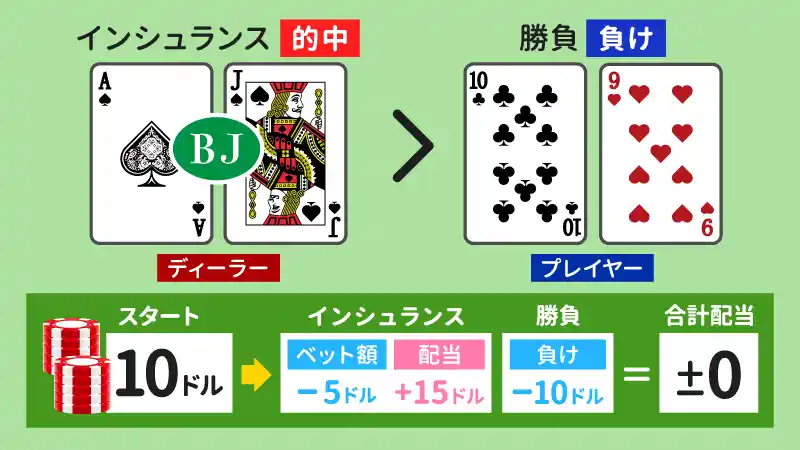
In this scenario, the dealer’s hole card is a 10-value card, which gives the dealer a blackjack, and the player loses the main bet in the usual way.
- Original bet: −$10 (lost)
- Insurance bet: −$5
- Insurance payout: +$15 (pays 2 to 1: $10 won plus the $5 bet returned)
- Net result: $0
This is the only scenario in which taking insurance prevents a loss (here, $10), and effectively the only case in which insurance works as insurance.
(2) Insurance Loses and the Main Bet Wins
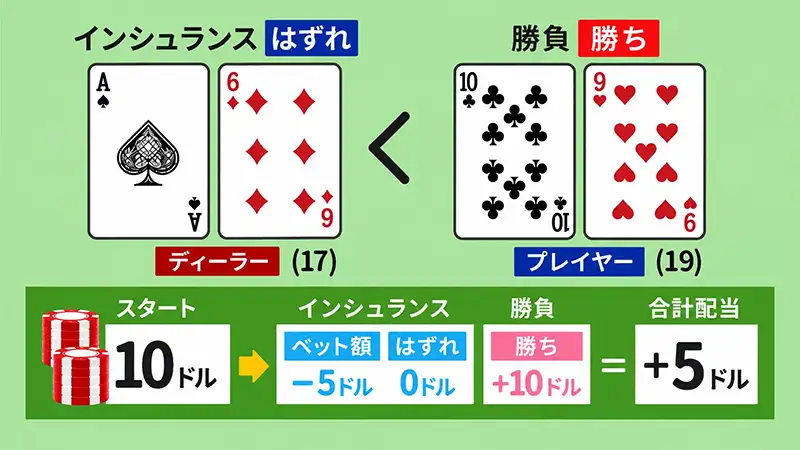
In this scenario, the dealer’s hole card is not a 10-value card, and the player wins the hand in the normal course of play.
- Insurance bet: −$5 (lost)
- Main bet win (pays 1 to 1): +$10
- Net result: +$5
Taking insurance cut your profit from $10 to $5.
(3) Insurance Loses and the Main Bet Also Loses
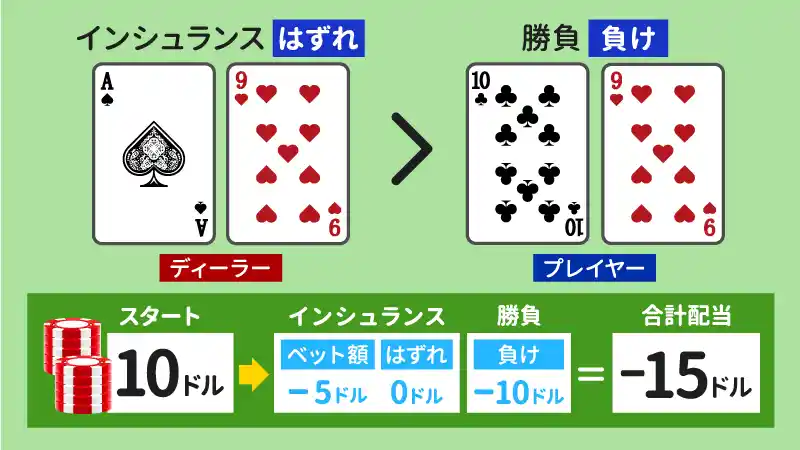
In this scenario, the dealer’s hole card is not a 10-value card, and the player also loses the main bet.
- Insurance bet: −$5 (lost)
- Original bet: −$10 (lost)
- Net result: −$15
Taking insurance made the loss $5 larger.
A dealer hand that contains an ace also tends to be relatively strong even when it is not a blackjack. Keep in mind, therefore, that this scenario, where both the insurance bet and the main bet lose, is the most likely one in actual play and produces the largest loss.
(4) The Player Has Blackjack
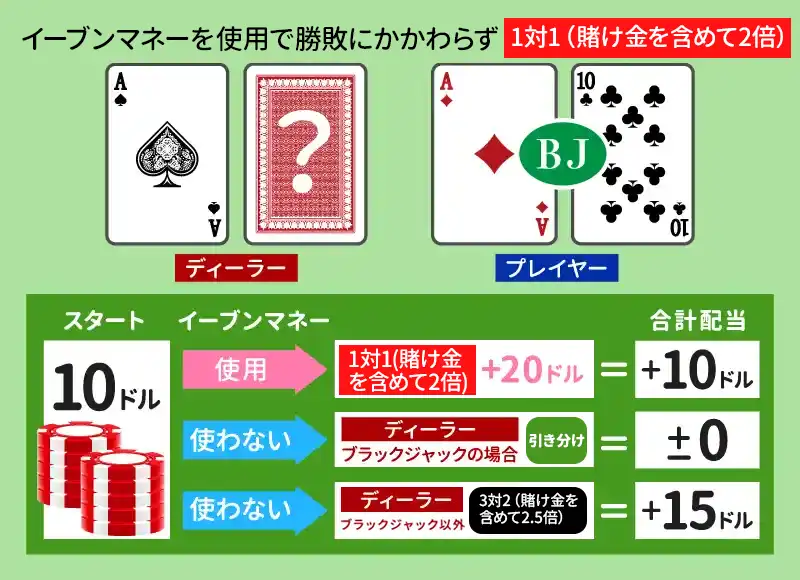
In this case, the player has been dealt a blackjack (a total of 21) with the first two cards.
Strictly speaking, the option offered here is not insurance but even money, which is explained in the next section. Because the player already holds a winning hand, the choice is whether to lock in a payout before the result is known.
| Dealer’s result | With even money | Without even money |
|---|---|---|
| The dealer also has blackjack | +$10 (1 to 1 payout locked in) | $0 (push) |
| The dealer does not have blackjack | +$10 (1 to 1 payout locked in) | +$15 (standard 3 to 2 payout) |
Taking even money always locks in a $10 profit, while declining it keeps open the chance of a larger $15 profit if the dealer does not have blackjack.
Should You Take Insurance or Even Money?
As mentioned under “(4) The Player Has Blackjack,” when you have a blackjack and the dealer’s upcard is an ace, you are offered even money instead of insurance.
Despite the different name, even money can be regarded as a form of insurance. Both rest on the same idea: you remove the uncertainty of whether the dealer has a blackjack by accepting a guaranteed payout.
- A winning player blackjack normally pays 3 to 2, so a $10 bet wins $15.
- If the dealer also has blackjack, however, the hand is a push and nothing is won.
- Taking even money locks in a 1 to 1 payout before the result is known, so a $10 bet wins $10.
In other words, the choice is a trade-off between going for the 3 to 2 payout and taking a sure 1 to 1.
Expected Value: Taking Even Money vs. Declining It
As a rule, declining both insurance and even money gives a higher expected value over the long run.
| Choice | Calculation | Expected profit |
|---|---|---|
| Take even money | Always pays 1 to 1, regardless of probability | Guaranteed +$10 |
| Decline even money | (0.3084 × $0) + (0.6916 × $15) | Expected value +$10.37 |
Taking even money always locks in +$10. Declining it results in a push ($0 won) about 30.8% of the time and a 3 to 2 payout (+$15) about 69.2% of the time, for an average of +$10.37. In other words, declining even money gives an expected value about 3.7% higher.
Taking even money means accepting a slightly lower expected value in exchange for eliminating the variance, or swings, in your results. In terms of expected value, taking even money is never the correct play unless you count cards, so as a rule you should decline it, just as you decline insurance.
Strictly speaking, three cards have already been removed from the shoe at this point: the two cards of the player’s blackjack and the dealer’s ace upcard. The calculation is therefore over 413 cards, of which 127 are 10-value cards. The probability remains about 30.8%, and the difference in expected value appears only in the second decimal place. For consistency, the calculations in this article are based on 128/415 throughout.
Exceptions: When Insurance Can Have a Positive Expected Value
Under very limited conditions, however, it is possible for this expected value to turn positive.
When Card Counting Shows That Many 10-Value Cards Remain
The expected value calculations so far have assumed that the shoe contains the normal proportion of 10-value cards (4 of the 13 ranks).
When card counting shows that more 10-value cards than usual remain in the shoe, the probability that insurance wins can exceed one in three (about 33.3%), and in theory the expected value of insurance can turn positive.
This remains a theoretical possibility. Many live tables at online casinos reshuffle after only a small part of the shoe has been dealt, and some operators restrict the bets or accounts of players suspected of counting cards, so putting it into practice is very difficult.
- Related Article
-

How to Take Insurance
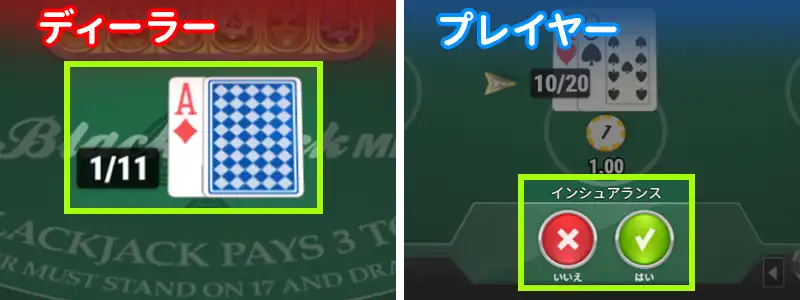
The steps below show how insurance is offered and taken when you play at an online casino.
Five Steps to Taking Insurance
(1) The Cards Are Dealt
The player and the dealer each receive two cards. Both of the player’s cards are face up. One of the dealer’s cards is face up (the upcard), and the other is face down (the hole card).
(2) The Dealer’s Upcard Is an Ace
If the upcard is anything other than an ace, the insurance option does not appear at all.
(3) The Insurance Option Appears on the Screen
At an online casino, a prompt such as “Insurance?” appears on the screen together with “Yes” and “No” buttons. At a land-based casino, the dealer announces the insurance option, and players who want it place their chips on the insurance line marked on the layout.
(4) Choose Whether to Take Insurance
Choosing “Yes” automatically places an additional bet of half your original bet (for example, $5 on a $10 bet). Choosing “No” lets the game continue as normal.
(5) The Dealer Checks the Hole Card and the Result Is Settled
If the hole card is a 10-value card, the insurance bet wins; otherwise it loses. The payouts and results are as described earlier under “How Insurance Works and What It Pays”.
Taking insurance is a simple Yes or No decision. It is worth knowing how the option works so that it does not catch you off guard at the table, but base your actual decision on the numbers: insurance has a negative expected value. Basic strategy likewise says that, as a rule, you should not take insurance.
Summary: As a Rule, Insurance Is Best Avoided
Here is a summary of what we found by examining insurance from three angles: probability, expected value and RTP.
- The insurance bet wins about 30.8% of the time (128/415 with 8 decks), so it loses more often than it wins.
- The expected value is about −7.5%, so players lose money on insurance over the long run.
- The RTP is about 92.5%, 7 percentage points lower than the main bet’s RTP of around 99.5%.
- In the four scenarios above, insurance prevents a loss in only one: the insurance bet wins and the main bet loses.
- Even money, offered when the player has blackjack, likewise has a lower expected value than declining it.
Despite the reassurance its name suggests, insurance is mathematically a bet to avoid. Apart from exceptions such as knowing from card counting that the remaining shoe is rich in 10-value cards, the sensible approach is to decline insurance when the dealer’s upcard is an ace and concentrate on your main bet.
This site is for adults of legal gambling age (18+, or older where required) who live in countries or regions where online gambling is legal.
Use of this site is subject to our Terms and Conditions.
Gambling involves risk. Only bet what you can afford to lose, and do not use online gambling services where they are illegal.

Bell | Editor of Online Casino Winners Club. Since the site launched in 2003, Bell has written guides to casino game rules, tested betting systems and covered land-based casinos around the world, and still plays the games before writing about them. Bell's core advice: choose the bets with the lowest house edge, and decide in advance how much you are prepared to lose.