

Basic strategy is the first thing to learn if you want to play blackjack well. What You Will Learn Basic strategy is the fundamental way to play every…
When to Hit in Blackjack: Hit or Stand Rules and Strategy Chart

In blackjack, hitting is the action players take most often, and it has the most direct effect on whether they win or lose.
To hit means to draw one more card to bring your hand total closer to 21. The rule is very simple, but the many decisions about whether to draw another card add up, and over the long run they make a real difference to your results.
What You Will Learn
- A hit is the action of adding one more card to your hand.
- Start by learning two simple rules: hit when your hand totals 8 or less, and stand on a hard hand of 17 or more.

This article takes about 11 minutes to read.
Contents
Show
What Are Hit and Stand in Blackjack?
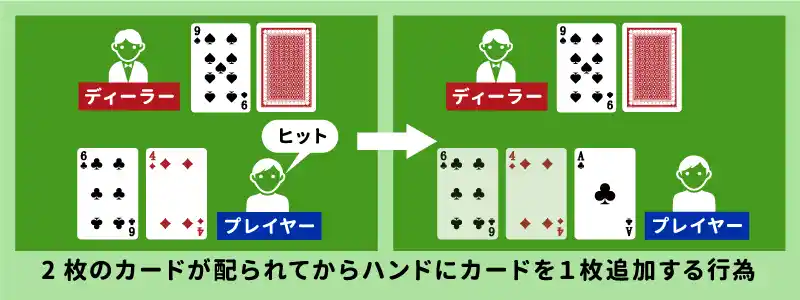
In blackjack, to hit means to take one more card from the shoe to bring your hand total closer to 21. To stand means to take no more cards.
It is the most frequent basic action in the game. Deciding whether to press on or stop with what you have, while anticipating the dealer’s hand, is a large part of what makes blackjack interesting.
Basic Rules for Hitting
- Number of cards: Each hit adds one card to your hand.
- No limit: You can hit as many times in a row as you like, as long as your total is 20 or less. You are also free not to hit at all, and to stand instead, if you judge your first two cards to be good enough.
- Risk of busting: If a hit brings your total to 22 or more, you bust, and you lose immediately, regardless of what the dealer’s hand turns out to be.
- Hard hands and soft hands: A hand in which an ace can be counted as 11 without busting is a soft hand. A hand with no ace, or in which an ace can only be counted as 1, is a hard hand.
Why Hitting Matters: Weighing Your Hand Against the Dealer’s
The point of deciding whether to hit is not simply to raise your total. It is to weigh your own chance of busting against the chance that the dealer will bust.
Understanding when to draw another card and when to stop is the first step toward playing blackjack well.
Stand and Other Blackjack Actions You Need to Know
The rest of this article uses the following terms without explaining them again, so we recommend reviewing them before reading on.
Stand
To stand means to take no more cards. Standing is also called staying. It is the opposite of hitting: you play out the round against the dealer with the hand you have.
The dealer hits on a total of 16 or less and stands on 17 or more. Some tables, however, use the H17 rule, under which the dealer hits a soft 17 (a 17 that counts an ace as 11). At those tables, the house edge is about 0.22 percentage points higher.
Double Down
To double down means to double your bet in exchange for receiving only one more card. Players use it to raise their bet only in favorable situations, such as when one more card is likely to bring the hand close to 21 or when the dealer is likely to bust.
Once you have hit, you can no longer double down.
Split
To split means to separate your first two cards into two hands when they are a pair of the same rank, and play each hand separately. Players use it to break up a hand that would be weak as it stands and turn each card into the start of a hand with a higher expected value.
Each additional hand needs its own bet, however, so you have more money at stake, and any theoretical loss is larger in dollar terms.
You can hit or stand on each split hand just as you would on an ordinary hand (whether you can double down after splitting depends on the table).
Insurance
Insurance is a bet you can place when the dealer’s first card, called the upcard, is an ace.
You take insurance by betting half of your original bet. If the dealer has a natural blackjack, the insurance bet pays 2 to 1, so with a $10 main bet, a $5 insurance bet wins $10, and your overall result breaks even.
The expected value of insurance, however, is about −7.5% (8 decks), which is strongly negative, so you should not take it.
Surrender
To surrender means to give up your hand when you judge that it cannot beat the dealer’s. You lose only half of your bet.
Once you have hit, surrender is no longer available.
How Hit and Stand Work in a Round of Blackjack
- The Three Steps of Hitting
-
- Place your bet
- Choose “Hit” to draw another card
- Choose “Stand” when your hand total is close to 21
STEP1
Place Your Bet
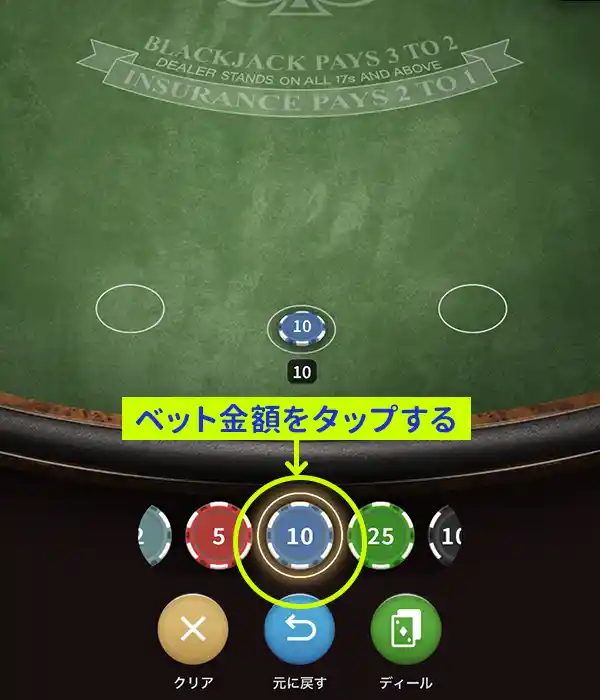
Place your bet in the betting area. Normally, you can bet on only one hand, but at tables that allow multi-hand play, you can bet on several hands.
STEP2
Choose “Hit” to Draw Another Card
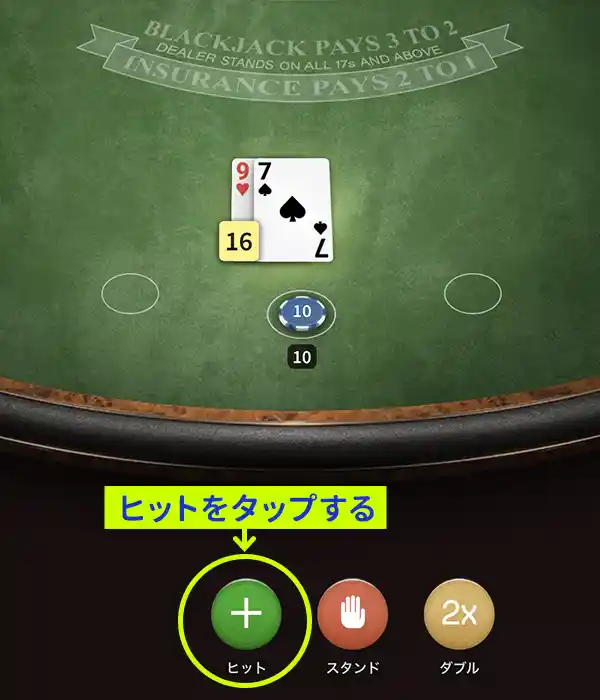
The screen shows buttons such as Hit and Stand. Tap Hit to add one card to your hand. You can hit as many times as you like as long as your total is 20 or less.
STEP3
Choose “Stand” When Your Hand Total Is Close to 21
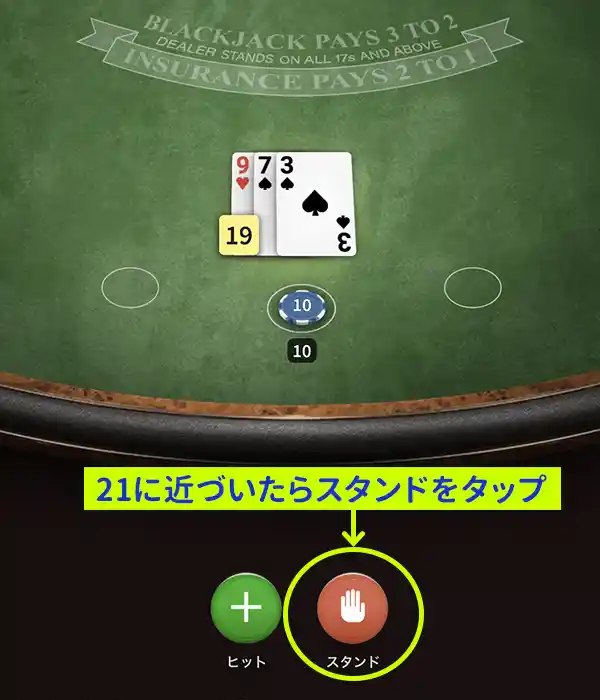
Once you decide to play the round with your current hand, press the Stand button to confirm it. The dealer turns over the face-down card, called the hole card, and your total is compared with the dealer’s. If you beat the dealer, you are paid 1 to 1, so a $10 bet wins $10 and you get $20 back in total.
How to Use Hit and Stand Effectively in Blackjack

The player’s goal is to beat the dealer’s total, not simply to reach 21.
If the dealer busts, you win with any total as long as you have not busted yourself. Keep in mind, then, that hitting indiscriminately is not the right approach.
Follow Basic Strategy

For every combination of player hand and dealer upcard, blackjack has an established way of playing that tells you which action has the highest expected value. This set of decisions is called basic strategy.
A table that sets out basic strategy for each situation is called a strategy chart. In general, following the strategy chart is what matters most.
How other players at the same table play has no effect on your expected value. You follow the chart not to copy anyone else but to choose the option with the highest expected value on every decision. Even if you play exactly according to basic strategy, a house edge of about 0.5% remains.
Experienced players know basic strategy by heart. Beginners can start by keeping a strategy chart next to their computer or phone while playing and checking it, then learn it gradually.
- Related Article
-

Understand the Idea Behind Card Counting
Generally speaking, you can leave your hit and stand decisions to basic strategy, but in certain situations basic strategy is not necessarily the best play. Card counting is the technique used to identify those situations.
Card counting means keeping track of the cards that have already been dealt in order to work out which cards remain in the shoe and estimate which ranks are more likely to appear.
If counting shows, for example, that more 10-value cards (10, J, Q, K) than usual remain in the shoe, you might deliberately stand in the hope that the dealer busts, or double down instead of hitting.
Although card counting can improve expected value in theory, in practice it rarely produces a usable advantage in software-based (RNG) blackjack, which is shuffled after every round, at tables with continuous shuffling machines, or at online live tables where the shoe is reshuffled after only a small portion has been dealt.
Focus on mastering basic strategy first.
When to Hit and When to Stand in Blackjack
The chart below is a standard basic strategy chart (8 decks, dealer stands on soft 17, double down allowed on any first two cards, no doubling after splitting, no surrender).
- HHit
- SStand
- DDouble down
- DsDouble down (stand if not allowed)
- PSplit
| Player | Dealer’s upcard | |||||||||
|---|---|---|---|---|---|---|---|---|---|---|
| 2 | 3 | 4 | 5 | 6 | 7 | 8 | 9 | 10 | A | |
| 5–8 | H | H | H | H | H | H | H | H | H | H |
| 9 | H | D | D | D | D | H | H | H | H | H |
| 10 | D | D | D | D | D | D | D | D | H | H |
| 11 | D | D | D | D | D | D | D | D | D | H |
| 12 | H | H | S | S | S | H | H | H | H | H |
| 13 | S | S | S | S | S | H | H | H | H | H |
| 14 | S | S | S | S | S | H | H | H | H | H |
| 15 | S | S | S | S | S | H | H | H | H | H |
| 16 | S | S | S | S | S | H | H | H | H | H |
| 17–20 | S | S | S | S | S | S | S | S | S | S |
| A,2 | H | H | H | D | D | H | H | H | H | H |
| A,3 | H | H | H | D | D | H | H | H | H | H |
| A,4 | H | H | D | D | D | H | H | H | H | H |
| A,5 | H | H | D | D | D | H | H | H | H | H |
| A,6 | H | D | D | D | D | H | H | H | H | H |
| A,7 | S | Ds | Ds | Ds | Ds | S | S | H | H | H |
| A,8 | S | S | S | S | S | S | S | S | S | S |
| A,9 | S | S | S | S | S | S | S | S | S | S |
| 2,2 | H | H | P | P | P | P | H | H | H | H |
| 3,3 | H | H | P | P | P | P | H | H | H | H |
| 4,4 | H | H | H | H | H | H | H | H | H | H |
| 5,5 | D | D | D | D | D | D | D | D | H | H |
| 6,6 | H | P | P | P | P | H | H | H | H | H |
| 7,7 | P | P | P | P | P | P | H | H | H | H |
| 8,8 | P | P | P | P | P | P | P | P | P | P |
| 9,9 | P | P | P | P | P | S | P | P | S | S |
| 10,10 | S | S | S | S | S | S | S | S | S | S |
| A,A | P | P | P | P | P | P | P | P | P | P |
Memorizing all of basic strategy at once is difficult, so start with the situations where the decision is clear: when you should hit and when you should stand. Two of the three patterns below depend very little on the dealer’s upcard.
Always Hit When Your Hand Totals 8 or Less
If your hand totals 8 or less, such as a 3 and a 5, you should always hit. In blackjack, face cards count as 10, and even an ace counted as 11 brings a hand of 8 to only 19, so there is no risk of busting.
Because there is a fairly good chance you will need to draw two or more cards, we recommend that you hit rather than double down.
Hit or Double Down When Your Hand Totals 9, 10 or 11
If your hand totals 9–11, such as a 4 and a 6, consider either hitting or doubling down.
With a total of 11 or less, one more card cannot bust you, so you should take another card. With 9–11 in particular, drawing a 10-value card gives you 19–21, a very strong hand. Because this raises the expected value, doubling down is often the better choice.
According to basic strategy, the actions with the highest expected value on a total of 9, 10 or 11 are as follows.
- On a total of 9: hit if the dealer’s upcard is a 2, 7, 8, 9, 10-value card or ace; otherwise double down
- On a total of 10: hit if the dealer’s upcard is a 10-value card or ace; otherwise double down
- On a total of 11: hit if the dealer’s upcard is an ace; otherwise double down
As a Rule, Stand When Your Hand Totals 17 or More
Generally speaking, you should stand on a hard total of 17 or more. This applies even when the dealer’s upcard is a 10 or an ace.
With a total of 17 or more, the chance of busting when you hit rises sharply. Even on 17, any card of 5 or higher busts you, so you bust about 70% of the time (69.23%) before the dealer even has to play out their hand.
The expected value is therefore higher if you stand and let the dealer play out the hand, hoping the dealer busts (or that the hand is a push if the totals are equal).
Some hands of 17 or more that include an ace, such as A,6 (soft 17) and A,7 (soft 18), can have a higher expected value when you hit or double down. For details, refer to basic strategy.
Points to Keep in Mind When Hitting in Blackjack

This section explains how to decide whether to hit or stand based on the dealer’s upcard. If the dealer’s hand is likely to end up high, you should play to improve your hand even at the risk of busting.
Decide Carefully When the Dealer’s Upcard Is 7 Through A
When the dealer’s upcard is 7 through A, the dealer’s hand is likely to end up at 17–21, because 10-value cards are the most likely to come next. If your hand totals 16 or less, you should therefore hit, accepting the risk of busting.
If you bust, you lose even when the dealer also busts, so many players are tempted to stand and hope the dealer busts.
When the dealer’s upcard is a 10, however, the dealer busts only 21.2% of the time, and with an ace the figure falls to 11.5% (8 decks, S17; figures include hands where the dealer has blackjack). In most cases, then, you should hit when the upcard is 7 through A.
There are some exceptions. For example, where surrender is allowed, you should surrender a 16 against a dealer 10, so it pays to decide carefully.
When the dealer’s upcard is a weak card from 2 to 6, on the other hand, the dealer is more likely to bust.
In that case, the expected value is higher if you stand on 12–16 and wait for the dealer to bust rather than hitting and risking a bust. There are exceptions, such as hitting a hard 12 against a 2 or 3, so check the strategy chart for details.
Split When You Have Certain Pairs
With a pair of aces or a pair of 8s, the expected value is higher if you split regardless of the dealer’s upcard at standard tables where the dealer takes a hole card. After splitting, decide whether to hit or stand on each hand according to basic strategy.
Summary: Use Basic Strategy to Decide When to Hit and Stand
Hitting and standing are the most basic actions in blackjack, and they are also the decisions that have the greatest effect on the outcome.
Here are the key points that will help you choose between hitting and standing with confidence.
- The fundamental principle of blackjack is to decide between hitting and standing based on which option has the higher expected value.
- Instead of relying on intuition, play according to a strategy chart, which shows the optimal decision for each situation based on probability.
- Hitting and standing exactly as the chart indicates is the most direct way to minimize losses and keep your results close to the game’s theoretical expected value.
Once you understand the principles of hitting and standing, you will be less likely to play too cautiously out of fear of busting or to take reckless risks.
Start by keeping a basic strategy chart at hand and practicing until you can choose the right moments to hit and to stand.
This site is for adults of legal gambling age (18+, or older where required) who live in countries or regions where online gambling is legal.
Use of this site is subject to our Terms and Conditions.
Gambling involves risk. Only bet what you can afford to lose, and do not use online gambling services where they are illegal.

Bell | Editor of Online Casino Winners Club. Since the site launched in 2003, Bell has written guides to casino game rules, tested betting systems and covered land-based casinos around the world, and still plays the games before writing about them. Bell's core advice: choose the bets with the lowest house edge, and decide in advance how much you are prepared to lose.