

Roulette Payouts: Chart of Every Bet and RTP by Wheel Type

Many roulette players are unsure how much each bet actually pays. Most know that a winning bet on red or black doubles their money, but fewer can say right away what a single number pays or how much the other bets return.
Each type of bet has a fixed payout, and the total returned, including your stake, follows a simple rule: 36 divided by how many numbers the bet covers.
What You Will Learn
- Roulette bets fall into two groups: inside bets and outside bets.
- Payouts vary by bet, but on the same type of roulette the return to player (RTP) stays the same.

This article takes about 11 minutes to read.
Types of Roulette
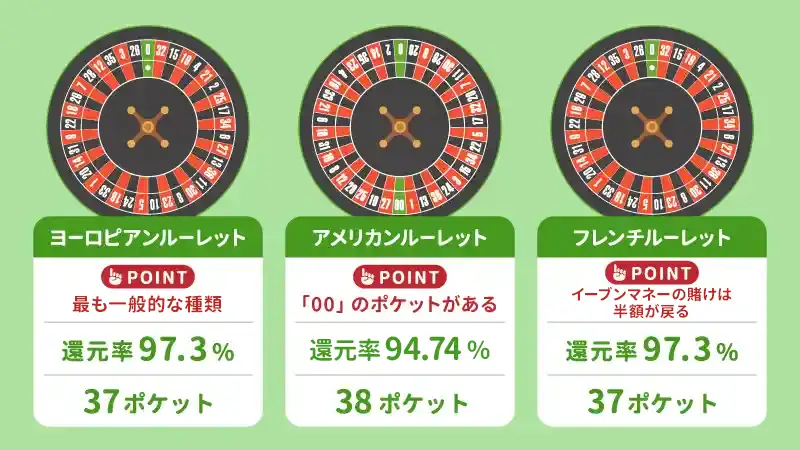
Casino roulette comes in three main types: European roulette, American roulette and French roulette. European roulette is the most widely played.
| Type | RTP | House edge |
|---|---|---|
| European (single zero, 37 pockets) | 97.30% | 2.70% |
| American (double zero, 38 pockets) | 94.74% | 5.26% |
| French (red/black, odd/even and high/low bets only) | 98.65% | 1.35% |
If you are choosing between European and American roulette, we strongly recommend European roulette. European roulette has an RTP of 97.30%, while American roulette is considerably lower at 94.74%.
If you bet on red/black, odd/even or high/low, French roulette offers the best return. On these three bets only, the RTP rises to 98.65%. This does not apply to bets on numbers or to dozen and column bets, which keep the same 97.30% RTP as European roulette.
European Roulette (Single Zero)
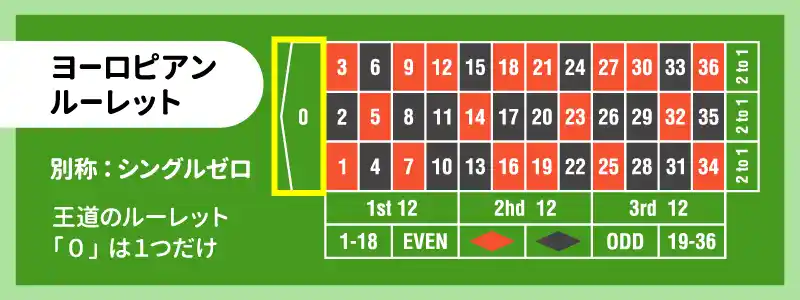
European roulette (single zero) is played mainly in Europe. Besides the red and black pockets, a roulette wheel has green pockets. When the ball lands in a green pocket, bets such as red/black and odd/even lose, so the fewer green pockets a wheel has, the higher its RTP.
European roulette has only one green pocket, the 0, so its RTP is not reduced by much.
The European wheel has 37 numbers in total, including 0, so a bet that pays 1 to 1, such as red or black, wins with a probability of 18 in 37.
RTP = (probability of winning × amount returned) = (18 ÷ 37) × 2 ≈ 0.973 → 97.30%
The 2 is the amount returned on a winning 1 to 1 bet: your stake (1) plus your winnings (1). A $10 bet wins $10, and you get $20 back in total. The house edge is therefore 1 − 0.973 = 0.027, or 2.70%. This is why European roulette, with a single 0, is considered a better game for players than American roulette, which has two zeros.
American Roulette (Double Zero)
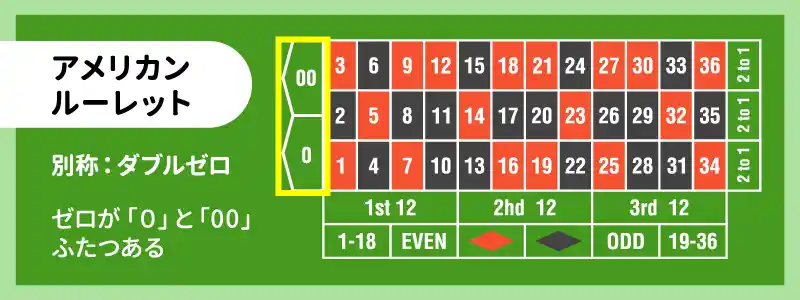
American roulette (double zero) is the standard version in North American land-based casinos.
Besides the red and black pockets, the wheel has two green pockets, 0 and 00. A bet on red or black loses when the ball lands in either of them, so the RTP is much lower than on single-zero European roulette.
The American wheel has 38 numbers in total, including 0 and 00, so a bet that pays 1 to 1, such as red or black, wins with a probability of 18 in 38.
RTP = (probability of winning × amount returned) = (18 ÷ 38) × 2 ≈ 0.9474 → 94.74%
The extra zero lowers the probability of winning from 18 in 37 (48.65%) to 18 in 38 (47.37%) and raises the house edge from 2.70% to 5.26%, almost double. This is why the RTP of American roulette is so much lower than that of European roulette.
French Roulette
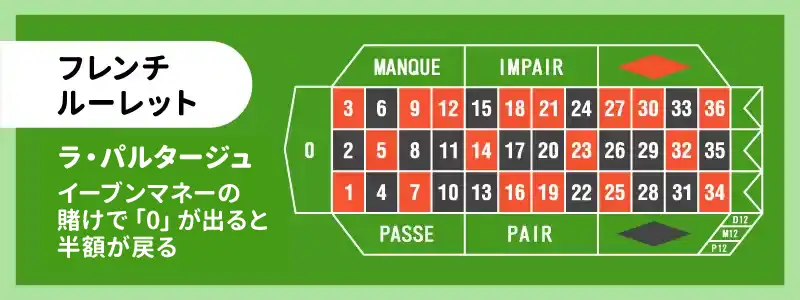
French roulette offers a higher RTP than European roulette, but only on even-money bets. Suppose you place a bet that pays 1 to 1, such as red/black or odd/even, and the ball lands on 0. In standard roulette you would lose the entire bet, but in French roulette half of your bet is returned. This is known as la partage.
Some tables use en prison instead. When 0 comes up, your entire bet is held over to the next spin; if the bet wins on that spin, the full amount is returned, and if it loses, the bet is forfeited. Under en prison, the house edge ranges from 1.35% to 1.39%, depending on how each table handles a second 0. The calculations below assume la partage.
In standard European roulette, a 1 to 1 bet such as red or black wins with a probability of 18 in 37, for an RTP of 97.30% (a house edge of 2.70%). Under la partage, the loss when 0 comes up falls from the full bet to half of it, so the house edge is also cut in half.
House edge = 2.70% ÷ 2 = 1.35%
RTP = 100% − 1.35% = 98.65%
As a result, the RTP rises to 98.65% on even-money bets (red/black, odd/even and high/low) only.
However, this rule applies only to these three bets. It does not apply to bets placed directly on numbers or to outside bets that pay 2 to 1, such as dozen and column bets; on those, a 0 loses the entire bet. Their RTP stays at 97.30%, the same as European roulette. On French roulette, concentrating on red/black, odd/even and high/low therefore keeps your expected losses lower.
To find these tables, type French roulette or la partage into an online casino’s game search. Some French roulette tables use neither rule, so check the table rules before you play.
Two Types of Roulette Bets
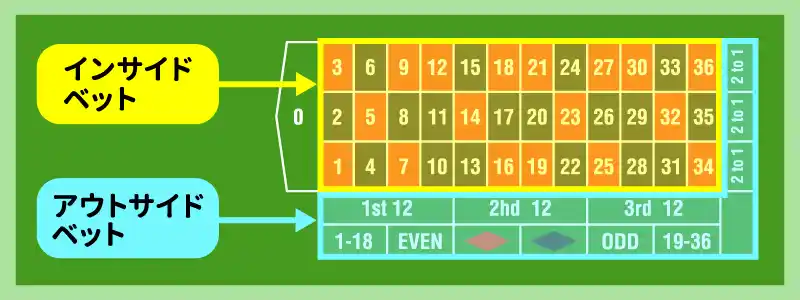
Roulette bets fall into two groups: inside bets and outside bets.
On the roulette layout, the printed betting area of the table, the numbers 0 to 36 are in the center, surrounded by other betting areas such as red, black and 1–12. An easy way to remember the difference is that inside bets go on the numbers in the center and outside bets go on the areas around them.
Inside Bets
Inside bets are placed on the numbers themselves: 0, 1, 2 and so on up to 36. The bet wins if the ball lands on a number you have bet on, so these bets are easy to understand.
You are not limited to a single number. You can also bet on two adjacent numbers such as 1 and 2, on a row of three such as 10, 11 and 12, or on four numbers that meet at a corner, such as 25, 26, 28 and 29.
Outside Bets
Outside bets are not placed on individual numbers but on groups of numbers.
For example, a bet on red wins if the ball lands on a red number. A bet on 25–36 wins if the winning number is between 25 and 36.
Roulette Payouts
In roulette, the payout depends on the bet. As a rule, every bet on a given wheel has the same house edge (the exceptions are the five-number bet on American roulette and even-money bets under the French la partage and en prison rules), and the harder a bet is to win, the more it pays.
Inside bets generally pay more than outside bets, although this depends on the specific bet. Choose inside bets for larger payouts and outside bets for more frequent wins.
Casino payouts are written as odds, such as 1 to 1 or 35 to 1, which state the amount won relative to the bet. If you bet one chip on red and receive two chips back, the payout is 1 to 1. This notation matches how a land-based casino pays: you receive one chip in winnings, and your original chip stays on the table. At an online casino, the bet and the winnings are both credited to your balance. In this article, payouts are given as odds, with the amount won shown in an example: at 1 to 1, a $10 bet on red wins $10, and you get $20 back in total.
Inside Bet Payouts
Inside bets pay between 5 to 1 and 35 to 1. They win less often, so each win pays more.
| Bet | Payout | Total returned on a $10 bet |
|---|---|---|
| Straight-up bet | 35 to 1 | $360 |
| Split bet | 17 to 1 | $180 |
| Street bet | 11 to 1 | $120 |
| Corner bet | 8 to 1 | $90 |
| Four-number bet (single-zero wheels only) | 8 to 1 | $90 |
| Five-number bet (American roulette only) | 6 to 1 | $70 |
| Line bet | 5 to 1 | $60 |
As a rule, the total returned, including your stake, is 36 divided by how many numbers the bet covers. The only exception is the five-number bet, which is available only on American roulette: 36 ÷ 5 would give 7.2 times the stake, but the bet returns 7 times the stake (6 to 1).
Straight-Up Bet (Single Number): 35 to 1
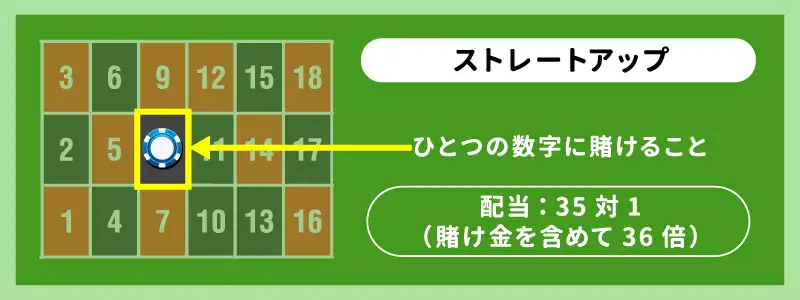
A straight-up bet is a bet on a single number. To place a straight-up bet on 1, for example, place your chip in the center of the box for 1. It pays 35 to 1, the highest payout in roulette, so a $10 bet wins $350.
Split Bet (Two Numbers): 17 to 1
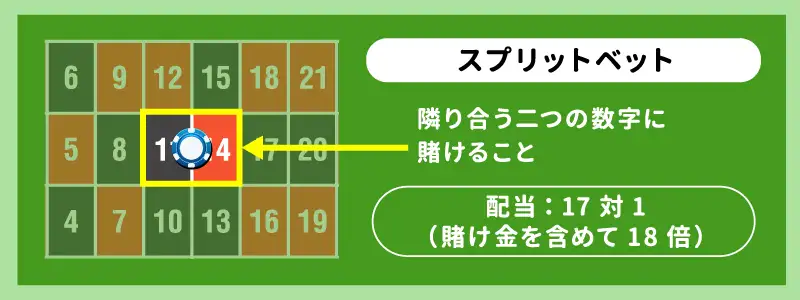
A split bet covers two adjacent numbers. To place a split bet on 1 and 2, for example, place your chip on the line between 1 and 2.
A split bet can be placed only on two numbers that are adjacent on the layout. To cover two numbers that are not adjacent, such as 1 and 5, divide your stake in half and place a straight-up bet on each number; the payout if one of them wins is the same.
Street Bet (Three Numbers): 11 to 1
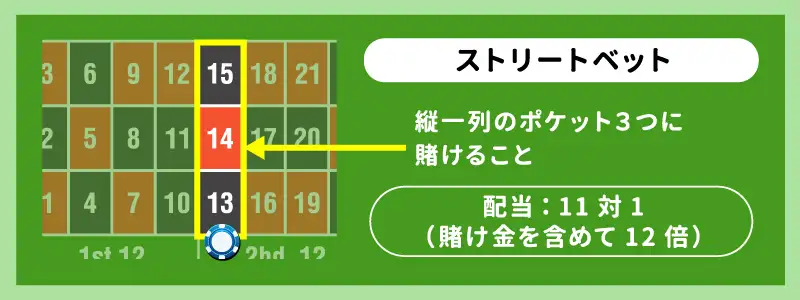
A street bet covers a row of three numbers. To place a street bet on 1, 2 and 3, for example, place your chip on the lower edge of the 1.
Here too, only three numbers in the same row can be combined. To cover three numbers that span two rows, such as 3, 4 and 5, divide your stake into thirds and place a straight-up bet on each number.
Corner Bet (Four Numbers): 8 to 1
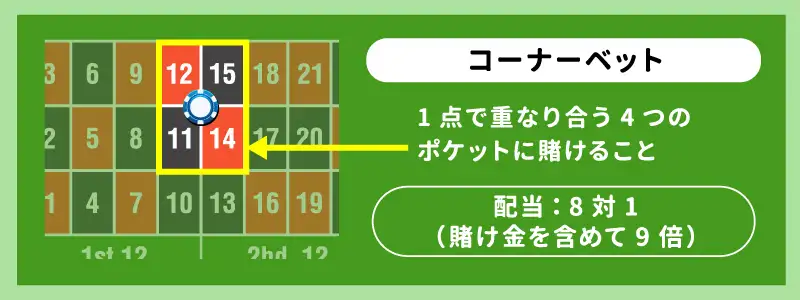
A corner bet covers four numbers that meet at a single point. To place a corner bet on 1, 2, 4 and 5, for example, place your chip on the point where the four numbers meet.
Five-Number Bet: 6 to 1
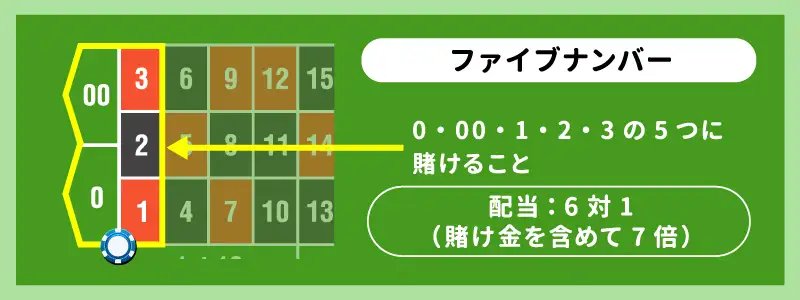
The five-number bet, available only on American roulette, covers 0, 00, 1, 2 and 3. To place it, put your chip at the outer end of the line between 0 and 1, where it meets the edge of the number grid. A chip placed in the middle of the line between 0 and 1 may be treated as a split bet on 0 and 1, so be careful where you place it.
The five-number bet returns 7 times the stake (6 to 1), which makes it the bet with the lowest expected value in American roulette.
Its RTP is 92.11%, lower than the 94.74% of the other bets on American roulette and far below the 97.30% of European roulette. For this reason, avoid this bet.
Line Bet (Double Street): 5 to 1
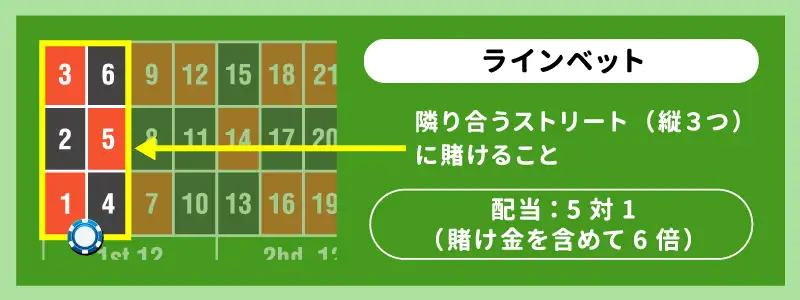
A line bet covers two adjacent streets, six numbers in total.
To place a line bet on 1, 2, 3, 4, 5 and 6, for example, put your chip at the outer end of the line between 1 and 4, where it meets the edge of the number grid. A chip placed in the middle of the line between 1 and 4 may be treated as a split bet on 1 and 4, so be careful where you place it.
Outside Bet Payouts
Outside bets generally pay only 1 to 1 or 2 to 1. In return, they win more often, which suits players who want their balance to rise and fall more gradually.
| Bet | Payout | Total returned on a $10 bet |
|---|---|---|
| Dozen bet | 2 to 1 | $30 |
| Column bet | 2 to 1 | $30 |
| Odd/even | 1 to 1 | $20 |
| High/low | 1 to 1 | $20 |
| Red/black | 1 to 1 | $20 |
All of these bets lose if the ball lands on 0 (or on 00 on American roulette).
Dozen Bet: 2 to 1
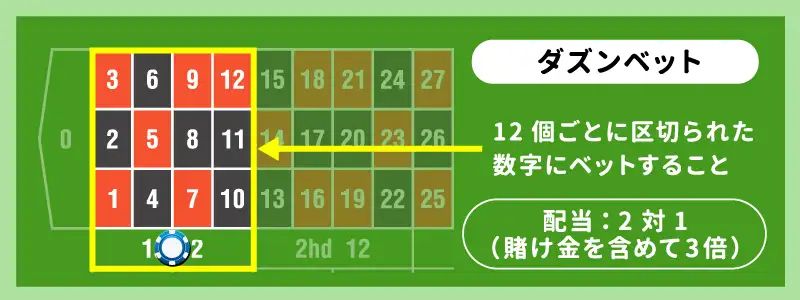
A dozen bet covers one of three groups of 12 numbers.
The first 12 numbers (1–12) are called the first dozen, the middle 12 (13–24) the second dozen and the last 12 (25–36) the third dozen.
You bet on which of these three groups the winning number will fall in.
Column Bet: 2 to 1
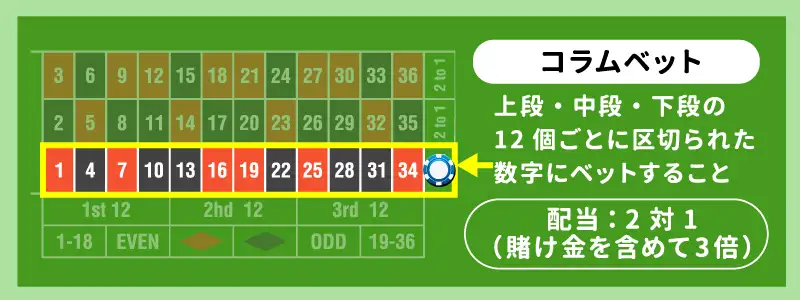
A column bet also covers 12 numbers, but the numbers are grouped differently from a dozen bet.
The 36 numbers on the layout are arranged in three long lines of 12, which run the length of the table. These are the columns.
- First column: 1, 4, 7, 10, 13, 16, 19, 22, 25, 28, 31, 34
- Second column: 2, 5, 8, 11, 14, 17, 20, 23, 26, 29, 32, 35
- Third column: 3, 6, 9, 12, 15, 18, 21, 24, 27, 30, 33, 36
You bet on which of the three columns the winning number will fall in.
Odd/Even: 1 to 1
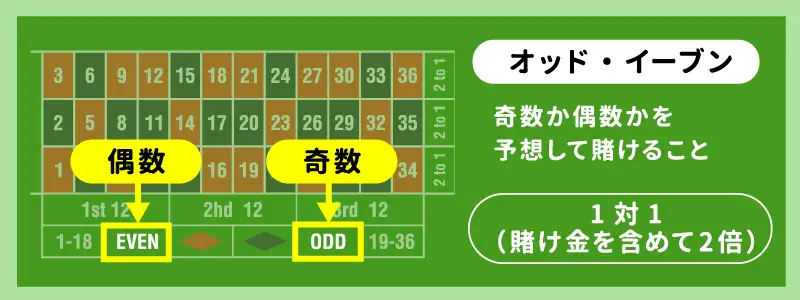
Odd covers the odd numbers (1, 3, 5 and so on up to 35), and even covers the even numbers (2, 4, 6 and so on up to 36). You bet on whether the winning number will be odd or even. Mathematically, 0 is also an even number, but both odd and even bets lose when 0 comes up.
High/Low: 1 to 1
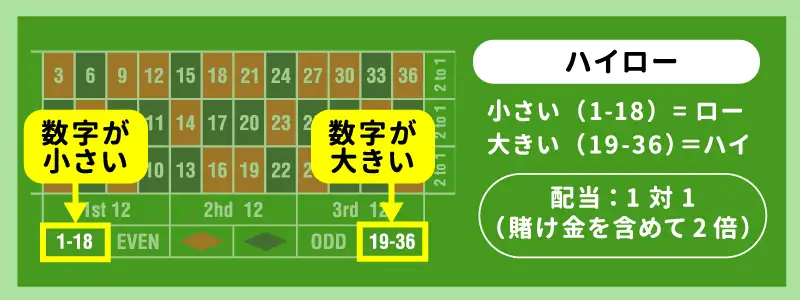
The numbers 1–36 are split into two halves: 1–18 is low and 19–36 is high. You bet on whether the winning number will be high or low.
Red/Black: 1 to 1
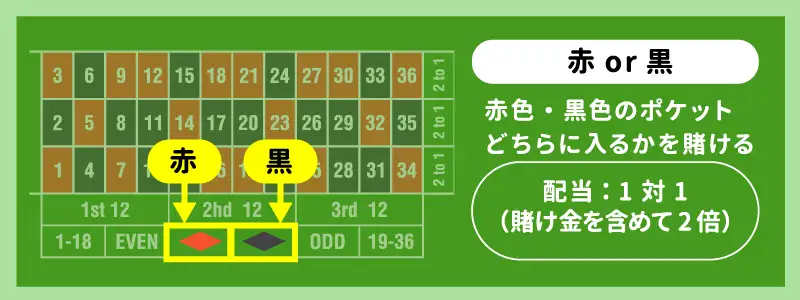
Except for 0 (and 00 on American roulette), the numbers 1–36 are either red or black. The colors do not simply alternate in numerical order; they are assigned as follows.
- Red: 1, 3, 5, 7, 9, 12, 14, 16, 18, 19, 21, 23, 25, 27, 30, 32, 34, 36
- Black: 2, 4, 6, 8, 10, 11, 13, 15, 17, 20, 22, 24, 26, 28, 29, 31, 33, 35
On the European wheel, by contrast, red and black alternate all the way around, apart from 0. The American wheel has two exceptions, at 0 and 00: the pockets on either side of 00 are both red (1 and 27), and the pockets on either side of 0 are both black (2 and 28). A red/black bet is a bet on which of the two colors the ball will land on.
Payouts on 0 and 00 in Roulette
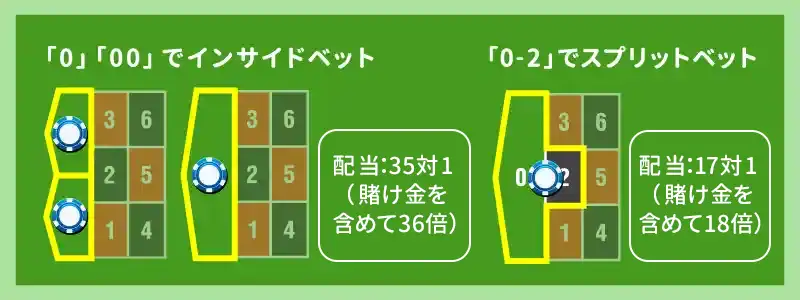
When the ball lands on 0 or 00, all outside bets lose. As explained above, the exceptions are the French roulette rules for even-money bets: la partage, which returns half of the stake, and en prison, which holds the bet for the next spin. Inside bets are different: you can bet on 0 and 00 just as you would on any other number, and the payouts are exactly the same.
On both European and American roulette, a straight-up bet on 0 pays 35 to 1, returning 36 times the stake. Because the American wheel has the extra 00 pocket, American roulette has a higher house edge than European roulette on inside bets as well.
Summary: Payouts Vary by Bet, but the RTP Is Almost Always the Same
In roulette, inside bets, which are placed directly on numbers, pay more than outside bets, which cover groups of numbers. The RTP, however, is the same whichever you choose, apart from the exceptions above. The basic approach is to decide whether you want to win more often or win larger amounts, and to choose your bets according to your goal for the session.
Some betting systems rely on bets that win very often, such as placing straight-up bets on 35 of the 37 numbers. Before you try one, make sure you understand each type of bet.
The numbers on the layout run in order, but they are not arranged 1, 2, 3 on the wheel. A street bet on 1, 2 and 3 covers pockets that are scattered around the wheel. Keep in mind that the order of the numbers on the layout and their order on the wheel are two different things.
This site is for adults of legal gambling age (18+, or older where required) who live in countries or regions where online gambling is legal.
Use of this site is subject to our Terms and Conditions.
Gambling involves risk. Only bet what you can afford to lose, and do not use online gambling services where they are illegal.

Bell | Editor of Online Casino Winners Club. Since the site launched in 2003, Bell has written guides to casino game rules, tested betting systems and covered land-based casinos around the world, and still plays the games before writing about them. Bell's core advice: choose the bets with the lowest house edge, and decide in advance how much you are prepared to lose.