

Roulette Wheel Numbers: Layout, Zeros and Hot Number Myths

This article explains what you need to know to enjoy roulette: which numbers appear on the wheel, why they are not arranged in order, and whether some numbers come up more often than others.
What You Will Learn
- The numbers on a roulette wheel are 1–36 plus 0, and 00 on American wheels.
- The numbers on the wheel are arranged irregularly so that red and black, and high and low numbers, are not clustered together.

This article takes about 11 minutes to read.
Overview of Roulette Numbers
Roulette is a very simple game. A ball is launched around a spinning wheel, and you bet on which numbered pocket it will land in.
The main numbers are 1 to 36, each colored red or black. The wheel also has green pockets numbered 0 (zero) and 00 (double zero), which give the casino its edge.
A wheel has 37 or 38 numbers in total, and the order in which they appear is deliberately designed.
The Numbers Are 1–36 Plus 0 and 00
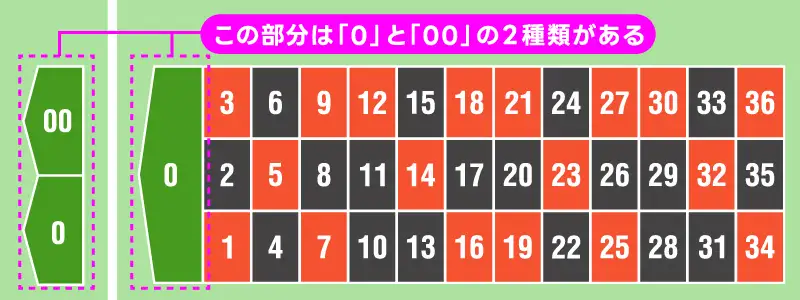
| Red numbers | 1, 3, 5, 7, 9, 12, 14, 16, 18, 19, 21, 23, 25, 27, 30, 32, 34, 36 |
|---|---|
| Black numbers | 2, 4, 6, 8, 10, 11, 13, 15, 17, 20, 22, 24, 26, 28, 29, 31, 33, 35 |
| Green numbers | 0, 00 (00 on American roulette only) |
The numbers 1–36 on the wheel are designed to divide exactly in half: odd and even, red and black, and 1–18 (low) and 19–36 (high).
Because 0 and 00 are added, however, the actual chance of winning these bets is 48.65% on a European wheel and 47.37% on an American wheel, just short of one half.
If the ball lands on 0 or 00, the standard rule is that all even-money bets, such as red/black and odd/even, lose. French roulette, however, has special rules that protect even-money bets when 0 comes up.
Under la partage, half of the bet is returned immediately. Under en prison, the entire bet is held over to the next spin: if it wins on that spin, the full bet is returned, and if it loses, the bet is lost.
As a result, the house edge on even-money bets is 1.35% with la partage, and 1.35–1.39% with en prison, depending on how each table handles a second 0.
American and European Roulette Have a Different Number of Zeros
There are three main types of roulette: European roulette (single zero), American roulette (double zero) and French roulette. This section compares the first two, which differ in the number of zeros.
American roulette has both 0 and 00, while European roulette has a single 0. French roulette also has a single 0, and its pockets are the same as on a European wheel.
Because the total number of pockets differs, so does the probability of winning. A European wheel has 37 pockets and an American wheel has 38, so the chance of hitting a specific number is slightly higher in European roulette.
The difference also shows in the house edge: 2.70% for European roulette against 5.26% for American, nearly twice as much. In terms of return to player (RTP), that is 97.30% against 94.74%.
If the casino offers both, we recommend starting with European roulette, where the house edge is lower and it is easier to limit your losses.
Why Are the Numbers on the Wheel Out of Order?
The numbers on the wheel do not run in order (1, 2, 3 and so on) but are arranged very irregularly. This is so that adjacent numbers alternate between red and black, and so that high and low numbers are not clustered together.
Apart from the zeros, the colors alternate perfectly only on the European wheel. On the American wheel, there are two places where the same color appears on either side of a zero: 1 (red), 00, 27 (red) and 2 (black), 0, 28 (black).
If the numbers were placed in order, the low numbers would gather on one side of the wheel and the high numbers on the other, upsetting the balance of colors and of high and low. The irregular arrangement is intentional: whichever section of the wheel you look at, red and black, and high and low, are spread almost evenly.
How the Betting Layout Is Arranged

The numbers on the wheel are out of order, but on the betting layout, where you place your chips, they run neatly 1, 2, 3 and so on. This arrangement makes it easier for players to place their bets.
The layout is divided into two main areas: inside bets, placed on specific numbers, and outside bets, placed on groups such as red/black or columns.
Inside bets are harder to win but pay more when they do, while outside bets win more often. Because the payout falls as a bet covers more numbers, however, the expected value per spin is the same whichever bet you choose.
A winning straight-up bet (a bet on a single number) pays 35 to 1: a $10 bet wins $350, and with the stake you get $360 back, 36 times your bet.
Beginners can start with bets that win 48.65% of the time (on a European wheel), such as red/black, odd/even and 1–18 (low)/19–36 (high). Because these bets win more often, it is easier to get a feel for how the game flows.
This does not improve your expected value; it only means your bankroll tends to shrink more slowly.
Numbers That Come Up More and Less Often in Roulette

When you watch a roulette wheel for a while, it can seem as if the same number keeps coming up again and again, while other numbers never appear at all.
Many players try to read streaks and patterns in these results.
Do Some Numbers Really Come Up More Often Than Others?
Mathematically, every spin is independent, so no number is more or less likely to come up. Unless the wheel has a physical defect, every number has the same chance of appearing: 1 in 37 on a European wheel or 1 in 38 on an American wheel.
The ball has no memory. If 7 came up on the last spin, it is no less likely to come up on the next one, and no more likely either.
Even so, casinos display “hot numbers” (numbers that have come up often) and “cold numbers” (numbers that have not come up) on an electronic display next to the table, and many players enjoy using them to choose their bets.
Can a Dealer Aim the Ball at a Specific Number?
There is a persistent rumor that an experienced dealer can aim the ball at a particular section of the wheel.
The theory that a dealer’s spinning habits make the ball favor certain sections of the wheel is known as “dealer signature.” It assumes a physical bias at a land-based casino, however, and under modern casino controls it has limited practical value. In RNG roulette at online casinos, no one spins a ball at all, so the theory does not apply.
Each spin involves countless variables, such as the speed and force with which the ball is launched and the wear on the ball and the wheel. Modern wheels also have shallow pockets, and the metal deflectors (called diamonds) that the ball strikes are carefully positioned, so the ball does not land where it was aimed. Hitting a single target number is practically impossible.
Casinos also run checks to prevent cheating, so the most realistic way to approach the game is to assume that even the dealer does not know where the ball will land.
If you are still concerned, you can wait until the dealer has launched the ball before placing your bet. Bets are accepted after the ball is in play until the dealer calls “no more bets,” so even if a dealer could aim the ball, players could watch the spin and bet on the same section.
Because of this, aiming the ball would not benefit the casino.
How to Decide Which Numbers to Bet On

No method can reliably predict roulette results. Part of the appeal of the game is choosing your bets for your own reasons.
In theory, every number in roulette has the same probability of coming up. In practice, however, the results only even out when they are added up over millions or tens of millions of spins. Over a single day, large imbalances are not at all unusual.
Short-term imbalances can only be seen after the fact, and they do not tell you which number will come up next. The approaches below are not ways to improve your chances of winning. They are presented only as enjoyable ways to decide where to put your chips.
Some players take an analytical approach based on past results, while others take an intuitive approach and simply trust their gut or their luck.
Choosing Your Bet from the Results History
Casino roulette tables often have a monitor (an electronic display) beside them that shows the winning numbers from the last 10–20 spins. Looking at it to see recent trends is a common way to play.
For example, a player might predict that black is due because red has come up five times in a row, or, conversely, follow the trend and bet on red again because red is on a run.
Predicting from previous results in this way is sometimes called “reading the roads,” a term borrowed from baccarat and similar games. It is really just pattern-spotting, but reviewing past results can make the game more absorbing.
Looking at Which Numbers and Areas Have Come Up Most
This approach uses the “hot numbers” shown on the display. Some tables have a feature that shows which numbers have come up most often over roughly the last 100 spins.
With 37 numbers on a European wheel and 38 on an American wheel, some numbers will inevitably seem to come up more often in the short term. They are random fluctuations, and hot numbers only show past results. Treat betting on a perceived trend as one way to enjoy the game, on the understanding that a hot number is no more likely to come up next.
Some players also look for imbalances not in individual numbers but in groups of 12 numbers on the betting layout, such as the three columns (column bets) or the three dozens (dozen bets).
The Belief That a Number That Has Not Come Up Is Due
Another strategy targets numbers that have not come up for a while, known as “cold numbers.” The idea is that if a number has not appeared in 100 or more spins, it should come up soon to even things out.
This belief is known as the gambler’s fallacy. In reality, every number has the same probability on every spin, so no number is ever “due.” Keep in mind that it has no mathematical basis, and treat it simply as a way to enjoy the excitement when a number you have waited a long time for finally hits.
If you keep raising your bet until the number hits, however, this approach can lead to heavy losses, so do not chase them. With betting systems that keep raising the stake, such as the Martingale system and the Cocomo system (a Fibonacci-style progression), the loss is locked in once you reach the table limit or run out of funds, unless you stop at a loss limit set in advance.
Trying Your Luck with Birthdays and Lucky Numbers
The simplest approach is to bet on your favorite numbers.
Some players use their own lucky numbers, such as a birthday, an anniversary, a number from their license plate, or a number that comes to mind on the day.
A winning straight-up bet (a bet on a single number) pays 35 to 1, so even a $1 bet wins $35 and returns $36 including the stake.
Logical predictions can be fun, but the moment your lucky number hits is the one you tend to remember.
Betting on 0 or a Favorite Number Every Spin Instead of Predicting
Some players skip predictions altogether and keep placing chips on one specific number, such as 0 or one particular spot, spin after spin until it hits.
Zero, for example, is special because all outside bets such as red/black lose when it comes up, so some players deliberately keep betting on it.
There are also bets that cover the numbers next to 0 on the wheel as a group, such as Jeu Zéro, a call bet (announced bet) placed on the racetrack. There is no reason to think 0 comes up more often, however. The only benefit is practical: with a fixed bet, you can keep playing without hesitating over where to bet.
A single-number bet rarely wins, but it pays a lot when it does. It is one option if you want to play for a long time with small bets, but even on a European wheel it wins only 2.70% of the time. Decide in advance how much to bet per spin and how many spins to play, and you can stop before your bankroll runs out.
Frequently Asked Questions About Roulette Numbers
- Why do some roulette wheels have one zero and others have two?
-
The difference comes from the history of roulette and from how casinos earn their revenue. European roulette has a single 0, while American roulette, which has an extra 00, became widespread in the United States.
The more zeros a wheel has, the more likely the player is to lose on every type of bet, including even-money bets such as red/black. As a result, the house edge is 2.70% for European roulette and 5.26% for American roulette, nearly twice as much. In land-based casinos, American roulette is the norm in North America, while European roulette is widely offered in Europe and Asia.
Summary: The Numbers Are Arranged for a Reason, but the Next Result Cannot Be Predicted
The numbers on a roulette wheel, 1 to 36 plus 0 or 00, are arranged in a carefully balanced layout. Which number comes up is purely a matter of chance, and analyzing the results history will not help you predict the next result.
That is exactly why the fun lies in the predictions themselves, whether you follow past trends or trust your lucky numbers. We recommend treating the game in that spirit.
When you play for the first time, look for European roulette, which has fewer zeros, and start with bets that win more often, such as red/black. The result of each spin is decided by chance, but you control which type of table you choose and how you manage your money.
Keep your choice of table and your money management in mind, and set a maximum amount to spend for the day before you start playing.
This site is for adults of legal gambling age (18+, or older where required) who live in countries or regions where online gambling is legal.
Use of this site is subject to our Terms and Conditions.
Gambling involves risk. Only bet what you can afford to lose, and do not use online gambling services where they are illegal.

Bell | Editor of Online Casino Winners Club. Since the site launched in 2003, Bell has written guides to casino game rules, tested betting systems and covered land-based casinos around the world, and still plays the games before writing about them. Bell's core advice: choose the bets with the lowest house edge, and decide in advance how much you are prepared to lose.