

Roulette Odds Chart: Win Probability for Every Bet and Streaks

Roulette offers many different bets, and the probability of winning differs from one bet to the next, from a straight-up bet on a single number to a bet on red or black. Roulette also comes in three main variants, and the exact probabilities depend on which one you play.
This article explains the probability of winning for each roulette bet, including how each figure is calculated. These probabilities are the starting point for using betting systems and deciding how to play.
What You Will Learn
- There are three main types of roulette, European, American and French, and the probability of winning differs slightly between them.
- When you use a betting system, we recommend setting your stop-loss limit based on the probability of winning and losing streaks.
- Betting on more pockets raises your chance of winning, but the payout falls accordingly, so the expected value does not change.

This article takes about 12 minutes to read.
Roulette Win Probabilities: How the Variants Differ

Roulette at online casinos comes in three main variants: European roulette, American roulette and French roulette.
In addition to the red and black pockets, a roulette wheel has green pockets, and when the ball lands in one of them, every outside bet loses. European and American roulette differ in the number of green pockets, and this changes both the probability of winning and the return to player (RTP).
European Roulette
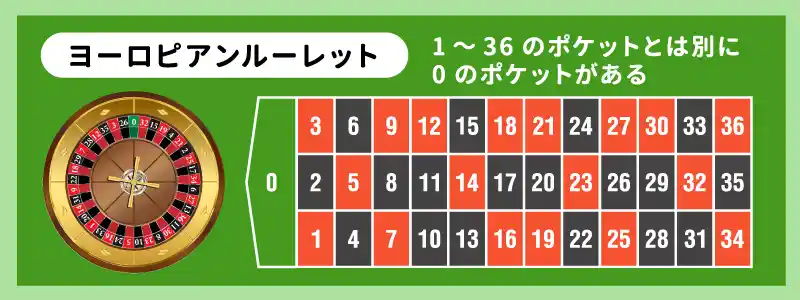
European roulette, the standard version at most online casinos and in European land-based casinos, has a single green pocket, numbered 0 (zero), in addition to the pockets numbered 1–36.
A European wheel therefore has 37 pockets, and the probability of hitting any single pocket is higher than in American roulette.
American Roulette

American roulette, the standard game in land-based casinos in North America, has two green pockets, 0 and 00 (double zero), in addition to the pockets numbered 1–36.
An American wheel therefore has 38 pockets, and the probability of each bet winning is lower than in European roulette.
French Roulette
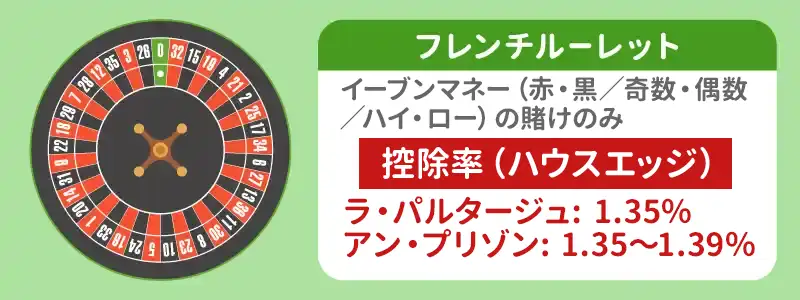
French roulette originated in France and is played mainly in Europe. Like European roulette, it has a single green pocket, 0, in addition to the pockets numbered 1–36, so in terms of the number of zeros alone, the probabilities are the same as in European roulette.
Some French roulette tables, however, use special rules called la partage and en prison, although not every table labeled “French roulette” offers them.
These rules apply only to even-money bets (red/black, odd/even and high/low). On those bets, the house edge is 1.35% with la partage and 1.35–1.39% with en prison, depending on the table rules, lower than the 2.70% house edge of standard European roulette. The rules do not apply to dozen bets or column bets.
How to Calculate the Probability of Each Roulette Bet
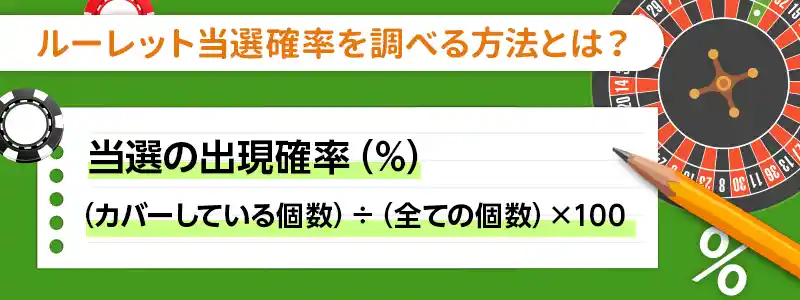
Before we look at the probability of winning for each bet, here is the formula used to calculate it.
The probability that a roulette bet wins, in other words the probability that one of its numbers comes up, is calculated as follows.
Probability (%) = (numbers covered by the bet) ÷ (total pockets on the wheel) × 100
The numbers covered by the bet are the pockets that make it a winner. For the probability that the ball lands on 10, for example, the figure is 1, because the wheel has only one 10 pocket. For the probability that it lands on any number from 1 to 10, the figure is 10, because ten pockets count: 1, 2, 3, 4, 5, 6, 7, 8, 9 and 10.
The total is the number of pockets on the wheel being used: 37 for European roulette and 38 for American roulette.
What Is the Probability of a Green Pocket (0 or 00)?
As an example, here is the calculation of the probability that the ball lands in a green pocket in European roulette and in American roulette.
European roulette
There is 1 green pocket out of 37 pockets in total, so the probability is 1 ÷ 37 × 100 = 2.702…, or 2.70% when rounded.
American roulette
There are 2 green pockets out of 38 pockets in total, so the probability is 2 ÷ 38 × 100 = 5.263…, or 5.26% when rounded.
The probability of a green pocket is therefore 2.70% in European roulette and 5.26% in American roulette.
Probability of Each Inside Bet in Roulette
| Inside bet | European roulette probability of winning |
American roulette probability of winning |
|---|---|---|
| Straight-up bet | 2.70% | 2.63% |
| Split bet | 5.41% | 5.26% |
| Street bet | 8.11% | 7.89% |
| Corner bet | 10.81% | 10.53% |
| Five-number bet | – | 13.16% |
| Four-number bet | 10.81% | – |
| Line bet | 16.22% | 15.79% |
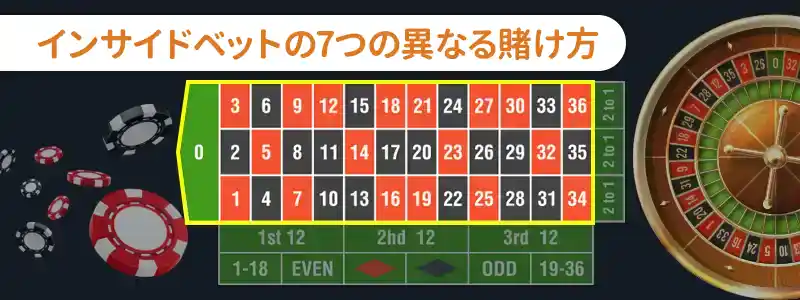
Inside bets are a group of roulette bets in which the player places chips directly on the numbers printed on the layout.
There are seven different inside bets: the straight-up bet on a single number, the split bet, the street bet, the corner bet, the five-number bet (American roulette only), the four-number bet (single-zero wheels only) and the line bet (also called a double street).
Inside bets have a lower probability of winning than outside bets, but they pay more when they win.
The probabilities above are calculated for a single bet. If you place straight-up bets on 10 different numbers, for example, multiply the straight-up probability by 10.
Straight-Up Bet
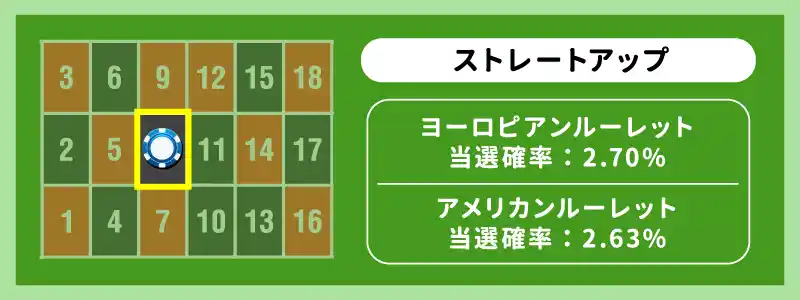
A straight-up bet is a bet on a single number. To bet straight up on 8, for example, place your chip in the center of the 8 box, as in the example above.
Split Bet
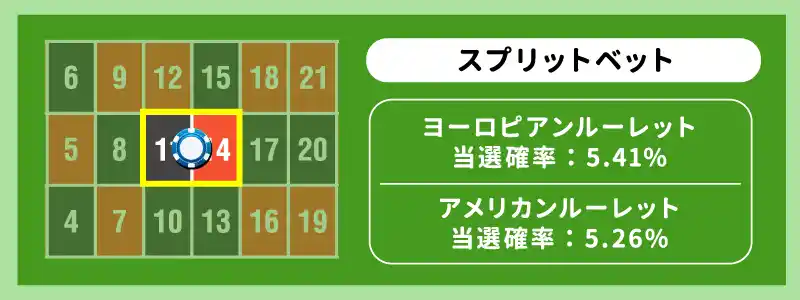
A split bet is a bet on two adjacent numbers. To place a split bet on 11 and 14, for example, place your chip on the line between 11 and 14, as in the example above.
Street Bet
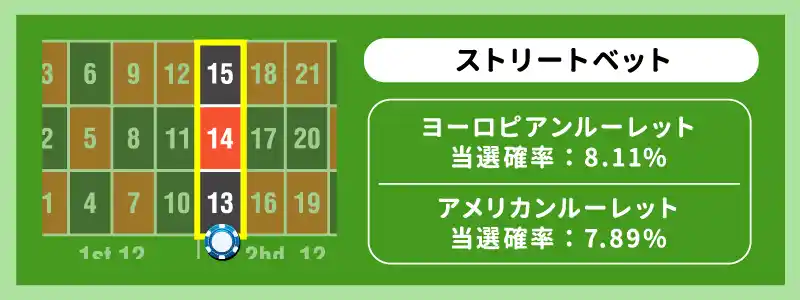
A street bet is a bet on a row of three consecutive numbers on the layout, such as 13, 14 and 15. To place a street bet on 13, 14 and 15, for example, place your chip on the bottom edge of the 13 box, as in the example above.
Corner Bet
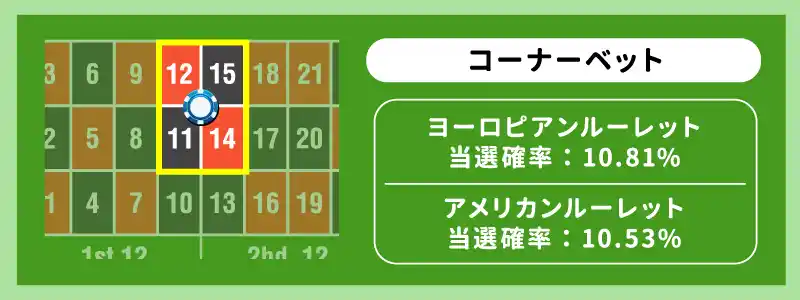
A corner bet is a bet on four numbers that meet at a single point. To place a corner bet on 11, 12, 14 and 15, for example, place your chip on the point where the four numbers meet, as in the example above.
Five-Number Bet
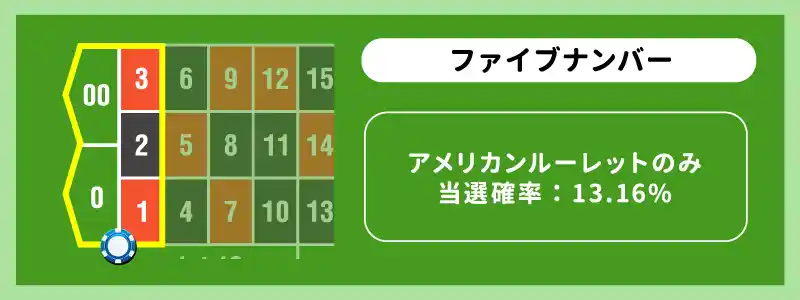
The five-number bet, available only in American roulette, covers five numbers: 0, 00, 1, 2 and 3. To place it, put your chip on the bottom edge of the line between 0 and 1, as in the example above.
Four-Number Bet
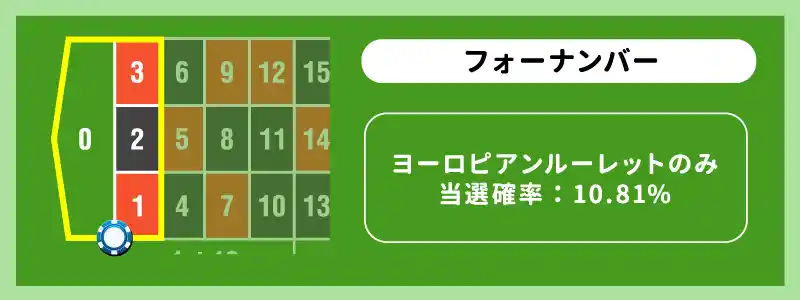
European roulette has no 00, so it offers a four-number bet instead, covering 0, 1, 2 and 3. As with the American five-number bet, place your chip on the bottom edge of the line between 0 and 1.
Line Bet (Double Street)
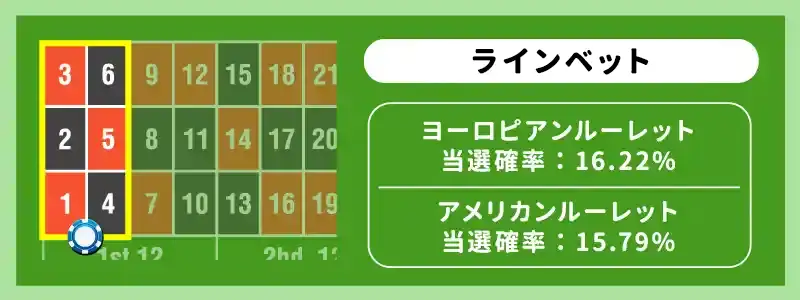
A line bet is a bet on two adjacent streets, six numbers in total. To place a line bet on 1, 2, 3, 4, 5 and 6, for example, place your chip on the bottom edge of the line between 1 and 4, as in the example above.
Probability of Each Outside Bet in Roulette
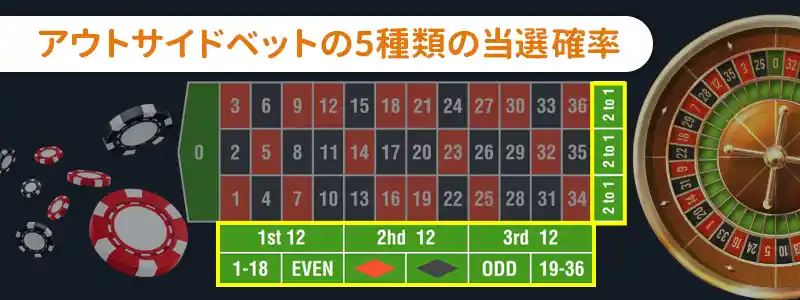
| Outside bet | European roulette probability of winning |
American roulette probability of winning |
|---|---|---|
| Dozen bet / Column bet | 32.43% | 31.58% |
| Odd/Even, High/Low, Red/Black | 48.65% | 47.37% |
Outside bets are bets on groups of numbers, such as red or black and odd or even. There are five outside bets: the dozen bet, the column bet, odd/even, high/low and red/black.
Outside bets have a higher probability of winning than inside bets, and they pay correspondingly less when they win.
Dozen Bet and Column Bet
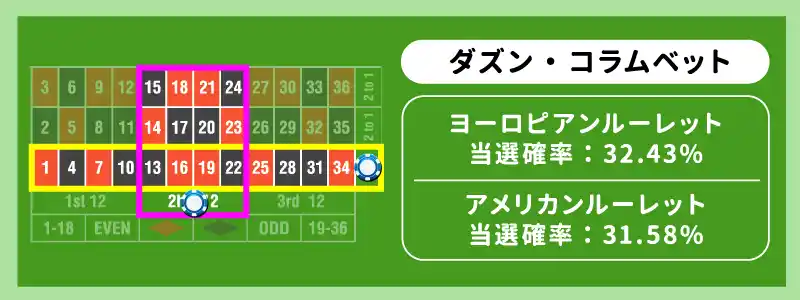
A dozen bet is a bet on one of three groups of 12 numbers: 1–12, 13–24 and 25–36. You are betting on which of the three groups the winning number will fall in.
A column bet is a bet on one of the three columns of 12 numbers that run the length of the layout.
Both bets cover 12 numbers, so they have the same probability of winning.
Odd/Even, High/Low and Red/Black
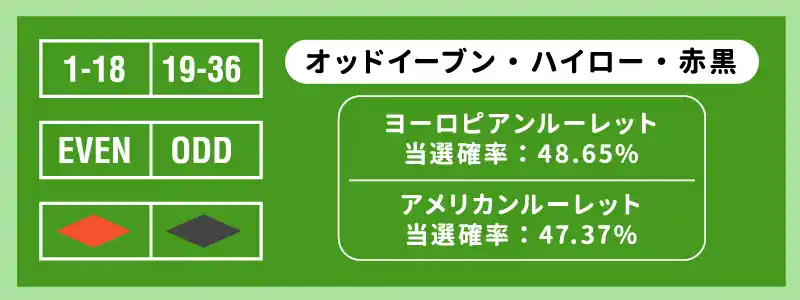
An odd/even bet is a bet on whether the winning number will be odd or even.
A high/low bet is a bet on whether the winning number will be high (19–36) or low (1–18).
A red/black bet is a bet on whether the winning pocket will be red or black.
Each of these bets covers 18 numbers, so they all have the same probability of winning.
Probability of Winning or Losing 10 Times in a Row in Roulette

This section covers the probability of winning streaks and losing streaks in roulette, first for red/black bets and then for dozen and column bets.
When you use a betting strategy in roulette, you set your limits in advance, such as “take profit after 3 wins in a row” or “stop after 5 losses in a row.” With betting systems such as the Martingale and Paroli systems in particular, setting a profit target and a stop-loss based on winning and losing streaks is essential.
Without knowing how likely a winning or losing streak is, you have no basis for deciding where to set these limits. The probabilities of winning and losing streaks give you a reference point.
The figures below are the probabilities, worked out in advance, that a given number of consecutive spins will all win or all lose. Each spin is an independent event, so a run of losses does not make the next spin more likely to win.
Note that the probabilities in this section are for European roulette. The probabilities of winning and losing streaks in American roulette are different.
Probability of Winning or Losing Streaks When Betting on Red or Black
| Streak length | Winning streak probability | Losing streak probability |
|---|---|---|
| 1 | 48.65% | 51.35% |
| 2 | 23.67% | 26.37% |
| 3 | 11.51% | 13.54% |
| 4 | 5.60% | 6.95% |
| 5 | 2.72% | 3.57% |
| 6 | 1.33% | 1.83% |
| 7 | 0.64% | 0.94% |
| 8 | 0.31% | 0.48% |
| 9 | 0.15% | 0.25% |
| 10 | 0.07% | 0.13% |
The table above shows the probabilities of winning and losing streaks when betting on red or black in European roulette.
The probability of winning 3 times in a row is 11.51%, 5 times in a row 2.72% (about 1 in 37), 7 times in a row 0.64% (about 1 in 155) and 10 times in a row 0.07% (about 1 in 1,347). A realistic target is a streak of 3–5 wins.
A 10-win streak happens only about once in 1,347 attempts, so it is not realistic to build a strategy around it.
For losing streaks, the probability of losing 3 times in a row is 13.54%, 5 times in a row 3.57% (about 1 in 28), 7 times in a row 0.94% (about 1 in 106) and 10 times in a row 0.13% (about 1 in 784).
Comparing the two, a 10-loss streak is about 1.7 times as likely as a 10-win streak.
A difference that looks small on a single spin grows considerably over a streak. For this reason, allow more consecutive losses for your stop-loss than consecutive wins for your profit target—around 5–7 losses in a row. Make sure your bankroll is large enough to cover that.
Probability of Winning or Losing Streaks on Dozen and Column Bets
| Streak length | Winning streak probability | Losing streak probability |
|---|---|---|
| 1 | 32.43% | 67.57% |
| 2 | 10.52% | 45.65% |
| 3 | 3.41% | 30.85% |
| 4 | 1.11% | 20.84% |
| 5 | 0.36% | 14.08% |
| 6 | 0.12% | 9.52% |
| 7 | 0.04% | 6.43% |
| 8 | 0.01% | 4.34% |
| 9 | – | 2.94% |
| 10 | – | 1.98% |
| 15 | – | 0.28% |
| 20 | – | 0.04% |
A dash (–) in the winning streak column indicates a probability that rounds to 0.00% at two decimal places (0.0040% for 9 wins in a row and 0.0013% for 10 wins in a row).
The table above shows the probabilities of winning and losing streaks on dozen and column bets in European roulette.
The probability of winning 2 times in a row is 10.52%, 3 times in a row 3.41% (about 1 in 29), 4 times in a row 1.11% (about 1 in 90), 5 times in a row 0.36% (about 1 in 280) and 10 times in a row 0.0013% (about 1 in 78,000).
A realistic target is a streak of 2–4 wins. From 5 wins in a row onward, the probability drops sharply, so such streaks are not suitable as a profit target.
Because a single dozen or column bet wins far less often than a red/black bet, the losing streak figures are very different as well. Even 4 losses in a row has a probability of over 20%. The probability does not fall to 9.5% (about 1 in 10) until 6 losses in a row, and 10 losses in a row still has a probability of about 2%, or roughly 1 in 50.
The probability of losing 20 times in a row is 0.039% (about 1 in 2,540), which is slightly higher than the 0.038% probability of winning 7 times in a row on a dozen or column bet. Because the table rounds all figures to two decimal places, both appear as 0.04%.
Dozen and column bets are often used with betting systems such as the Cocomo system, which is designed for 2 to 1 bets, and the Monte Carlo system, which can be used on 2 to 1 as well as 1 to 1 bets. When you use one, plan your session on the assumption that a streak of around 10 losses can happen.
Can You Win by Covering More Numbers?
The more numbers you cover, the higher your probability of winning. A bet that wins more often, however, pays correspondingly less, so the expected value stays the same.
In roulette, bets that cover fewer numbers, and therefore win less often, pay more. Because the probability of winning and the payout move in opposite directions, the theoretical loss is the same whichever bet you choose.
In other words, covering more numbers raises only your probability of winning on a given spin. It does not make you more likely to come out ahead.
There are two exceptions. The five-number bet in American roulette (0, 00, 1, 2 and 3) has a house edge of 7.89%, higher than the 5.26% on every other bet on the American wheel, and even-money bets on French roulette with la partage or en prison have a lower house edge of 1.35–1.39%.
Frequently Asked Questions About Roulette Probability
- Should I play European roulette or American roulette?
-
European roulette.
The zero pockets work in the casino’s favor. The European wheel has one, and the American wheel has two. The same bet has a higher probability of winning on the European wheel, so if you can choose your table, choose European roulette.
- How does knowing roulette probabilities help?
-
Knowing the probabilities shows you how often each bet wins and how much risk it carries. For example, red/black and odd/even bets win 48.65% of the time in European roulette, the highest win rate of any bet. The house edge also differs between the two versions: 2.70% in European roulette and 5.26% in American roulette.
You can also use these probabilities to plan your bets with a betting system such as the Martingale system. A betting system, however, changes only how much your results swing; it does not change the house edge itself. Knowing the probabilities gives you a guide for choosing a betting approach you can comfortably afford.
- Am I more likely to win if I keep betting on the same color or on odd or even?
-
Each spin in roulette is an independent event, so the number that comes up is not affected by previous results. Betting repeatedly on the same color, or on odd or even, does not change your chances of winning.
Summary: The Bet You Choose Does Not Change the Expected Value, but Choose European Roulette If You Can
Roulette at online casinos comes in three main versions: European roulette, American roulette and French roulette.
Every bet has a higher probability of winning on European roulette, and the European house edge of 2.70% is lower than the 5.26% of American roulette. You will lose money in the long run on either version, but your losses are smaller on European roulette.
Among inside bets, the probability of winning ranges from 2.70% for a straight-up bet, the lowest, to 16.22% for a line bet, the highest. These figures are lower than the 32.43%–48.65% of outside bets, but inside bets pay correspondingly more when they win.
What changes from one bet to another is the probability of winning and the size of the payout, in other words how much your results swing. The expected value itself stays the same. Whether you favor frequent small wins or aim for larger payouts, the theoretical loss is the same.
What you can control is which type of roulette you play. If you can choose your table, pick European roulette and decide on your bets according to how much variation in results you are comfortable with. That is how to avoid unnecessary losses.
This site is for adults of legal gambling age (18+, or older where required) who live in countries or regions where online gambling is legal.
Use of this site is subject to our Terms and Conditions.
Gambling involves risk. Only bet what you can afford to lose, and do not use online gambling services where they are illegal.

Bell | Editor of Online Casino Winners Club. Since the site launched in 2003, Bell has written guides to casino game rules, tested betting systems and covered land-based casinos around the world, and still plays the games before writing about them. Bell's core advice: choose the bets with the lowest house edge, and decide in advance how much you are prepared to lose.