

Basic strategy is the first thing to learn if you want to play blackjack well. What You Will Learn Basic strategy is the fundamental way to play every…
Dealer Advantage in Blackjack: Why It Exists and How to Reduce It

Blackjack is a card game in which the player competes against the dealer, and the hand whose total is closer to 21 wins. Because players choose their own actions, many assume they have the edge over the dealer, but in fact the dealer plays under more favorable conditions.
What You Will Learn
- The dealer has the edge because the dealer acts last, and a player who busts first has already lost.
- The dealer’s actions are fixed: in general, the dealer hits on 16 or less and stands on 17 or more.

This article takes about 8 minutes to read.
Contents
Show
What Is the Dealer’s Role in Blackjack?
In short, a round of blackjack works like this: the player and the dealer are each dealt a hand, each chooses whether to take more cards or stand with what they have, and the hand whose total is closer to 21 wins.
The dealer therefore has the following roles:
- Dealing cards to the players and to the dealer’s own hand
- Dealing additional cards according to each player’s actions
- Running the game, including playing out the dealer’s hand according to the rules
- Paying out and collecting chips once the results are final
At the same time, the dealer is the players’ opponent in blackjack. What sets the blackjack dealer apart from dealers in other games is this dual role: running the game while also playing against you.
Dealer-Specific Rules in Blackjack
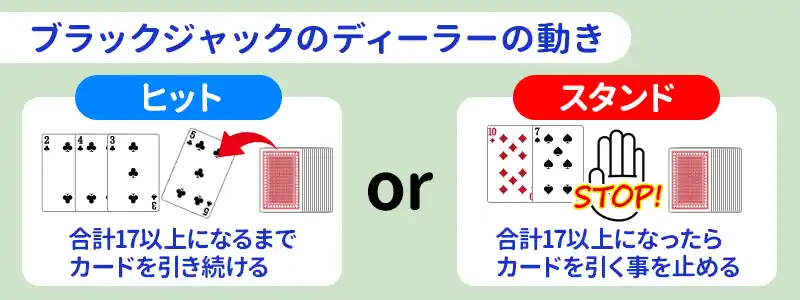
In blackjack, the actions available to the players differ slightly from those the dealer takes.
A Simpler Set of Actions
In blackjack, the dealer can only hit or stand.
The dealer cannot take any of the actions that involve the bet, such as splitting, doubling down or surrendering.
The Dealer’s Hits and Stands Follow a Fixed Rule
The dealer’s decisions to hit or stand also follow a fixed rule.
Under this rule, the dealer must hit on 16 or less and stand on 17 or more.
As a result, the dealer’s final hand is always either 17–21 or a bust.
Some Tables Have the Dealer Hit Soft 17
There is an exception, however, for soft hands, which are hands in which an ace is counted as 11.
A soft 17 is a hand such as A + 6 or A + 2 + 4 that totals 17 when the ace counts as 11. On a soft 17, the dealer hits at some tables. On a soft 18 or higher, the dealer stands at every table.
A table where the dealer stands on soft 17 (S17) has a return to player (RTP) about 0.22 percentage points higher than a table where the dealer hits soft 17 (H17).
Why the Dealer Has the Edge in Blackjack
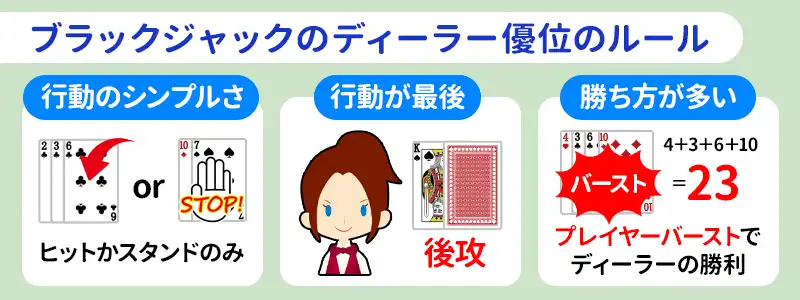
The sections above explain how the blackjack dealer plays. Many players may conclude that since the dealer acts automatically while players make their own decisions, the players must have the edge.
In reality, however, the dealer has the edge.
The Dealer Acts After the Players
In blackjack, the dealer draws cards only after the players have finished acting. The only part of the dealer’s hand that players can see is a single card, the upcard. This means players must decide without knowing the dealer’s final hand.
For example, an upcard of 6 may look reassuring, but the dealer can draw a 5 and then a 10-value card (10, J, Q or K) to make 21. Conversely, an upcard of 10 may look threatening, yet the dealer can draw two 6s in a row and bust.
This uncertainty makes it easy to misjudge a hand, for example by standing when you should hit or by cautiously hitting when you should double down. As a result, players give up expected value, even though blackjack itself has a high RTP.
The most important factor is the rule that a player who busts first loses immediately, regardless of whether the dealer busts afterward.
Whenever you hit on a total of 12 or more, you therefore run the risk of busting with the next card, and that risk grows as your total gets higher.
The dealer also busts fairly often, since the dealer must hit on 16 or less. If a player has already busted, however, the dealer wins that hand before drawing a single card, so acting last works in the dealer’s favor.
The Dealer Never Makes Mistakes
Because the dealer’s play is fixed by the rules, the dealer never makes mistakes.
In blackjack, players have to play out their own hands. Always choosing the action with the highest expected value is therefore the first step toward avoiding unnecessary losses.
A chart called basic strategy shows the action with the highest expected value in each situation, but following it exactly is not easy.
For example, when the dealer’s upcard is an ace and you hold a pair of 8s, most charts say to split, but it takes nerve to put more money on the table against an ace.
Sticking to basic strategy hand after hand is difficult, and human errors happen. The dealer makes no such errors, and that consistency alone works in the dealer’s favor.
Three Ways to Counter the Dealer’s Edge in Blackjack
As explained above, blackjack is a game that favors the dealer.
Even so, blackjack has one of the higher RTPs among casino games. Because the player’s decisions affect the outcome, how you play determines how close you come to the game’s full RTP.
Wait for the Dealer to Bust (Upcard of 2–6)
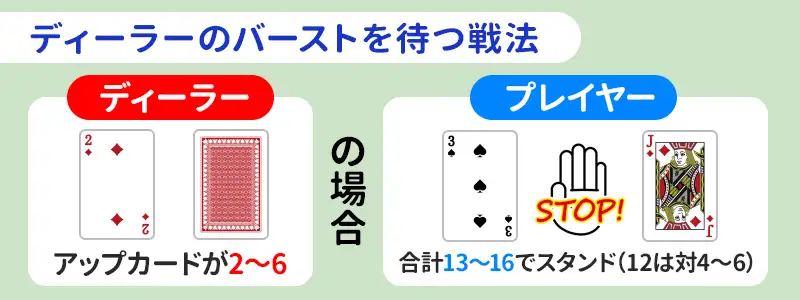
The fact that blackjack favors the dealer does not mean the dealer rarely busts.
When the dealer’s first card, the upcard, is a 2–6, the upcard and the face-down hole card often total 12–16. Since the dealer must hit on 16 or less, the bust rate rises to 35.4–42.3%. With an upcard of 5 or 6 it exceeds 40%, and it is highest with a 6, at 42.3%.
These figures are theoretical values for 8 decks with the dealer standing on soft 17.
For this reason, when your hand totals 13–16 (or 12 when the upcard is 4–6), stand rather than risk busting and let the dealer take the chance of going over.
When your hand totals 9–11, or when you hold a soft hand such as A + 6 or A + 5, doubling down often has a higher expected value than hitting against these upcards (for example, 9 against 3–6, or A + 6 against 3–6). Check the chart for the exact cells. If the chart calls for a double down, committing to it keeps you from giving up expected value.
Use Basic Strategy
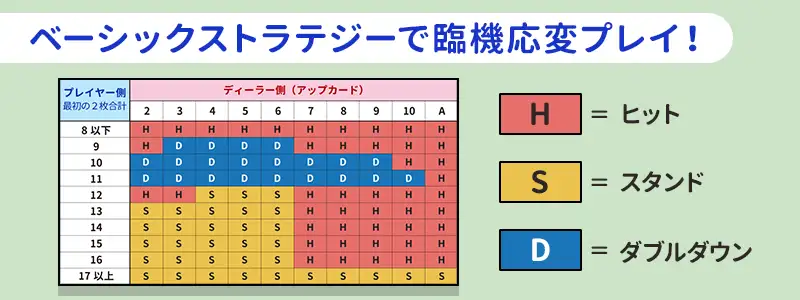
Blackjack has a chart that shows the action with the highest expected value for each situation, such as “hit on 12 when the dealer’s upcard is a 2.” This is called basic strategy.
Playing according to basic strategy typically gives an RTP of about 99.5%, depending on the rules. The chart covers not only hitting and standing but also special actions such as doubling down, splitting and surrendering, so even beginners can play without hesitating over their decisions.
Even when you follow it exactly, however, a house edge of about 0.5% remains. Basic strategy is not a way to win but a way to keep the house edge as low as possible.
- Related Article
-

Card Counting Works Only at Tables That Meet Certain Conditions
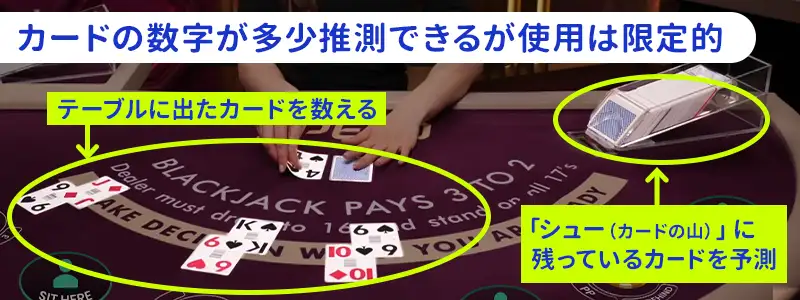
Card counting is a well-known blackjack technique.
In blackjack, cards are dealt from a box called a shoe, which holds several decks shuffled together. By keeping track of the cards already played, you can estimate to some extent which ranks remain in the shoe.
Card counting can also help you adjust your actions. For example, when many aces and 10-value cards remain, the chance of a natural blackjack (an ace plus a 10-value card) increases.
Counting does not change the RTP itself, but betting more in the situations where the count turns favorable can improve your expected value. It works only when the conditions are right, such as at tables where the shoe is not reshuffled early.
At RNG blackjack tables, which shuffle after every hand, at tables using continuous shuffling machines, and at online live tables that reshuffle when only a small part of the shoe has been dealt, counting does not lead to any practical advantage.
- Related Article
-

Two Principles Every Blackjack Player Should Follow

Avoiding unnecessary losses in blackjack takes more than clever techniques. Two things matter more: staying calm at all times and managing your bankroll strictly.
Blackjack asks the player to make many decisions, so beginners in particular often feel rushed. A mistake made under pressure adds to the stress, which leads to more mistakes and more losses in a vicious circle.
Make Decisions Calmly
Above all, blackjack requires knowing which action has the highest expected value in each situation. Base your decisions on the basic strategy chart.
If you play according to basic strategy, a loss is never the result of your own misjudgment. Remind yourself that you made the play with the highest expected value and simply lost to bad luck, and the stress is easier to manage.
When basic strategy calls for an action that requires an additional bet, such as doubling down or splitting, following it is also the best choice in terms of expected value.
For example, if you hit out of fear of losing in a situation that calls for a double down, your results drift away from the game’s expected value and your long-term losses grow.
Because blackjack favors the dealer, every favorable situation you fail to take advantage of adds to the expected value you give up. Play blackjack calmly and methodically, without letting fear drive your decisions.
Manage Your Bankroll Strictly
Strict bankroll management applies to every casino game, not just blackjack.
First, set your limits for the session: how much you need to win before you stop and lock in your winnings, and at what point you stop to cut your losses.
For example, suppose you decide to stop once you are $50 ahead or $100 behind. When you reach +$50, stop no matter how well things are going. When you reach −$100, stop no matter how much you want to win it back. Stick to these rules without exception.
Unexpected losses tend to stay with you longer than unexpected wins. Stop as soon as you reach the limit you set, whether you are winning or losing, so that you lock in your winnings and cut your losses while they are still small.
Frequently Asked Questions About the Dealer’s Edge in Blackjack
- Why does the dealer have to follow fixed rules?
-
There are several reasons the dealer’s actions are fixed, but the most important one is to keep the game fair.
Suppose the dealer could play each hand freely. A dealer who wanted to lose could easily do so hand after hand, for example by colluding with a particular player, and the game could not be kept fair.
Summary: The Dealer’s Edge Comes from Acting Last, and the Answer Is to Keep the House Edge Low
At first glance, blackjack seems to favor the player, who gets to choose their own actions. However, a player who busts first loses at that moment, regardless of whether the dealer busts afterward, and this rule gives the dealer the edge.
Players still have ways to counter it. Two methods matter most: do not draw unnecessarily when the dealer’s upcard makes a bust likely, and play according to basic strategy. Together, these keep the house edge as low as the rules allow.
Card counting works only at tables that meet certain conditions, so it is safest not to rely on it when playing online.
Even though the dealer has the edge, blackjack has one of the higher RTPs among casino games. If you play well, you can keep the house edge to a minimum and enjoy the game for longer.
This site is for adults of legal gambling age (18+, or older where required) who live in countries or regions where online gambling is legal.
Use of this site is subject to our Terms and Conditions.
Gambling involves risk. Only bet what you can afford to lose, and do not use online gambling services where they are illegal.

Bell | Editor of Online Casino Winners Club. Since the site launched in 2003, Bell has written guides to casino game rules, tested betting systems and covered land-based casinos around the world, and still plays the games before writing about them. Bell's core advice: choose the bets with the lowest house edge, and decide in advance how much you are prepared to lose.