

Blackjack Side Bets: Types, Payouts, RTP and Betting Tips

Some blackjack tables offer side bets alongside the main bet, the contest between the player and the dealer. Side bets offer high payouts that the main bet alone cannot match.
What You Will Learn
- To place a side bet, you must first place a main bet (Bet Behind is the exception).
- Side bets have a lower return to player (RTP) than the main bet, but they offer the chance of a large single win.

This article takes about 13 minutes to read.
What Are Blackjack Side Bets?
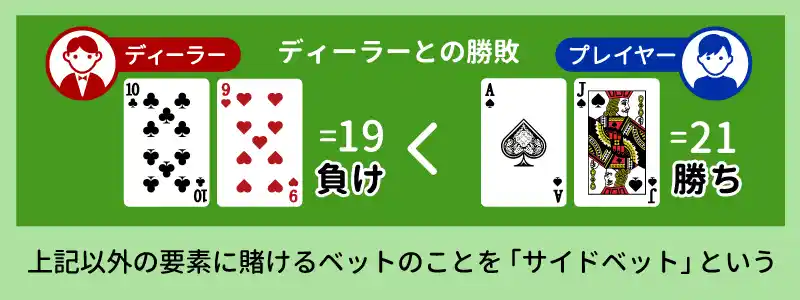
The central contest in blackjack is the main bet, in which the player and the dealer compete to finish closer to 21.
A side bet is settled separately from that contest. It is a wager on something other than whether you beat the dealer, such as the combination of cards dealt to you or the hand of another player.
There are many kinds of side bets, and the rules allow you to place several of them at once. Keep in mind, though, that the more side bets you place, the more of your money goes on bets with a low RTP. Except for Bet Behind, you cannot place a side bet without a main bet.
What Kind of Player Are Side Bets For?
When a winning combination comes up, a side bet can return anywhere from several times to several hundred times your stake, but the probability of that combination appearing is correspondingly low. Compared with the main bet, where results vary less from hand to hand, side bets win less often but pay much more when they do.
Side bets suit players who are looking for a large single win. Players who prefer a steady session and want to limit how quickly their bankroll shrinks are better off focusing on the main bet rather than side bets.
Types of Blackjack Side Bets and Their Payouts
| Group | Side bet | Payout |
|---|---|---|
| Perfect Pairs | Perfect Pair | 25–30 to 1 |
| Colored Pair | 10–12 to 1 | |
| Mixed Pair | 5–6 to 1 | |
| 21+3 | Suited Trips | 100 to 1 |
| Straight Flush | 40 to 1 | |
| Three of a Kind | 30 to 1 | |
| Straight | 10 to 1 | |
| Flush | 5 to 1 | |
| Hot 3 | 7-7-7 | 100 to 1 |
| Suited 21 | 20 to 1 | |
| Unsuited 21 | 4 to 1 | |
| Total of 20 | 2 to 1 | |
| Total of 19 | 1 to 1 | |
| Other | Bust It | 1–250 to 1 |
| Bet Behind | Same as standard blackjack |
Payouts in the table are given as odds, which state the amount won relative to the bet: at 25 to 1, a $10 bet wins $250. The 15 bets and winning hands above fall into four groups, each of which is explained below.
Perfect Pairs Side Bets in Blackjack
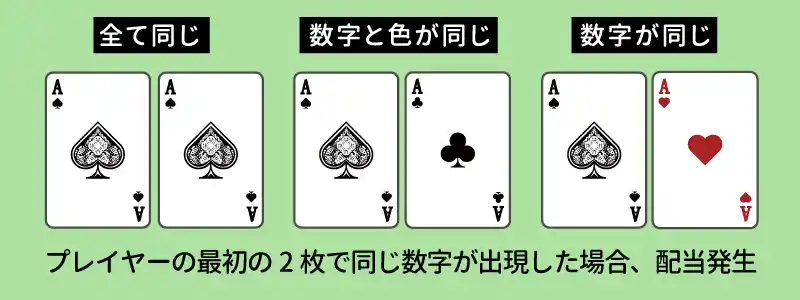
The best-known blackjack side bet is Perfect Pairs. It pays when the first two cards dealt to you are of the same rank, that is, when they form a pair.
Any pair wins, but a pair of the same color or the same suit (♠, ♦, ♣ or ♥) pays more.
Although all 10-value cards (10, J, Q and K) count as 10, only two cards of the same rank, such as 10 and 10 or K and K, count as a pair.
Perfect Pair
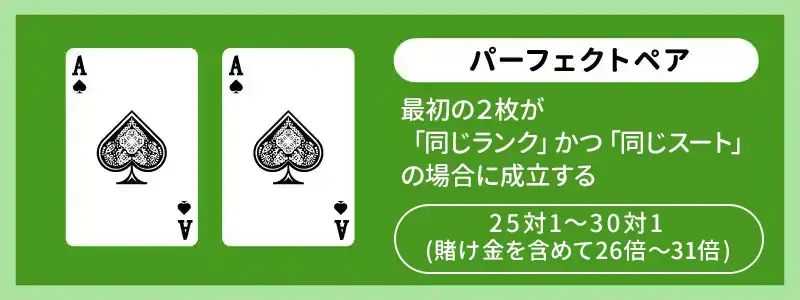
You have a Perfect Pair when your first two cards are of the same rank and the same suit. For example, if your first card is the A♠, the second card must be another A♠ (possible because the shoe contains several decks).
A Perfect Pair pays 25–30 to 1, so a $10 bet wins $250–$300.
Colored Pair
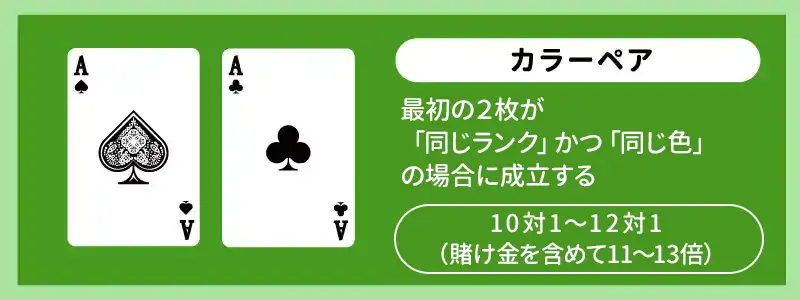
Your first two cards form a Colored Pair when they are the same rank and the same color but different suits. Hearts and diamonds are both red, and spades and clubs are both black. For example, if your first card is the A♠, you have a Colored Pair if the second card is the A♣.
A Colored Pair pays 10–12 to 1, so a $10 bet wins $100–$120.
Mixed Pair
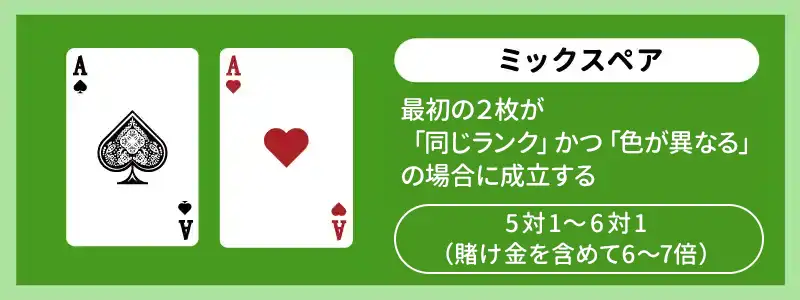
A Mixed Pair means your first two cards are of the same rank but different colors. For example, if your first card is the A♠, the second card must be the A♦ or the A♥ for a Mixed Pair. It is the most likely of the three combinations to appear, so it pays the least.
A Mixed Pair pays 5–6 to 1, so a $10 bet wins $50–$60.
21+3 Side Bets in Blackjack
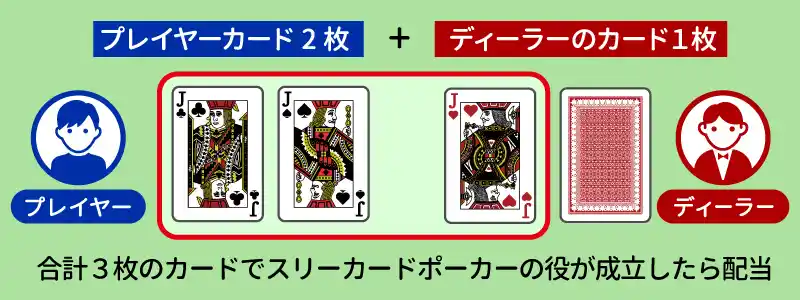
21+3 is a side bet that pays when your first two cards and the dealer’s upcard (the dealer’s first card) form a winning three-card poker hand.
The winning hands are similar to those in standard poker, such as flushes and straights, and the top payout is 100 to 1.
Suited Trips
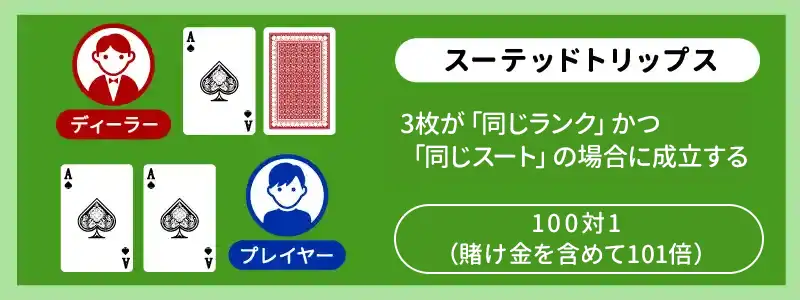
Suited Trips is the top hand in 21+3. All three cards must be of the same rank and the same suit.
For example, if your first card is the A♠, both your second card and the dealer’s upcard must also be the A♠. Because blackjack is played with 6–8 decks, each card appears several times in the shoe, so Suited Trips is possible, but it is very rare. That is why it pays so much.
Suited Trips pays 100 to 1, so a $10 bet wins $1,000.
Straight Flush
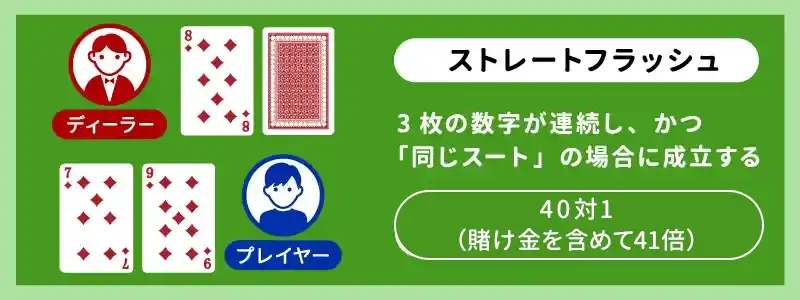
A straight flush is three cards in sequence, all of the same suit. The order in which the cards are dealt does not matter, as long as the three ranks are consecutive.
For example, if your first card is the 9♦, your second card is the 7♦ and the dealer’s upcard is the 8♦, the cards form the sequence 7-8-9 in a single suit, so you have a straight flush.
A straight flush pays 40 to 1, so a $10 bet wins $400.
Three of a Kind
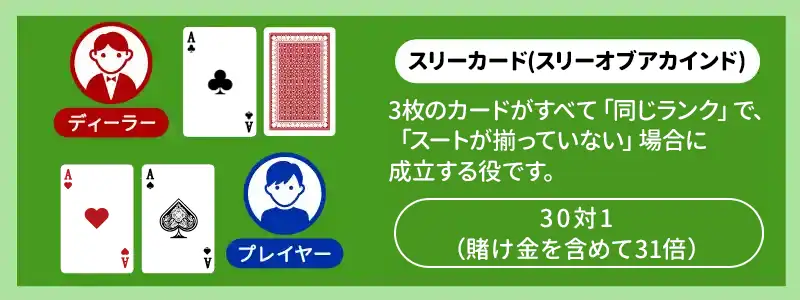
Three of a kind means all three cards are of the same rank but not all of the same suit.
Like Suited Trips, it requires three cards of the same rank, but because the suits do not have to match, it appears more often and pays less.
Three of a kind pays 30 to 1, so a $10 bet wins $300.
Straight
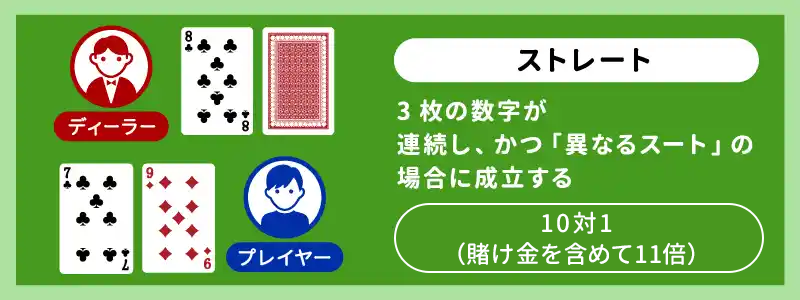
You have a straight when the three cards are in sequence but not all of the same suit. The order in which the cards are dealt does not matter, as long as the three ranks are consecutive.
For example, if your first card is the 9♦, your second card is the 7♣ and the dealer’s upcard is the 8♣, the cards form the sequence 7-8-9 but are not all of the same suit, so you have a straight.
A straight pays 10 to 1, so a $10 bet wins $100.
Flush
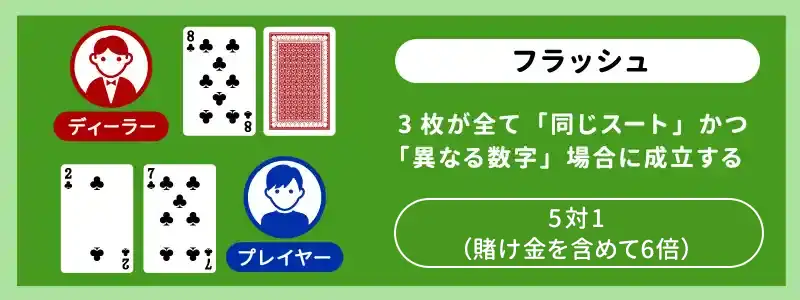
A flush is three cards of the same suit that are not in sequence. For example, you have a flush when your first card is the 2♣, your second card is the 7♣ and the dealer’s upcard is the 8♣.
A flush pays 5 to 1, so a $10 bet wins $50.
Hot 3 Side Bets in Blackjack
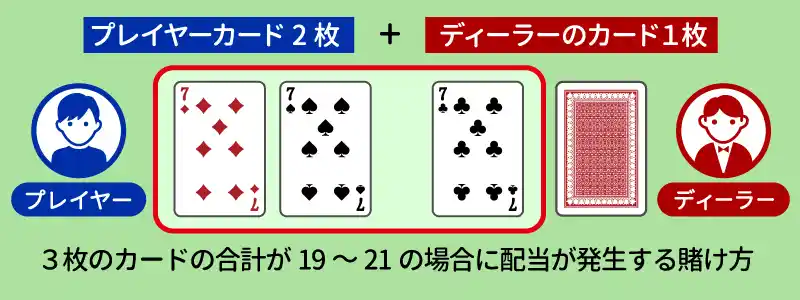
Like 21+3, Hot 3 is a side bet on three cards: your first two cards and the dealer’s upcard.
The bet pays when the three cards total 19–21. The payout rises with the total: a total of 19 pays 1 to 1, a total of 20 pays 2 to 1, an unsuited 21 pays 4 to 1 and a suited 21 pays 20 to 1. Three 7s, known as 7-7-7, pay 100 to 1.
Cards are counted as in standard blackjack: an ace counts as 1 or 11, and 10-value cards count as 10.
7-7-7
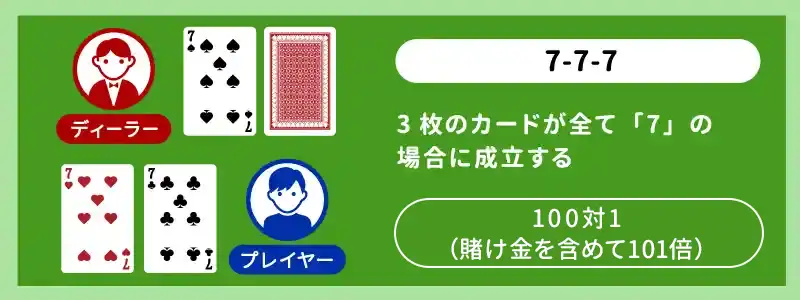
7-7-7 means all three cards are 7s. The suits do not have to match.
Because your first two cards are a pair of 7s, a Perfect Pairs bet wins at the same time, at a higher payout if the two 7s are the same color or suit. Because all three cards are 7s, a 21+3 bet wins as three of a kind, or as Suited Trips if all three are of the same suit. If you have placed several side bets, this one hand can win on all of them at once.
7-7-7 pays 100 to 1, so a $10 bet wins $1,000.
Suited 21
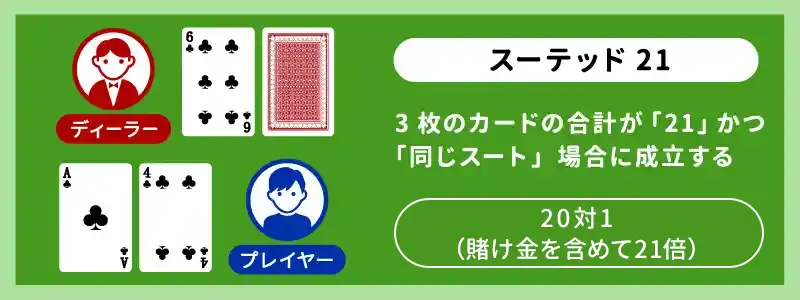
A suited 21 is three cards that total 21 and are all of the same suit.
For example, if your first card is the A♣, your second card is the 4♣ and the dealer’s upcard is the 6♣, the cards total 21 (11 + 4 + 6) in a single suit, so you have a suited 21.
A suited 21 pays 20 to 1, so a $10 bet wins $200.
Unsuited 21
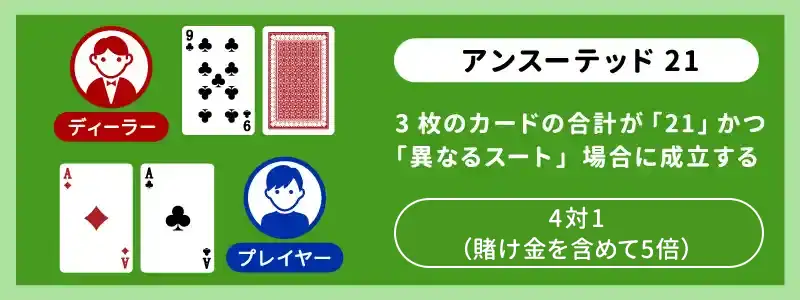
You have an unsuited 21 when the three cards total 21 but are not all of the same suit.
For example, if your first card is the A♦, your second card is the A♣ and the dealer’s upcard is the 9♥, the cards total 21 (11 + 1 + 9) and are not all of the same suit, so you have an unsuited 21.
An unsuited 21 pays 4 to 1, so a $10 bet wins $40.
Total of 20
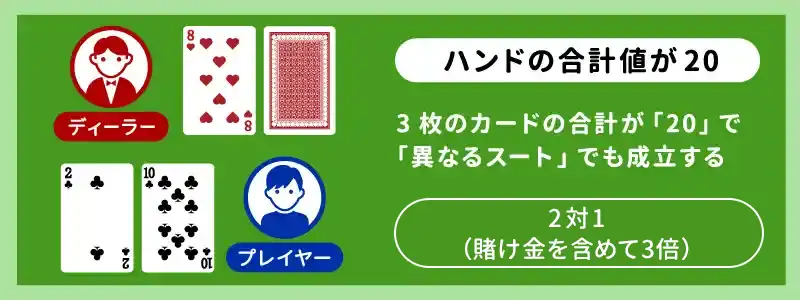
Hot 3 also pays when the three cards total 20. The payout is the same whether or not the cards are of the same suit, although if you have also placed a 21+3 bet, three cards of the same suit can pay more on that bet.
A total of 20 pays 2 to 1, so a $10 bet wins $20.
Total of 19
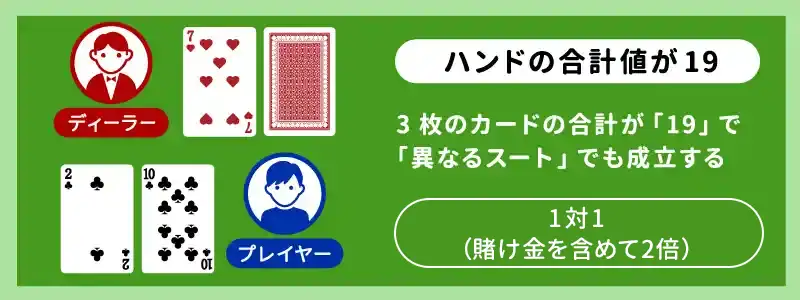
Hot 3 also pays when the three cards total 19. This is the most common winning result in Hot 3, so it has the lowest payout. The payout is the same whether or not the cards are of the same suit.
A total of 19 pays 1 to 1, so a $10 bet wins $10.
Other Blackjack Side Bets
Bust It
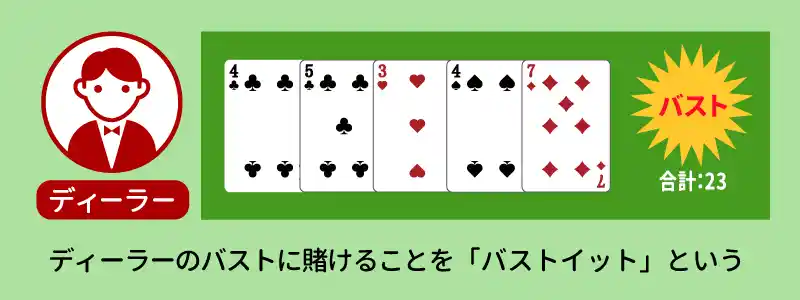
Bust It is a side bet that pays when the dealer’s hand reaches 22 or more and busts.
With 8 decks and the dealer standing on soft 17 (a 17 that counts an ace as 11), the dealer busts about 28% of the time across all upcards, so this bet wins more often than the other side bets. Its RTP, however, is about 94.1%, the lowest of the side bets covered here, so winning often does not make it a better bet. The payout is not fixed: it depends on how many cards the dealer holds at the moment of the bust.
| Cards in the dealer’s hand | Payout |
|---|---|
| 8 or more | 250 to 1 |
| 7 | 100 to 1 |
| 6 | 50 to 1 |
| 5 | 9 to 1 |
| 4 | 2 to 1 |
| 3 | 1 to 1 |
With the minimum of three cards, the bet pays 1 to 1, so a $10 bet wins $10, and with four cards it pays only 2 to 1, so a $10 bet wins $20. The payout rises sharply with each additional card, and a bust with 8 or more cards pays 250 to 1, the highest payout of any side bet covered here: a $10 bet wins $2,500.
A bust with 8 or more cards means the dealer’s first 7 cards total 16 or less and the next card takes the hand over 21, so this result is very rare. Because Bust It has the lowest RTP of the side bets covered here, it is best treated as a small bet placed in the hope of a large payout.
Bet Behind
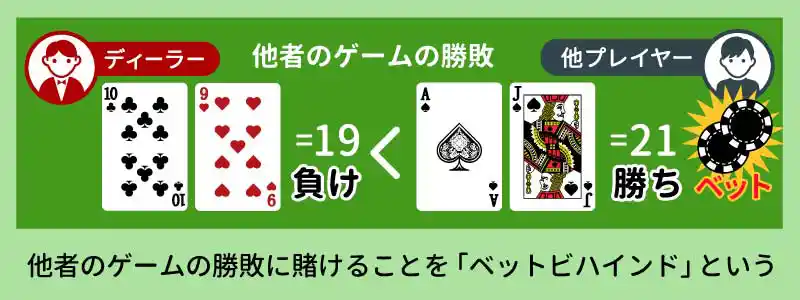
Bet Behind is one of the few bets you can place without playing a hand yourself. Unlike the other side bets, which are placed on card combinations, it rides on another player’s hand, and it is available even when every seat at the table is taken.
As the name suggests, you place your bet behind a seated player and win or lose with that player’s hand. Payouts are the same as in standard blackjack: if that player gets a natural blackjack, your bet pays 3 to 2, so a $10 bet wins $15.
However, you have no say in that player’s decisions, such as whether to hit or stand, and must leave every choice to them. Backing a player who follows basic strategy therefore keeps your theoretical loss as low as possible.
Bet Behind also has some additional rules. For example, if the player you are backing doubles down, you may choose whether to increase your bet as well, and if that player splits, you may choose whether to bet on both hands.
These rules vary by table, so check them before you play.
Pros and Cons of Blackjack Side Bets: RTP and House Edge
The RTP of a side bet varies from table to table, so treat the figures below as examples only.
| Side bet | RTP |
|---|---|
| Perfect Pairs | About 95.9% |
| 21+3 | About 96.3% |
| Hot 3 | About 94.6% |
| Bust It | About 94.1% |
The house edge is what remains when the RTP is subtracted from 100%. The high payouts that make side bets attractive and the low RTP that counts against them are two sides of the same coin: the house edge is simply the other way of expressing that low RTP. Figures of 94–96% may look high, but they correspond to a house edge of about 3.7–5.9%, roughly 10 times the main bet’s house edge of about 0.5%.
With basic strategy, the main bet has an RTP of around 99.5%, so side bets return 3–5 percentage points less.
There are two reasons for this. The first is that there is no optimal way to play a side bet.
With the main bet, you choose your own actions. Side bets are placed on outcomes you cannot influence, such as the first two cards you are dealt or whether the dealer busts.
The second reason is the chance of a large payout. Side bets pay up to 250 to 1, so a $10 bet can win $2,500, and these large payouts are their main appeal.
When you play, remember that the lower RTP is the price of those large payouts.
Three Tips for Blackjack Side Bets
(1) The Main Bet Comes First: Avoid Mistakes When Choosing Your Action
In blackjack, you cannot place a side bet without a main bet, with Bet Behind as the only exception. The main bet is always the core of the game.
Side bets are settled automatically, so your attention should stay on the main bet, where you have to choose your own actions.
Beginners who check a basic strategy chart before each decision should be especially careful not to be so distracted by their side bets that they choose the wrong action.
(2) Keep Side Bet Stakes Small Because of the Higher House Edge
As explained above, side bets have an RTP of about 94–96%, well below the main bet’s RTP of around 99.5%, and their winning combinations also come up less often.
For this reason, we recommend that you weight your bets toward the main bet in each round. If you bet a total of $30, for example, you might put $20 on the main bet, $5 on Perfect Pairs and $5 on 21+3, so that most of the money goes on the main bet.
(3) Card Counting Can Sometimes Help with Side Bets
Card counting is a technique in which you assign a point value to each card as it is dealt and keep a running total, so you can judge whether the cards remaining in the shoe are rich in high cards or low cards. It is used for the main bet in blackjack, but under the right conditions it can also serve as a guide to the expected value of a side bet. In online live blackjack, however, frequent shuffling and continuous shuffling machines (CSMs) make counting far less practical.
For example, the standard Hi-Lo system counts 7s as 0, so you would need a separate side count of 7s. If that count shows very few 7s have been dealt, the probability of 7-7-7 in Hot 3 is in theory slightly higher. Likewise, when many low cards remain, the dealer tends to draw several small cards, so a bust is more likely to come with a larger number of cards. In this situation, though, the probability that the dealer busts at all goes down, so higher payouts become more likely while wins become less frequent.
Card counting can therefore inform your side bet decisions when the conditions are right, but keep in mind that at most online tables those conditions are difficult to meet.
Summary: Side Bets Suit Players Who Want a Chance at a Large Payout
Blackjack side bets are popular wagers that can pay a large amount regardless of whether you win or lose the main hand. Their top payouts are high: 100 to 1 for the 21+3 and Hot 3 side bets, so a $10 bet wins $1,000, and up to 250 to 1 for Bust It, so a $10 bet wins $2,500. A single winning round can bring a large return.
Their RTP, however, is 3–5 percentage points lower than the main bet’s, and they win less often in exchange for larger individual payouts. Players who want to play for a long time while limiting how quickly their bankroll shrinks should focus on the main bet, while players looking for more excitement from blackjack can add side bets.
This site is for adults of legal gambling age (18+, or older where required) who live in countries or regions where online gambling is legal.
Use of this site is subject to our Terms and Conditions.
Gambling involves risk. Only bet what you can afford to lose, and do not use online gambling services where they are illegal.

Bell | Editor of Online Casino Winners Club. Since the site launched in 2003, Bell has written guides to casino game rules, tested betting systems and covered land-based casinos around the world, and still plays the games before writing about them. Bell's core advice: choose the bets with the lowest house edge, and decide in advance how much you are prepared to lose.