

Labouchère System: How to Build the Sequence and Set a Stop-Loss

The Labouchère system (also called the cancellation system or split martingale) is a betting system in which you divide your target profit into several numbers, then add and cross off numbers according to set rules. A cycle ends once every number has been crossed off.
How difficult the system is depends on how many numbers you split the target into, and the rules for adding and crossing off numbers take a little getting used to. If you clear the whole sequence, however, you finish the cycle with a profit equal to your target.
What You Will Learn
- The Labouchère system splits your target amount into three or more numbers to form a sequence. If you clear the sequence, you finish with a profit equal to the amount you set.
- The Labouchère system is somewhat difficult to use, and it helps to understand the Monte Carlo system first.

This article takes about 11 minutes to read.
What Is the Labouchère System?
The Labouchère system is a betting system that can be used in live dealer games and table games. Its other name, the cancellation system, comes from the way numbers in the sequence are canceled, or crossed off, each time you win.
You set your target amount in advance, and clearing the sequence earns you a profit equal to that amount. This clear goal is part of the system’s appeal. Being able to set a target is not the same as having an edge, however. The house edge itself does not change.
Casino Games That Work Well with the Labouchère System
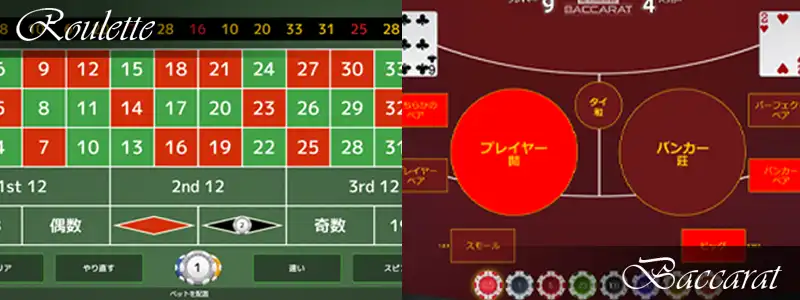
The Labouchère system assumes a bet that pays 1 to 1, so a $10 bet wins $10. For this reason, it is used with bets such as the following.
- Red/black, odd/even and high/low in roulette (the system works with any bet that covers 18 pockets)
- The Player bet in baccarat
In baccarat, the Banker bet carries a 5% commission and pays 0.95 to 1 (19 to 20), so a $10 bet wins $9.50. Even a winning bet does not fully recover the amount the sequence calls for, which is why players usually bet on Player. No-commission baccarat has a similar issue: a Banker win on 6 pays half (1 to 2), so a $10 bet wins $5, and the house edge on the Banker bet rises from about 1.06% to about 1.46%. In blackjack, plays that require an additional wager, such as doubling down and splitting, are sometimes the correct decision, and never making them significantly lowers the return to player (RTP).
How to Bet with the Labouchère System
Building the Sequence and the Basic Steps
First, set the profit you want to win in one cycle. A good guideline is about 10% of your total bankroll, which makes it easier to complete a cycle before your bankroll runs out. In this example, the target is $20.

Split this 20 into three or more numbers to form a single sequence. In other words, the numbers in the sequence must add up to 20. You can split it any way you like, but the usual practice is to list the numbers from smallest to largest, left to right (for example, 3, 4, 6, 7). In this explanation, we use the sequence 2, 3, 4, 5, 6.
Your first bet is the sum of the numbers at the left and right ends of the sequence. With the sequence 2, 3, 4, 5, 6, you bet 2 + 6 = $8.
If You Win

If you win, cross off the numbers at both ends.
The sequence 2, 3, 4, 5, 6 becomes 3, 4, 5, so your next bet is 3 + 5 = $8.
If You Lose
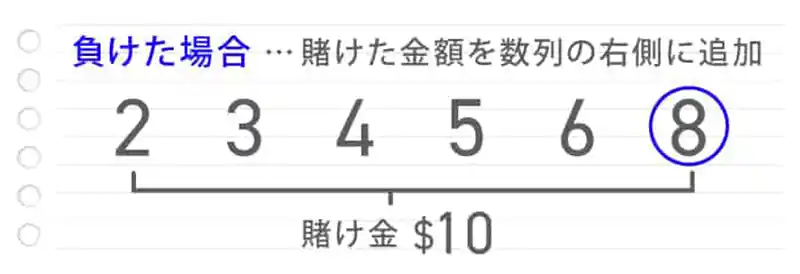
If you lose, add the amount you just bet to the right end of the sequence.
The sequence 2, 3, 4, 5, 6 becomes 2, 3, 4, 5, 6, 8, so your next bet is 2 + 8 = $10.
If a win leaves only one number in the sequence, bet that number alone.
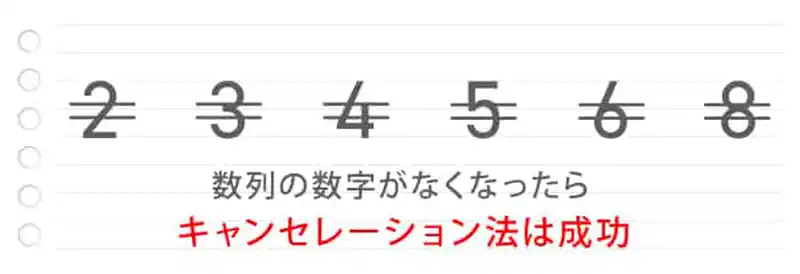
Keep repeating these steps. Once no numbers are left in the sequence, the cycle is complete. At that point, you have made a profit equal to the target amount you set.
Results of a Labouchère System Simulation
The simulations below assume you keep betting on black in roulette. Because the starting sequence can differ from cycle to cycle, we go through the bet amounts one cycle at a time.
Cycle 1
| Round | Bet | Result | Win/loss | Running total | Sequence |
|---|---|---|---|---|---|
| Starting sequence | 2, 3, 4, 5, 6 | ||||
| 1st | $8 | Loss | −$8 | −$8 | 2, 3, 4, 5, 6, 8 |
| 2nd | $10 | Win | $10 | +$2 | 3, 4, 5, 6 |
| 3rd | $9 | Loss | −$9 | −$7 | 3, 4, 5, 6, 9 |
| 4th | $12 | Win | $12 | +$5 | 4, 5, 6 |
| 5th | $10 | Win | $10 | +$15 | 5 |
| 6th | $5 | Win | $5 | +$20 | (Sequence cleared; cycle ends) |
Cycle 1 starts with the sequence 2, 3, 4, 5, 6, so the target is $20 in total. The cycle ended with 4 wins and 2 losses, and once the whole sequence had been crossed off, the profit was exactly $20.
Note that the Monte Carlo system ends when one number or fewer remains, while the Labouchère system continues even when only one number is left.
Cycle 2
| Round | Bet | Result | Win/loss | Running total | Sequence |
|---|---|---|---|---|---|
| Starting sequence | 2, 3, 4, 5, 6 | ||||
| 1st | $8 | Loss | −$8 | −$8 | 2, 3, 4, 5, 6, 8 |
| 2nd | $10 | Loss | −$10 | −$18 | 2, 3, 4, 5, 6, 8, 10 |
| 3rd | $12 | Win | $12 | −$6 | 3, 4, 5, 6, 8 |
| 4th | $11 | Loss | −$11 | −$17 | 3, 4, 5, 6, 8, 11 |
| 5th | $14 | Loss | −$14 | −$31 | 3, 4, 5, 6, 8, 11, 14 |
| 6th | $17 | Win | $17 | −$14 | 4, 5, 6, 8, 11 |
| 7th | $15 | Loss | −$15 | −$29 | 4, 5, 6, 8, 11, 15 |
| 8th | $19 | Win | $19 | −$10 | 5, 6, 8, 11 |
| 9th | $16 | Loss | −$16 | −$26 | 5, 6, 8, 11, 16 |
| 10th | $21 | Win | $21 | −$5 | 6, 8, 11 |
| 11th | $17 | Loss | −$17 | −$22 | 6, 8, 11, 17 |
| 12th | $23 | Win | $23 | +$1 | 8, 11 |
| 13th | $19 | Win | $19 | +$20 | (Sequence cleared; cycle ends) |
This second simulation shows a cycle in which losses piled up early on. Even with 6 wins and 7 losses, the cycle still produced a profit of $20. The Labouchère system makes it easier to complete a cycle when you win more than about one-third of your bets, but keep in mind that this does not remove the house edge.
The running total in this cycle also dropped to −$31 at one point. The longer the sequence grows, the lower the chance of clearing it, so it is sensible to cut your losses at a point you decide on. Our recommended stop-loss limit is reached when the sequence becomes five or more numbers longer than at the start.
With the same $20 target, changing the sequence to something like 1, 2, 3, 4, 10 changes the bet amounts along the way, but clearing it still earns the same $20. The target is set by the sum of the sequence, not by how you split it.
Advantages of the Labouchère System
- Works for both low-risk and high-risk play
- On a bet that pays 1 to 1, a cycle is easier to complete when you win more than about one-third of your bets
- Clear goal: you set your own target, and a successful cycle earns exactly that amount
Each bet is the sum of the two numbers at the ends of the sequence, so each bet is roughly twice the average of the numbers in the sequence (the sum of the sequence divided by how many numbers it contains, times two). With the same target, splitting the sequence into more numbers makes each bet smaller. Being able to choose both the target and how many numbers the sequence contains is what makes this betting system flexible.
Because the system follows the same mechanics as the Monte Carlo system, on bets that pay 1 to 1 the sequence tends to be easier to clear when you win more than about one-third of your bets. The house edge itself stays the same.
Disadvantages of the Labouchère System
- The longer a cycle lasts, the higher the bets become
- The first bet is fairly high, so a losing streak carries real risk
- Hard to use without first understanding the Monte Carlo system
Like the Monte Carlo system, the Labouchère system works with a sequence of numbers, so it is easier to pick up if you already know the simpler Monte Carlo system. It is somewhat demanding for players trying a betting system for the first time, so we recommend getting comfortable with the more basic systems first.
Many betting systems let you start with a bet of about $1, but even at medium risk the Labouchère system requires a bet of roughly one-half to one-third of your target. For example, with a target profit of $50, the first bet is typically around $20. Instead of trying to reach the full target in a single cycle, set a smaller target and spread it over several cycles. This keeps the swings in each cycle smaller.
Finally, as with the Monte Carlo system, a Labouchère cycle that drags on without succeeding pushes the bets higher, and a single bet can end up exceeding the target amount. At times it makes sense to cut your losses, reset the sequence and start a new cycle.
What to Know Before Using the Labouchère System
Using the Labouchère system does not change the expected value or the house edge of the game. Only the size of the swings in your results (the variance) changes. The system simply reshapes the distribution of outcomes: a high probability of small wins is traded for a low probability of a large loss.
Each loss lengthens the sequence and raises the next bet, so the bankroll you need grows rapidly during a losing streak. If you start with a $20 target and the sequence 2, 3, 4, 5, 6 and then lose five times in a row, the sequence grows to 10 numbers, your total loss reaches $60 and the next bet is $18. At that point you have just reached our recommended stop-loss limit (the sequence is five or more numbers longer than at the start).
Table limits and your bankroll are both finite, so at some point you will no longer be able to keep extending the sequence. Once you hit that limit, all the losses accumulated up to then become final. The profit from one cycle is fixed at your target, while the loss from a failed cycle has no upper limit.
That is why you should set a stop-loss limit before you start. A stop-loss limit does not change the expected value either. It is a money management rule that caps how much you can lose in one session. Play with a bankroll you can comfortably afford.
The Labouchère System Is Easy to Adjust and Customize
The Labouchère system is a very flexible betting system. By changing how you split the sequence, you can set the level of risk yourself: keep the risk low and play over a longer stretch, or raise each bet to complete a cycle quickly. For example, with a $20 target, you can build sequences for each risk level as follows.
| High risk | 5, 5, 10 | 6, 6, 8 |
|---|---|---|
| Medium risk | 2, 3, 4, 5, 6 | 3, 3, 4, 5, 5 |
| Low risk | 1, 1, 2, 2, 3, 3, 4, 4 | 2, 2, 2, 2, 2, 2, 2, 2, 2, 2 |
Here is a simulation of the Labouchère system using a high-risk sequence of three numbers.
Target set at $20
| Round | Bet | Result | Win/loss | Running total | Sequence |
|---|---|---|---|---|---|
| Starting sequence | 6, 6, 8 | ||||
| 1 | $14 | Loss | −$14 | −$14 | 6, 6, 8, 14 |
| 2 | $20 | Win | $20 | +$6 | 6, 8 |
| 3 | $14 | Loss | −$14 | −$8 | 6, 8, 14 |
| 4 | $20 | Win | $20 | +$12 | 8 |
| 5 | $8 | Win | $8 | +$20 | (Sequence cleared, cycle ends) |
The bets are higher, but the target profit was reached quickly. In general, the fewer numbers in the sequence, the higher each bet and the higher the risk, but the sooner you can reach the target.
Some sources give a two-number sequence as a high-risk example, but we do not recommend using only two numbers. With the sequence 10, 10, for example, the first bet is 10 + 10 = $20. You would be betting the full target profit on a single bet, which defeats the purpose of splitting the target into a sequence.
Betting Systems Similar to the Labouchère System
Monte Carlo System
The Monte Carlo system has come up several times in this article. Like the Labouchère system, it is a betting system that works with a sequence of numbers.
The steps are the same as in the Labouchère system, with two differences. A Monte Carlo cycle ends as soon as one number is left in the sequence, and the starting sequence follows a 1:2:3 ratio, with a separate way of crossing off numbers for bets that pay 2 to 1.
Because the procedure is the same, the advantages and disadvantages are also largely the same as those of the Labouchère system.
The Winners Method
The Winners Method is similar to the Labouchère system in that it also uses a sequence of numbers.
It differs from the Labouchère system in two ways: you start building the sequence only after two losses in a row, and after a win you cross off only the leftmost number, not the numbers at both ends.
The bets do not increase during a losing streak, so the loss on each bet stays relatively small, and the longer a cycle lasts, the larger the profit when it succeeds. However, the Winners Method succeeds only if your overall win rate ends up above 50%, which is a stricter condition than the Labouchère system requires. Smaller swings do not tilt the odds in your favor.
Summary: A Sequence-Based Betting System with a Profit Target You Set First
The Labouchère system is a betting system you can use in games such as baccarat and roulette. You build your own sequence of numbers, bet the sum of the numbers at both ends, and add or cross off numbers in the same way as in the Monte Carlo system. When every number has been crossed off, the cycle is complete and you have won a profit equal to the target you set at the start.
You choose the target yourself, and on even-money bets a cycle tends to be easier to complete once your win rate is above about one-third. However, only the size of the swings changes; neither the expected value nor the house edge changes. The loss from a failed cycle has no upper limit, so decide on a stop-loss limit and a realistic target before you start.
- Martingale Strategy Explained
- D'Alembert Betting System
- Paroli Betting System
- Labouchère Betting System
- Percentage Betting (10% System)
- Oscar's Grind Betting System
- 1-3-2-6 Betting System
- 1-2-3-5 Betting System
- Monte Carlo Betting System
- Cocomo Betting System
This site is for adults of legal gambling age (18+, or older where required) who live in countries or regions where online gambling is legal.
Use of this site is subject to our Terms and Conditions.
Gambling involves risk. Only bet what you can afford to lose, and do not use online gambling services where they are illegal.

Bell | Editor of Online Casino Winners Club. Since the site launched in 2003, Bell has written guides to casino game rules, tested betting systems and covered land-based casinos around the world, and still plays the games before writing about them. Bell's core advice: choose the bets with the lowest house edge, and decide in advance how much you are prepared to lose.