

Basic strategy is the first thing to learn if you want to play blackjack well. What You Will Learn Basic strategy is the fundamental way to play every…
Percentage Betting: How the 10% System Works and When to Stop

The 10% system (a form of percentage betting) is a betting system in which you always bet 10% of your current bankroll. With $100, you bet $10. If you win, your next bet is $11, which is 10% of $110; if you lose, it is $9, which is 10% of $90.
Because your bet size follows your bankroll, the system adjusts easily to both winning and losing streaks. The drawback is that winning back the losses from a long losing streak takes a long winning streak.
What You Will Learn
- As the name suggests, the 10% system is a betting system in which you simply bet 10% of your bankroll every time.
- Your bet grows during winning streaks and shrinks automatically during losing streaks, which helps keep the swings in your results small.

This article takes about 9 minutes to read.
Contents
Show
What Is the 10% System?
The 10% system is a betting system that can be used in table games such as roulette and baccarat, whether at a standard table or with a live dealer. A betting system is a way of managing your bankroll in which the size of each bet changes according to rules set in advance.
As the name suggests, the system works by having you always bet 10% of your bankroll, so even first-time players can follow it without confusion. The procedure is straightforward, but because your bet rises and falls in proportion to your bankroll during both winning and losing streaks, your results tend to move more gradually.
How to Bet with the 10% System

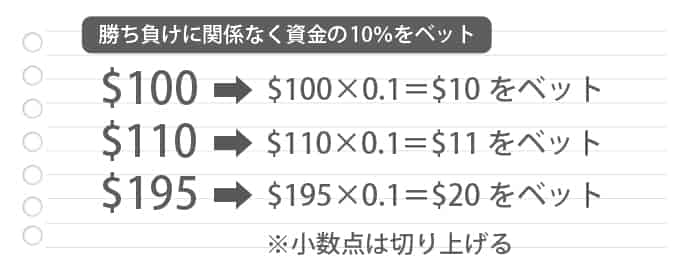
Your bet is always 10% of your bankroll. With $100, for example, you bet $10. If you win that bet, your bankroll becomes $110, so your next bet is $11.
Round any fraction up. If your bankroll is $195, for example, 10% is $19.50, which you round up to a $20 bet.
Keep betting 10% of your bankroll in the same way after every result. The system has no fixed profit-lock level or stop-loss limit, so you need to set both yourself. Guidelines are given later in this article, in the section on what to keep in mind when using the system.
Casino Games That Work Well with the 10% System
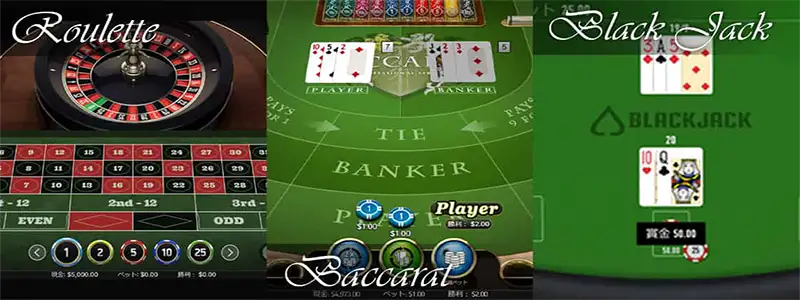
The 10% system is designed for even-money bets that pay 1 to 1. Because the next bet is based on your balance rather than on the exact amount you just won, however, it also works with bets that pay close to even money. The casino games that suit it best are the following:
- European roulette bets with an 18 in 37 (about 48.65%) chance of winning, such as red/black, odd/even and high/low
- The Player bet in baccarat (about 49.32% chance of winning, excluding ties) and the Banker bet (about 50.68% on the same basis, although a 5% commission is deducted, which means it pays 0.95 to 1 (19 to 20), so a $10 bet wins $9.50)
- Blackjack
In blackjack, doubling down and splitting require you to put up a second bet equal to your original bet. This does not cause a problem: even if your total bet increases after a double down or split, simply recalculate your next bet as 10% of your balance at that point.
Simulation Results for the 10% System
For this simulation, we started with a bankroll of $100 and placed the Player bet in baccarat.
| Round | Bet | Result | Win/loss | Running total | Balance |
|---|---|---|---|---|---|
| 1 | $10 | Win | $10 | +$10 | $110 |
| 2 | $11 | Loss | −$11 | −$1 | $99 |
| 3 | $10 | Win | $10 | +$9 | $109 |
| 4 | $11 | Loss | −$11 | −$2 | $98 |
| 5 | $10 | Win | $10 | +$8 | $108 |
| 6 | $11 | Loss | −$11 | −$3 | $97 |
| 7 | $10 | Loss | −$10 | −$13 | $87 |
| 8 | $9 | Loss | −$9 | −$22 | $78 |
| 9 | $8 | Loss | −$8 | −$30 | $70 |
| 10 | $7 | Loss | −$7 | −$37 | $63 |
| 11 | $7 | Win | $7 | −$30 | $70 |
| 12 | $7 | Win | $7 | −$23 | $77 |
| 13 | $8 | Win | $8 | −$15 | $85 |
| 14 | $9 | Win | $9 | −$6 | $94 |
| 15 | $10 | Win | $10 | +$4 | $104 |
| 16 | $11 | Win | $11 | +$15 | $115 |
| 17 | $12 | Win | $12 | +$27 | $127 |
We stopped and locked in the profit once we were up $27 after 10 wins and 7 losses. Starting from a balance of $100, the first rounds alternate between wins and losses: win, loss, win, loss. The difference is small, but because the 10% system raises the bet after a win and lowers it after a loss, a repeated win-loss pattern gradually eats into your bankroll.
A losing streak follows, but because the bet shrinks after every loss, the loss on each round does not grow. With the Martingale system and the same $10 starting bet, you would have to place $320, or 32 times the initial bet, on the sixth hand after five straight losses, and your cumulative loss up to that point would already reach $310. The difference is that this sharp increase never happens with the 10% system.
A winning streak at the end brought the session into profit. Because the bet does not jump sharply even during a winning streak, your balance moves more smoothly.
Advantages and Disadvantages of the 10% System
- Profits grow easily during a winning streak, but recovering from a losing streak requires a winning streak
- Risk during a losing streak is limited, but the starting bet is higher than with other betting systems
- The system is easy for beginners to use, but you have to calculate each bet yourself
Because your bet moves with your balance under the 10% system, the swings in your results stay small during both winning and losing streaks. This is also why you tend to keep some of your profit even if you start losing after a winning streak.
Because the 10% system lowers your bet during a losing streak, the loss on each round becomes smaller, but recovering also takes a long winning streak. As long as the game has a house edge, the long-term expected value never turns positive, and changing how you size your bets does not change that.
The starting bet is also high compared with other betting systems: with a $100 bankroll, for example, you have to start at $10. If that feels like too much, you can lower the percentage and bet 5% of your bankroll instead, for example.
The procedure itself is simple, but because the bet changes every round, it helps to work out each bet with a calculator app until you get used to the system.
What the 10% System Changes and What It Does Not Change
Any betting system, the 10% system included, can change only two things: the size of the swings in your results (the variance) and the shape of the distribution of wins and losses. The game’s house edge, its return to player (RTP) and your total expected value stay exactly the same no matter how you size your bets.
The 10% system moves your bet in proportion to your balance, so the loss on each round automatically gets smaller during a losing streak. The trade-off is that recovering from a long losing streak takes more wins than the losses you suffered, since a winning streak of the same length will not bring you back to where you started. Your balance also grows more slowly when you win. The system only spreads your losses out more evenly; it does not reduce the house edge itself.
Your bet also has to stay within the table limits. The 10% system raises your bet as your balance grows, so with a large enough bankroll, your bet eventually reaches the table limit, and you can no longer bet 10% of your balance. At a table with a $500 maximum bet, for example, you can no longer keep the ratio once your balance exceeds $5,000.
The most you should expect to lose is the stop-loss limit you set in advance. If you start with $100 and decide to stop when your balance falls below 50%, the most you can lose in that session is $50. The system makes it hard to lose your bankroll all at once, but losses can build up over time, so set your bankroll at an amount you can afford to lose.
Things to Keep in Mind When Using the 10% System
Set a Clear Profit-Lock Level and Stop-Loss Limit, and Stick to Them
The 10% system has no fixed rule for when to lock in profits or cut losses, so you need to decide these yourself. Because the bet gets smaller as your balance falls, it takes a long time for your bankroll to approach zero. We recommend setting your stop-loss limit at around the point where your bankroll drops below 50%.
For the profit-lock level, a reasonable guide is a gain of about 20–30% to lock in profits more often. If you would rather make a larger profit each time, aim for a gain of anywhere from about 50% to 100% (doubling your bankroll).
Setting a stop-loss limit or a profit-lock level does not change the expected value itself. These are money management rules that cap how much you can lose in a single session.
Combine It with the Right Playing Strategy for the Game
Blackjack, for example, has basic strategy, which sets out the best decision for each hand. Depending on the rules, following it brings the RTP close to the game’s theoretical value of over 99%. The 10% system only determines how much you bet, so the two serve different purposes. Combining them does not change the RTP or the house edge. It lets you avoid costly mistakes while keeping your bet sizing consistent.
- Related Article
-

Betting Systems Similar to the 10% System
Here are three betting systems that, like the 10% system, help keep the loss on each round small.
31 System
The 31 system moves your bet between 1 and 8 units according to a fixed table, and two wins in a row at any point put you in profit. Winning twice in a row is a hurdle, but you get up to nine chances, and even if you lose nine times in a row, your loss is capped at 31 units. This makes it easy to estimate in advance how much you could lose.
Many variations and refinements of the system exist, and once you are used to it, it is easy to adjust to the size of your bankroll.
Monte Carlo System
The Monte Carlo system raises and lowers your bet according to a sequence of numbers. You cross numbers off the sequence after each win and add a number after each loss, and one cycle ends when the whole sequence has been crossed off or only one number is left.
It takes some getting used to, but on bets that pay 2 to 1, such as dozen bets and column bets, a single win crosses off four numbers (two from each end). A cycle is therefore relatively easy to complete even though these bets win only about one time in three, and your bet does not rise sharply during a losing streak. However, the profit from completing a cycle and the loss when a cycle fails are not symmetrical, and there is no guarantee that you will be able to clear the sequence.
2-1-2 System
As its name suggests, the 2-1-2 system moves your bet in the order of 2 units, 1 unit and 2 units. The sequence does not always run in full, though: if you bet 2 units first and lose, that cycle counts as a failure and you move on to the next one.
Only if you win the first 2-unit bet do you go on to bet 1 unit and then 2 units, and these two bets are always placed, whether they win or lose. Because the system continues only after you have won the first 2 units, even losing both of the following bets costs you just 1 unit, so the loss per cycle tends to stay small.
Summary: The 10% System Smooths Out Swings but Does Not Change the Expected Value
The 10% system is a betting system that can be used at a wide range of table games, including live dealer versions. It is a very simple money management method: you always bet 10% of the bankroll you currently have.
Your bet rises during a winning streak and falls during a losing streak, which helps your balance move more smoothly. Only the size of the swings and the pattern of wins and losses change. The expected value and the house edge stay the same. The system also does not require a bet that pays exactly 1 to 1. Besides red/black in roulette and the Player bet in baccarat, it works well with the Banker bet in baccarat, which charges a commission, and with blackjack, where payouts vary.
Beginner's Guide to Betting Systems
- Martingale Strategy Explained
- D'Alembert Betting System
- Paroli Betting System
- Labouchère Betting System
- Percentage Betting (10% System)
- Oscar's Grind Betting System
- 1-3-2-6 Betting System
- 1-2-3-5 Betting System
- Monte Carlo Betting System
- Cocomo Betting System
This site is for adults of legal gambling age (18+, or older where required) who live in countries or regions where online gambling is legal.
Use of this site is subject to our Terms and Conditions.
Gambling involves risk. Only bet what you can afford to lose, and do not use online gambling services where they are illegal.

Bell | Editor of Online Casino Winners Club. Since the site launched in 2003, Bell has written guides to casino game rules, tested betting systems and covered land-based casinos around the world, and still plays the games before writing about them. Bell's core advice: choose the bets with the lowest house edge, and decide in advance how much you are prepared to lose.