

Oscar's Grind Betting System: How It Works, Pros and Cons

Oscar’s Grind is a betting system in which you do not raise your bet during a losing streak and raise it only during a winning streak. Even if you are behind, a run of wins afterward makes it relatively easy to recover your losses.
What You Will Learn
- Oscar’s Grind is a betting system in which you keep your bet the same when you lose and raise it when you win.
- Even after a long losing streak, a short run of wins can recover your losses relatively easily.

This article takes about 14 minutes to read.
What Is Oscar’s Grind?
Oscar’s Grind is a betting system used in table games and live dealer games such as roulette and baccarat. It aims for a profit by keeping your bet flat after losses and raising it after wins.
Because the bet goes up after a win, Oscar’s Grind is classed as a positive progression system. It works the opposite way from the Martingale system and the Cocomo system, which raise the bet after a loss (negative progression systems).
Casino Games That Work Well with Oscar’s Grind

Oscar’s Grind is designed for even-money bets, which pay 1 to 1: a $10 bet wins $10.
| Game | Bets you can use | Notes |
|---|---|---|
| Roulette | Red/black, odd/even, high (19–36)/low (1–18) | Any combination that covers 18 pockets works, so you can also use the system with bets covering 0 and 1–17 |
| Baccarat | Player bet | The Banker bet is excluded because a 5% commission is deducted: it pays 0.95 to 1 (19 to 20), so a $10 bet wins $9.50. In no-commission baccarat the Banker bet pays 1 to 1, but its house edge rises from about 1.06% to about 1.46% |
| Sic Bo | Big/Small | – |
| Dream Catcher | – | The “1” segment hits only about 44.23% of the time, even counting respins from the multiplier segments, and multipliers mean the payout is not constant, so avoid using the system here |
| Blackjack | – | Not recommended, because splits and double downs can require additional bets |
How to Bet with Oscar’s Grind: Rules and Steps
Oscar’s Grind has many variations. This article explains the most common one, which we call the one-unit profit method.
Each sequence of bets that ends in a profit is called a cycle, and you bet according to the steps below.
- Choose the unit size and the game
- If your first bet wins, the cycle ends; if it loses, the cycle continues
- Change your next bet based on the result
- Adjust the bet when a win would bring a profit of two units or more
Step (1): Choose the Unit Size and the Game
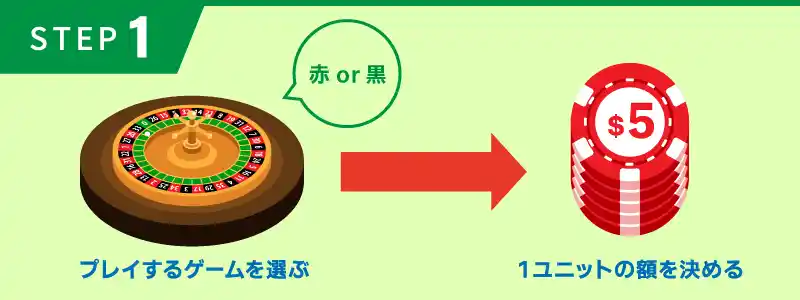
First, decide how much one unit is worth. One unit is both your first bet and the profit you make when a cycle succeeds. In this article, one unit is $5.
Once you have set the unit, choose one of the games that work well with the system and start betting. Your first bet is one unit ($5 here).
Step (2): If Your First Bet Wins, the Cycle Ends; If It Loses, the Cycle Continues
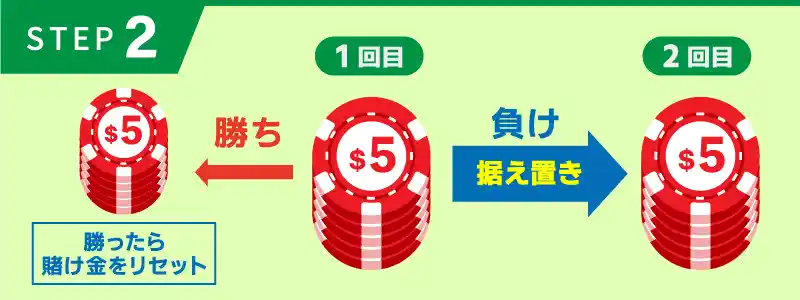
If you win your first bet, you have already reached the target profit of one unit, so the cycle ends successfully. Reset your bet to one unit ($5) and start the next cycle.
If you lose, the cycle continues. Your bet stays the same after a loss, so you bet one unit ($5) again.
Step (3): From the Second Bet On, Change Your Next Bet Based on the Result
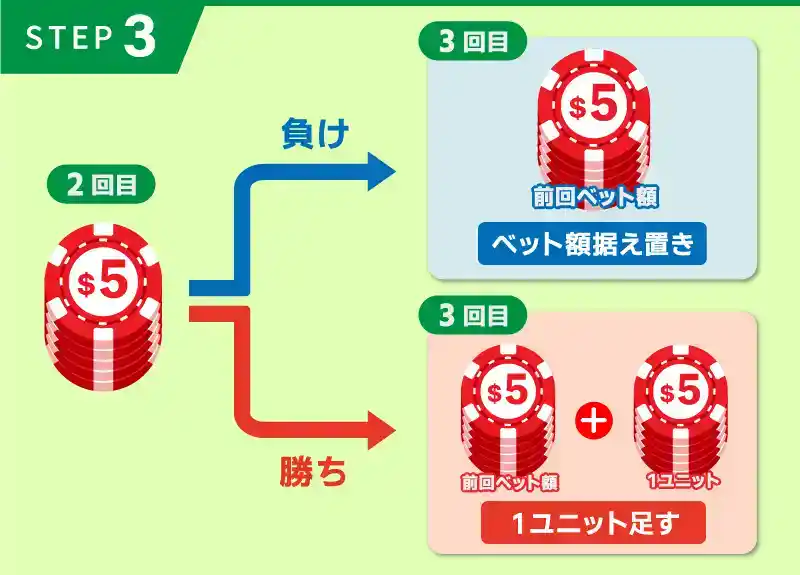
From the second bet on, how you change your bet depends on whether you win or lose.
If you lose
After a loss, leave your bet unchanged and bet one unit ($5) again. Keep doing this until you win.
If you win
After a win, add one unit to your bet (if your current bet is $5, raise it to $10). Repeat this until you reach the point where one more win would put you in profit.
In short, keep your bet the same after a loss and add one unit ($5) after a win.
Step (4): Adjusting the Bet When the Next Win Would Produce a Profit
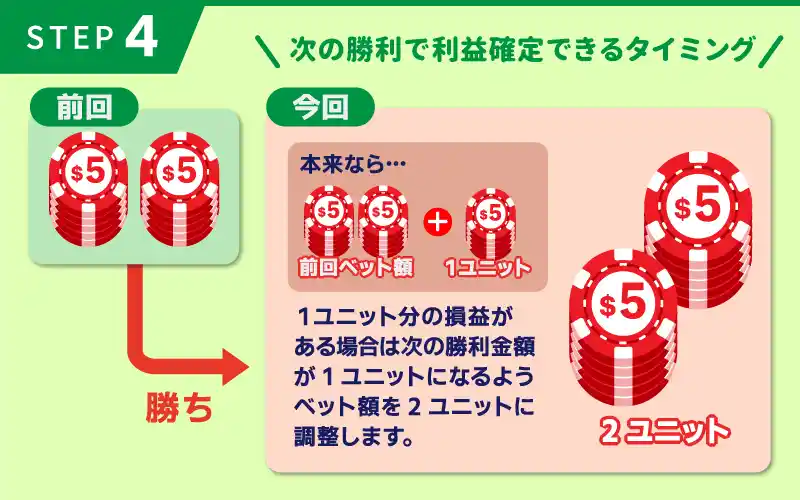
Oscar’s Grind relies on winning streaks, so a run of wins always brings you to a point where the next win would produce a profit. At that point, if a win would bring a profit of two units or more, you must adjust your bet so that the profit is exactly one unit.
This adjustment keeps your bet and your cumulative loss from growing too large if you lose, so remember to make it every time.
What happens if you do not adjust
Take a cycle with one unit set at $5 that starts with four losses followed by two wins. After the 6th round, you are down $5 and your next bet would be $10. Raising it to $15 would make the profit on a win two units ($10), so in our version the bet stays at $10. The table below shows the difference if the next three rounds are all losses.
| Round | Result | With adjustment Bet |
With adjustment Running total |
Without adjustment Bet |
Without adjustment Running total |
|---|---|---|---|---|---|
| 7th | Loss | $10 (unchanged) | −$15 | $15 (raised) | −$20 |
| 8th | Loss | $10 | −$25 | $15 | −$35 |
| 9th | Loss | $10 | −$35 | $15 | −$50 |
Without the adjustment, you bet $15 in the 7th round, and three straight losses from there leave you down $50. With the adjustment, you would have been down only $35, so skipping it cost you an extra $15.
If you skip the adjustment when a win would bring a profit of two units or more, your bet is larger than it needs to be, and a loss at that point costs you more. Always make the adjustment.
Had you won the 7th round instead, you would have made a profit of one unit ($5) and completed the cycle. You would then reset everything and start the next cycle.
Oscar’s Grind Simulation Results
The steps of Oscar’s Grind are simple, but knowing when a cycle ends can be a little tricky. We recommend getting a feel for the system with a simulation before you use it at the table.
This simulation starts with one unit set at $5 and runs through four losses, two wins, three losses and three wins.
| Round | Bet | Result | Win/loss | Running total | Action after the result |
|---|---|---|---|---|---|
| 1st | $5 | Loss | −$5 | −$5 | Bet unchanged |
| 2nd | $5 | Loss | −$5 | −$10 | Bet unchanged |
| 3rd | $5 | Loss | −$5 | −$15 | Bet unchanged |
| 4th | $5 | Loss | −$5 | −$20 | Bet unchanged |
| 5th | $5 | Win | $5 | −$15 | Raise the bet by $5: $5 → $10 |
| 6th | $10 | Win | $10 | −$5 | A $15 bet would make the profit $10 on a win, so the bet stays at $10 |
| 7th | $10 | Loss | −$10 | −$15 | Bet unchanged |
| 8th | $10 | Loss | −$10 | −$25 | Bet unchanged |
| 9th | $10 | Loss | −$10 | −$35 | Bet unchanged |
| 10th | $10 | Win | $10 | −$25 | Raise the bet by $5: $10 → $15 |
| 11th | $15 | Win | $15 | −$10 | A $20 bet would make the profit $10 on a win, so the bet stays at $15 |
| 12th | $15 | Win | $15 | +$5 | Profit of $5 (one unit) reached, so the cycle ends |
The simulation shows that Oscar’s Grind is a betting system that does well during winning streaks. The cycle ended in profit despite 5 wins and 7 losses, mainly because the losing streaks were cheap, while the bet grew during winning streaks, so the final run of wins was enough to turn the cycle into a profit.
Pay attention to the “Action after the result” column for rounds 6 and 11. In the version explained on this site, if a win would bring a profit of two units or more, you adjust the bet so that the profit is one unit (keep it the same or reduce it).
Some sources describe the system without this adjustment. In that case the bet can keep rising without limit, and a long cycle can become very costly, which is why the version that reduces the bet is the more common one.
Variations and Improvements to Oscar’s Grind
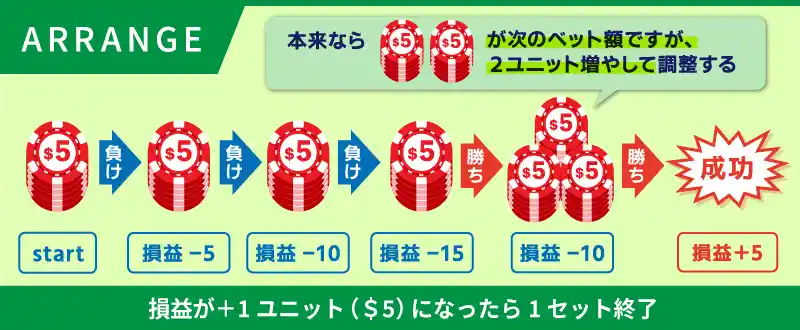
Oscar’s Grind can also be modified, for example by changing how much you raise the bet.
The variation covered here raises the bet by two units after a win instead of the standard one unit. We ran a simulation using these steps.
The first cycle ended after five rounds: three losses followed by two wins. Because the bet was raised from $5 to $15 after the win in round 4, the win in round 5 alone brought the net result to +$5 (under the standard steps, the 5th bet would have been $10 and the cycle would not yet be in profit). Up to this point, the variation works in your favor. The table below shows the second cycle, played with the same steps, which ran much longer.
| Round | Bet | Result | Win/loss | Running total | Action after the result |
|---|---|---|---|---|---|
| 1st | $5 | Loss | −$5 | −$5 | Bet unchanged |
| 2nd | $5 | Loss | −$5 | −$10 | Bet unchanged |
| 3rd | $5 | Loss | −$5 | −$15 | Bet unchanged |
| 4th | $5 | Win | $5 | −$10 | Raise the bet by $10: $5 → $15 |
| 5th | $15 | Loss | −$15 | −$25 | Bet unchanged |
| 6th | $15 | Loss | −$15 | −$40 | Bet unchanged |
| 7th | $15 | Loss | −$15 | −$55 | Bet unchanged |
| 8th | $15 | Loss | −$15 | −$70 | Bet unchanged |
| 9th | $15 | Win | $15 | −$55 | Raise the bet by $10: $15 → $25 |
| 10th | $25 | Win | $25 | −$30 | Raise the bet by $10: $25 → $35 |
| 11th | $35 | Win | $35 | $5 | Profit of $5 (one unit) reached, so the cycle ends |
The second cycle still ended in profit with 4 wins and 7 losses, but securing a $5 profit required a $35 bet.
The drawback is that the bet rises faster, so we recommend always keeping a stop-loss limit in mind. Raising the bet by two units instead of one does not change the expected value or the house edge. It only trades how quickly you reach a profit against how much you lose during a losing streak.
Advantages of Oscar’s Grind
- Bets rise and fall gradually, which helps keep risk under control
- Losses are relatively easy to recover even after you fall behind
- A losing streak early in a cycle results in only small losses
Oscar’s Grind is a betting system that keeps the bet the same during a losing streak and raises it during a winning streak. Unlike systems in which the bet snowballs as losses pile up, it carries relatively little risk during a losing streak. Early in a cycle, bets are small, so even a run of losses is unlikely to leave you far behind.
Later in a cycle, after the bet has risen, a losing streak—or a run of alternating wins and losses—does carry some risk. Even so, bets in Oscar’s Grind rise by only one unit at a time, so the increase is quite gradual. If you put together a winning streak later in the cycle, you can recover the earlier losses quickly and are more likely to finish one unit ahead.
The one-unit profit method described on this site also tends to lower the bet when you adjust it to keep the profit at one unit, which keeps the swings during a losing streak smaller. Keep in mind, however, that if you raise the size of one unit, both your losses during a losing streak and the bankroll you need grow in the same proportion. Set the unit at an amount you can afford to lose.
Disadvantages of Oscar’s Grind
- The profit from each cycle is capped at one unit
- If wins and losses stay roughly even over a long cycle, you may need to consider cutting your losses
- The calculations take effort and can be difficult for beginners
First, each cycle of Oscar’s Grind gains one unit, or only as much as your initial bet. As with the Martingale system, the profit from a cycle is capped at one unit, so the system is not suited to players who want large wins.
You can also modify the steps so that you skip the bet adjustment and end the cycle once the profit reaches one unit or more, although this increases the risk.
In a long cycle, the bet keeps rising, and a losing streak leads to larger losses. Even if you get through it and win, the cycle still earns just one unit, so a single failed cycle can turn your overall result negative.
Oscar’s Grind itself does not set a stop-loss limit. On this site, we recommend stopping once you lose a bet of 20 units or more, but decide on a limit that fits your own bankroll. Setting a stop-loss limit does not change the expected value. It is a money management rule that caps how much you can lose in one session.
Finally, the one-unit profit method described on this site requires you to adjust the bet.
It is not simply a matter of adding one unit after each win: whenever a win would produce a profit of more than one unit, you hold the bet back or lower it. Beginners are likely to find this difficult, so we recommend keeping paper and a pen, a notes app or a calculator at hand while you play.
What to Know Before Using Oscar’s Grind
Oscar’s Grind is a money management method that sets how your bets change from round to round. It does not change the conditions of the game itself. Keep the following three points in mind before you use it.
The Expected Value and House Edge Do Not Change
Changing how you size your bets does not change the game’s house edge or return to player (RTP), which stay at the values built into the game. On red/black in European roulette, the house edge remains 2.70% whichever steps you follow. The longer you play, the more your overall result tends toward a loss in line with that house edge.
What Oscar’s Grind changes is the shape of the distribution of wins and losses and the size of the swings in your results (the variance). It rearranges the outcomes into frequent small profits in exchange for occasional larger losses, and the overall expected value stays the same.
Table Limits and the Bankroll You Need
While a winning streak continues, the bet keeps rising by one unit at a time. The increase is not as steep as in doubling systems, but once the bet reaches the table limit, you can no longer follow the steps. At a table with a $1,000 maximum bet and a $5 unit, the bet hits the limit when it reaches 200 units.
Because the bet stays the same during a losing streak, the minimum bankroll you need is the number of consecutive losses times one unit. With a $5 unit, 10 losses in a row cost $50 and 20 losses in a row cost $100. A losing streak that comes after the bet has risen during a winning streak, however, costs the current bet times the number of losses. In the variation example in this article, the bet had risen to $15 when four losses in a row followed, and the net result fell to −$70.
The Largest Loss to Expect
The probability of losing a bet on red in European roulette is 19/37, or about 51.35%, and the probability of losing 10 times in a row is about 0.13% (roughly 1 in 780). On the Player bet in baccarat (with ties not counted), the probability of losing is about 50.68%, and 10 losses in a row occur roughly once in 890 attempts. Even when the probability is low, such a streak will eventually happen if you play enough rounds.
Because a cycle earns only one unit, the structure of the system means that a single long losing streak can wipe out all the profit you have accumulated up to that point. Choose a unit size you are comfortable with, and play only with money you can afford to lose.
Comparison with Related Betting Systems
This section looks at two betting systems similar to Oscar’s Grind and sets out how they differ from it. Use the comparison to decide which one suits your bankroll and the way you play.
Cocomo System
The Cocomo system is a betting system in which, after a loss, your next bet is the sum of your current bet and your previous bet. The main difference is direction: Oscar’s Grind raises the bet after a win, while the Cocomo system raises it after a loss.
The Cocomo system is also designed so that a single win after a losing streak can easily recover the losses, so unlike Oscar’s Grind, it does not need a winning streak. In exchange, the bet keeps growing during a losing streak and you need a reasonably large bankroll, so the Cocomo system may be the better choice if you have money to spare.
Martingale System
The Martingale system is the best-known betting system among casino players. The steps are very simple: double your bet after a loss, and go back to your initial bet after a win.
What the Martingale system and Oscar’s Grind have in common is that a successful cycle earns one unit.
Oscar’s Grind can still end a cycle in profit even when your win rate is somewhat low, but it always requires a winning streak. In return, losses during a losing streak stay limited: even after 10 losses in a row early in a cycle, your bet remains at the minimum unit ($5).
With the Martingale system, a single win recovers all the losses up to that point, however long the losing streak has been. Keep in mind, though, that the bet rises sharply during a losing streak and you will eventually be unable to place it because of your bankroll or the table limit. As a result, a long losing streak leads to far larger losses than with Oscar’s Grind. After 10 losses in a row, for example, your next bet would have to be $5 × 2¹⁰ = $5,120.
In short, the Martingale system tends to finish cycles quickly but lets losses soar during a losing streak, while Oscar’s Grind tends to run cycles longer but keeps losses during a losing streak limited. The two systems simply shift the swings to different points, and neither changes the expected value.
Summary: A Betting System for Players Who Want to Limit Losses During Losing Streaks
Among the betting systems you can use in table games and live dealer games at online casinos, Oscar’s Grind stands out because cycles tend to run long, but losses during a losing streak are easier to contain. You keep the bet the same after a loss and raise it after a win, aiming for a profit of one unit per cycle. The house edge itself does not change.
The system works with bets that pay 1 to 1 (even money), so we recommend using it in live dealer games such as roulette and baccarat.
The profit from each cycle is relatively small, though, and the longer a cycle runs, the longer your money stays tied up, so always keep a stop-loss limit in mind while you play. This betting system suits players who want to build results gradually with limited risk.
- Martingale Strategy Explained
- D'Alembert Betting System
- Paroli Betting System
- Labouchère Betting System
- Percentage Betting (10% System)
- Oscar's Grind Betting System
- 1-3-2-6 Betting System
- 1-2-3-5 Betting System
- Monte Carlo Betting System
- Cocomo Betting System
This site is for adults of legal gambling age (18+, or older where required) who live in countries or regions where online gambling is legal.
Use of this site is subject to our Terms and Conditions.
Gambling involves risk. Only bet what you can afford to lose, and do not use online gambling services where they are illegal.

Bell | Editor of Online Casino Winners Club. Since the site launched in 2003, Bell has written guides to casino game rules, tested betting systems and covered land-based casinos around the world, and still plays the games before writing about them. Bell's core advice: choose the bets with the lowest house edge, and decide in advance how much you are prepared to lose.