

Many of the methods that are called casino "strategies" or "sure ways to win" are in fact betting systems, and some players use them as a structured…
Dragon Tiger Rules, Payouts and House Edge: Can You Count Cards?

Dragon Tiger, available in both live and RNG versions, is a card game that is popular for its fast pace and simple rules: just two cards decide the outcome.
Dragon Tiger resembles baccarat, but its rules are even simpler, so it is easy to pick up even if you are new to casinos. Because rounds move quickly, it also works well with betting systems.
What You Will Learn
- Dragon Tiger is an even simpler version of baccarat.
- The house edge on the main bets (Dragon and Tiger) is about 3.73%, higher than on the Banker bet in baccarat (about 1.06%).

This article takes about 12 minutes to read.
Contents
Show
Basic Rules of Dragon Tiger

In Dragon Tiger, one card is dealt to each of two hands, Dragon and Tiger, and you predict which card will be higher. “Dragon” and “Tiger” are simply the names of the betting spots. You are not playing against an opponent.
Because a single card decides each hand, the rules are very simple. You can understand them at a glance, which makes Dragon Tiger a good starting point if you are trying live casino games for the first time.
Card Values and Rankings

Card rankings are very simple: the number on the card is its value. An ace (A) counts as 1, a jack (J) as 11, a queen (Q) as 12 and a king (K) as 13.
This makes the ace the lowest card and the king the highest. Suits (clubs, diamonds and so on) do not matter, and cards of the same rank are treated as equal.
Differences Between Dragon Tiger and Baccarat
Dragon Tiger closely resembles baccarat in that two hands compete on card value. However, while baccarat deals 2–3 cards each to the Player hand and the Banker hand, Dragon Tiger deals only one card to each hand.
| Item | Dragon Tiger | Baccarat |
|---|---|---|
| Cards per hand | 1 | 2–3 |
| Card ranking | K is highest | The total closest to 9 wins |
| When a tie occurs | Half the bet is returned | The full bet is returned |
The table above lists other differences between the two games. Note also that baccarat counts face cards and 10s as 0, while Dragon Tiger ranks each face card separately.
What We Like About Dragon Tiger
- The rules are simpler than baccarat’s, so even people new to card games can pick it up easily
- Some providers offer side bets
- Luck plays a large role, so no complex strategy is needed
Dragon Tiger Bets and Payouts
Basically, you bet on whichever hand, Dragon or Tiger, you think will win. You can also bet on a tie.
Basic Bets in Dragon Tiger

The main bets are on which of the two hands, Dragon or Tiger, will win.
Each hand receives just one card under identical conditions, so neither bet is better than the other. If the round ends in a tie, half of your bet is returned, whichever hand you bet on.
Two Kinds of Tie Bets
Tie
The Tie bet wins when the Dragon card and the Tiger card are of the same rank. Dragon Tiger is played with 8 decks, so the probability of a tie is 7.47% (about once every 13.4 rounds).
Suited Tie
The Suited Tie bet wins when the Dragon card and the Tiger card are of the same rank and also of the same suit (hearts, spades and so on).
It pays very well, but it is correspondingly rare: the probability is 1.69% (about once every 59.3 rounds).
The probabilities for both the Tie and the Suited Tie assume two cards drawn at random from a full 8-deck shoe of 416 cards. The actual probabilities vary slightly with the cards remaining in the shoe.
Other Bets (Side Bets)
Besides the Dragon, Tiger, Tie and Suited Tie bets, Dragon Tiger offers side bets on the Dragon card and the Tiger card individually.
Dragon Tiger itself is a simple game decided by two cards, and each side bet is decided by a single card, which makes it simpler still.
Examples of Side Bets
- Big/Small: a bet on whether the Dragon or Tiger card is high or low (6 or lower is Small, 8 or higher is Big; a 7 loses)
- Red/Black: a bet on the color of the Dragon or Tiger card
- Odd/Even: a bet on whether the Dragon or Tiger card is odd or even
In every case, the bet loses automatically if the card is a 7.
The side bets available vary by table, and some providers do not offer side bets at all.
Dragon Tiger Pay Table
| Bet | Payout (odds) |
|---|---|
| Dragon | 1 to 1 |
| Tiger | 1 to 1 |
| Tie | Between 8 to 1 and 11 to 1 (varies by provider) |
| Suited Tie | 50 to 1 |
| Side bets | 1 to 1 |
Dragon and Tiger both pay 1 to 1, so a $10 bet wins $10. The Tie payout depends on the provider’s rules, and tables that pay 11 to 1 on the Tie offer a higher return to player (RTP).
All side bets, including Red/Black and Big/Small, pay 1 to 1. Because a 7 always loses, however, only six of the 13 ranks win and seven ranks lose. So even at the same 1 to 1 payout, the house edge on side bets is about 7.69%, roughly twice that of the main bets.
How to Play Dragon Tiger
A round of Dragon Tiger is very simple, so you can follow it easily the first time you play. If you already know how a round of baccarat works, nothing here will be new to you.
STEP1
Place Your Bet

While betting is open, predict the result of the next round and place your chips on a betting area such as Dragon, Tiger or Tie.
STEP2
The Cards Are Dealt
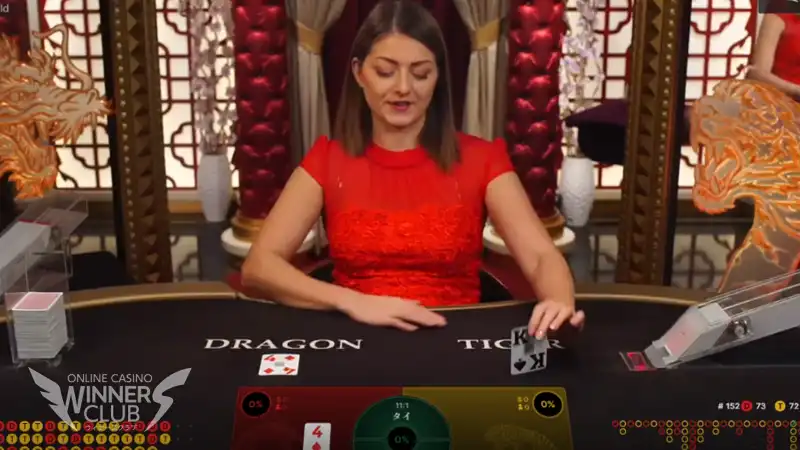
The dealer deals one card each to Dragon and Tiger and turns them face up right away, which decides the result of the round.
STEP3
Collect Your Payout If Your Bet Wins
If your bet wins, you are paid according to the payout for that bet.
Dragon and Tiger pay 1 to 1, the Tie pays between 8 to 1 and 11 to 1, and the Suited Tie pays 50 to 1.
Dragon Tiger RTP and House Edge
Depending on the provider, the Tie pays between 8 to 1 and 11 to 1, and the higher the payout, the higher the RTP. The table below shows the figures for a Tie that pays 11 to 1 and a Suited Tie that pays 50 to 1.
| Bet | RTP | House edge |
|---|---|---|
| Dragon / Tiger | 96.27% | 3.73% |
| Tie | 89.64% | 10.36% |
| Suited Tie | 86.02% | 13.98% |
| Side bets (Big/Small, Red/Black, Odd/Even) | 92.31% | 7.69% |
As in baccarat, the main bets, Dragon and Tiger, have the highest RTP. The Tie and the Suited Tie pay too little for how rarely they win, so their RTP is lower.
If you want to keep your losses down, it is generally best to bet on either Dragon or Tiger.
Even so, an RTP in the 96% range is still below 100%, so in theory, the longer you play, the more you can expect to lose.
Can You Use the Scoreboard or Card Counting in Dragon Tiger?

Some players claim that the scoreboard can predict results or that counting the cards left in the shoe tells you when to bet. This section looks at whether either method actually works.
The Scoreboard Does Not Reveal a Trend

The scoreboard is a display of past results. On the Big Road, for example, a Dragon win is shown as a red icon and a Tiger win as a yellow icon.
Consecutive wins by the same hand are stacked downward in one column, and when the other hand wins, the next icon moves to a new column. A tie is marked with a green diagonal line through the most recent icon.
Other roads, such as the Big Eye Boy, the Small Road and the Cockroach Pig, compare each column with earlier columns to show whether results are following the same pattern. Some players decide where to bet by studying these roads.
Suppose, for example, that Dragon has won five rounds in a row. Which hand will win the next round?
Betting on Dragon again is called following the streak, and betting on Tiger is called betting against the streak, but neither tells you which hand will win next. The probability of winning each round is the same no matter which road you look at.
The scoreboard can add to the enjoyment of following the game, but each round is independent, so the scoreboard does not change the probability of winning or the expected value.
Predicting Results by Counting Cards Is Almost Impossible
Dragon Tiger is dealt from a shoe that holds 8 shuffled decks of playing cards, and each round uses two cards from it. Card counting means keeping track of which cards have already been dealt from the shoe.
To see how much counting can change the odds, take the probability of a tie as an example.
With all 8 decks still in the shoe, the probability of a tie is
32C2 × 13 ÷ 416C2 ≈ 7.470%, where 32C2 is the number of ways to choose 2 cards from 32.
Now suppose the first round produces A,A. The probability of a tie then becomes
(32C2 × 12 + 30C2) ÷ 414C2 ≈ 7.471%
The difference is only about 0.001 percentage points, or roughly 1 in 100,000.
As this shows, however unevenly the cards have come out of the shoe, the probabilities in Dragon Tiger barely change.
Small differences may appear near the end of the shoe, but the shoe is replaced after about two-thirds of it has been dealt, so card counting is of almost no use in Dragon Tiger.
Testing Betting Systems in Dragon Tiger
A winning bet on Dragon or Tiger pays 1 to 1, so most betting systems can be used in Dragon Tiger.
We ran simulations to see what happens when the D’Alembert system and the Martingale system are used in Dragon Tiger.
Because a tie returns only half of your bet, treat that round as a loss when deciding your next bet. These systems cannot be used on the Tie or the Suited Tie.
- Related Article
-

Using the D’Alembert System

In the D’Alembert system, you raise your bet by one unit after a loss and lower it by one unit after a win. For the full procedure, see the related article below.
The simulation below uses a unit of $1 and a starting bet of $10, with the first $10 bet losing.
| Round | Result | Bet | Balance |
|---|---|---|---|
| 1 | Loss | $10 | -$10 |
| 2 | Loss | $11 | -$21 |
| 3 | Win | $12 | -$9 |
| 4 | Loss | $11 | -$20 |
| 5 | Win | $12 | -$8 |
| 6 | Win | $11 | +$3 |
| 7 | Win | $10 | +$13 |
Compared with the Martingale system, the D’Alembert system raises bets more gradually, which makes swings in your balance easier to contain. Changing the size of your bets does not change the expected value, though, and because it can take many rounds before you win, your losses can grow during that time.
Using the Martingale System

In the Martingale system, you double your bet after a loss and return to your starting bet after a win. For the full procedure, see the related article below.
For example, if your first $1 bet loses, you double your bet each round: $2 on the second, $4 on the third and $8 on the fourth. A win on the fifth round recovers all of your previous losses and leaves a profit of $1, the same as your starting bet.
| Round | Result | Bet | Balance |
|---|---|---|---|
| 1 | Loss | $1 | -$1 |
| 2 | Loss | $2 | -$3 |
| 3 | Loss | $4 | -$7 |
| 4 | Loss | $8 | -$15 |
| 5 | Win | $16 | +$1 |
Although in theory the Martingale system is designed to recover losses, it does not change the expected value of the game (the house edge). In practice, you may run into a long losing streak or reach the table’s maximum bet, and in that case you risk a large loss.
What Players Say About Winning and Losing at Dragon Tiger
Dragon Tiger appeals to players because of its relatively simple rules and fast pace, and it is popular with everyone from beginners to experienced players.
Players on social media often mention how quickly money changes hands. Some describe winning a large amount within seconds and losing much of it just as fast, while others report losing $500 in a single session and say they will never play again.
Some players argue that because Dragon and Tiger pay 1 to 1, losses can always be won back. As explained above, however, doubling your bets again and again does not change the house edge. Stories of large sums won or lost in a short time attract attention, but there is no reason to expect the same results to repeat.
Recommended Providers for Dragon Tiger
Dragon Tiger is not as widely offered as baccarat, and only a limited number of providers make it. Below are three providers whose versions are relatively easy to find at online casinos.
Evolution

Evolution offers a wide range of live casino games. It streams most of the major table games live, and Dragon Tiger is among them.
Betting is open for about 15 seconds, and the round itself takes only about 5 seconds because the dealer simply turns over one card for each hand. This simple format suits players who want to play many rounds in a short time.
The only bets available are Dragon, Tiger, Tie and Suited Tie. With so few options, the game is easy to follow even the first time you play.

Pragmatic Play

Pragmatic Play’s Dragon Tiger runs at a faster pace than Evolution’s.
The cards are dealt while betting is still open and turned over as soon as betting closes, so there is almost no wait for the result. Including the betting period, the game moves at about three rounds per minute, which suits players who prefer a fast pace.
Besides Dragon, Tiger and Tie, the game offers side bets on the Dragon hand and the Tiger hand separately, such as Red/Black and Odd/Even, which widen the range of bets. All of them pay 1 to 1, but keep in mind that their house edge of 7.69% is higher than that of the main bets.
OneTouch
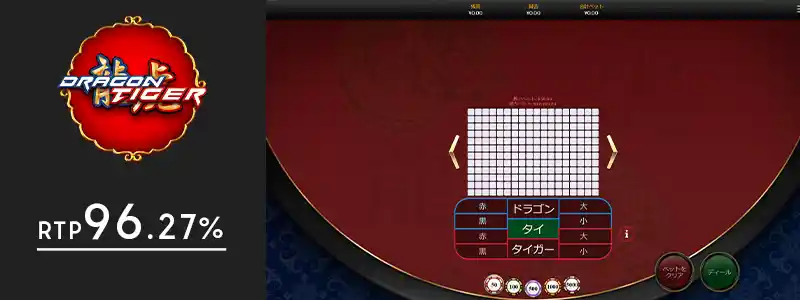
OneTouch offers Dragon Tiger as an RNG game rather than a live game. Few providers make an RNG version of Dragon Tiger. This one lets you play at your own pace, with no betting time limit.
Bets range widely, from $0.50 to $5,000, and the game includes a good selection of side bets, so it suits a wide range of players.
You can also place bets such as “Dragon wins with an 8 or higher,” so you can choose the bets that suit you.
Frequently Asked Questions About Dragon Tiger
- How is Dragon Tiger different from baccarat?
-
In both Dragon Tiger and baccarat, you do not play against the dealer. Instead, you bet on which of two hands will win. In Dragon Tiger, the result depends only on which card ranks higher, so the rules are simpler than in baccarat. Only one card is dealt to each of the Dragon and Tiger hands, so the game also moves faster than baccarat.
The house edge, however, is about 3.73% in Dragon Tiger and about 1.06% on the Banker bet in baccarat, so your expected losses are lower in baccarat. If you value simple rules, Dragon Tiger is the better choice. If you want to keep your losses down, baccarat is.
- How can I win at Dragon Tiger? Is there a winning strategy?
-
Dragon Tiger is largely a game of luck, and neither the scoreboard nor any other method can predict the next result. If you want to keep your losses down, money management is what matters: choose the Dragon or Tiger bets, which have a lower house edge, stop early if you hit a losing streak, and keep your bets at a level you can afford.
Summary: Simple Rules, but a Higher House Edge Than Baccarat
Dragon Tiger has some of the simplest rules of any casino card game.
One card is dealt to each of the Dragon and Tiger hands, and the higher card wins. Beginners can enjoy it from the first round, and it is also played by high rollers and experienced players.
Dragon Tiger is also offered as a live game, and because each round ends quickly, it suits players who prefer a fast pace. Keep in mind, however, that the house edge on the main bets (Dragon and Tiger) is about 3.73%, higher than on the Banker bet in baccarat (about 1.06%). Neither reading the scoreboard nor using a betting system lowers the house edge, but the rules are easy to understand, and the game appeals to a wide range of players.
Beginner's Guide to Card Games
- Red Dog Poker Rules
- Casino War Rules and Strategy
- High Low Card Game Rules
- Dragon Tiger Rules and Payouts
This site is for adults of legal gambling age (18+, or older where required) who live in countries or regions where online gambling is legal.
Use of this site is subject to our Terms and Conditions.
Gambling involves risk. Only bet what you can afford to lose, and do not use online gambling services where they are illegal.

Bell | Editor of Online Casino Winners Club. Since the site launched in 2003, Bell has written guides to casino game rules, tested betting systems and covered land-based casinos around the world, and still plays the games before writing about them. Bell's core advice: choose the bets with the lowest house edge, and decide in advance how much you are prepared to lose.