

When you play baccarat, you will probably notice a grid-like chart on screen below the table. This is the baccarat scoreboard, which records the…
Baccarat Strategy: Do Winning Systems Really Change the Odds?

Because baccarat is such a simple game, players have devised many methods for it over the years. This article covers the main ones used around the world.
Along the way, we also make clear that these methods only help you manage your bankroll and organize how you bet. They do not change your probability of winning.
What You Will Learn
- Some methods are promoted as winning strategies or systems, but no method guarantees a win.
- Card counting, reading the scoreboard and betting systems do not raise your probability of winning. They are tools for managing your bankroll and enjoying the game.

This article takes about 21 minutes to read.
Contents
Show
The Three Methods Often Called Winning Baccarat Strategies

Baccarat is said to be the game with the most money wagered at online casinos. Because all you do is predict whether the Player hand or the Banker hand will win, you may wonder whether a real strategy for it can exist at all.
In baccarat, cards are dealt to two hands called “Player” and “Banker,” and you bet on which of them will win. Here, “Player” is simply the name of a bet, not you. From this point on, we refer to them as the Player hand and the Banker hand to keep the two apart.
That very simplicity, however, has led players to devise many methods promoted as winning strategies or systems. Some change how bets are sized, while others try to read trends in past results, and many players still use these methods when they play baccarat today.
In practice, these methods only raise or lower your bet size and help you organize how you bet. Once you learn how they work, they are easy to use.
Naturally, you need to know the rules of baccarat to use them, so it is a good idea to start with the basics of the game.
Baccarat Method (1): Reading the Scoreboard

The scoreboard is a chart that records whether the Player hand or the Banker hand won each previous round of baccarat. It shows how many times in a row each side has won, and a new entry is added after every round.
The scoreboard itself cannot change the return to player (RTP) or your probability of winning. Still, when you are unsure whether to bet on the Player hand or the Banker hand, you can enjoy following the patterns of the game and use them to guide your own choice.
- Related Article
-

Baccarat Method (2): Card Counting

Card counting is a method of keeping track of the cards that have appeared in previous rounds in order to work out which cards remain in the shoe (the box that holds the cards).
The technique is best known from blackjack, and in theory it can be applied to baccarat as well. The idea is that, because the Player hand and the Banker hand follow different rules for drawing a third card, the makeup of the remaining cards shifts which side is more likely to win.
In baccarat, however, the effect of the remaining cards on the outcome is very small, and there is no way to act on that information (there are no choices like doubling down or insurance in blackjack). As a result, card counting has almost no practical effect and cannot change your probability of winning or the RTP.
There are also no reliable figures showing which cards favor which side.
There are several counting methods, and the simplest is the Hi-Lo count, which tracks the makeup of the remaining cards by counting certain ranks as +1 or −1. Details and other counting methods are covered in the related article below.
- Related Article
-

Baccarat Method (3): Betting Systems

A betting system (sometimes called a staking plan or progression) is a bankroll management method that raises or lowers your bet according to the situation in order to control how your wins and losses play out.
It is purely a way of managing your bankroll, and using one does not raise your probability of winning.
Betting systems are the most widely used of the three methods and are the main approach to making your bankroll last.
10 Classic Bankroll Management and Betting Systems for Baccarat
None of these systems offers a higher expected value than the others, and none of them changes the RTP. Choose whichever one suits the way you like to play.
- Martingale System
- Paroli System
- Winners Method
- Monte Carlo System
- D’Alembert System
- 1-2-3-5 System (Goodman System)
- 1-3-2-6 System
- 10% System
- Oscar’s Grind
- 31 System
In the explanations below, the first bet is $1 ($4 for the Monte Carlo system and $10 for the D’Alembert and 10% systems). If you want to bet more, scale the amounts accordingly.
- Related Article
-

Martingale System
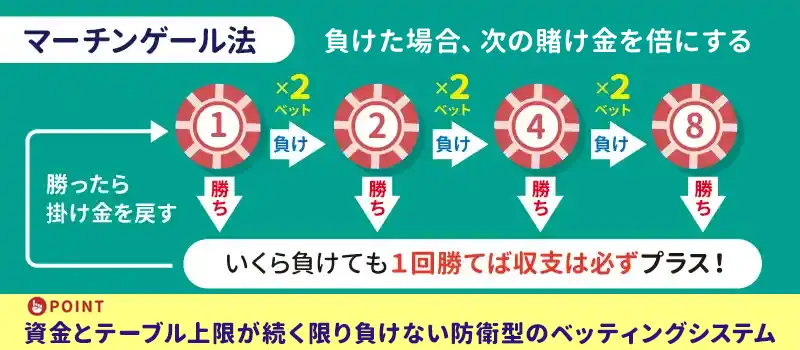
The Martingale system is a very simple method: you double your bet after each loss and return to your original bet after a win. Because a single win recovers all previous losses, it is known for ending many cycles with a small profit.
It is also easy to follow, even for first-time users. In theory, with an unlimited bankroll and no betting limit, you would always recover your losses, so it is sometimes promoted as a system that cannot lose. In reality, table limits and the size of your bankroll stand in the way, and the house edge does not change.
The drawback is that, because your bet doubles after every loss, your bankroll can survive only a short losing streak. Your losses can also grow very quickly, while a win still earns only your original one unit.
How to use the Martingale system
- Bet $1 on the Player hand.
- If you lose, raise your bet to $2. Each time you lose again, double your bet to $4, $8 and so on. When you win, go back to $1.
Paroli System
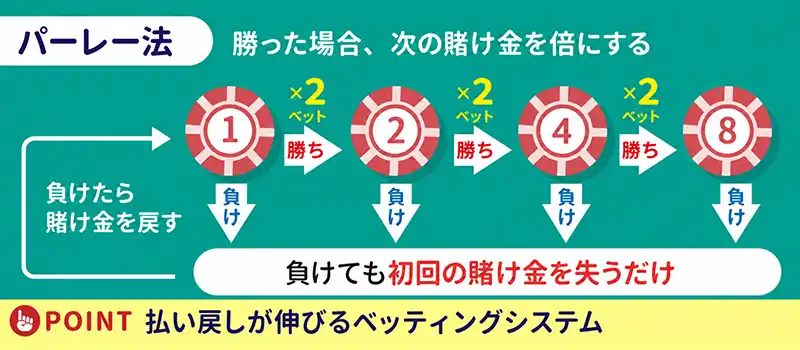
The Paroli system works the opposite way to the Martingale system and is also called the reverse Martingale. In other words, you increase your bet after a win and return to your original bet after a loss.
Because the Paroli system raises your bet using your previous winnings, a loss costs you only your original bet. Your winnings also grow quickly with each consecutive win, so if you take your profit at a set number of wins in a row, the amount can be substantial.
The drawback is that any loss leaves the cycle in the red, so the success rate is low. Always decide on a point at which to take your profit (such as 3 or 5 wins in a row) before you start.
How to use the Paroli system
- Bet $1 on the Player hand.
- If you win, raise your bet to $2. Each time you win again, double your bet to $4, $8 and so on. If you lose, go back to $1.
- Decide in advance how many consecutive wins you are aiming for, and take your profit once you reach that number.
Winners Method
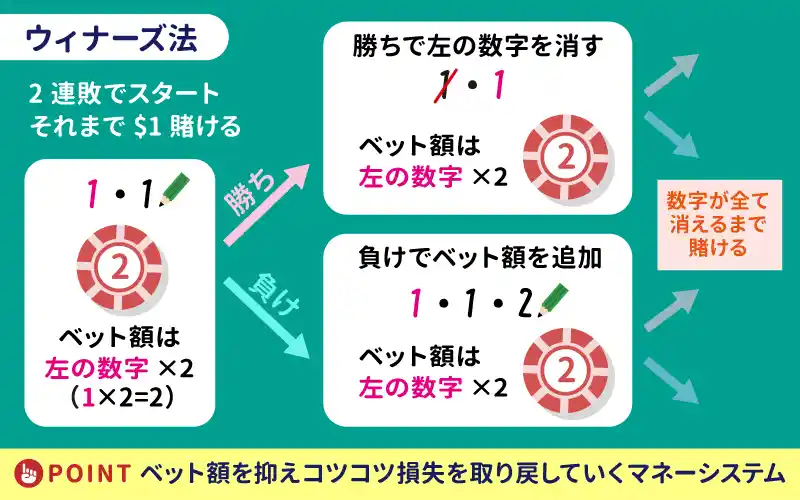
The Winners Method adjusts your bet using a sequence of numbers. The rules themselves are simple, so it is easy for beginners to use.
Its advantage is that bets do not rise sharply, so large losses are less likely. Losses are recovered a little at a time.
One caution is that, because your probability of winning in baccarat is below 50%, the sequence can be hard to complete and may keep growing. Set a stop-loss point in advance.
How to use the Winners Method
- Bet $1 on the Player hand, and start the method after two losses in a row.
- Write down the sequence (1, 1). Your next bet is twice the leftmost number (in this case, $2).
- If you win, cross out that number. If you lose, add the amount you just bet to the right end of the sequence.
- The Winners Method is complete once every number has been crossed out.
Monte Carlo System
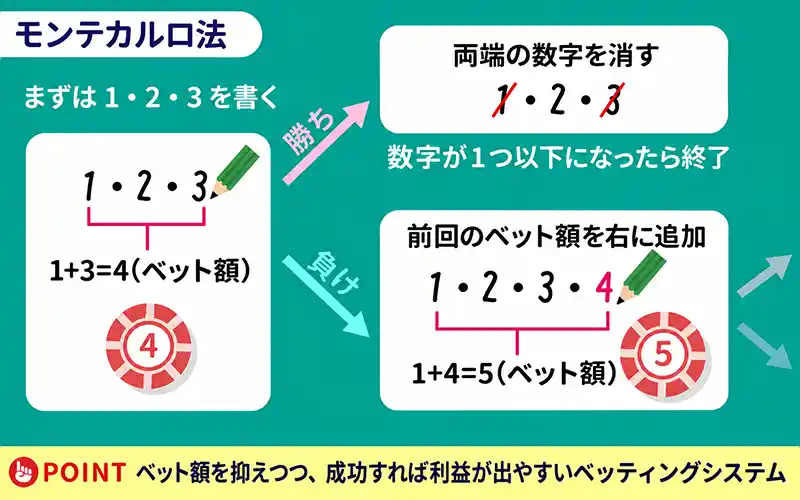
The Monte Carlo system is associated with a story that it once bankrupted the casino in Monte Carlo. You write down a sequence of numbers according to fixed rules, and the system succeeds once every number has been crossed out.
Its advantage is that bets do not rise sharply, so losses per cycle are less likely to grow large. Whether the sequence clears, however, depends on the order of wins and losses, and the system does not change your probability of winning or the RTP.
One thing to note is that you need a note-taking app or a pen and paper. Even when the cycle ends, you may not make a profit if one number remains in the sequence.
How to use the Monte Carlo system
- Write down the sequence (1, 2, 3). You bet the sum of the leftmost and rightmost numbers, so your first bet is 1 + 3 = $4 on the Player hand.
- If you win, cross out the numbers at both ends. If you lose, add the amount you just bet to the right end of the sequence.
- The Monte Carlo system is complete when all the numbers have been crossed out or only one remains.
D’Alembert System
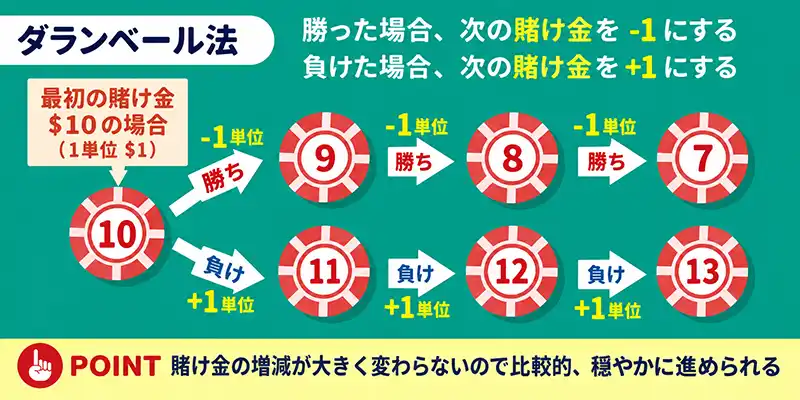
The D’Alembert system increases your bet by a fixed amount after a loss and decreases it by the same amount after a win. Bet sizes move more gently than with other systems.
Its advantage is that bet sizes change gradually, so your bankroll does not drop suddenly. However, because your probability of winning in baccarat is below 50%, the longer you play, the closer your results move toward a loss equal to the house edge.
One caution is that the starting bet itself is relatively high, so recovering from a run of losses is difficult.
How to use the D’Alembert system
- Set your first bet at $10 and one unit at $1.
- Bet $10 on the Player hand. If you win, reduce your bet by one unit (in this case, $1). If you lose, increase it by $1.
- Decide in advance when to stop (for example, when your bet returns to the starting amount, or when your bankroll has dropped by 5 units).
1-2-3-5 System (Goodman System)
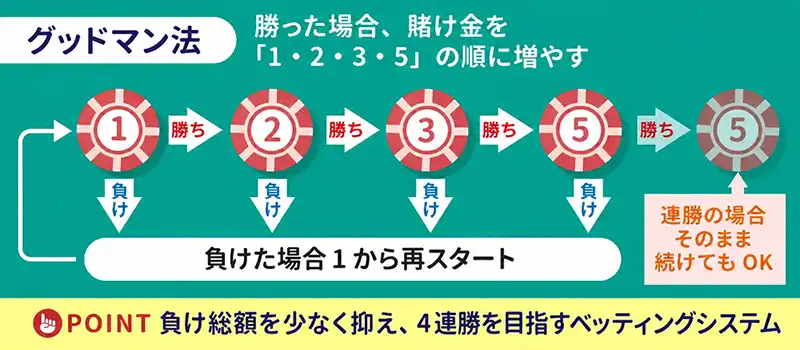
The 1-2-3-5 system (also called the Goodman system) raises your bet from 1 to 2, 3 and then 5 units with each consecutive win, as the name suggests.
Its advantages are that, whenever you lose, your loss for that cycle is no more than one unit, and that a cycle is complete after four wins in a row, which makes a profit realistically achievable.
Keep in mind that the system is designed to earn 11 units from four consecutive wins, and stopping partway leaves you short of 11 units. If you rarely manage four wins in a row, you slowly lose your bankroll.
How to use the 1-2-3-5 system
- Bet $1 on the Player hand.
- If you win, raise your bet to $2. With each further consecutive win, raise it to $3 and then $5. If you lose, go back to $1.
- The 1-2-3-5 system is complete when you win the $5 bet. Return to $1 and start the next cycle.
1-3-2-6 System
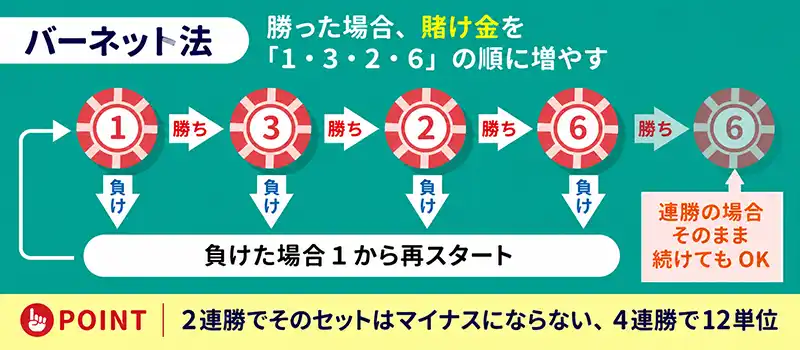
The 1-3-2-6 system changes your bet from 1 to 3, 2 and then 6 units with each consecutive win, as the name suggests.
Its advantages are that two wins in a row keep the cycle from ending in a loss, and that four wins in a row earn 12 units. This is second only to the Paroli system, which earns 15 units from four consecutive wins.
The drawback is that, when you fail to string wins together, your bankroll drops faster than with the 1-2-3-5 system, and a profit is hard to achieve unless you win four in a row.
How to use the 1-3-2-6 system
- Bet $1 on the Player hand.
- If you win, raise your bet to $3. With each further consecutive win, change it to $2 and then $6. If you lose, go back to $1.
- The 1-3-2-6 system is complete when you win the $6 bet. Return to $1 and start the next cycle.
10% System

The 10% system is very simple: you always bet 10% of your current bankroll.
Its advantage is that your bet goes up when you win and down when you lose, so the stake adjusts automatically to your balance.
The drawback is that if you deposit $1,000, for example, you bet $100, so bets can easily become large. In that case, we recommend adjusting the calculation as needed, for example by switching to a 5% system.
How to use the 10% system
- Suppose you deposit $100. Bet 10% of $100, which is $10, on the Player hand.
- If you win, your balance is $110, so your next bet is $11. If you lose, your balance is $90, so your next bet is $9.
- Continue to bet 10% of your current bankroll in the same way. Round any fractions up.
Oscar’s Grind
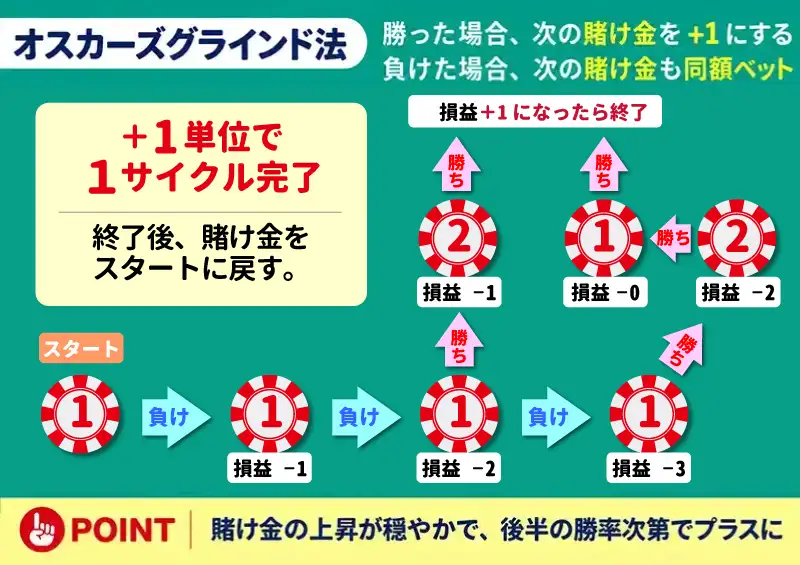
Oscar’s Grind keeps your bet the same after a loss and raises it by one unit after a win, aiming for a profit over the cycle as a whole.
Its advantages are that bets rise gradually, and that if your wins cluster toward the end of a cycle, you are likely to finish ahead.
One point to note is that Oscar’s Grind is designed to make a profit of one unit, so you need to reduce your final bet. The calculations can feel tedious until you get used to them.
How to use Oscar’s Grind
- Bet $1 on the Player hand.
- Keep your bet the same while you are losing.
- After a win, raise your bet by one unit at a time: $2, $3, $4. If you lose along the way, your next bet stays the same as the previous one.
- Continue until you are ahead by at least one unit, at which point Oscar’s Grind is complete. Return to your starting bet and begin the next cycle.
31 System
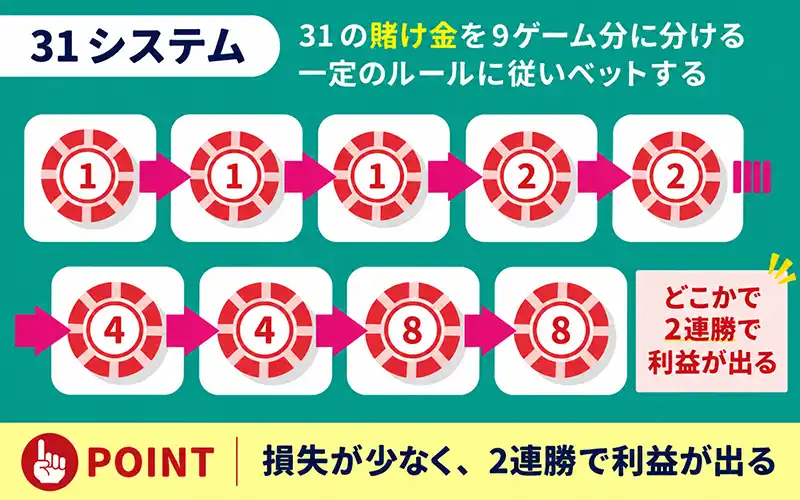
The 31 system raises your bet according to a sequence of numbers, and two wins in a row always produce a profit. It takes its name from the fact that even nine losses in a row never cost more than 31 units.
Its advantages are that losses are limited, which makes it easy to use, and that two consecutive wins produce a profit, so even a small number of wins can put you ahead. It does not raise your probability of winning, however; it is simply a way of allocating bets to limit losses while aiming for a profit.
Keep in mind that the system is somewhat complex and takes time to learn, and that if wins and losses alternate (win, loss, win, loss), your losses grow even though you win 50% of the time.
How to use the 31 system
- Prepare the sequence (1, 1, 1, 2, 2, 4, 4, 8, 8). You bet from the start of the sequence, so your first bet is $1.
- If you lose, move one place to the right in the sequence and bet that amount.
- If you win a bet of $1, bet $2 next; if you win a bet of $2, bet $4; if you win a bet of $4, bet $8; and if you win the first bet of $8, bet $8 again.
- Two wins in a row means the 31 system has succeeded. If you reach the end of the sequence without ever winning twice in a row, the system has failed. Either way, reset your bet and begin the next cycle.
Baccarat Win Probabilities by the Numbers
The betting systems covered so far are only ways of managing your bankroll. They do not raise your probability of winning. Before using one, it helps to know the probability of winning at baccarat itself.
In baccarat, the Banker hand wins slightly more often than the Player hand. To offset this, a 5% commission is deducted from Banker wins (except in no-commission baccarat).
The Banker Hand Wins Slightly More Often Than the Player Hand
In theory, the Player hand wins 44.62% of the time and the Banker hand 45.86%. The remaining rounds are ties. All figures below assume 8 decks (416 cards).
The rules are the same for the first two cards, but the rules for drawing a third card differ, which makes the Banker hand’s probability slightly higher. The 5% commission is set to offset this difference, so a winning Banker bet pays 0.95 to 1 (19 to 20) after the 5% commission: a $10 bet wins $9.50, and you get $19.50 back in total.
As a result, the house edge is about 1.06% on the Banker hand and about 1.24% on the Player hand, so both bets lose money in the long run.
| Bet | Probability of winning |
|---|---|
| Player hand | 44.62% |
| Banker hand | 45.86% |
| Tie | 9.52% |
If ties are excluded and only Player and Banker results are counted, the Player hand wins 49.32% of the time and the Banker hand 50.68%. Again, the Banker hand comes out slightly ahead.
Explanations of doubling systems usually use the Player hand because, with the 5% commission, a winning Banker bet pays only 0.95 to 1 (19 to 20), so a win may fall short of recovering what you have already lost.
Even so, the Banker hand has both the higher probability of winning and the lower house edge, so it also loses less over the long run.
Probability of Consecutive Banker and Player Wins
The table below shows the probability of consecutive wins with ties excluded, adjusted so that the Player and Banker probabilities add up to 100%. In other words, a tie does not end a streak, but it does not count as a win.
| Wins in a row | Consecutive Player wins | Consecutive Banker wins |
|---|---|---|
| 1 | 49.32% | 50.68% |
| 2 | 24.32% | 25.68% |
| 3 | 12.00% | 13.02% |
| 4 | 5.92% | 6.60% |
| 5 | 2.92% | 3.34% |
| 6 | 1.44% | 1.69% |
| 7 | 0.71% | 0.86% |
| 8 | 0.35% | 0.44% |
| 9 | 0.17% | 0.22% |
| 10 | 0.09% | 0.11% |
For a single win, the difference looks small, but the probability of five wins in a row is about 2.92% for the Player hand and about 3.34% for the Banker hand, slightly higher for the Banker hand.
The probability of ten wins in a row is about 0.09% (about 1 in 1,200) for the Player hand and about 0.11% (about 1 in 890) for the Banker hand. The longer the streak, the wider the Banker hand’s lead becomes in relative terms (about 1.3 times at ten wins in a row). The actual difference in probability is small, however, and because of the commission, betting on winning streaks does not make the Banker hand the better choice.
Betting Systems Change Only the Size of Your Swings
Every method covered so far changes only how you decide the size of your bets. None of them affects the probability of winning each game or the RTP. Before using one, it helps to be clear about what a betting system can and cannot change.
- What cannot change: the probability of winning each game, the RTP, the house edge and the long-term expected value
- What can change: the size of the swings in your results (variance) and the shape of the distribution of wins and losses
The Martingale system reshapes your results so that you make small profits often in exchange for occasional large losses, and the Paroli system does the reverse. Whichever you use, over the long run your results move toward a loss equal to the house edge.
Doubling Systems Cannot Continue Once You Reach the Table Limit
Because table limits and your bankroll are both finite, any doubling system will eventually reach a point where it can no longer be followed.
With a first bet of $1 at a table with a $1,000 maximum bet, you can double from $1 to $2, $4 and so on only up to the 10th bet of $512. The 11th bet would be $1,024, which exceeds the limit, so after 10 losses in a row you cannot place the next bet, and your cumulative loss of $1,023 is locked in.
The probability of 10 losses in a row is about 0.11%. That is a small figure for any single attempt, but over enough attempts it will happen. The bankroll you need also doubles with every loss, so set your first unit small enough relative to your bankroll.
Bankroll and Risk Management to Limit Losses in Baccarat

These methods can help you manage your bankroll, but used the wrong way, they can also end up controlling the way you play.
For example, a player using the Paroli system who keeps losing may bet their entire balance, lose it, then deposit more money and lose even more.
To limit your losses and enjoy baccarat over a longer period, it is important to make a plan in advance and stick to it without exception.
Knowing When to Stop Matters Most with Betting Systems
Two typical examples show why: the Martingale system doubles your bet after every loss, and the Paroli system doubles it after every win.
As a result, with the Martingale system, the long losing streak that will eventually come can wipe out your entire bankroll, and with the Paroli system, chasing winning streaks without limit will eventually drain your bankroll.
When you use either of these systems, we recommend that you set clear stopping points in advance, such as how many losses in a row mean you cut your losses and how many wins in a row mean you take your profit.
This does blunt each system’s main strength: with Martingale, the repeated chances to recover losses, and with the Paroli system, the fast growth of profits during a winning streak. Given the risk of losing your entire bankroll, however, deciding when to stop is essential.
Setting a stop-loss point does not change the expected value itself. It is a bankroll management rule that caps how much you can lose in a single session.
As the table of consecutive wins above shows, the probability of 5 wins or 5 losses in a row is around 3% for any given run. That is frequent enough that it will happen if you play long enough, so using this level as a guide for your stopping points is realistic.
Our recommended stopping points are 5 consecutive losses (Martingale) and 5 consecutive wins (Paroli). This applies when your first bet is no more than 1% of your deposit ($1 if you deposit $100). If your first bet is larger than that, use 3–4 wins or losses in a row as your stopping point.
Set a Budget and a Target and Stick to Your Bankroll Plan
Whichever system you use, decide on a budget and a target amount before you start. Settle at the outset how much profit you will take and how much loss you will accept, and make it a habit to stop as soon as you reach either one.
If you go well past your target, it is reasonable to keep playing with the amount above the target, but never let your balance fall below your take-profit point.
If playing for a long time is your priority, it is a good idea to set a budget larger than your target. For example, if your target for the day is +$30, your budget (stop-loss point) should be at least $50, and ideally $100, to give you a comfortable margin.
Also, once you have set your budget and target, avoid changing them. Once you have set “Target: +$30, budget (stop-loss point): −$50,” do not change your bet size, even as you approach your stop-loss point.
Even if you reach your target early and feel that today might be your day, do not push your luck. We recommend making a habit of sticking to the limits you have set.
Players set take-profit and stop-loss points in different ways. Here are some examples.
- Set the take-profit point at +2% of the previous day’s bankroll
- At a casino that offers cashback or a wagering rebate, set a wagering target instead of a profit target
- Stop as soon as a bet you felt confident about loses
One approach is to set your take-profit point at about 30% of your deposit and your stop-loss point at about −50%. These figures have no firm basis, however; they are simply our own recommended guideline. Adjust them to suit your bankroll and the way you play, and stay within limits you can afford.
Keep Your Maximum Bet to 20% of Your Bankroll
Whichever system you use, we recommend keeping your maximum bet within 20% of your initial deposit.
If you deposit $100, your maximum bet is $20. Decide your first bet based on that maximum.
For example, suppose you use the Martingale system and set your stop-loss point at 5 losses in a row.
With a first bet of $1, your bets rise from $1 to $2, $4, $8 and $16, and the fifth loss comes at $16, so this stays within the limit.
With a first bet of $2, your bets rise from $2 to $4, $8 and $16, and the fifth bet would be $32, so this exceeds the limit.
When deciding how large one unit should be, keep your maximum bet in mind and choose an amount accordingly.
Scams and Problems Involving Baccarat Winning Systems

As the sections above show, the methods used in baccarat are surprisingly ordinary. Yet when you see well-known casino players showing off glamorous lifestyles on social media, you may start to think there must be some brilliant winning system that only a few players know about.
Below are some examples of problems caused by scams that take advantage of players who think this way.
Automated Betting Tools
In one case, a player paid a high price for a tool that automatically placed bets on live baccarat based on the scoreboard and a betting system. The casino, however, judged this to be a breach of its terms and conditions and froze the account.
Most casinos treat playing with such tools as a breach of their terms. In most cases, claims such as “this tool dramatically increased my win rate” are also false. Be careful not to be taken in.
Paid Strategy Guides
In another case, a player bought a strategy guide on an online marketplace that promised a 99% win rate with its winning system. Most of the content was information available online for free, and it also contained statements that were not true. When the player contacted the seller, they were told that refunds were not possible.
Now that information is shared so widely, there is no winning system known only to a select few. Do not buy these products.
Paid Online Communities
In another case, a player joined the paid online community of someone moderately well known on X, but the livestreams covered nothing but the Martingale system. Access to the host’s supposed baccarat method required signing up for an even more expensive plan.
Baccarat is a game in which you only choose where to bet, so there is almost no room for any secret method. Members of paid online communities tend to become dependent on the host’s judgment. Avoid assuming that whatever this person says must be right.
After all, if such a remarkable method existed, its owner could simply keep it and make money. The only reason to go out of your way to teach it to others is that selling it is more profitable, which means the method does not exist. Be very wary of offers that sound too good to be true.
Summary: Baccarat “Winning Systems” Do Not Change the Odds, Only How You Manage Your Bankroll
Methods described as baccarat “winning systems” or “strategies” do not actually change the probability of winning. They are bankroll management methods that raise and lower your bets, or simply a way to make the game more enjoyable. Keep this in mind and use them only within limits you can afford.
Baccarat is a simple game in which no more than six cards are dealt, yet its mix of simplicity and excitement has made it popular enough to be called the king of casino games.
Of the methods discussed for baccarat, such as reading the scoreboard and card counting, the most popular today is the betting system. By raising and lowering your bets according to the situation, you can manage how your results play out, including your payouts when you win and your losses when you lose.
Using these methods does not mean you will always win, though. Make a plan before you start, including a budget and a target amount, and never break it while you play.
Even with a method and a plan, the house edge means your results will generally move toward a loss over the long run. No system guarantees a better chance of finishing ahead.
Baccarat simply costs you less than many other casino games; it does not give you an edge. Avoid getting carried away and placing one large bet after another, and play within limits you can afford.
This site is for adults of legal gambling age (18+, or older where required) who live in countries or regions where online gambling is legal.
Use of this site is subject to our Terms and Conditions.
Gambling involves risk. Only bet what you can afford to lose, and do not use online gambling services where they are illegal.

Bell | Editor of Online Casino Winners Club. Since the site launched in 2003, Bell has written guides to casino game rules, tested betting systems and covered land-based casinos around the world, and still plays the games before writing about them. Bell's core advice: choose the bets with the lowest house edge, and decide in advance how much you are prepared to lose.