

Deal or No Deal Casino Game: How to Play and Expected Value

Deal or No Deal from Evolution is a live game show based on a popular American TV show. Each player is given one briefcase containing a prize and plays through the rounds trying to work out how much that case holds. The game centers on the back-and-forth with the Banker and leaves a lot of room for your own decisions.
What You Will Learn
- Deal or No Deal is a game modeled on a popular TV show.
- The game is built around a battle of wits with the Banker.

This article takes about 9 minutes to read.
Deal or No Deal Is a Live Game Show Based on a Popular TV Show

Deal or No Deal is a live game show based on the TV show of the same name, which has aired in the United States and many other countries. The rules are easier to follow once you know how the TV show works, so we start with the show.
The TV show Deal or No Deal is a game show in which members of the public play as contestants. Each contestant chooses one of 26 briefcases, each holding a different prize from $0.01 to $1 million. The other 25 briefcases are then opened one at a time, and the prize in an opened case can no longer be won. If the $10,000 case is opened, for example, the contestant knows that their own case does not hold $10,000. With each case opened, the contestant learns a little more about what their own case might contain.
After a set number of cases have been opened, the Banker, who represents the show and does not know what is in the cases, calls in by phone with an offer. The offer is roughly the average of the prizes in the remaining cases, and the contestant chooses either to take that amount and leave the game (Deal) or to keep playing (No Deal). Choosing Deal ends the game, and the contestant takes home the amount offered. A contestant who says No Deal all the way to the end wins whatever is in the case they chose at the start.
To win the top prize, a contestant has to keep saying No Deal. But if the last two cases hold $1 and $1 million and the Banker offers about $500,000, most people would be tempted to stop there. This battle of nerves with the Banker is what makes Deal or No Deal work.
The live game show version of Deal or No Deal recreates this battle of nerves faithfully.
Basic Rules of Deal or No Deal
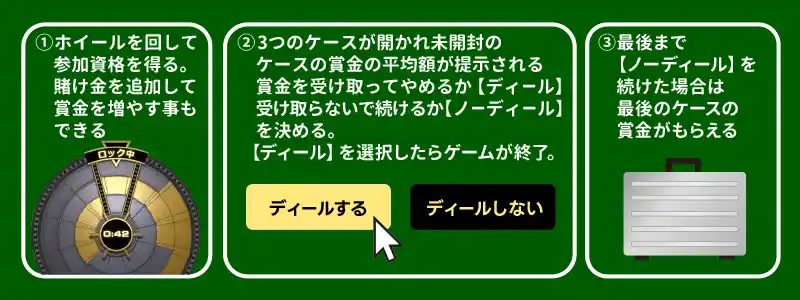
Before you can take part in the game, you first need to qualify by placing a bet and spinning a wheel. Once the wheel is unlocked, you can play in the next Deal or No Deal game. After qualifying, you can also place additional bets to increase the prizes in that game.
The main game has four rounds. In each round, several cases are opened, and the Banker then makes an offer close to the average of the remaining cases. Choose Deal to take the offer and end the game, or No Deal to keep playing.
| Game | Deal or No Deal |
|---|---|
| Provider | Evolution |
| Return to player (RTP) | 95.42% |
| Max win | 500x (the cap on briefcase 16, not including top-ups) |
| Payout limit | — |
| Minimum–maximum bet | — |
Bet limits vary by casino.
How to Play Deal or No Deal
You have only a short time to respond to each of the Banker’s offers, so try a few games with small bets while following this guide.
Spin the Wheel to Qualify
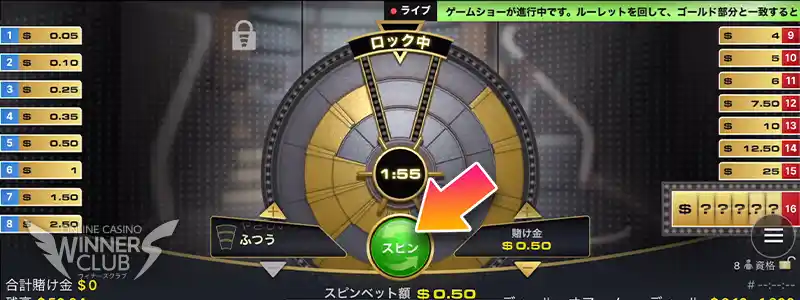
To play Deal or No Deal, you first need to qualify. There are three wheels, and you spin them by placing a bet and tapping Spin.
The wheels work like the dials of a combination lock, and each one is divided into gold and gray sections. When the gold sections of the inner, middle and outer wheels all line up in the center, the lock opens and you qualify for the next game.
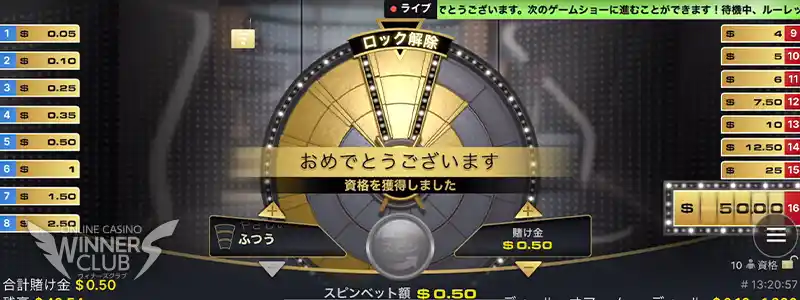
The amounts in the 16 briefcases are set according to the bet you placed when you qualified. Briefcase 16 shows a randomly drawn prize of 75x–500x your bet.
| Difficulty | Required bet | Chance of unlocking |
|---|---|---|
| Normal | The base bet | 1 in 18 (5.56%) |
| Easy | 3x the base bet | 1 in 6 (16.67%) |
| Very Easy | 9x the base bet | 1 in 2 (50.00%) |
To make qualifying easier, you can also fix the inner and middle wheels in the gold position in advance. Fixing the inner wheel triples your bet, and fixing both the inner and middle wheels raises it to 9 times the base bet. The higher bet comes with a higher chance of unlocking the wheel.
Top Up the Prizes
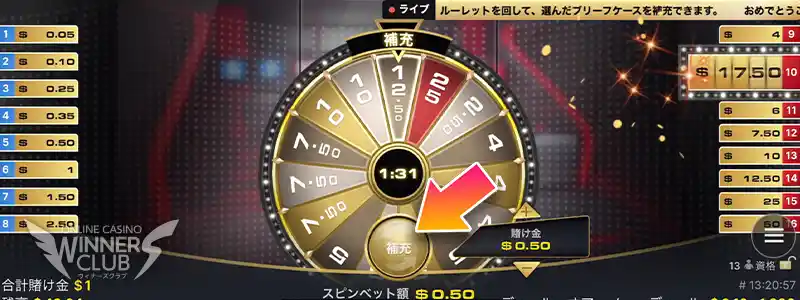
After the lock is released, you can top up the prizes if there is still time before the game starts.
Choose one of the 16 briefcases and press the Top Up button. A top-up wheel then spins, and an amount equal to 5x–50x your bet is added to the briefcase you chose.
By default, the top-up goes to the case with the highest amount (briefcase 16), but you can also choose the case yourself. You can top up as many times as you like until the game starts. How to decide where to place your top-ups is explained later in “Concentrating vs. Spreading Top-Ups: What Changes.”
Make Your Decisions Against the Banker

Once the top-up window closes, the live game show begins.
There are 16 briefcases in the studio. Fifteen are lined up at the back, and one is placed in front of the presenter. This front case holds the prize the player can win. The game has four rounds, and in each round players choose Deal or No Deal.
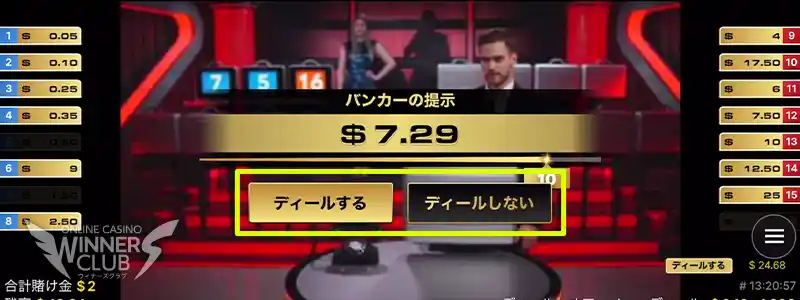
Round 1
The three briefcases at the back left are opened. Each case is numbered, and once a case is opened, its number and the amount it held are removed from the list on screen.
The Banker then makes an offer close to the average of the 13 cases that remain. You choose whether to take this amount and end the game or to keep playing for a higher prize.
Choose Deal to end the game or No Deal to continue. Choosing Deal pays you the amount offered, and choosing No Deal moves the game on to the next round. If you do not choose anything, No Deal is selected automatically.
Round 2
The four briefcases at the back right are opened. The Banker makes an offer close to the average of the 9 remaining cases, and you choose Deal or No Deal.
Round 3
The four briefcases at the front left are opened. The Banker makes an offer close to the average of the 5 remaining cases, and you choose Deal or No Deal.
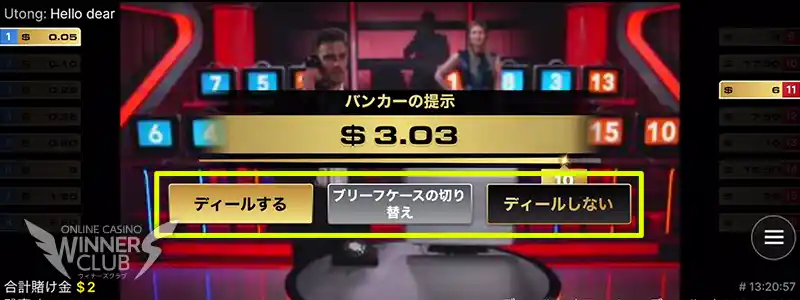
Round 4
Of the four briefcases at the front right, only three are opened. That leaves two unopened cases: the one in front of the presenter and the last one at the back.
In Round 4, you choose one of the following three options.
- Deal: win an amount close to the average of the two remaining cases
- No Deal: win the amount in the case in front of the presenter
- Switch: exchange your briefcase for the last one remaining at the back and win the amount it holds

When Round 4 ends, all players are paid and the live game show is over. The game then returns to the qualifying wheel, where you can try to qualify for the next game.

Do Any Choices in Deal or No Deal Change the Expected Value?
Payouts in Deal or No Deal are not fixed relative to your bet, so betting systems such as the Martingale system and the Monte Carlo system do not work as intended. In any case, betting systems do not change the expected value. In this game, the difficulty you choose and the point at which you take a deal mainly change how widely your results vary; the expected value changes little.
Easier Settings Raise Both the Chance of Unlocking and the Bet
To qualify, you need to release the lock, but on “Normal” difficulty the wheel unlocks on only 1 in 18 spins. Choosing “Easy” releases the inner lock from the start, and choosing “Very Easy” releases the middle lock as well. As a result, you qualify on 1 in 6 spins on “Easy” and 1 in 2 on “Very Easy.”
The trade-off is the bet: “Easy” triples it, and “Very Easy” raises it to 9 times the base bet.
The expected value is the same at every difficulty level, but on “Normal,” even 9 spins give you less than a 50% chance of releasing the lock (1 − (17 ÷ 18)^9 = about 40.2%). On “Very Easy,” each spin has a 50% chance of unlocking the wheel, so if your bankroll allows, an easier setting makes the number of spins needed to qualify far more predictable. Each spin, however, costs 9 times as much.
Deal vs. No Deal: Little Difference in Expected Value
The Banker’s offer is close to the average of the prizes in the briefcases that remain, so neither choice makes a large difference to the expected value. Either way, the RTP is below 100%, so the longer you play, the more you can expect to lose.
If you do plan to take a deal, it helps to decide in advance when you will do so. If only one high-value briefcase remains, for example, the offer drops sharply once that case is opened. Changing when you take the deal does not change the expected value; it only changes how widely the payout varies.
When several high-value cases remain, it is unlikely that all of them will be opened, so you may not need to take a deal yet. Sometimes both of the last two briefcases turn out to hold high amounts. You have only about 8 seconds to choose Deal or No Deal each time, so decide beforehand at what point you will take a deal.
Concentrating vs. Spreading Top-Ups: What Changes
Concentrate your top-ups if you plan to keep saying No Deal, and spread them out if you plan to take a deal partway through. Spreading the prize money across several cases keeps the offers from dropping sharply during the game, which makes it easier to decide when to take the deal. If instead you are aiming for a large payout by landing briefcase 16, a 1-in-16 chance, you would put all your top-ups on that case. Both approaches have the same expected value; only the spread of payouts changes.
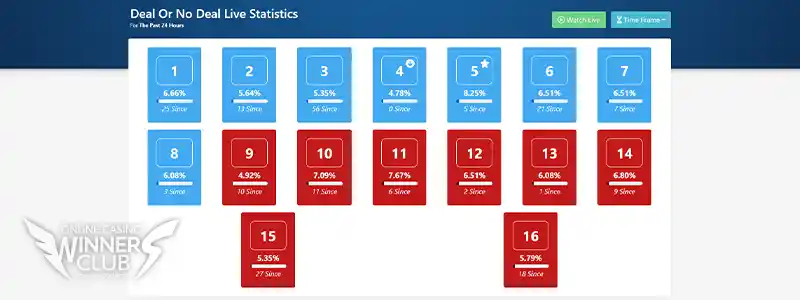
The online casino tracker site Tracksino used to show past results for Deal or No Deal, but as of August 2026 the game is no longer covered, so its results cannot be checked there.
The site used to show which briefcase numbers had been revealed and how large the payouts had been over periods such as the past 24 hours, the past week and the past month. Over a month, every number appeared with roughly the same frequency. Each round’s result is independent of the others, so these statistics cannot be used to predict the next result.
Other live game shows, such as Crazy Time and Monopoly Live, can still be tracked there.
Summary: Deal or No Deal Is a Live Game Show Built Around the Decision to Deal
Deal or No Deal is a live game show from Evolution based on the TV show of the same name, broadcast in the United States and many other countries. Each player is assigned one briefcase containing a prize and tries to work out how much it holds from the prizes revealed in the other cases. The game centers on the choice between Deal and No Deal, which you face several times in each game. Neither choice makes a large difference to the expected value.
This site is for adults of legal gambling age (18+, or older where required) who live in countries or regions where online gambling is legal.
Use of this site is subject to our Terms and Conditions.
Gambling involves risk. Only bet what you can afford to lose, and do not use online gambling services where they are illegal.

Bell | Editor of Online Casino Winners Club. Since the site launched in 2003, Bell has written guides to casino game rules, tested betting systems and covered land-based casinos around the world, and still plays the games before writing about them. Bell's core advice: choose the bets with the lowest house edge, and decide in advance how much you are prepared to lose.