

Some travelers want to try a real casino without much fuss, and others have never been to one and feel nervous about formal venues. For both, South…
Taiwan Casino Guide: Legal Status, Poker, Slots and Lotteries

Taiwan is a popular destination for travelers, but there are no legal casinos, and any venue that lets you bet money is operating illegally.
Even so, you can enjoy poker tournaments that award prize money, the receipt lottery (officially the Uniform Invoice lottery), and pachinko and pachislot (Japanese-style pinball and slot machines) outside Taipei, as long as you do not exchange your winnings for cash.
What You Will Learn
- Gambling is illegal in Taiwan, so there are no legal casinos.
- Outside Taipei, you can play pachinko and pachislot as long as you do not exchange your winnings for cash.

This article takes about 8 minutes to read.
Contents
Show
Are There Casinos in Taiwan?
Note: The information below is as of September 2026. Enforcement of the law, fine amounts and exchange rates may change, so check each venue’s official website before you travel.
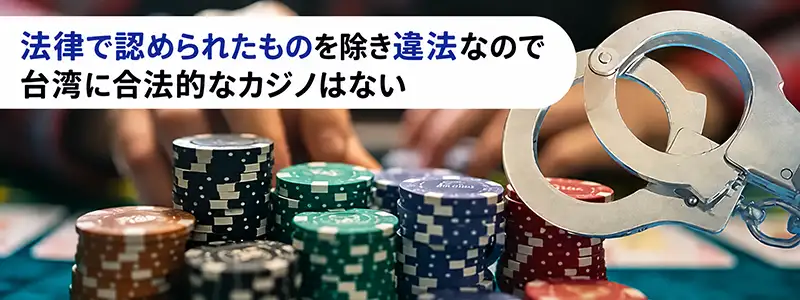
There are no casinos in Taiwan.
In Taiwan, betting money is illegal except for forms permitted by law, such as the Public Welfare Lottery and the Taiwan Sports Lottery. For this reason, there are no casinos where you can play legally.
Gambling for money or property is prohibited in any location, and violators are subject to fines.
Source: Ministry of Justice (Taiwan), Laws & Regulations Database: Criminal Code, Article 266
Foreign visitors are subject to Taiwanese law while in Taiwan, so gambling there can lead to arrest and punishment. If a tout approaches you about an illegal casino in Taiwan, do not go.
Are There Plans to Legalize and Open Casinos?
As of September 2026, there are no plans to legalize casinos or open new ones in Taiwan.
Local opposition remains strong, and casino legalization has not moved forward. In 2012, a referendum on the Matsu Islands, an outlying island group rather than the main island of Taiwan, approved a casino, but the plan has since stalled.
Gambling itself also carries a deeply negative image in Taiwan, and there is no sign that public support will grow.
All “Casinos” in Taiwan Are Illegal: Watch Out for Touts and Penalties
Some venues in Taiwan call themselves casinos, but any place where you can bet money is an illegal casino (an underground casino). Anyone caught gambling can be fined under Article 266 of the Criminal Code. Both those who run the gambling and those who take part in it are subject to punishment.
Touts are especially active in the nightlife districts around Taipei, steering tourists to illegal casinos without telling them the venues are illegal. Do not go near them, even if you are invited. Illegal casinos are not verified by any independent third party, and there is no guarantee that the games are run fairly.
Pachinko and pachislot parlors are not permitted in Taipei, even for amusement only, so any venue there with pachinko machines is illegal.
Can You Play Slots and Poker in Taiwan?
Can You Play Slots in Taiwan?
In Taiwan, you can play slot machines at pachinko parlors. Taipei is the exception, because the parlors themselves are not permitted to operate there.
- Taichung area: Several large parlors cater to visitors from overseas, and many are relatively easy for first-time visitors to get into.
- Tainan area: Many parlors require membership by referral, which makes them relatively hard for travelers from abroad to get into.
Can You Play Poker in Taiwan?
Taiwan has a very active poker tournament scene.
Cash games (poker played directly for money) are illegal in Taiwan, but tournaments that award prize money to the winners are legal, and the country has a large number of poker players as a result.
Taiwan also hosts stops of the Asian Poker Tour (APT), a regional poker series, and Taiwanese players regularly compete against players from other countries. Many players from abroad take part, and, along with South Korea, Taiwan is a popular destination for players traveling to tournaments in Asia.
Other Forms of Gambling in Taiwan
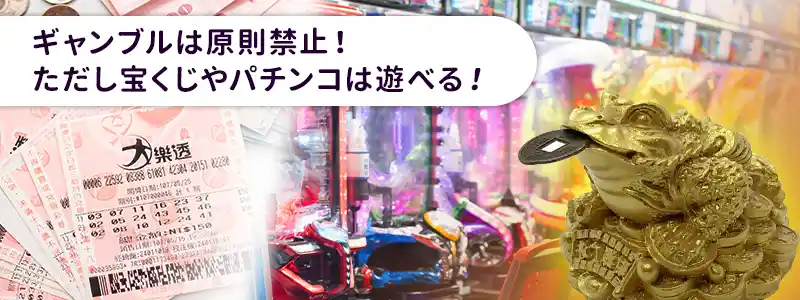
Gambling is generally prohibited in Taiwan, but some forms of betting are permitted by law, such as lotteries run for public welfare.
Taiwan is best known for its receipt lottery, and outside Taipei you can also play pachinko and slot machines.
Conventional lottery tickets are sold as well, but the receipt lottery, which you enter automatically every time you shop, is the most familiar.
The Receipt Lottery
Receipts in Taiwan follow a uniform format, and every receipt you receive when you shop carries an 8-digit number. This number is your automatic entry in the Uniform Invoice lottery.
Draws are held once every two months, and matching all 8 digits wins a prize of NT$10 million. Prizes can be claimed by tourists as well.
For this reason, it pays to keep any receipts you collect in Taiwan. Note, however, that prizes must be claimed within three months.
Public Welfare Lottery (Conventional Lottery Tickets)
Taiwan sells conventional lottery tickets under the name Public Welfare Lottery. The lottery is run to raise money for public bodies, and part of the revenue funds social welfare and pensions.
Several types are available, including draws in which you choose numbers, games in which you predict sports results, and scratch-off tickets.
Lotteries Where You Pick Your Own Numbers
Number-selection lotteries are among the most popular in Taiwan. As in a lotto game, you choose your own numbers and win a prize if they match the numbers drawn.
The top-prize odds in Taiwan’s lotto are long, so the jackpot often rolls over and builds up.
Lotteries Based on Sports Results
Among Taiwan’s lotteries, the Taiwan Sports Lottery, in which you predict the results of sporting events, is especially popular.
Bets are offered on a wide range of sports, including baseball and basketball in Taiwan’s domestic leagues, tennis, soccer, the Olympics and world championships. Anyone used to sports betting will find the format familiar.
Scratch-Off Tickets
The simplest option is scratch-off tickets, which pay out if you reveal a winning combination.
Scratch-off tickets in Taiwan cost NT$100–NT$2,000 each. The prizes are correspondingly large, and some tickets offer a top prize of NT$20 million.
Pachinko and Slot Machines
Many parlors in Taiwan offer slot machines based on older Japanese pachislot machines, including machines with illegally modified circuit boards, and they are popular with players.
Pachinko and pachislot are banned in the Taipei area, but elsewhere parlors are permitted as long as winnings are not exchanged for cash. Prizes other than money are allowed, so with some luck you may win merchandise.
Exchanging winnings for cash inside the parlor and having the parlor buy back prizes are explicitly prohibited under the Electronic Game Arcade Business Regulation Act. The situation is less clear when a separate business outside the parlor buys tokens or prizes from players: one high court ruling found that this did not amount to gambling, but courts have not been consistent.
This does not mean the practice has been confirmed as legal, and arrests and prosecutions continue. If the parlor is involved in an organized way, it can be held liable under Article 14 of the Electronic Game Arcade Business Regulation Act (an administrative penalty) or for operating a gambling venue, and players may also face charges under Article 266 of the Criminal Code, so do not exchange your winnings for cash.
Asian Countries with Casinos Within Reach of Taiwan
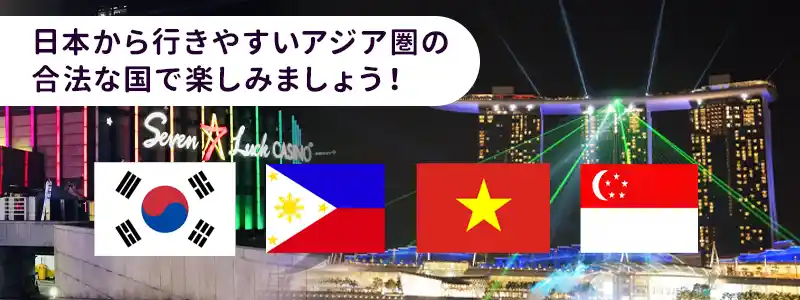
As explained above, Taiwan has no legal casinos, so if a casino is the purpose of your trip, you will need to visit a neighboring country.
South Korea
South Korea has casinos in many cities, including Seoul, Busan, Incheon and Jeju Island. Large-scale integrated resorts (IRs) built around a casino have also become popular in recent years.
Besides the long-established Seven Luck Casino, a popular choice is Paradise City, a joint venture between Korea’s Paradise Group and the Japanese entertainment company Sega Sammy Holdings. It is a few minutes by bus from Incheon International Airport, so it is easy to reach.
- Related Article
-
The Philippines
In the Philippines, casino resorts are being developed at tourist destinations across the country, including Manila, Clark, Cebu and Boracay. A $1 billion casino resort project is also underway in Quezon City.
If you want a relaxed casino visit at a warm-weather resort, the Philippines is a good option.
- Related Article
-

Singapore
Singapore has just two casinos, Resorts World Sentosa and Marina Bay Sands, but both are among the largest in Asia.
The two have different characters. Resorts World Sentosa is family-oriented, with a theme park on site, while Marina Bay Sands, known for its rooftop pool, is positioned as a luxury destination. Both are options if you are looking for an experience out of the ordinary.
- Related Article
-
Vietnam
Vietnam has casinos scattered across cities such as Ho Chi Minh City, Hanoi and Da Nang. Some venues, however, have no dealers, and their roulette is automated, with a machine launching the ball. Without a dealer, the games are easy to play at your own pace, which is an advantage.
Some resort casinos in Vietnam, such as Crowne International Club in Da Nang, have live dealers, and staff at the larger resort casinos are used to helping first-time players, so beginners should have no trouble getting started.
- Related Article
-
Frequently Asked Questions About Casinos in Taiwan
- What kinds of gambling are available in Taiwan?
-
Gambling is generally not permitted in Taiwan, but lotteries are a legal exception. Options range from conventional tickets sold at lottery outlets to the receipt lottery, which is unique to Taiwan.
Outside Taipei, you can also play pachinko and pachislot as long as you do not exchange your winnings for cash. Exchanging winnings for cash inside the parlor and having the parlor buy back prizes are prohibited under the Electronic Game Arcade Business Regulation Act, and buying and selling tokens outside the parlor can also lead to arrests.
- What are the penalties for gambling at an illegal casino in Taiwan?
-
In Taiwan, gambling or betting, including at an illegal casino, can result in a fine of up to NT$50,000 under Article 266 of the Criminal Code. Illegal gambling includes online gambling, so when you travel to Taiwan, stay away from illegal casinos and do not play at online casinos either.
- Can you cash out chips at poker rooms or tournament venues in Taiwan?
-
Venues are not permitted to exchange chips for cash. If chips are exchanged for cash or merchandise, the venue may be liable for breaching regulations or for operating a gambling venue, and players may face charges under Article 266 of the Criminal Code. Claims on social media that you can make money by winning are common, but do not take them at face value.
Summary: Taiwan Has No Legal Casinos, but You Can Enjoy Poker Tournaments, Lotteries and Pachinko Outside Taipei
Taiwan strictly regulates gambling by law and has no casinos. Any venue where you can exchange winnings for cash is an illegal casino, and if it is raided, you could end up being questioned by the authorities in a foreign country. Never gamble for real money at an illegal venue in Taiwan.
Outside Taipei, you can also play pachinko and pachislot, but exchanging winnings for cash inside the parlor and having the parlor buy back prizes are prohibited under the Electronic Game Arcade Business Regulation Act. The legal assessment of buying and selling tokens outside the parlor is divided, but arrests continue, so the safe choice is to stay out of any cash exchange.
If you want to try your luck in Taiwan, enter a poker tournament or buy lottery or scratch-off tickets. If the casino itself is the goal of your trip, neighboring countries with casino resorts, such as South Korea, the Philippines, Singapore and Vietnam, are the options to consider.
World Casino Guide
- Las Vegas Casino Guide
- Okada Manila Casino Guide
- Macau Casino Guide
- Casino de Monte-Carlo and Monaco Casinos
- Singapore Casino Guide
- Casinos in Canada
- London Casino Guide
- Casinos in Dubai and the UAE
- What to Wear to a Casino
- Casino Chips and Their Values
- Casino Dealer Salary by Country
This site is for adults of legal gambling age (18+, or older where required) who live in countries or regions where online gambling is legal.
Use of this site is subject to our Terms and Conditions.
Gambling involves risk. Only bet what you can afford to lose, and do not use online gambling services where they are illegal.

Bell | Editor of Online Casino Winners Club. Since the site launched in 2003, Bell has written guides to casino game rules, tested betting systems and covered land-based casinos around the world, and still plays the games before writing about them. Bell's core advice: choose the bets with the lowest house edge, and decide in advance how much you are prepared to lose.