

Casino Chips: Colors, Values, Buying In and Cashing Out

Have you ever wondered why casinos have you exchange your cash for chips? Many casinos do not accept cash bets directly. At table games in particular, you usually exchange your money for the casino’s own chips before you start playing.
What You Will Learn
- Casinos use chips for security and because their values are easy to tell apart.
- Roulette uses its own colored chips, called roulette chips, instead of regular casino chips.

This article takes about 10 minutes to read.
What Are Casino Chips? An Essential Part of Every Game

Casino chips are not just tokens. They serve as the casino’s own currency for betting and payouts.
At most table games, such as baccarat and blackjack, you first exchange your cash for chips and then start playing. Some casinos and tables accept cash bets, but it is safest to treat that as the exception.
Casinos add this exchange step mainly for the following operational reasons.
- Keeping the game moving smoothly (bets are easier to track and settle)
- Strong security, including protection against counterfeiting
Bills take time to count and can get creased or torn. Chips of a uniform size, color-coded by value, let the dealer (the casino employee who runs the game) see the amount at a glance and settle payouts quickly.
Some large casinos with advanced systems such as smart tables also use RFID chips, which have a tiny electronic tag embedded inside, to prevent counterfeiting and monitor play in real time.
Exchanging cash for chips also has a downside: it can make it easy to lose sight of how much money is at stake. The chips on the table are worth exactly as much as cash, so keep track of how much you are betting at all times.
Types of Casino Chips and Their Typical Colors and Values
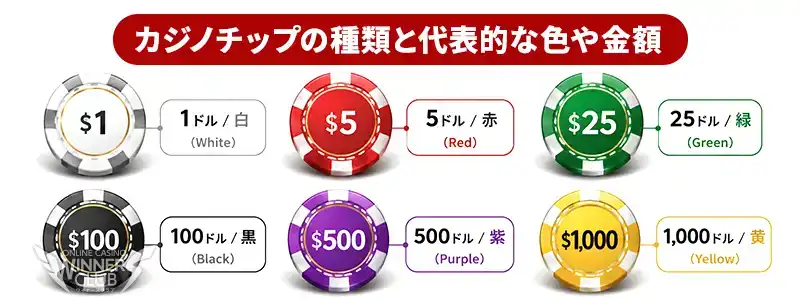
The information below is current as of August 2026. Chip colors and values, typical tip amounts and ID requirements for cashing out may change, so check each casino’s official website before you visit.
Knowing which chip colors go with which values makes play easier. Instead of checking the value printed on every chip, you can tell at a glance roughly how much is on the table.
There is no universal rule for chip colors, but many casinos in the US use a common set of color and value combinations. The table below shows one typical example.
| Value (US$) | Chip color | Common nickname (slang) |
|---|---|---|
| $1 | White | White |
| $5 | Red | Nickel |
| $25 | Green | Quarter |
| $100 | Black | Black |
| $500 | Purple | Purple / Barney |
| $1,000 | Yellow | Yellow / Banana |
In general, the higher the value, the darker or more striking the color (black, purple, yellow and so on). In US casinos, purple is commonly used for $500 and yellow for $1,000. Chips worth $5,000 or more come in special colors that vary from casino to casino.
From the $1 White to the $100 Black: Low-Value Chips Are Also Used for Tips
The chips you will see most often at low-limit tables are the white $1 chip and the red $5 chip.
Besides being used in play, these low-value chips also serve as small tips inside the casino.
In the United States and other places where tipping is customary, it is usual to give a small tip to the cocktail server who brings your drinks or to a dealer who has patiently explained the rules, or to place a bet for the dealer during the game. Dealer tips are known as tokes in casino slang.
As a guide, cocktail servers usually receive about $1–2 per drink, and dealers about $1–5 when you win or when you leave the table, either pushed toward the dealer on the table or placed as a bet for the dealer.
Both ways of tipping — pushing chips toward the dealer or placing a bet for the dealer — are explained in the section on tipping below.
Keeping a few low-value chips on hand makes it easier to tip without fumbling when the moment comes.
At tables where the $25 green and $100 black chips are in use, more money changes hands each round, and play tends to be more serious.
Chip Rules Differ by Region and Casino, as in Macau
Chip colors and rules vary from casino to casino, and some regions have their own local practices, so it pays to be careful.
In Macau, one of the world’s leading casino cities, the official currency is the Macanese pataca (MOP), but chips denominated in Hong Kong dollars (HKD) are widely used in its casinos.
The colors assigned to each value, however, differ greatly between casinos. A color used for a low value at one casino may stand for a high value at another, so there is no general rule that a given color is worth a given amount.
Whenever you visit a casino for the first time, make it a habit to check the chip values shown at the table (usually in a corner of the table, along with any exchange rates) before you start playing.
Chips for Specific Uses, Such as Roulette Chips

Not every chip in the casino can be taken straight to the cashier (the cage) and exchanged for cash. Roulette in particular uses its own roulette chips (also called wheel chips or non-value chips).
At roulette, several players place chips on the same layout at the same time, so with regular chips it would be impossible to tell who bet where. Each player is therefore given chips of a different color, which prevents confusion when bets are paid.
Roulette chips have no value printed on them. When you sit down at the table, you buy them and tell the dealer how much each chip should be worth.
A common beginner’s mistake is to try to take these roulette chips to another game.
Roulette chips have value only at the roulette table where you bought them, so when you leave, always exchange them for regular value chips (chips with a printed denomination that can be used throughout the casino).
Plaques: Rectangular Chips for High Values

At high-stakes tables, you may see special rectangular chips called plaques instead of the usual round chips.
Plaques are used mainly for large bets. Their shape sets them apart from the usual round chips, so high-value chips can be recognized at a glance. Because plaques are handled one at a time rather than stacked, they are also less likely to be mixed up or miscounted on the table.
Beginners are unlikely to handle plaques right away, but if you see rectangular chips in a casino, you are probably at a high-limit table or in an area where high-value chips are in use.
How to Buy Chips and Basic Casino Etiquette
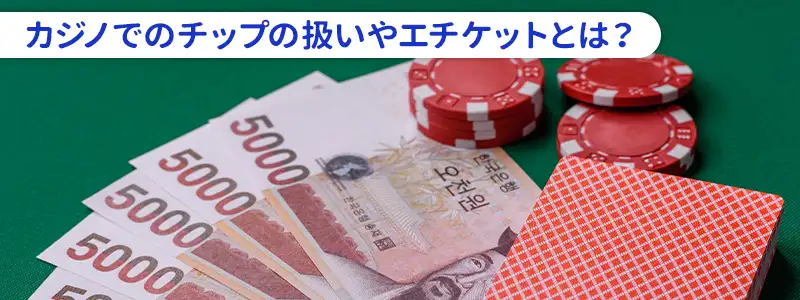
Casino floors have procedures and etiquette that keep the games safe and orderly.
If you play without knowing them, a staff member may correct you, or the game may be held up.
The way cash and chips are handled, in particular, follows customs shared by most casinos.
Do Not Hand Over Cash: How to Exchange Cash for Chips the Right Way
When you join a table game and buy chips (buy in), the most important rule is not to hand your cash directly to the dealer.
So that games can be monitored and procedures followed precisely, every exchange of cash and chips in a casino takes place in plain view on the table. For this reason, dealers are generally not allowed to take cash directly from a player’s hand.
To buy chips without any confusion, follow these steps.
- Wait for a break in the game (when a round has finished)
- Lay your cash flat on the table (the felt) in front of you
- Say something like “Chips, please” (or “Change, please” / “Buy-in, please”)
Once you put your cash down, the dealer checks the amount, then counts out the matching value in chips and places them in front of you. Knowing this procedure is enough to make your first buy-in go without a hitch.
How to Tip the Dealer
Tipping the dealer is not required, but players sometimes tip to thank the dealer for good service or after enjoying a game.
If you want to give the dealer a small tip, the same rule applies: do not hand it to the dealer directly. The usual way is to place your chips on the table and push them slightly toward the dealer.
Another way to tip is to place a bet for the dealer.
You place chips for the dealer right next to your own bet (or in a designated spot), and if that bet wins, the payout goes to the dealer as a tip.
Three Things to Avoid at the Casino
Touching your chips after “No more bets”
Once the dealer has called “No more bets” at roulette or a similar game, or while cards are being dealt or a round is in progress, you are not allowed to move or touch chips you have already bet, as a safeguard against cheating.
Using your phone or taking photos without checking first
Many casinos restrict taking photos or videos, making calls and using smartphones on the casino floor for privacy and security reasons.
Some casinos ban these outright, while others allow some photography, so the policy differs from casino to casino. Check with staff or look for posted signs before you use your phone.
Commenting on other players’ decisions
In games such as blackjack, avoid offering advice on, or criticizing, another player’s decision to hit or stand. Good etiquette means respecting each other’s style of play and not interfering.
How to Cash Out Your Chips Before You Leave
When you finish playing, you can usually exchange your remaining chips for cash by taking them to the cashier on the casino floor.
Dealers at the gaming tables do not exchange chips for cash on the spot.
If you have a large number of low-value chips, ask the dealer to color up (exchange them for fewer higher-value chips) before you leave the table, so you can take a neat stack to the cashier.
Note that coloring up is unrelated to exchanging roulette chips for regular chips.
Chips are a store of value issued by that particular casino and cannot be spent elsewhere like ordinary currency. If you do not plan to return to the casino, the safest course is to cash them in at the cashier before you head home.
Cashing out is simple: hand your chips to the cashier and you receive cash on the spot. There is generally no fee for exchanging chips for cash, although an exchange rate and fees may apply if foreign currency exchange is involved.
For small amounts, ID is generally not required. When you cash out more than a certain amount at once, or at the casino’s discretion, you may be asked to show government-issued photo ID and have the transaction recorded as part of anti-money laundering reporting procedures.
If you plan to cash out large winnings, bring photo ID just in case.
Frequently Asked Questions About Casino Chips
Below are answers to some of the questions about chips that beginners most often ask before a casino visit.
- Can I take casino chips home as a souvenir?
-
Some visitors do keep a few low-value chips as a souvenir.
If you are visiting from another country, customs rules differ, so check the rules where you live before you bring chips home.
Casino operators also assume in their accounting that a certain number of chips will never be redeemed.
If you do take chips home, keep the following two points in mind.
Banks and currency exchange offices will not cash them
Chips are a store of value that only the issuing casino is obliged to redeem. A bank or an ordinary currency exchange office at home cannot exchange them for cash.
They may become unusable in the future
Casino regulations, such as Nevada Gaming Commission Regulation 12 on chips and tokens, allow casinos to retire old chips and replace them with new designs to prevent counterfeiting or for business reasons. Once the redemption notice period has passed, the old chips are destroyed, so if you return to the same casino a few years later, your chips may no longer be accepted.
For this reason, if you take chips home, it is safest to keep only a few chips worth about $1–5, an amount you can treat as a keepsake you will never cash in.
Summary: Chip Colors and Values, How to Buy Chips and How to Handle Roulette Chips
Casino chips are an essential part of how a casino works. They keep the games moving and help maintain the security and order a casino depends on.
Learning a few basics in advance — the typical colors and values used in US casinos, the correct way to buy chips by placing your cash on the table for the dealer, and etiquette such as not touching your chips after “No more bets” — lets you avoid unnecessary trouble and play with confidence.
It also helps to know beforehand that some chips, such as roulette chips, have value only at the table where you bought them, so you will not be caught off guard.
With a good understanding of chips and casino etiquette, you can relax and enjoy your time on the casino floor.
- Las Vegas Casino Guide
- Okada Manila Casino Guide
- Macau Casino Guide
- Casino de Monte-Carlo and Monaco Casinos
- Singapore Casino Guide
- Casinos in Canada
- London Casino Guide
- Casinos in Dubai and the UAE
- What to Wear to a Casino
- Casino Chips and Their Values
- Casino Dealer Salary by Country
This site is for adults of legal gambling age (18+, or older where required) who live in countries or regions where online gambling is legal.
Use of this site is subject to our Terms and Conditions.
Gambling involves risk. Only bet what you can afford to lose, and do not use online gambling services where they are illegal.

Bell | Editor of Online Casino Winners Club. Since the site launched in 2003, Bell has written guides to casino game rules, tested betting systems and covered land-based casinos around the world, and still plays the games before writing about them. Bell's core advice: choose the bets with the lowest house edge, and decide in advance how much you are prepared to lose.