

Red Dog Poker (Acey Deucey) Rules, Payouts and Raise Strategy

Red Dog (also known as acey-deucey or in-between) is a card game with a simple rule: you win if the next card you draw falls between the two cards already dealt.
The rules are easy to learn and require no skill, but the payout can change considerably depending on which two cards are dealt.
What You Will Learn
- Red Dog is a simple game that pays out when the third card falls between the first two cards dealt.
- With a spread of 7 or more, the probability of winning is 56.00% or higher, so the additional bet (the raise) has a positive expected value.

This article takes about 8 minutes to read.
What Is Red Dog?
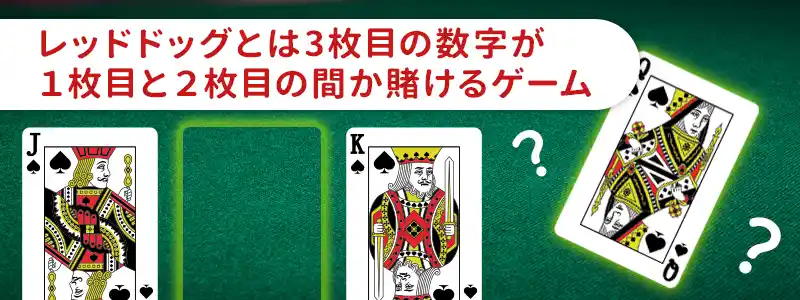
Red Dog is a table game in which three cards are dealt each hand. Two cards are dealt first, and the player wins if the third card falls between them. The gap between the ranks of the first two cards is called the spread.
The narrower the spread between the first and second cards, the less likely the third card is to fall between them, and the higher the payout on a win. If all three cards are the same rank, the bet pays 11 to 1, so a $10 bet wins $110. Payouts that vary widely from one hand to the next are a defining feature of Red Dog.
The History of Red Dog
Red Dog is said to have originated in the United States in the 1800s, and it became better known as casinos spread.
One theory holds that the game takes its name from an establishment where it was played at the time, but no reliable source has been found to confirm this.
Red Dog Rules
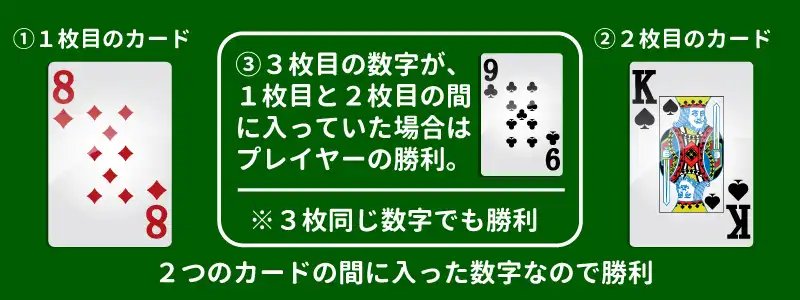
Red Dog is a table game played one-on-one between the player and the dealer. It uses a single standard 52-card deck.
Two cards are dealt first. Of these two, the lower-ranked card is referred to as the first card and the higher-ranked card as the second card. The number of ranks between the first and second cards is called the spread.
For example, if the first card is a 7 and the second is a J (11), the three ranks 8, 9 and 10 lie between them (the ranks of the two cards themselves are not counted). This is called a spread of 3.
The player then draws a third card, and if it falls between the first and second cards, the bet wins. The payout depends on the size of the spread and is 1 to 1, 2 to 1, 4 to 1 or 5 to 1. At 1 to 1, for example, a $10 bet wins $10. If the third card does not fall between the first two, including when it matches the rank of either card, the bet loses.
That is really all you need to know to play Red Dog: you win if the third card falls between the first two.
Card Rankings
Cards rank in the following order.
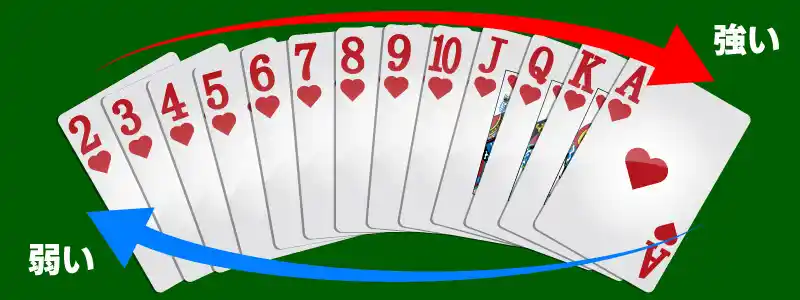
In other words, the 2 is the lowest card and the ace is the highest. The order is the same as in poker, which makes it easy to remember.
Suits (clubs, diamonds and so on) are not ranked, so all cards of the same face value have the same rank.
Red Dog Hands and Payouts

Red Dog has only four possible outcomes: a spread, consecutive cards, a pair and a Red Dog. The fourth shares its name with the game and refers to three cards of the same rank. Because a Red Dog can only occur after a pair is dealt, the two are covered together below, so the outcomes are explained under three headings.
Throughout the explanations below, the lower-ranked of the two cards is called the first card and the higher-ranked one the second card.
Spread
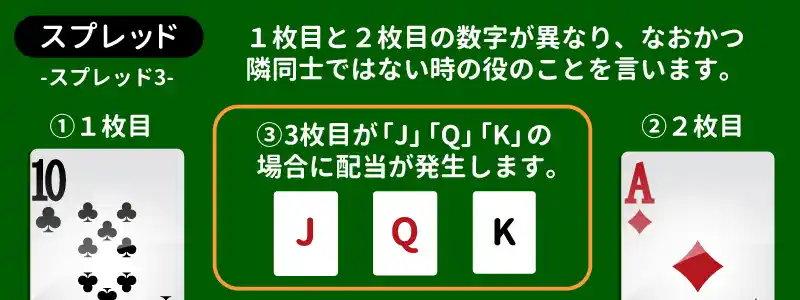
A spread occurs when the first and second cards are of different ranks and are not adjacent. It is described by the number of ranks between the two cards, as in a spread of 3.
The payouts for each spread are as follows.
| Spread | Payout |
|---|---|
| 1 | 5 to 1 (a $10 bet wins $50) |
| 2 | 4 to 1 (a $10 bet wins $40) |
| 3 | 2 to 1 (a $10 bet wins $20) |
| 4–11 | 1 to 1 (a $10 bet wins $10) |
When the first two cards form a spread, you can also raise, doubling your bet before the third card is drawn.
Consecutive Cards
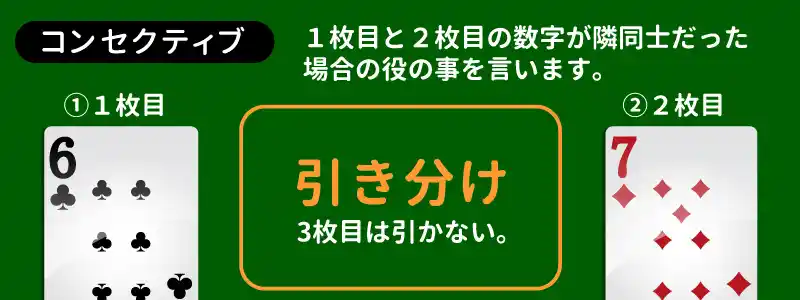
Consecutive cards occur when the first and second cards are adjacent in rank, for example a 6 and a 7.
With consecutive cards, no third card is drawn and the hand is always a push, so your bet is returned.
Pair / Red Dog

A pair occurs when the first and second cards are of the same rank, for example two aces (A-A).
With a pair, a third card is drawn. If it is a different rank from the first two, the hand is a push and your bet is returned.
If all three cards are the same rank, the hand is a Red Dog (three of a kind) and pays 11 to 1, so a $10 bet wins $110.
How a Round of Red Dog Is Played
The steps differ slightly depending on whether the first two cards form a spread or are consecutive cards or a pair.
STEP1
Place Your Bet
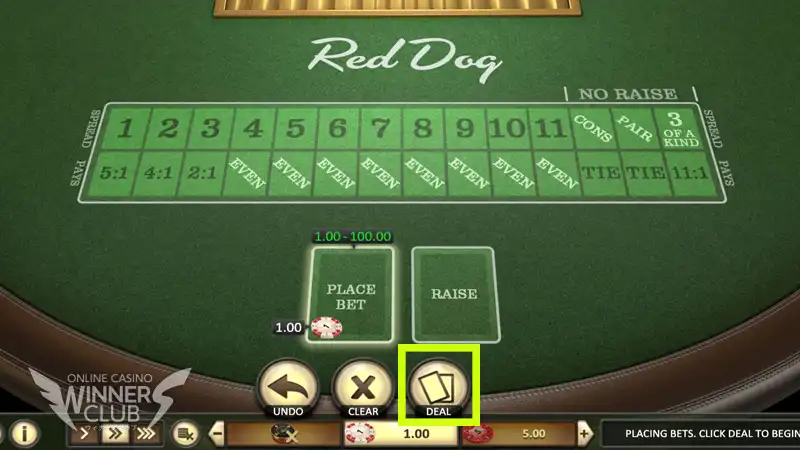
Place the amount you want to bet and tap the Deal button.
STEP2
Two Cards Are Dealt
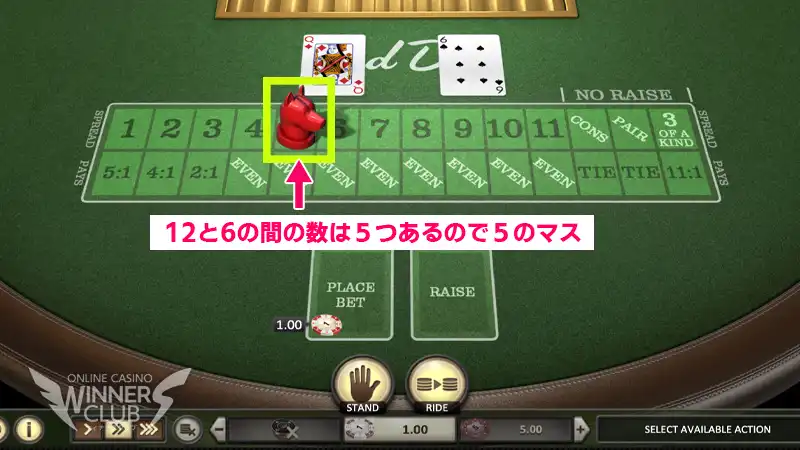
The dealer deals two cards. The game automatically determines whether they form a spread, consecutive cards or a pair, and a small red dog marker appears on the pay table to show which outcome has been dealt.
STEP3
(Spread Only) Decide Whether to Add to Your Bet

If the two cards are not the same rank and are not adjacent, they form a spread, and you can decide whether to double your bet. Choose Raise to double it, or Stand to keep it as it is.
STEP4
Bets Are Settled
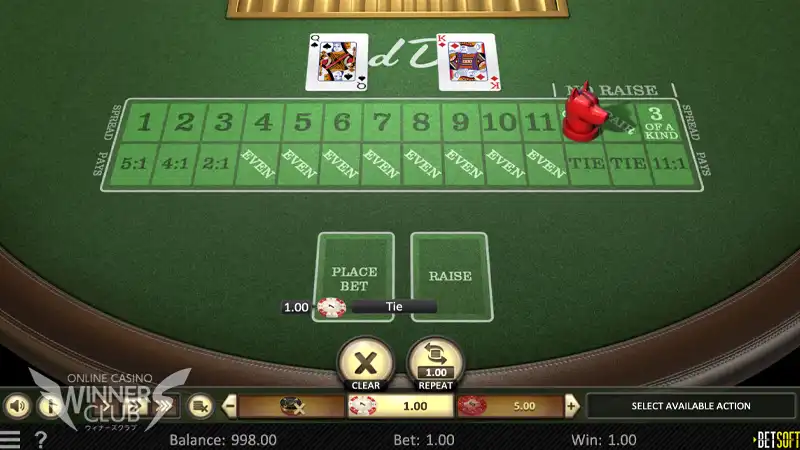
Consecutive Cards
No third card is drawn, and your bet is returned.
Pair / Red Dog
A third card is drawn. If it is a different rank, your bet is returned. If it is the same rank, the bet pays 11 to 1, so a $10 bet wins $110.
Spread
If the third card falls within the spread, the bet is paid. If it does not, the bet loses. If you raised to double your bet, the payout odds stay the same but the amount you win doubles: at 1 to 1, for example, a $10 bet raised to $20 wins $20.
Red Dog Win Probability by Spread and When to Raise
The only decision a player makes in Red Dog is whether to raise on a spread. With consecutive cards or a pair, the round simply continues, but with a spread you can choose whether to increase your bet.
| Spread | Payout | Win probability |
|---|---|---|
| 1 | 5 to 1 (a $10 bet wins $50) | 8.00% |
| 2 | 4 to 1 (a $10 bet wins $40) | 16.00% |
| 3 | 2 to 1 (a $10 bet wins $20) | 24.00% |
| 4 | 1 to 1 (a $10 bet wins $10) | 32.00% |
| 5 | 1 to 1 (a $10 bet wins $10) | 40.00% |
| 6 | 1 to 1 (a $10 bet wins $10) | 48.00% |
| 7 | 1 to 1 (a $10 bet wins $10) | 56.00% |
| 8 | 1 to 1 (a $10 bet wins $10) | 64.00% |
| 9 | 1 to 1 (a $10 bet wins $10) | 72.00% |
| 10 | 1 to 1 (a $10 bet wins $10) | 80.00% |
| 11 | 1 to 1 (a $10 bet wins $10) | 88.00% |
Note: These figures assume a single standard 52-card deck, with the third card drawn from the 50 cards remaining after the first two are dealt. The win probabilities change if a different number of decks is used.
In Red Dog, every spread from 4 to 11 pays 1 to 1. No matter how high the win probability is, the payout stays the same.
For this reason, with a spread of 7 or more, where the win probability is above 50%, the extra bet from a raise has a positive expected value. With a spread of 11, the win probability is 88.00%. Raising increases the variance of your results, but looking at the extra bet alone, it is the sensible choice in these situations.
With a spread of 6 or less, by contrast, the extra bet has a negative expected value in every case, so it is best not to raise. A spread of 1 is the clearest example: the win probability is 8.00%, and a win returns 6 times your stake, so the return to player (RTP) in that situation is only 48.00%. The more you add to your bet here, the larger your expected loss.
Providers That Offer Red Dog
Betsoft

Betsoft’s version of Red Dog has a simple layout and moves at a quick pace. It suits players who want to get through many rounds in a short time.
At least one of the online casinos we have reviewed offers Betsoft’s Red Dog.
Frequently Asked Questions About Red Dog
- What is the house edge in Red Dog?
-
The house edge in Red Dog is generally given as 2.7%–3.2%, depending on the number of decks used. That is relatively low for a casino game.
The house edge in any single situation also depends on the spread. For spreads of 4–11, where the payout is fixed at 1 to 1, a wider spread means a higher win probability and therefore a lower house edge.
- Is there a strategy for playing Red Dog?
-
There are three points to keep in mind.
- Raise only when the spread is 7 or more
- Do not raise when the spread is 6 or less
- Set a budget and a stopping point for each session before you start
You cannot choose the two cards you are dealt, so there is no way to aim for a particular spread.
Following these points does not change the fact that the game has a negative expected value over the long run, but it does help you avoid unnecessary losses.
Summary: Raise Only on a Spread of 7 or More
Red Dog is one of the less common table games at online casinos, but its style of play is not quite like any other table game.
The rules are simple: you win if the third card falls between the first two. Even so, the result stays uncertain until the third card is turned over. The only decision you make is whether to raise, and the rule is simple: raise only on a spread of 7 or more. Following this rule does not eliminate the house edge, however, and the game still has a negative expected value over the long run.
- Red Dog Poker Rules
- Casino War Rules and Strategy
- High Low Card Game Rules
- Dragon Tiger Rules and Payouts
This site is for adults of legal gambling age (18+, or older where required) who live in countries or regions where online gambling is legal.
Use of this site is subject to our Terms and Conditions.
Gambling involves risk. Only bet what you can afford to lose, and do not use online gambling services where they are illegal.

Bell | Editor of Online Casino Winners Club. Since the site launched in 2003, Bell has written guides to casino game rules, tested betting systems and covered land-based casinos around the world, and still plays the games before writing about them. Bell's core advice: choose the bets with the lowest house edge, and decide in advance how much you are prepared to lose.