

How to Play Craps: Rules, Bets and Payouts for Beginners

Craps is very popular in land-based casinos such as those in Las Vegas. The whole table plays together, almost as if all the players were taking on the casino as a team, and the game draws lively crowds of spectators.
What You Will Learn
- Craps is a simple game in which players bet on the outcome of a roll of two dice.
- Take full advantage of the odds bet, which has a house edge of 0% (it can only be placed alongside a pass line or come bet).
- Craps offers many types of bets, but beginners only need to learn the basics: the pass line, come and odds bets.

This article takes about 15 minutes to read.
Craps Rules and How to Play: The Flow of the Game

Craps is a casino game played with two dice. One player is chosen as the shooter (the person who rolls the dice), and the other players bet on whether the shooter wins or on the numbers rolled. That is the basic idea of craps.
Craps is a dice game that remains a favorite in casinos worldwide. Because the players and spectators around the table react together to every roll, craps tables tend to draw some of the biggest crowds on the casino floor.
At a craps table, the player acting as shooter rolls the dice themselves. Everyone celebrates a good roll together and groans at a bad one, and this shared experience among the players is a defining feature of craps.
Probabilities of Each Dice Total
Knowing in advance how likely each total of the two dice is makes it easier to judge which bets keep the house edge low.
| Dice total | Combinations | Probability |
|---|---|---|
| 2 | (1,1) | 2.78% |
| 3 | (1,2) (2,1) | 5.56% |
| 4 | (1,3) (2,2) (3,1) | 8.33% |
| 5 | (1,4) (2,3) (3,2) (4,1) | 11.11% |
| 6 | (1,5) (2,4) (3,3) (4,2) (5,1) | 13.89% |
| 7 | (1,6) (2,5) (3,4) (4,3) (5,2) (6,1) | 16.67% |
| 8 | (2,6) (3,5) (4,4) (5,3) (6,2) | 13.89% |
| 9 | (3,6) (4,5) (5,4) (6,3) | 11.11% |
| 10 | (4,6) (5,5) (6,4) | 8.33% |
| 11 | (5,6) (6,5) | 5.56% |
| 12 | (6,6) | 2.78% |
With two dice, the most common total is 7. Of the 6 × 6 = 36 possible combinations, 6 produce a 7, so the probability is 1/6, or 16.67%.
On the first roll, called the come-out roll, the probability of a 7 or 11 (a natural) is 8/36, while the probability of a 2, 3 or 12 (craps) is 4/36, so the shooter is more likely to win on the first roll.
On later rolls, however, the shooter wins by rolling the point, which is always one of 4, 5, 6, 8, 9 or 10 (5/36 or less each), and loses by rolling a 7 (6/36). From the second roll on, the shooter is more likely to lose.
The sequence from one come-out roll until the bet is decided is called a “round.” Each term is explained as it comes up, so you can follow along even if you have never played.
(1) Choose the Shooter
First, a shooter, the person who rolls the dice, is chosen.
In a land-based casino, the players at the table usually take turns as shooter. At online casinos, you are the shooter in RNG (software-based) craps, while in live craps the dealer rolls the dice.
(2) Bet on the Outcome of the Roll
Players bet on the outcome of the game, such as whether the shooter wins or loses or which numbers will be rolled.
In a land-based casino, all the players act as a team, so the usual bet is the pass line (a bet that the shooter wins).
(3) The First Roll (Come-Out Roll)
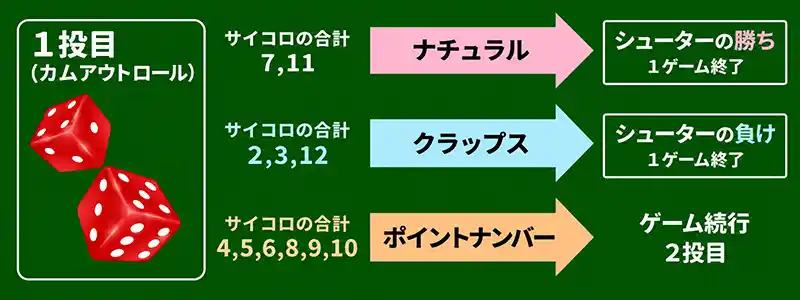
The first roll is called the come-out roll, and what happens next depends on the total the shooter rolls.
- A total of 7 or 11 (a natural): the shooter wins
- A total of 2, 3 or 12: the shooter loses (these totals are called “craps,” the same as the name of the game)
- A total of 4, 5, 6, 8, 9 or 10: play continues, and the number rolled becomes the point
In other words, a roll of 4–10 (except 7) continues the round, while any other number ends it and the next round begins. Even when the come-out roll decides the bet, the shooter does not change, and the same shooter throws the next come-out roll.
(4) Rolling Continues Until the Bet Is Decided

If the come-out roll is 4, 5, 6, 8, 9 or 10, the number rolled is called the point, and the round continues.
On every roll after that, the shooter wins by rolling the point and loses by rolling a 7. Any other number settles nothing, and play continues. The round ends as soon as the bet is decided, and the next round begins. If the shooter wins by making the point, the same shooter keeps rolling; if the shooter loses with a 7 (a seven-out), the dice pass to a new shooter.

Craps Bets and Payouts
Payouts can vary slightly from game to game. If a table pays less than the amounts shown below, you can assume its rules have a lower return to player (RTP).
Craps Payouts
| Bet | Payout |
|---|---|
| Pass line / Don’t pass | 1 to 1 (a $10 bet wins $10) |
| Come / Don’t come | 1 to 1 (a $10 bet wins $10) |
| Pass line / come odds bet | |
| 4 and 10 | 2 to 1 (a $10 bet wins $20) |
| 5 and 9 | 3 to 2 (a $10 bet wins $15) |
| 6 and 8 | 6 to 5 (a $10 bet wins $12) |
| Place bet | |
| 4 and 10 | 9 to 5 (a $10 bet wins $18) |
| 5 and 9 | 7 to 5 (a $10 bet wins $14) |
| 6 and 8 | 7 to 6 (a $12 bet wins $14) |
Most other bets, such as one-roll bets, have a much lower RTP, so it is safer not to place them (buy and lay bets are covered below).
Three Basic Bets Beginners Should Learn
Once you know these three bets, you can join a game at a land-based or online casino without any trouble. You do need to know when each one wins and when it loses, though.
Pass Line
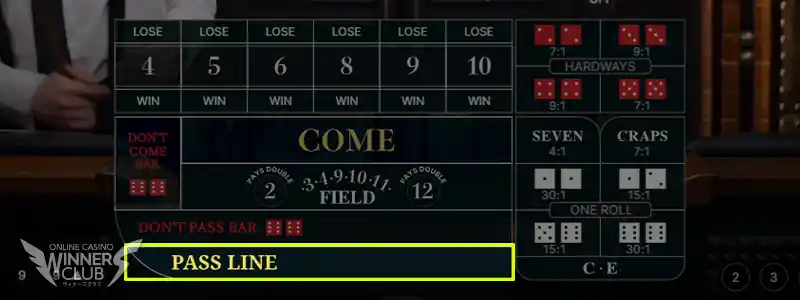
The pass line is a bet that wins when the shooter wins. It can be placed only before the come-out roll (the first roll), and it pays 1 to 1.
On the come-out roll, a 7 or 11 wins and a 2, 3 or 12 loses.
On later rolls, the bet wins if the shooter rolls the point (the number rolled on the come-out roll) and loses if the shooter rolls a 7.
Come
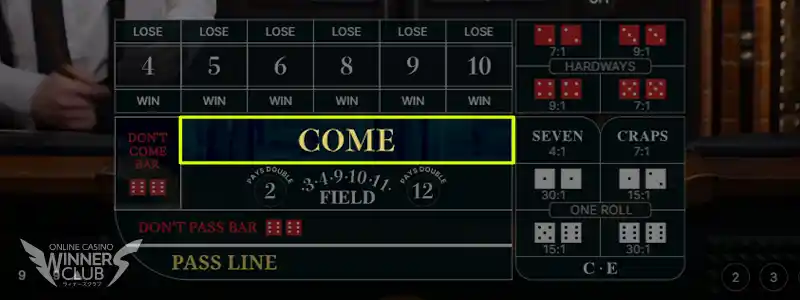
A come bet works exactly like a pass line bet, but you can place it on any roll after the come-out roll. It pays 1 to 1.
A come bet wins and loses under the same conditions as the pass line. Here, however, the “first roll” is not the come-out roll but the roll after you place the come bet. If any other number is rolled, that number becomes the point for your come bet.
Odds Bet
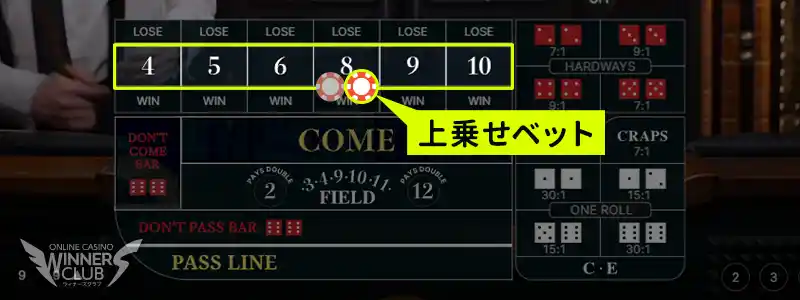
An odds bet is an additional bet you place on top of a pass line or come bet.
It is not just a way to increase your stake: the odds bet is paid at true odds, which vary with the point, so the house edge is 0%. That makes it the bet with the lowest house edge, but keep in mind that you can place it only alongside a pass line or come bet.
The odds bet pays 2 to 1 when the point (the number the shooter rolled on the come-out roll) is 4 or 10, 3 to 2 when it is 5 or 9, and 6 to 5 when it is 6 or 8. A $10 odds bet therefore wins $20, $15 or $12, respectively.
Bets for Intermediate and Advanced Players
Once you know the three basic bets, learning the four below gives you more options.
Don’t Pass
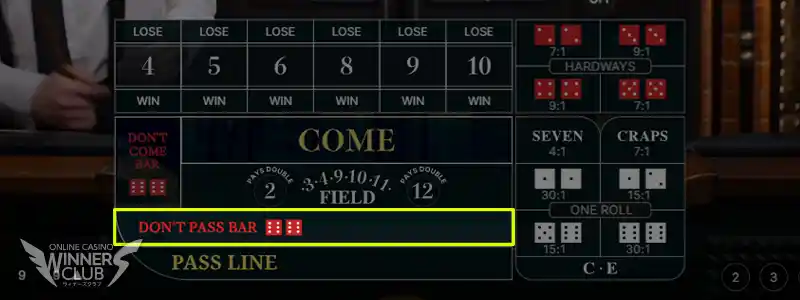
The don’t pass bet wins when the shooter loses.
On the come-out roll, a 2, 3 or 12 wins and a 7 or 11 loses. On later rolls, a 7 wins and the point loses.
Land-based casinos have a don’t pass area on the layout, but the bet is often frowned upon there. At online casinos, you can place it without any concern.
Don’t Come
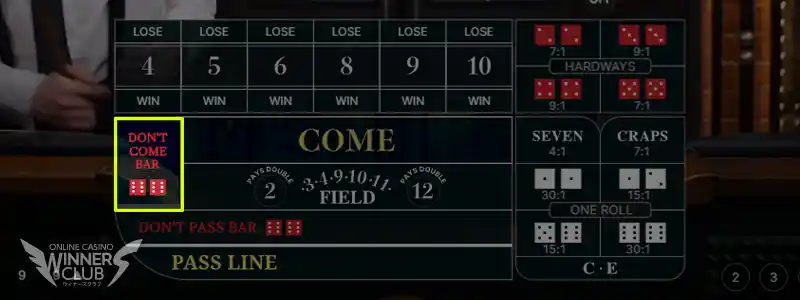
A don’t come bet works exactly like a don’t pass bet, but you can place it on any roll after the come-out roll.
A don’t come bet wins and loses under the same conditions as don’t pass. Here too, the “first roll” is not the come-out roll but the roll after you place the don’t come bet. If any other number is rolled, that number becomes the point.
You can place a don’t come bet even if you already have a bet on the pass line or don’t pass.
Place Bet
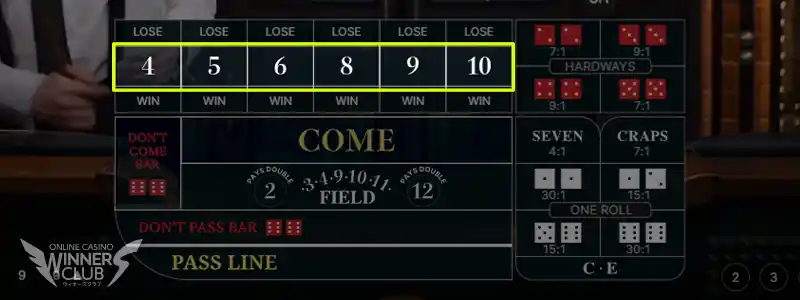
The place bet is independent of the pass line and don’t pass, and you can make it at any time after the come-out roll.
You can bet on 4, 5, 6, 8, 9 or 10, and the bet pays if your number is rolled before a 7 (there is also a place-to-lose bet, which wins if a 7 is rolled first).
After the come-out roll, you can make, increase, reduce or take down the bet whenever you like. Because of the payout ratios, however, part of your winnings may be rounded down if your bet is not in the increments the ratio requires.
Buy Bets and Lay Bets
Like a place bet, a buy bet wins if your number is rolled before a 7. A lay bet is the opposite: it wins if a 7 is rolled before your number.
The payouts on place bets include a house edge, whereas buy and lay bets are paid at true odds, so they pay more when they win; the house edge comes from the commission instead.
In return, a 5% commission is charged: 5% of the amount bet on a buy bet, and 5% of the amount won on a lay bet.
Differences from the Place Bet
- Payouts are calculated at true odds, matching the actual probability of each number
- A commission is charged (buy bet: 5% of the amount bet; lay bet: 5% of the amount won)
Craps Bets to Avoid
Some craps bets have a far lower RTP than the alternatives, or duplicate another bet that offers better terms, so there is no point in placing them at all.
As a rule, avoid all of them.
| Bet | RTP | House edge |
|---|---|---|
| Big 6 / Big 8 | 90.91% | 9.09% |
| Hardways (4 and 10) | 88.89% | 11.11% |
| Hardways (6 and 8) | 90.91% | 9.09% |
| Any Craps | 88.89% | 11.11% |
| Any Seven | 83.33% | 16.67% |
| Craps 2, 3, 12 / Yo (11) | 83.33% | 16.67% |
| Field | — | — |
The field’s house edge is either 2.78% or 5.56%, depending on how much the casino pays on a 12. Check the pay table at the table where you play.
Big 6 and Big 8
Big 6 and Big 8 are almost the same as a place bet. You can make them after the come-out roll, and they pay if a 6 (Big 6) or an 8 (Big 8) is rolled before a 7.
They win and lose under the same conditions as a place bet on 6 or 8 but pay less, so their house edge of 9.09% is far higher than the 1.52% on a place bet on 6 or 8. Some casinos now pay Big 6 and Big 8 at the same rate as place bets, but either way, there is no reason to make these bets.
Hardways
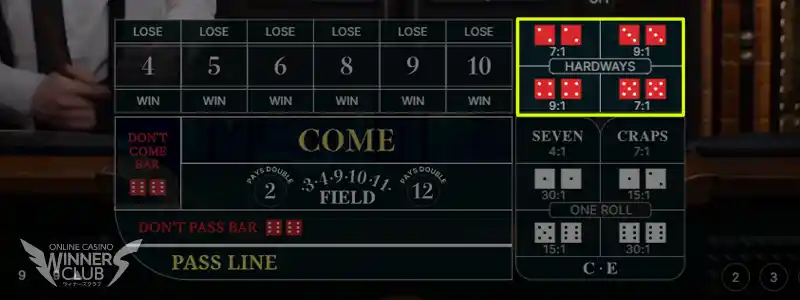
Hardways are bets that a specific pair — 2‑2, 3‑3, 4‑4 or 5‑5 (totals of 4, 6, 8 or 10) — will be rolled.
For example, a hard 4 wins if (2,2) is rolled and loses if a 7 is rolled or if a 4 is rolled the easy way, (1,3) or (3,1).
Each double comes up only 1 time in 36, and the bet has many losing combinations, so the payout is small for how rarely it wins. The RTP is also very low, so there is no need to make these bets at all.
Field
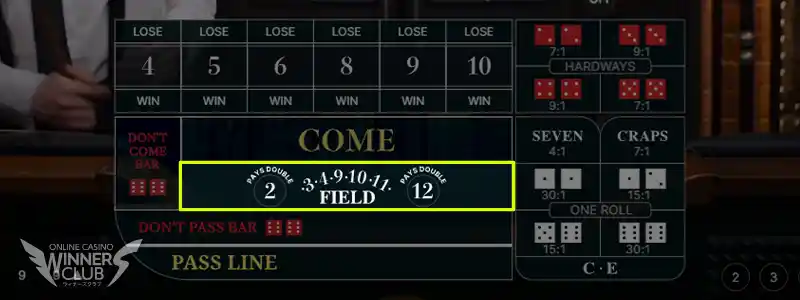
The field is a bet that wins if the total of the two dice is 2, 3, 4, 9, 10, 11 or 12. It loses on any total from 5–8.
A 2 or 12 pays more. Those higher payouts apply only to totals that each come up just 1 time in 36, though, while the losing totals of 5–8 make up 20/36 of all rolls, so the house edge is higher than on the pass line.
Any Craps and Any Seven

Any Craps and Any Seven are one-roll bets that apply only to the very next roll after you bet.
Any Craps wins if craps (2, 3 or 12) is rolled, and Any Seven wins if the total is 7. Any Craps pays 7 to 1 (a $10 bet wins $70), and Any Seven pays 4 to 1 (a $10 bet wins $40).
However, Any Craps has an RTP of only 88.89% and Any Seven only 83.33%, so there is no reason to choose either bet.
Craps 2, 3 or 12 / Yo (11)

These are also one-roll bets. With Craps 2, 3 or 12, you bet on one of those numbers and win if that number is rolled. The Yo bet wins if an 11 is rolled.
A 2 or 12 can only be rolled as (1,1) or (6,6), so these bets are very hard to win, but they pay 30 for 1 (29 to 1), so a $10 bet wins $290. A 3 or 11 is easier to roll than a double, so these bets pay 15 for 1 (14 to 1), and a $10 bet wins $140. Either way, the payouts do not match the probabilities, so you should not make these bets.
Craps RTP, House Edge and How to Limit Losses

RTP is a theoretical figure that shows how much of the money bet is paid back over the long run, and the house edge is the share the casino keeps. The two always add up to 100%.
| Bet | RTP | House edge |
|---|---|---|
| Pass line | 98.59% | 1.41% |
| Don’t pass | 98.64% | 1.36% |
| Come | 98.59% | 1.41% |
| Don’t come | 98.64% | 1.36% |
| Odds bet | 100.00% | 0.00% |
| Place bet (4 and 10) | 93.33% | 6.67% |
| Place bet (5 and 9) | 96.00% | 4.00% |
| Place bet (6 and 8) | 98.48% | 1.52% |
The higher the RTP, the lower the house edge you face, so if you want to limit your losses, the pass line and don’t pass are the basic choices.
With the right bets, craps joins baccarat and blackjack as one of the games in which the house edge is easy to keep low.
Make Full Use of the Odds Bet

If you have a bet on the pass line or come and it is not decided on the first roll, you can make what is called an odds bet.
As explained above, the odds bet is placed alongside your pass line or come bet, and its payout depends on the current point.
The payout is set purely by the probability of winning. When the point is 4, for example, a 4 has a 3/36 chance of being rolled and a 7 has a 6/36 chance, so the 4 comes up before the 7 one time in three. In that case the bet pays 2 to 1, so a $10 bet wins $20.
In other words, the odds bet has a house edge of 0% and an RTP of 100%.
Because the odds bet always comes with a pass line or come bet, the RTP on your total stake is below 100% in practice, but it is still high.
Odds Limits and How Much to Bet

The odds you can take behind a pass line or come bet have a maximum, and the multiple allowed varies by table and game.
The odds portion has a house edge of 0%, so the more you put on the odds, the lower the house edge on your total stake. The amount you put at risk grows as well, however, so your results swing more widely. If you plan to take odds, keep your initial bet below one-tenth of your bankroll at most, or around one-hundredth if you want to play safely.
Smaller bets mean smaller swings in your results, and larger bets mean larger swings. Either way, the house edge, and therefore your expected return as a percentage of what you bet, stays the same.
Craps Etiquette at Land-Based Casinos

Craps is one of the most popular table games in land-based casinos. Much of its popularity comes from its festive, party-like atmosphere, which gives the feeling that all the players at the table are taking on the casino together.
It Is Best to Avoid Don’t Pass and Don’t Come at Land-Based Casinos
Craps is a game in which you bet on whether the shooter, and with them the rest of the table, will beat the casino or lose to it. For that reason, don’t pass and don’t come bets, which are bets against the shooter, are strongly disliked by other players. If you do not want to spoil the mood at the table, it is better to avoid them.
The shooter in particular should avoid betting on don’t pass or don’t come, since other players are betting on the shooter to win.
Sharing the Ups and Downs of Each Roll Is Part of the Fun
The same player keeps rolling until a point is established and the shooter then rolls a 7 (a seven-out). The shooter does not change after a win or a loss on the come-out roll; after a seven-out, the dice pass clockwise to the next player. When the shooter rolls well, such as a 7 or 11 on the come-out roll, join the table in cheering. Exchanging a few quick words with others at the table when snake eyes (1,1) or boxcars (6,6) comes up is also part of the fun of craps.
Craps has always been a lively table game for players and onlookers alike, so relax and take in the atmosphere.
Frequently Asked Questions About Craps Rules
- What is the probability of rolling a 7 in craps?
-
The probability of rolling a 7 in craps is 1/6. Six combinations add up to 7: (1,6), (2,5), (3,4), (6,1), (5,2) and (4,3). Two dice can land in 6 × 6 = 36 ways, so the probability of a 7 is 6/36 = 1/6, or 16.67%.
- What makes craps different from other casino games?
-
Unlike most other casino games, craps is a social game, with play driven by the actions of the shooter and the players around the table. The wide range of bets can make it seem complicated to beginners, but it becomes enjoyable once you learn the rules. The pass line and don’t pass in particular have a low house edge, and there is also the odds bet, which has a house edge of 0%. The odds bet cannot be made on its own, however; it requires a bet on the pass line or come.
At land-based casinos, you can roll the dice yourself as the shooter, so you can enjoy the suspense of every roll in an atmosphere unlike that of any other game.
Summary: The Pass Line and the Odds Bet Are All You Need to Enjoy Craps
Craps is a casino game played around the world, with Las Vegas as its best-known home. It is especially popular at land-based casinos and is also available at online casinos.
Two dice are rolled, and the game unfolds according to the result. The same number can lose on one roll and win on a later one. Because bets are often not settled on a single roll, some players avoid craps, but once you learn how a round works, the game is easy to play.
The pass line has an RTP of 98.59%, and adding the odds bet lowers the house edge on your total stake even further. As long as the RTP is below 100%, however, you will still lose money over the long run. If you want to play while limiting your losses, craps is one option to consider.
This site is for adults of legal gambling age (18+, or older where required) who live in countries or regions where online gambling is legal.
Use of this site is subject to our Terms and Conditions.
Gambling involves risk. Only bet what you can afford to lose, and do not use online gambling services where they are illegal.

Bell | Editor of Online Casino Winners Club. Since the site launched in 2003, Bell has written guides to casino game rules, tested betting systems and covered land-based casinos around the world, and still plays the games before writing about them. Bell's core advice: choose the bets with the lowest house edge, and decide in advance how much you are prepared to lose.