

Card Suits: Meanings, Origins and Why the Ace of Spades Is Ornate

The four symbols on playing cards, known as suits, changed shape over a journey of thousands of miles. Behind them lie both a long history and some surprisingly practical reasons.
What You Will Learn
- A popular interpretation holds that the four suits represent swords for knights, cups for the clergy, coins for merchants and clubs for peasants, and that they stand for death, love, money and knowledge, respectively.
- The ace of spades is the only ornate ace because it once served as proof that Britain’s playing card duty had been paid.

This article takes about 19 minutes to read.
Where Did the Four Suits on Playing Cards Come From?

The suits on playing cards did not start out in their current form. As the cards traveled from the medieval Islamic world to Europe, the suits changed shape to suit the culture of each region.
The explanations below follow the most widely accepted of the various theories about their origins, but none of them can be confirmed with certainty.
The Original Four: Swords, Polo Sticks, Cups and Coins
There are several theories about the origin of playing cards. The most widely accepted is that they derive from Mamluk cards, a deck that reached Europe from the Islamic world around the 14th century. Its four suits looked nothing like the modern ones: swords, polo sticks, cups and coins.
These four were chosen because, for the upper classes of the time (knights and nobles), they were familiar symbols of power and status. Polo, for example, was a very popular sport among the elite, so it was natural for the cards to show polo sticks.
When the cards reached Europe, the suits changed to fit the culture of each country.
Italy and Spain: Close to the original (swords, clubs, cups and coins)
Germany: Motifs from nature (bells, hearts, acorns and leaves)
These may look nothing like the suits you know, but cards with these older designs are still used in parts of Italy and Spain today. The suits most of us use are just one stage in a long process of change.
How the Suits Got Their Current Shapes: Simplified Designs from France
The spades, hearts, diamonds and clubs that are now the world standard were created in 15th-century France. They spread quickly not because of any romantic symbolism but for a very practical reason: lower costs and more efficient production.
Card makers of the time struggled to draw intricate swords and cups. So they reduced the shapes to the simplest possible forms, which could be printed in a single color in one pass with stamps or stencils.
| Suit | How the Shape Changed |
|---|---|
| Spades | Simplified into a silhouette resembling a thrusting sword |
| Hearts | A simplified form of the German heart or the cup |
| Diamonds | Coins turned into a rhombus (diamond shape), like a tile or paving stone |
| Clubs | The club turned into a three-leaf symbol |
With the arrival of these French suits, playing cards quickly spread among ordinary people.
In effect, card makers more than 500 years ago were already applying what modern businesses would call user-interface design principles.
The Meanings of the Four Suits: Social Class, Seasons and Zodiac Signs (Theories Vary)

A well-known theory holds that the suits represent the four social classes of medieval Europe. It is less a historically documented fact than an interpretation that later spread as popular lore, but it makes for a very interesting story.
Later, as playing cards came to be used for fortune-telling and similar purposes, meanings such as seasons and zodiac signs were added on top of social class. The correspondences most commonly cited are shown below.
The Four Suits at a Glance: Symbol, Social Class, Season and Zodiac
| Suit | Symbol | Social Class | Season | Zodiac | Meaning |
|---|---|---|---|---|---|
| ♠ | Sword | Nobles and knights | Winter | Air signs | Death |
| ♥ | Cup | Clergy and monks | Fall | Water signs | Love |
| ♦ | Coin | Merchants | Summer | Earth signs | Money |
| ♣ | Club | Peasants | Spring | Fire signs | Knowledge |
Source: The History of Playing Cards
Spades: Death and High Rank

Spades represent swords and stand for the high-ranking classes whose occupation involved the sword, such as knights and nobles.
Knights were soldiers, and in those days many of them died in battle. This is why spades are also said to represent death.
Hearts: Based on the Cup and Meaning Love

Hearts represent the cup (the chalice) and stand for the clergy, such as monks.
The heart is also used as a symbol of affection and romantic love, so the suit is said to mean love.
Diamonds: Money and Merchants

Diamonds represent money and, by extension, stand for merchants.
In medieval European society, merchants ranked below the knights, nobles and clergy. This is reflected in many card games that rank the suits, where the usual order is spades > hearts > diamonds > clubs.
Clubs: Based on the Club and Representing Peasants

Clubs represent the club and stand for peasants. A club is a thick stick made to be gripped and swung, one of the most primitive weapons.
Another theory holds that the symbol is a three-leaf clover, so its origin is disputed. Its meaning is debated as well: besides knowledge, some theories assign it work or courage.
Knowing this background can give your favorite suit a little more meaning. The suits are sometimes used in fortune-telling or as good-luck symbols, for example spades (the knight) for competition and diamonds (the merchant) for money.
Keep in mind, however, that these meanings are most likely later interpretations.
As explained above, the suits changed shape mainly for the practical reason that simpler shapes were easier to print. Assigning social classes to them is thought to be an embellishment that later generations added to give playing cards more depth.
Why Playing Cards Are Red and Black

The red-and-black color scheme of playing cards is now a worldwide standard. Why not yellow or green, or a separate color for each of the four suits? The answer lies in card makers working at the limits of the printing technology of their day and in a long effort to make the cards as easy to read as possible during play.
The Main Reason for Two Colors: Keeping Printing Costs Down
The main reason playing cards were limited to two colors was to keep printing costs as low as possible in 15th-century France.
For playing cards to become a popular pastime among ordinary people, mass production was essential. In the woodblock printing of the time, every additional color meant another block and more work. Red (from mineral pigments) and black (from soot) were inks that were easy to obtain.
You might wonder why blue or green would not have done just as well. With the technology of the time, these colors were expensive or tended to fade. Choosing the cheapest combination with the strongest contrast led to red and black.
Do Red and Black Stand for Day and Night? A Symbolism Added Later
Although it was added later, the contrast between red and black has inspired an appealing symbolic interpretation. The best known is the theory that red represents the sun (day) and black represents night.
Red (hearts and diamonds): The rising sun, the active part of the day, or the vitality of life.
Black (spades and clubs): The sun after it has set, rest and death, or the mysterious night.
Red stands for the hours when the sun is up, from sunrise to sunset, and black for the hours after it has set. Seen this way, a deck of playing cards can be read as a symbol of a single day.
Given that playing cards also have a connection to the calendar (explained later), the contrast fits remarkably well. Historically, however, the generally accepted view is that this interpretation was spread by fortune-tellers and mystics who, after the cards had become widespread, tried to find meaning in their dual nature.
A Practical Reason: Cards That Are Easy to Read During Play
One more factor should not be overlooked: legibility, a practical benefit during play. In card games, a split-second judgment can decide the outcome. If all four suits had different colors (blue, green, yellow and red, for example), players would actually take longer to process the information, which puts extra strain on the brain.
By deliberately limiting the cards to two colors and giving each suit a completely different silhouette, card makers let players tell a red diamond from a black spade instantly, even in a dim tavern or a noisy town square.
- The color contrast (red or black) narrows the cards down by half
- The shape of the silhouette (pointed or rounded) identifies the suit
This two-step identification system is very sensible even by the standards of modern user interface (UI) design.
Four-color decks, in which each suit has its own color, do exist today.
They are sometimes seen in online poker, but they have never become mainstream, perhaps because the well-established combination of red and black is what our eyes are most used to.
Why Is Only the Ace of Spades So Ornate?
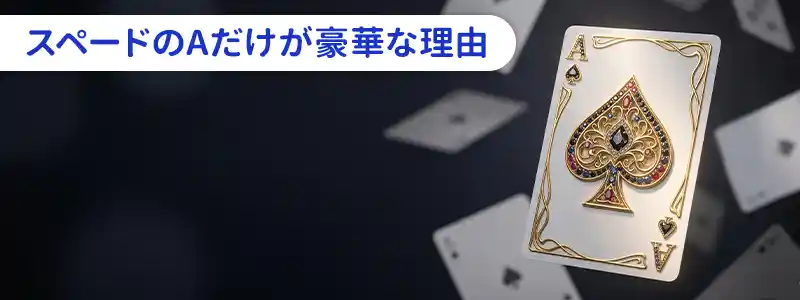
When you open a new deck of playing cards, the first card to catch your eye is often the ace of spades, which is noticeably larger and more elaborately decorated than the others.
The aces of the other three suits are plain, so why is the ace of spades so ornate? The answer lies in a strict tax once levied in Britain, the playing card duty, and in the state’s determination to stop counterfeiting.
The Background: Britain’s Tax on Playing Cards
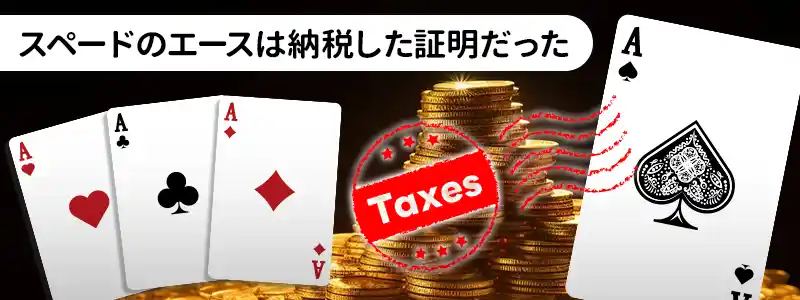
In medieval Europe, gambling with playing cards was popular among the nobility. In 1711, Britain introduced a tax on playing cards. For the state, playing cards were an important source of revenue, not just a pastime.
The ace of spades was the key to collecting this tax reliably. The government required a mark on the ace of spades showing that the duty had been paid, and from 1765 it ruled that only an ace of spades printed by the government could be used.
In other words, card makers produced the other 51 cards themselves but had to buy the most important card, the ace of spades, from the government, which was how they paid the tax. The ace of spades served, in effect, as a certificate that the duty had been paid.
The design that looks so lavish to us today was really something like an official receipt stamp from the government of the time, which shows a more down-to-earth side of the card’s history.
Stamps and Anti-Counterfeiting Measures That Survived as Decoration
Why did the design become so intricate? In a word, to prevent counterfeiting.
The early stamps were easy to forge. So from 1765 the system changed: the Stamp Office itself printed the ace of spades with a large, complex design.
With the printing technology of the time, copying intricate scrollwork or a detailed coat of arms was extremely difficult. To prove that a card was a genuine, duty-paid card, the government deliberately had craftsmen add elaborate decoration that was very hard to copy.
British law at the time was also remarkably harsh. Anyone who forged the ace of spades to avoid the tax faced the death penalty. That the design of a single card could literally be a matter of life and death is hard to imagine today.
Practical: Intricate patterns prevent copying.
Symbolic: The design displays the authority of the state (with motifs such as the crown).
In 1862 the duty was reduced, and makers no longer had to show payment with an ornate ace of spades. By then, however, the idea that the ace of spades should be ornate was firmly established, so card makers chose to continue the tradition and began using the card as a place for their own logos and brand names.
Even today, on widely sold brands such as Bicycle, the center of the ace of spades carries the maker’s own elaborate logo.
This is more than decorative display. It marks a handover in history: card makers took over the place of honor where the government’s tax stamp once appeared.
Source: 72: The Ace of Spades
Playing Card Numbers That Match the Calendar: Is the Mathematical Fit Intentional?

Look closely at how a deck of playing cards is made up, and you will notice some surprisingly precise numerical patterns. Something meant only for games turns out to line up neatly with the 365-day calendar. Is this a coincidence, or a deliberate design that carries ancient knowledge?
How to Interpret the Curious Match Between 52 Cards and 52 Weeks
Without the jokers, a deck has 52 cards. That number matches the number of weeks in a year exactly.
Each suit also has 13 cards (A–K), which matches the roughly 13 lunar months in a year and the number of weeks in one season (13 weeks × 4 seasons = 52 weeks).
It is understandable if this sounds too neat to be true. Historically, however, the deck settled into its current 52-card form only in the 15th century or later. Before that, many regions used decks with a different number of cards.
In fact, while many of us take a 52-card deck for granted, a standard deck has 40 cards in Italy and 36 in Russia. The idea that 52 cards equal one year is not a universal rule.
The sober view among historians today is that the deck was not designed as a calendar from the start. Rather, as practical numbers were chosen over time, it gradually settled into a form close to the natural cycle of the calendar.
Checking the Math: Do All the Cards Really Add Up to 365?
The best-known piece of playing card trivia is the claim that adding up all the card values gives the number of days in a year, 365. Let us do the calculation.
- Total for one suit (A through K): 1 + 2 + 3 + … + 13 = 91
- Total for all four suits: 91 × 4 = 364
The result is 364, just one short of a year. Add the single joker in the deck as 1 point, and the total comes to exactly 365.
If you also count the spare joker that some decks include as a second point, the total even covers a leap year of 366 days. When the numbers fit this perfectly, it is tempting to believe the deck was calculated that way.
The joker, however, was added to playing cards in 19th-century America and did not exist in earlier decks. This “365-day rule” is therefore most likely a remarkable after-the-fact interpretation, completed by later generations once the joker appeared.
When Did the Four Suits Become Linked to the Four Seasons?
The theory that the four suits (spades, hearts, diamonds and clubs) stand for the four seasons is also familiar to card enthusiasts.
The season assignments in the table “The Four Suits at a Glance” above vary by source, and many sources assign spring to hearts and fall to clubs instead.
This link grew stronger when playing cards became associated with fortune-telling (through their common ground with tarot) and with mystical ideas. The assignments differ from source to source simply because there was never a single correct answer.
The Models for the Face Cards (K, Q, J): The French Naming Tradition and the History of Their Designs

The kings and queens on the face cards (court cards) were each modeled on a real or legendary hero. This naming tradition was established in 16th-century France. Once you know it, cards that looked like mere symbols begin to look like dramatic figures from history.
The Kings: Named After Historical Heroes Such as David and Caesar

Each of the four kings (K) is assigned one of four great rulers from ancient and medieval times.
| Card | King Used as the Model | About the King |
|---|---|---|
| King of spades | King David | A king of ancient Israel. Also known as a skilled harpist, and some cards show him with a harp. |
| King of hearts | Charlemagne | Charles the Great. Called the father of medieval Western Europe. He is the only king without a mustache. |
| King of diamonds | Julius Caesar | A hero of ancient Rome. Shown in profile, like a portrait on a coin. |
| King of clubs | Alexander the Great | A conqueror from ancient Greece. The scepter in his hand is often shown with a cross. |
Look closely at what the kings hold and how they pose. The king of diamonds (Caesar), the only one shown in profile, is sometimes read as a symbol of greed and ambition, which fits a suit derived from coins, the symbol of money and power.
These small differences in the designs reflect both the respect the card makers of the time had for these heroes and their sense of playfulness.
The Names of the Queens and Jacks and the French Tradition
Like the kings, the queens (Q) and jacks (J) also have their own names. On cards made in 16th-century France, the following figures served as models.
Models for the queens (Q)
- ♠: Pallas (Pallas Athena, the Greek goddess of war)
- ♥: Judith (a Jewish heroine who fought for her people in the Old Testament)
- ♦: Rachel (the wife of Jacob in the Old Testament)
- ♣: Argine (an anagram of regina, the Latin word for “queen”)
Models for the jacks (J)
- ♠: Ogier the Dane (a legendary Danish hero)
- ♥: La Hire (a comrade-in-arms of Joan of Arc)
- ♦: Hector (a hero of the Trojan War)
- ♣: Traditionally named Lancelot, a Knight of the Round Table in medieval romance (some sources say Judas Maccabeus)
The queens are women who combine strength and wisdom, such as a goddess of wisdom and a heroine of the Bible. The jacks are loyal knights, such as one of Charlemagne’s paladins and a comrade-in-arms of Joan of Arc. French-pattern cards still carry these names and designs today.
The role of the jack is particularly interesting. Today it is often mistaken for a prince, but the word originally meant a servant (the knave) or a foot soldier.
Why is there no prince? Because playing cards mirror the social hierarchy of a royal court. There is a king (K), his queen (Q) and the knights (J) who surround them. These three cards represent, in miniature, the basic unit of the power structure in European society at the time.
What the Direction of the Faces on the Face Cards (J–K) Means
As explained earlier, spades are said to mean death, hearts love, diamonds money and clubs knowledge. One interpretation holds that whether the figure on a jack, queen or king looks toward the suit symbol or away from it shows how interested that figure is in what the suit represents.
Facing toward the suit symbol: strong interest

When the figure’s face is turned toward the suit symbol, the more directly it faces the symbol, the stronger the interest it is said to show.
The jack of hearts, for example, looks straight at the symbol, so he is read as being very interested in love. In the hearts suit, the queen and the king also look toward the symbol, which is taken to mean that love draws interest regardless of age or gender.
Facing away from the suit symbol: no interest or rejection

When the figure’s face is turned away from the suit symbol, it is said to show a lack of interest or outright rejection.
The jack of spades, for example, looks completely away from the symbol. As a young man, the jack is thought to have the strongest aversion to death. The queen and the king of spades also face away, but less sharply than the jack, which can be read as a degree of acceptance of death.
Today’s Standard Designs Do Not Depict Specific People
So far we have looked at the models behind the face cards, but there is one important point to add. The standard designs on the playing cards you buy today at a supermarket, drugstore or toy store (the Anglo-American pattern, also called the English pattern) are not based on any specific person.
Giving the face cards proper names was in fact a tradition unique to France. As playing cards spread to Britain and then to America, the designs were refined into more symbolic images.
In France: The heroes’ names were printed on the cards, and players enjoyed them as distinct characters.
In Britain and America: The designs became double-headed (mirrored top and bottom), so the cards could be read whichever way up they were held.
Along the way, the features of individual people were lost, and the cards settled into today’s practical form, with an image that looks the same from either end.
You may find it a little disappointing that the figures turn out to be no one in particular. Then again, it can be argued that by becoming nameless symbols, playing cards were freed from any one culture and became something people play with all over the world.
Other Playing Card Trivia

Why Some Languages Call Playing Cards “Trumps”
In Japanese and a few other languages, the everyday word for a deck of cards comes from the English word “trump.”
In English, however, “trump” refers only to a trump card, a card of the suit that outranks the other suits in a game. The cards themselves are simply called playing cards.
Casino Playing Cards Are Slightly Smaller
Standard playing cards come in two sizes: bridge size and poker size. Both are the same length, but bridge-size cards are 2.25 in (57 mm) wide and poker-size cards are 2.5 in (63 mm) wide, so bridge-size cards are the narrower of the two.
Most cards sold in stores are poker size, but many casino poker tables use bridge-size cards, which are slightly smaller. Because they are narrower, they suit games in which players hold many cards in their hand.
Ways to Enjoy Playing Cards: Games, Fortune-Telling and Memory

Card Games
Many casino games are played with playing cards, and blackjack, Dragon Tiger and Red Dog are among the popular ones. The table below compares baccarat and poker, two games in which the suits play a particularly important role.
| Game | Key Rules | Role of the Suits |
|---|---|---|
| Baccarat | The hand (Player or Banker) whose total, counting only the last digit, is closer to 9 wins | In the squeeze, where a card is revealed little by little, the excitement comes from watching for the suit symbols to appear |
| Poker | Players make a hand from 5 cards, and the higher-ranking hand wins | Five cards of the same suit make a flush, which is also the basis of a straight flush and a royal flush |
Poker is available at many online casinos. The article below ranks online casinos.
Fortune-Telling with Playing Cards
One form of fortune-telling, cartomancy, uses playing cards to read a person’s fortune. Tarot cards are the more common choice, but if you do not have a tarot deck at hand, a deck of playing cards makes an easy substitute.
There are many ways to read playing cards, and the simplest is a one-card draw (one-card reading), in which you pick a single card. It is used to read the day’s fortune or to look at the past and the future.
Card Memorization
As the name suggests, card memorization is a mind game in which you memorize the order of all 52 cards in a deck. In memory sports it is called speed cards, and some competitors around the world can memorize all 52 cards in little more than ten seconds. It is a popular way to train your memory.
Frequently Asked Questions About Playing Card Suits
- Why was the joker added to the deck?
-
The joker originated in the United States in the mid-19th century as the highest trump in a game called Euchre.
At the time it was called the Best Bower rather than the joker. “Bower” comes from the German word Bauer (farmer), and in Euchre it refers to the top-ranking jacks. There are several theories about how the name changed to “joker.”
The joker was not created to bring the deck’s total to the 365 days of the calendar. It was simply an extra card added to make the game more exciting.
- Why are spades the highest suit?
-
One theory links the top ranking of spades in many games to the history of the playing card duty described earlier. The ace of spades was the most expensive card, carried the government’s emblem, and forging it could even be punished by death. According to this view, the suit that included such a special card naturally came to be seen as the “king of suits.”
The interpretation that spades represent the highest social class, the knights and nobles, also supports the ranking of spades, hearts, diamonds and clubs, from highest to lowest.
- What do playing card suits have in common with tarot cards?
-
Playing cards and tarot cards are something like siblings. The 56 tarot cards known as the Minor Arcana use the same four symbols as the original playing cards: swords, cups, coins and wands.
Swords ⇒ spades
Cups ⇒ hearts
Pentacles (coins) ⇒ diamonds
Wands ⇒ clubs
Fortune-tellers still use these older forms today. Playing cards evolved toward practicality (ease of printing), while tarot kept its symbolism (depth of meaning), which makes the Minor Arcana an interesting record of the point where the two paths diverged.
Summary: Playing Cards Are More Interesting When You Separate Fact from Interpretation
The history packed into just 52 cards (plus the jokers) rests on two pillars.
Facts: The History of Technology and Regulation
Designs simplified to lower printing costs, anti-forgery measures (the elaborate decoration) to prevent tax evasion, and high visibility to make games easier to play.
Interpretations: Layers of Culture and Romance
Mathematical links to the seasons and the calendar, a reflection of the class structure of medieval society, and symbols modeled on historical heroes.
When we play cards, we are playing out the romantic stories that later generations built up, on top of a highly functional design created by craftsmen more than 500 years ago.
The next time you pick up a deck, run your finger over the intricate design of the ace of spades. It still carries the state’s determination to stop forgery, backed by the death penalty, and the pride of the craftsmen who turned that requirement into art.
- How to Play Online Bingo
- Plinko Game Rules and Payouts
- Bustabit Crash Game Rules
- Keno Rules and Odds
- Card Suits and Their Meanings
This site is for adults of legal gambling age (18+, or older where required) who live in countries or regions where online gambling is legal.
Use of this site is subject to our Terms and Conditions.
Gambling involves risk. Only bet what you can afford to lose, and do not use online gambling services where they are illegal.

Bell | Editor of Online Casino Winners Club. Since the site launched in 2003, Bell has written guides to casino game rules, tested betting systems and covered land-based casinos around the world, and still plays the games before writing about them. Bell's core advice: choose the bets with the lowest house edge, and decide in advance how much you are prepared to lose.