

This article covers the basics of the house edge, including what it is and how it differs between types of roulette, and then compares the house edge…
How to Play Roulette: Rules, Bets, Payouts and House Edge

Roulette, sometimes called the “Queen of Casino Games,” is one of the best-known games in any casino. Many players, however, are not very familiar with the detailed rules. Betting on red or black is only one option, and roulette offers many other ways to bet.
This article covers the basic roulette terms, the types of bets, how a round is played and the main variants of the game. It also explains the characteristics of each bet and how to choose a roulette game with a low house edge. By the end, even beginners should be able to play roulette with confidence.
What You Will Learn
- Casino roulette is a simple game: you predict which number the ball will land on after it is spun into the wheel.
- There are two types of bets: outside bets and inside bets.
- If you play roulette, we recommend European roulette, which has a house edge of 2.70% (American roulette has a house edge of 5.26%).

This article takes about 17 minutes to read.
Contents
Show
What Is Casino Roulette?
Roulette is one of the most popular table games in casinos. Its distinctive wheel and white ball are so closely associated with casinos that most people have seen them, even if they have never gambled.
European roulette has a return to player (RTP) of 97.30%, a reasonable level compared with other casino games.
The rules are simple, so anyone can learn to play quickly. Roulette is a good choice for casino beginners.
Basic Rules of Roulette
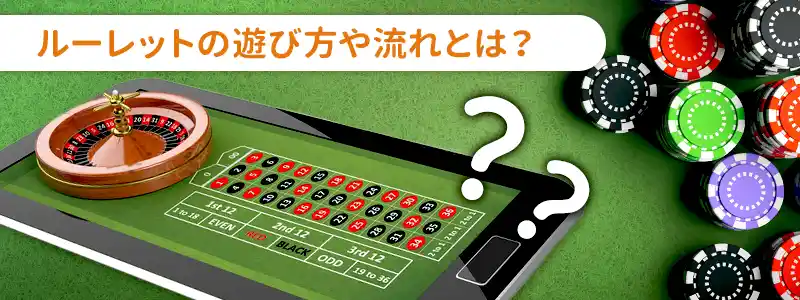
The basic rules of casino roulette are very simple. The whole game comes down to one thing: predicting which number the ball will land on after it is spun into the wheel. Many players already know this much.
In a little more detail, the roulette wheel is marked with the numbers 1–36 and a 0 (some wheels also have a 00). Before the round begins, players predict which color or number will come up and place their chips on the table.
Once the round begins, the dealer spins the ball into the wheel. If you bet on the number or the color of the pocket where the ball comes to rest, you win and are paid according to where you placed your bet.
The Roulette Table and Equipment
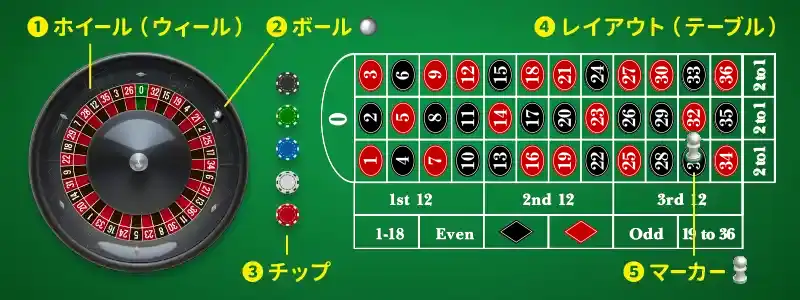
A roulette table has the wheel and the layout side by side.
Five pieces of equipment are used: the wheel, the ball, the chips, the layout and the marker. The person who runs the game and spins the ball into the wheel is called the dealer.
| Item | Description |
|---|---|
| (1) Wheel | The rotating disc used in roulette. It has 37 pockets (in European roulette), each marked with a different number, and the result is decided by spinning the ball into it. |
| (2) Ball | The ball the dealer spins into the wheel to decide the result. |
| (3) Chips | Coin-shaped tokens used to place bets. Unlike the chips used in other casino games, they carry no printed denomination; each player’s chips are identified by color, so they are also called “roulette chips” or “color chips.” |
| (4) Layout | The betting area where chips are placed. It is marked with red and black and with each number, and players put their chips on the spots they want to bet on. |
| (5) Marker | A marker that shows the winning spot. After the spin, the dealer places it on the winning number (the marker is often called the “dolly”). |
How a Round of Roulette Is Played
This section walks through a round step by step; where to place chips and what each bet pays are covered later.
- The Four Steps of a Roulette Round
-
- Predict the result and place your chips on the table
- The dealer spins the ball into the wheel
- Betting closes and the ball comes to rest in a pocket
- Winning bets are paid
STEP1
Predict the Result and Place Your Chips on the Table
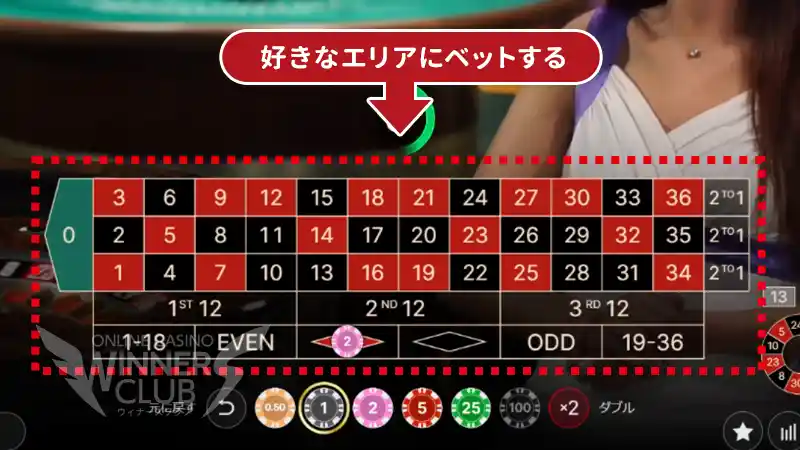
Once you are at the roulette table, predict where the ball will land next and place your chips on the table. There are many ways to bet: on a single number such as 1 or 36, on a range of numbers such as 1–6, or on a color such as red or black.
STEP2
The Dealer Spins the Ball into the Wheel
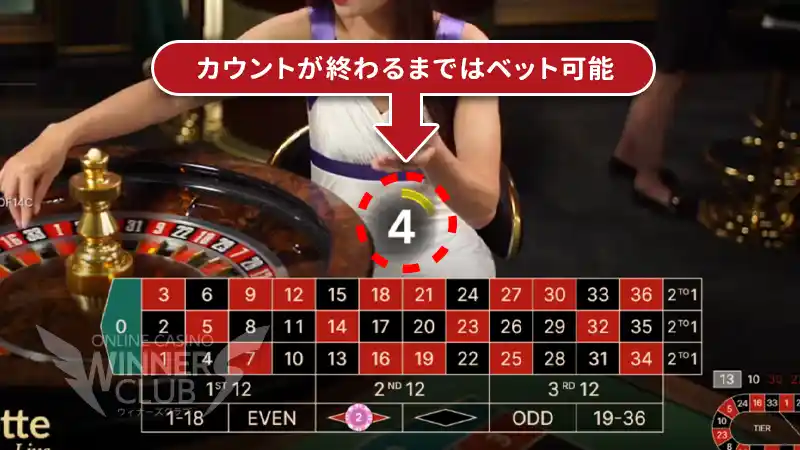
The dealer spins the ball into the roulette wheel. Players can still place bets right after the ball is spun.
STEP3
Betting Closes and the Ball Comes to Rest in a Pocket
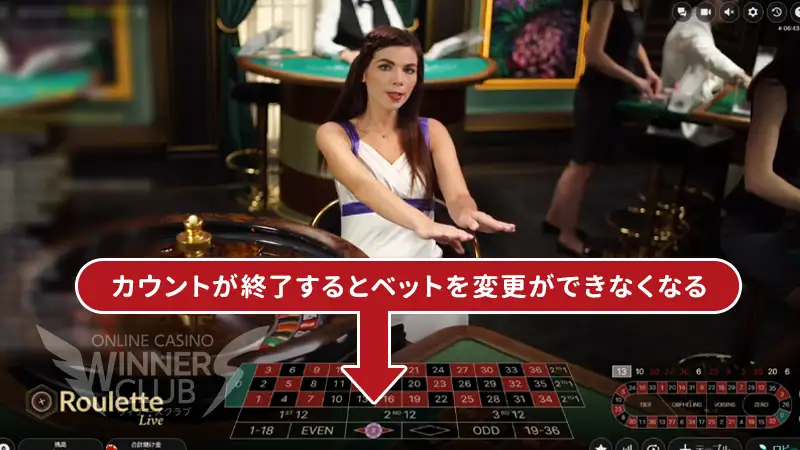
Once the dealer calls “No more bets,” you can no longer add chips, remove chips or cancel your bet. At an online casino, the same applies when the betting timer reaches zero.
The ball then drops into a pocket on the wheel, and the result is final.
STEP4
Winning Bets Are Paid
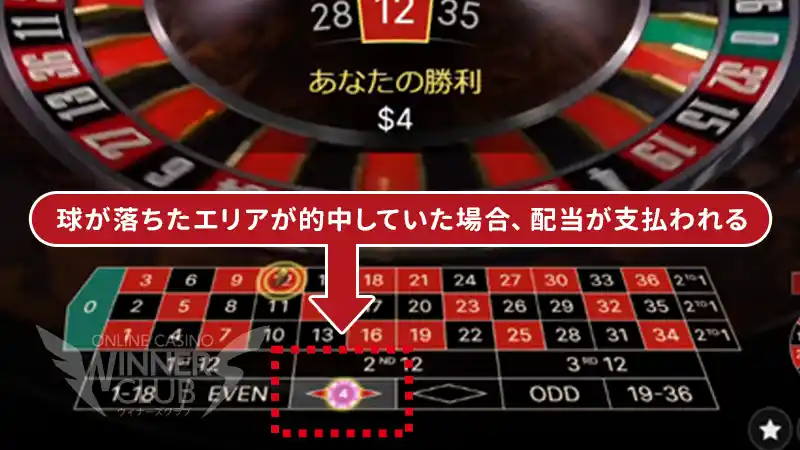
Once the result is final, the dealer settles the bets. First, all chips placed on losing spots are collected. The dealer then pays out winnings on the spots that won.
At a land-based casino, the chips you placed on a winning spot usually stay on the table; you can pick them up after collecting your winnings or leave them there as your bet for the next round. At an online casino, your original bet is usually credited to your balance together with your winnings.
Types of Roulette and House Edge
Casino roulette comes in three main types: European, American and French roulette. European roulette is the most widely played, and French roulette adds special rules for even-money bets.
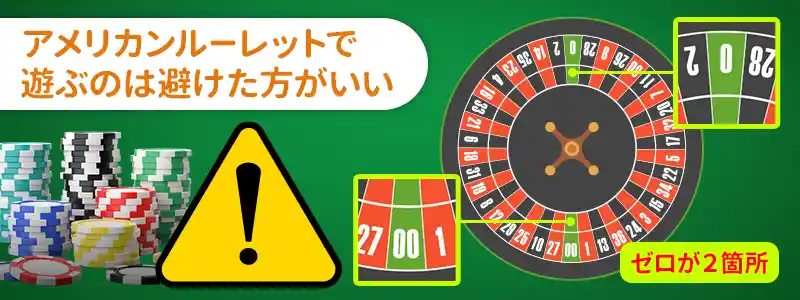
French and European roulette have a single 0, while American roulette has two zeros, 0 and 00. When the ball lands on a zero, every outside bet loses, so the fewer zeros the wheel has, the lower the house edge.
French roulette also has rules that favor the player: la partage, which returns half of an even-money bet when the ball lands on zero, and en prison, which holds the bet over until the next spin.
- Related Article
-

House Edge in European Roulette
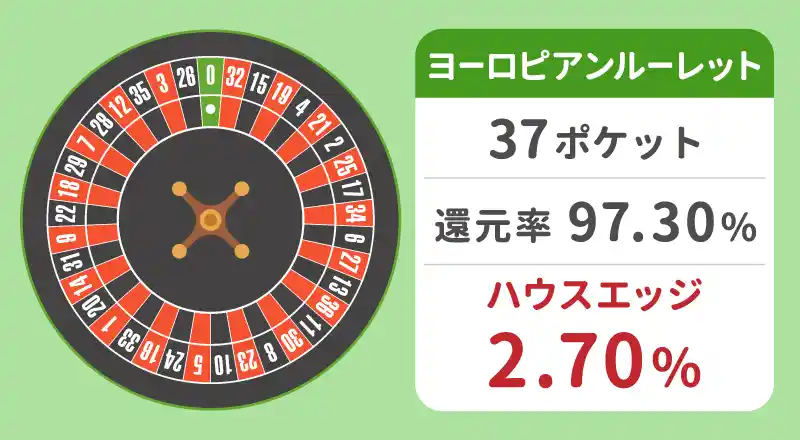
European roulette has the numbers 1–36 plus a single 0, so there are 37 possible outcomes.
The house edge can be calculated as follows.
House edge (%) = 100% − (expected return ÷ bet) × 100%
In European roulette, the house edge is the same for every bet, so as an example, we will calculate it for a bet on red.
A European wheel has 37 pockets, 18 of which are red. A winning bet on red pays 1 to 1, so a $1 bet returns $2 in total, including the stake.
The probability that a single bet on red wins is 18 / 37 (≈ 48.65%).
Because a winning bet returns twice the stake, the expected return is 2 × 18 / 37 = 36 / 37 (≈ 97.30%).
The house edge is therefore 100% − 97.30% = 2.70%.
House Edge in American Roulette
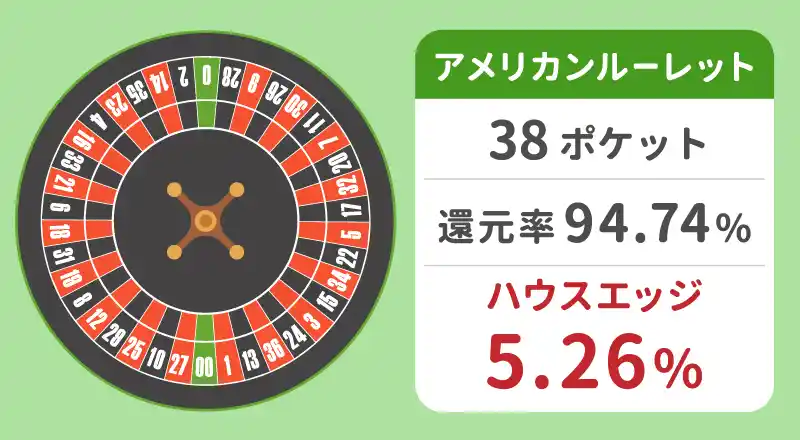
American roulette has the numbers 1–36 plus two zeros, 0 and 00, so there are 38 possible outcomes.
As with European roulette, we will calculate the house edge for a bet on red.
Following the same steps, the probability that a single bet on red wins is 18 / 38 (≈ 47.37%), and the expected return is 2 × 18 / 38 = 36 / 38 (≈ 94.74%).
The house edge is therefore 100% − 94.74% = 5.26%.
American roulette has nearly double the house edge of European roulette. Unless there is a promotion specific to American roulette, it is best to stay away from it.
House Edge in French Roulette
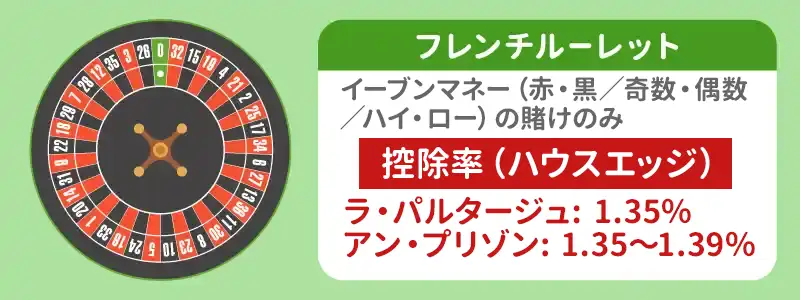
Note: Some online casino tables called “French Roulette” do not use la partage or en prison. Check the game’s rules for la partage or en prison before you play.
Like European roulette, French roulette has a single 0, so its base house edge is 2.70%.
However, when you place an even-money bet (red/black, odd/even or high/low) in French roulette and the ball lands on 0, half of your bet is returned. This is known as the la partage rule.
We will now calculate the house edge for a bet on red under the la partage rule.
Because half of the bet (0.5 times the stake) is returned when the ball lands on 0, that amount is added to the expected return. The probability that a single bet on red wins is 18 / 37 (≈ 48.65%), and the probability that the ball lands on 0 is 1 / 37 (≈ 2.70%), so the expected return is 2 × 18 / 37 + 0.5 × 1 / 37 = 36.5 / 37 (≈ 98.65%).
The house edge is therefore 100% − 98.65% = 1.35%.
This shows that French roulette has the lowest house edge for even-money bets.
You might conclude that you should always play French roulette, but French roulette tables are less common than European ones, and some tables called French roulette do not use la partage.
Because the house edge differs this much between the types, it is best to avoid playing American roulette.
Basic Roulette Bets and Their Payouts

Casino roulette bets fall into two main types: outside bets and inside bets. Put simply, an inside bet is placed directly on numbers, while an outside bet is placed on a group of numbers, such as red/black or odd/even, rather than on specific numbers.
Inside bets win less often but offer large payouts, while outside bets win more often but pay less.
The house edge is the same whichever type you choose, but beginners will usually find outside bets easier to get a feel for, because the winning areas are easy to understand and they win more often.
Casino payouts are written as odds. A bet such as red/black, where a one-chip bet wins one chip, is written as “1 to 1.” At a land-based casino, the winnings are paid in chips and your original bet stays on the table, while at an online casino the bet is rarely left on the table, and the bet and the winnings are both credited to your balance. In this article, payouts are given as odds, with the amount won shown in an example: at 1 to 1, a $10 bet wins $10, and you get $20 back in total. The last column of the table below shows the total returned on a $1 bet, including the stake.
| Category | Bet | Payout | Total returned on a $1 bet (incl. stake) |
|---|---|---|---|
| Outside bets | Red/Black | 1 to 1 | $2 |
| High/Low | 1 to 1 | $2 | |
| Odd/Even | 1 to 1 | $2 | |
| Column bet: 12 numbers | 2 to 1 | $3 | |
| Dozen bet: 12 numbers | 2 to 1 | $3 | |
| Inside bets | Straight-up bet: 1 number | 35 to 1 | $36 |
| Split bet: 2 numbers | 17 to 1 | $18 | |
| Street bet: 3 numbers | 11 to 1 | $12 | |
| Corner bet: 4 numbers | 8 to 1 | $9 | |
| Four-number bet: 4 numbers | 8 to 1 | $9 | |
| Five-number bet: 5 numbers | 6 to 1 | $7 | |
| Line bet: 6 numbers | 5 to 1 | $6 |
Outside Bets: Betting on Groups of Numbers
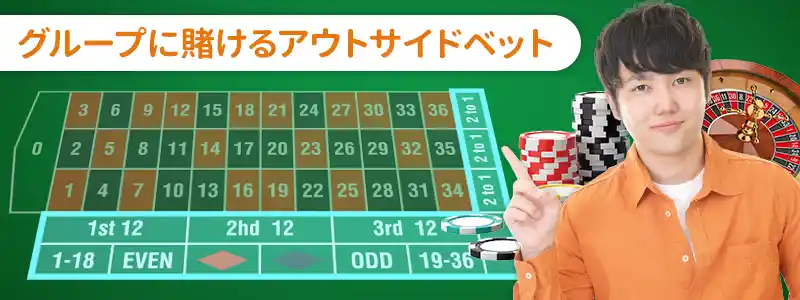
An outside bet is not placed on a number itself but on a group of pockets.
If you bet on black, for example, you win when the ball lands on a black number. If you bet on 19–36, you win when the winning number is between 19 and 36. For every outside bet, the bet loses if the ball lands on 0 or 00.
Outside bets generally pay only 1 to 1 or 2 to 1, but they win often in exchange for smaller payouts, which suits players who prefer frequent, smaller wins.
Red/Black
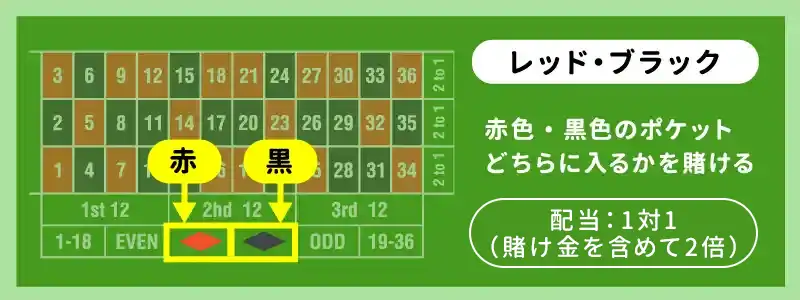
Apart from the 0, every number in roulette is either red or black. On a European wheel, red and black alternate all the way around apart from the 0, although the order of the numbers is different from the order on the layout. On an American wheel, the pockets on either side of the 0 and of the 00 are the same color, so the colors do not strictly alternate.
A red/black bet is a prediction of whether the ball will land in a red pocket or a black pocket. It pays 1 to 1, so a $10 bet wins $10.
High/Low
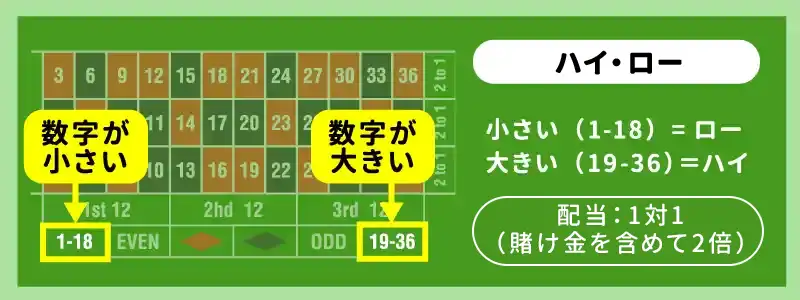
High covers the numbers 19–36 and low covers 1–18. A high/low bet is a prediction of whether the winning number will be one of the high numbers or one of the low numbers. It pays 1 to 1, so a $10 bet wins $10.
Odd/Even
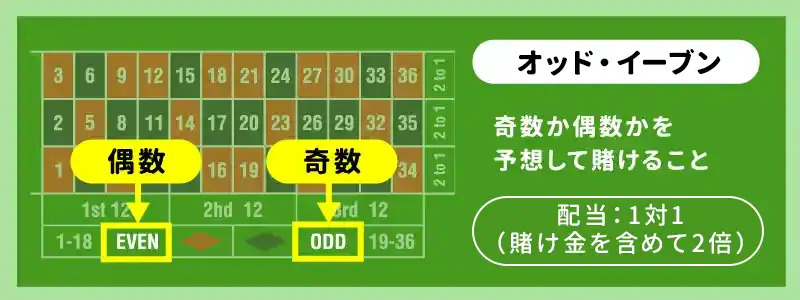
Odd covers the odd numbers (1, 3, 5 … 35) and even covers the even numbers (2, 4, 6 … 36; 0 does not count as even for this bet). An odd/even bet is a prediction of whether the winning number will be odd or even. It pays 1 to 1, so a $10 bet wins $10.
Column Bet: 12 Numbers
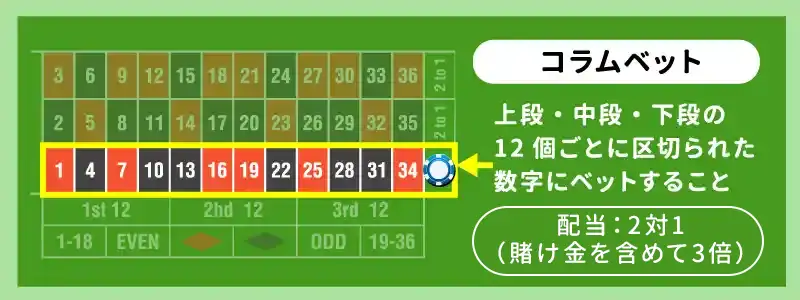
A column bet is a bet on one of three groups of 12 numbers.
- First column: 1, 4, 7, 10, 13, 16, 19, 22, 25, 28, 31, 34
- Second column: 2, 5, 8, 11, 14, 17, 20, 23, 26, 29, 32, 35
- Third column: 3, 6, 9, 12, 15, 18, 21, 24, 27, 30, 33, 36
You predict which of the three columns the winning number will be in. It pays 2 to 1, so a $10 bet wins $20.
Dozen Bet: 12 Numbers
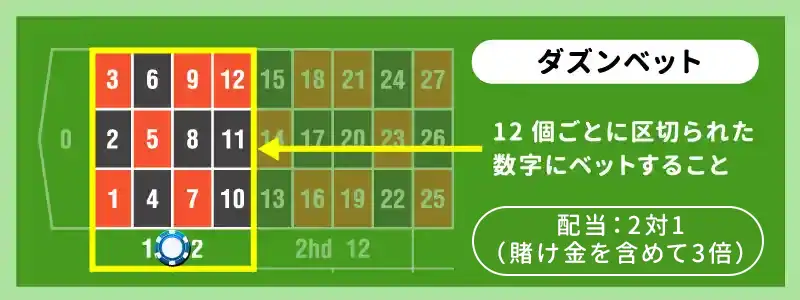
A dozen bet is also a bet on a group of 12 numbers, but the numbers are grouped differently from a column bet.
- First dozen: wins if the ball lands on 1–12
- Second dozen: wins if the ball lands on 13–24
- Third dozen: wins if the ball lands on 25–36
With a dozen bet, you predict which of these three groups the winning number will be in. It pays 2 to 1, so a $10 bet wins $20.
Inside Bets: Betting Directly on Numbers
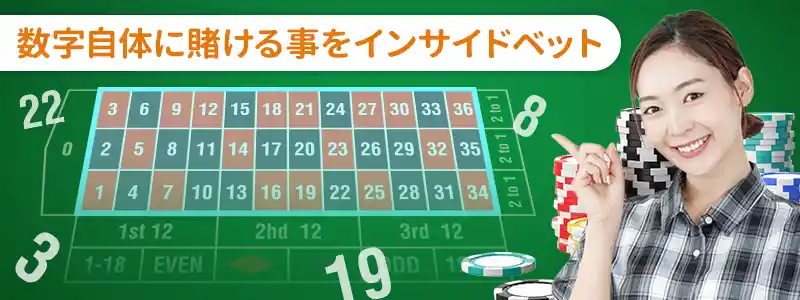
An inside bet is placed on the numbers themselves, from 0 to 36. You win if the ball lands in a pocket you bet on, so inside bets have a lower chance of winning but larger payouts.
You are not limited to a single number. You can also bet on two adjacent numbers such as 4 and 5, on a line of numbers such as 16, 17 and 18, or on four numbers such as 22, 23, 25 and 26.
Straight-Up Bet: 1 Number
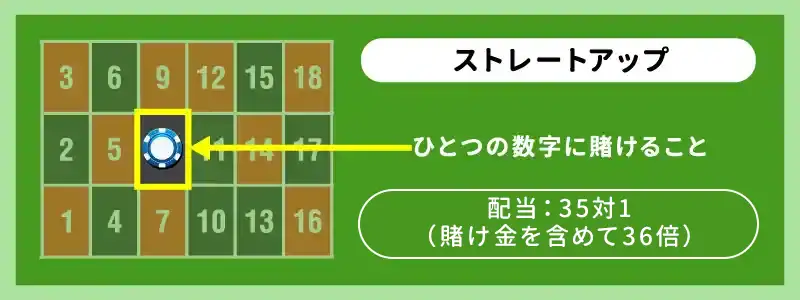
A straight-up bet is a bet on a single number. To place a straight-up bet on 8, for example, place your chip in the center of 8, as in the example above. It pays 35 to 1, so a $10 bet wins $350. This is the highest payout in roulette, but the probability of winning is 1/37 (about 2.70%), the lowest of any bet, so your results can swing widely.
Split Bet: 2 Numbers
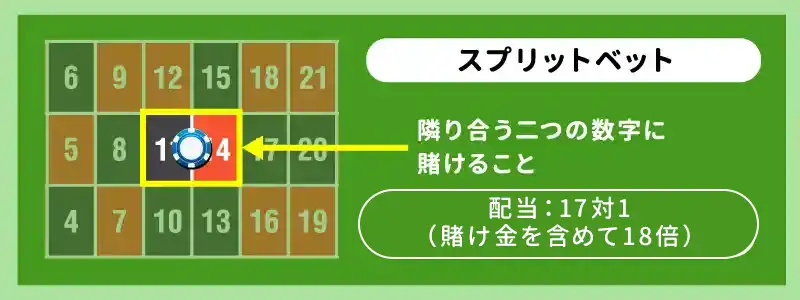
A split bet is a bet on two adjacent numbers. To make a split bet on 1 and 2, for example, place your chip on the line between 1 and 2. It pays 17 to 1, so a $10 bet wins $170.
Any two numbers that are next to each other on the layout can be combined, so a split bet on 11 and 14, as in the example above, is also possible. You cannot, however, make a split bet on numbers that are not next to each other vertically or horizontally on the layout, such as 1 and 5.
Street Bet: 3 Numbers
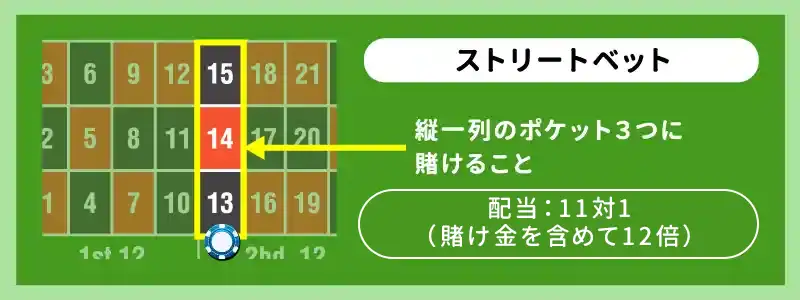
A street bet is a bet on three consecutive numbers in a single row on the layout (such as 13, 14 and 15). To make a street bet on 13, 14 and 15, as in the example above, place your chip on the outer edge of the row. It pays 11 to 1, so a $10 bet wins $110.
A street bet only covers the lines as they appear on the layout, such as 1, 2 and 3 or 16, 17 and 18. If you want to bet on consecutive numbers that do not form a single line, such as 8, 9 and 10, place a third of your stake on each of 8, 9 and 10 as straight-up bets.
Corner Bet: 4 Numbers
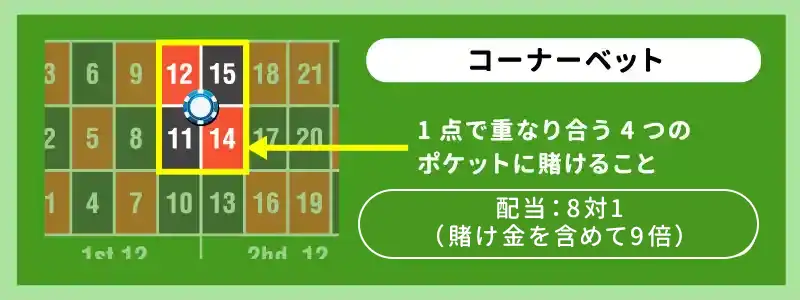
A corner bet is a bet on four adjacent numbers that share a single corner. To make a corner bet on 11, 12, 14 and 15, as in the example above, place your chip in the center of the corner where those four numbers meet. It pays 8 to 1, so a $10 bet wins $80.
Four-Number Bet: 0, 1, 2 and 3
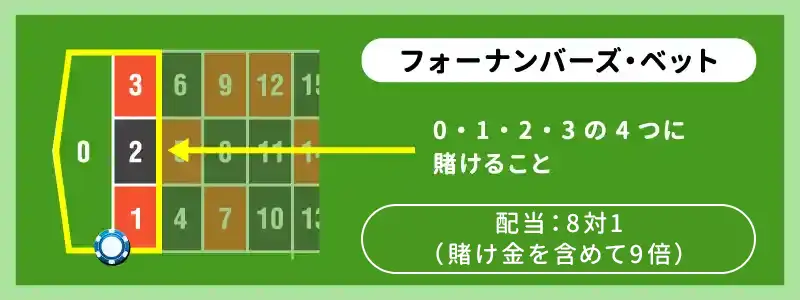
The four-number bet, available only on single-zero wheels (European and French roulette), is a bet on 0, 1, 2 and 3. To place it, put your chip on the bottom edge of the line between 0 and 1. If you place the chip in the middle of the line between 0 and 1, it may be treated as a split bet on 0 and 1, so be careful.
The four-number bet pays 8 to 1, the same as a corner bet.
Five-Number Bet: 0, 00, 1, 2 and 3
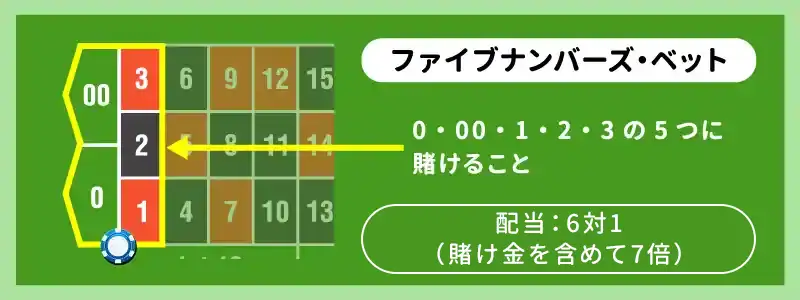
The five-number bet, available only in American roulette, is a bet on 0, 00, 1, 2 and 3. The chip is placed in the same way as for the four-number bet described above.
The five-number bet pays 6 to 1, so a $10 bet wins $60, and its house edge of 7.89% is the highest of any roulette bet.
Because its house edge is higher than that of every other bet, this bet is best avoided.
The differences between European and American roulette are explained in the section on types of roulette above.
Line Bet: 6 Numbers
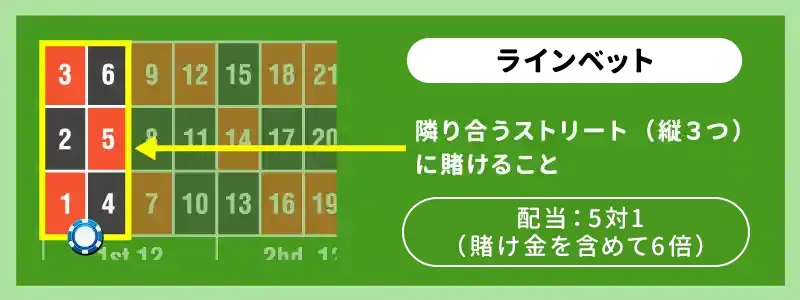
A line bet, also called a double street, is a bet on two adjacent lines, six numbers in total. To make a line bet on 1, 2, 3, 4, 5 and 6, for example, place your chip on the bottom edge of the line between 1 and 4 so that it is not mistaken for a split bet on 1 and 4. It pays 5 to 1, so a $10 bet wins $50.
Roulette Table Etiquette
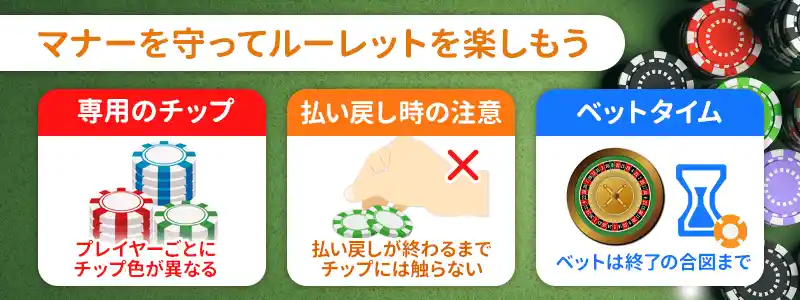
At an online casino, there is no etiquette to worry about when you play roulette. At a land-based casino, however, certain rules of conduct are expected. This section covers roulette etiquette at land-based casinos.
Exchanging Chips for Roulette Chips (Color Chips)
Roulette is played with chips called color chips, and each player at the table is given a different color. With ordinary casino chips, it would be impossible to tell who had bet how much and where when several players share a table. Giving each player a separate color makes every bet, and the player who placed it, easy to identify.
Color chips have no value printed on them and cannot be used anywhere other than the roulette table where they were issued. To play roulette, you first exchange your regular casino chips for color chips at the table, and before moving to another game, you need to exchange your color chips back into regular casino chips.
Do Not Touch Your Chips Until Payouts Are Finished
Even after the result is final, leave your chips alone until the dealer has finished paying out. The dealer collects the losing chips and then pays each winning player.
To avoid any suspicion of cheating, do not handle your chips until the dealer has finished paying out.
Respect the Close of Betting
Once the dealer calls “No more bets,” you cannot add, change or cancel a bet. Some casinos may overlook a delay of a few seconds, but if it happens repeatedly, you may be asked to leave the table.
Make a habit of finishing your bets within a few seconds of the dealer spinning the ball.
Roulette Betting Systems
Roulette players sometimes use staking strategies known as betting systems. Well-known examples include the Martingale, the d’Alembert and the Cocomo systems.
None of these systems guarantees a win, and no betting system changes the house edge, whichever bets you choose. They are simply tools for controlling the ups and downs of your bankroll and managing how you play. They may seem difficult at first, but the article below includes a table that groups them by difficulty, so learn how each system works before you try it.
- Related Article
-

Roulette Is a Casino Game with More Than 300 Years of History

Because of its precisely engineered wheel, roulette may look like a modern invention. In fact, its origins go back more than 300 years, giving it one of the longer histories among casino games. Its history is an interesting one that involves a famous philosopher and a French king.
Roulette Was Born in 17th-Century France
Roulette is believed to have originated in France in the 17th century. Blaise Pascal, who made major contributions to natural philosophy, is said to have built the device that became the prototype of the roulette wheel while trying to create a perpetual motion machine, one that would keep moving without any source of energy. He is thought to have drawn inspiration from hoca, a game enjoyed by Louis XIV. Advances in thermodynamics later showed that perpetual motion is impossible, but the roulette wheel created during that research went on to gain popularity, mainly in Europe.
Roulette Reached America in the Late 18th Century
In the late 1700s, the United States won its independence from Britain. Gambling, which was part of upper-class European culture, soon followed, and roulette had crossed the Atlantic by the end of the 18th century.
At that time, double-zero roulette with a 0 and a 00 was widely played in Europe as well, and America used the same wheel. Records show that early American roulette wheels had the numbers 1–28, the 0 and the 00, plus an extra slot marked with an American eagle, a symbol of American liberty. Because the extra slot lowered the RTP, it never caught on and was soon dropped.
The Modern Rules of Roulette Took Shape in the 19th Century
During the 19th century, roulette spread throughout Europe and America and became one of the most popular casino games.
A single-zero roulette wheel was introduced in Germany in 1843 and spread from there, with Monte Carlo at its center. This is said to be why single-zero roulette became the standard in Europe and double-zero roulette the standard in America.
The name “roulette” comes from a French word meaning “little wheel.”
Frequently Asked Questions About Roulette Rules
- What types of bets can you place in roulette?
-
Roulette bets fall into two types: inside bets, which predict the winning number directly, and outside bets, which are placed on grouped areas of the layout, such as red/black and odd/even. In European roulette, the house edge is 2.70% whichever type you choose. In American roulette, the house edge is 5.26% on every bet except the five-number bet, which has a higher house edge of 7.89%.
- How can I win at roulette?
-
Each spin in roulette is an independent event, so the result of one spin has no effect on the next. For this reason, you cannot use past results to predict which number or color will come up next.
Roulette also has a built-in house edge, and no choice of bets can eliminate it or turn it in your favor. This is the fundamental nature of roulette: in theory, the longer you keep playing, the more of your bankroll you can expect to lose to the house edge.
Summary: Changing Your Bets Does Not Change the House Edge, So Choose European Roulette
With more than 300 years of history, casino roulette is one of the most popular games played around the world. The rules themselves are very simple, but roulette comes in several variants and offers many different bets, so every kind of player can find a way to enjoy it.
In general, the house edge is the same whichever bet you place, with a few exceptions explained below. Players who prefer steady, small wins and players aiming for large payouts therefore play on the same terms.
Roulette has far fewer rules to learn than baccarat or blackjack, which makes it an easy entry point into table games. Once you are comfortable with roulette, other table games become easier to pick up.
This site is for adults of legal gambling age (18+, or older where required) who live in countries or regions where online gambling is legal.
Use of this site is subject to our Terms and Conditions.
Gambling involves risk. Only bet what you can afford to lose, and do not use online gambling services where they are illegal.

Bell | Editor of Online Casino Winners Club. Since the site launched in 2003, Bell has written guides to casino game rules, tested betting systems and covered land-based casinos around the world, and still plays the games before writing about them. Bell's core advice: choose the bets with the lowest house edge, and decide in advance how much you are prepared to lose.