

Roulette Zero Explained: Why the 0 Exists, Payouts and Odds

The green 0 stands out on every roulette wheel. Many players think of it as a losing number, the pocket where the casino simply collects their chips.
In fact, the 0 is the mechanism that creates the house edge, the casino’s built-in profit. As a betting option, however, it is a pocket with exactly the same odds and payout as the other 36 numbers.
Do you lose all your chips when the ball lands on 0? Can you bet on 0 yourself? This article answers questions like these by explaining why roulette has a 0, how the payouts work and which bets include the 0.
What You Will Learn
- Roulette has a green 0 so that the casino can make a profit.
- A bet on 0 pays 35 to 1, so a $10 bet wins $350 and you get $360 back. It wins 2.70% of the time, the same as any other number.
- On European roulette, which has a single 0, the house edge is 2.70%. At tables with la partage, half of your stake is returned when the ball lands on 0, but only on even-money bets.

This article takes about 4 minutes to read.
Why Does Roulette Have a 0?

The main reason roulette has a 0 is to create the house edge, which is the casino’s built-in profit on the game.
Even a bet on red or black, which looks like a 50-50 proposition, wins less than 50% of the time because of the 0. This small gap between the true odds and the payout is the house edge, and it means the casino makes a profit over the long run simply by offering the game.
Basic Rules for the 0 in Roulette
Bets are settled as follows when the ball lands on 0:
- Outside bets (red/black, odd/even, high/low and so on): If the ball lands on 0, all chips on these bets are lost. The 0 is a separate pocket that is neither red nor black and neither odd nor even.
- Inside bets (bets placed directly on numbers): You can bet on 0 directly, just like any other number. The payout and odds are covered below.
Some French roulette tables use a rule called la partage, which returns part of the stake when the ball lands on 0. Under this rule, half of each even-money bet (red/black, odd/even, high/low) is returned to the player.
The rule does not apply to dozen or column bets, even though they are also outside bets, and it does not apply to inside bets.
A game labeled “French roulette” at an online casino does not always use this rule. If you want to keep the house edge as low as possible, choose a game whose rules or game information mention la partage.
How the 0 Affects the Return to Player (RTP)
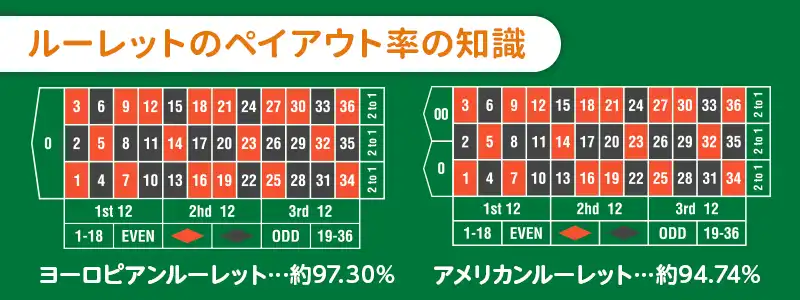
- European roulette (single 0): 37 numbers in total. RTP 97.30% (a red or black bet wins 48.65% of the time)
- American roulette (0 and 00): 38 numbers in total. RTP 94.74% (a red or black bet wins 47.37% of the time)
Because of the 0, even a red or black bet carries a house edge of 2.70% to 5.26%, depending on the variant.
Payout and Probability for the 0 in Roulette
| Payout | Probability |
|---|---|
| 35 to 1 (a $10 bet wins $350, and you get $360 back) | European roulette: 2.70% American roulette: 2.63% |
As the table shows, the payout and the probability of winning on 0 are exactly the same as for any other number. The chance that the ball lands on 0 is 1 in 37 on European roulette and 1 in 38 on American roulette.
How to Play Roulette with the 0 in Mind

Play European Roulette Instead of American Roulette
The first rule is to choose European roulette over American roulette. As explained above, American roulette has two green pockets, which nearly doubles the house edge.
Most roulette games at online casinos are European roulette, but American roulette and French roulette are offered as well. Check the table name or the game details to confirm the variant before you start playing.
Inside Bets That Include 0 Work the Same as Any Other Inside Bet
Inside bets that include 0 are available on exactly the same terms as inside bets on any other number.
For example, a winning straight-up bet on 0 pays 35 to 1, so a $10 bet wins $350 and you get $360 back including your stake. A split bet on the two numbers 0 and 1 pays 17 to 1 (a $10 bet wins $170, $180 back), and a four-number bet on 0, 1, 2 and 3 pays 8 to 1 (a $10 bet wins $80, $90 back).
Payouts are set according to the probability of winning in the same way for every bet, so a bet does not carry a higher house edge just because it includes 0. The one bet that does carry a higher house edge is the five-number bet (0, 00, 1, 2 and 3) on American roulette, which pays less than its probability warrants (a house edge of 7.89%, compared with 5.26% on other American bets).
Summary: The 0 Creates the House Edge but Is a Bet Like Any Other Number
The green 0 pocket on a roulette wheel is more than a losing pocket. It is what creates the house edge, which is the casino’s revenue.
- Because of the 0, bets such as red or black win 48.65% of the time, not 50%.
- When the ball lands on 0, bets on red or black, odd or even and other even-money bets are, as a rule, lost in full.
- You can bet on 0 as an inside bet. A winning bet pays 35 to 1, the same as any other number: a $10 bet wins $350, and you get $360 back.
The 0 stands out on the layout and some players like to bet on it, but its probability of winning and its payout are exactly the same as those of the other 36 numbers. Betting on it does not improve or worsen your odds.
If you mainly place even-money bets, choose a table with la partage. Otherwise, choose European roulette. With these two points in mind, you do not need to give the 0 any further thought.
This site is for adults of legal gambling age (18+, or older where required) who live in countries or regions where online gambling is legal.
Use of this site is subject to our Terms and Conditions.
Gambling involves risk. Only bet what you can afford to lose, and do not use online gambling services where they are illegal.

Bell | Editor of Online Casino Winners Club. Since the site launched in 2003, Bell has written guides to casino game rules, tested betting systems and covered land-based casinos around the world, and still plays the games before writing about them. Bell's core advice: choose the bets with the lowest house edge, and decide in advance how much you are prepared to lose.