

Roulette House Edge: Formula and European vs American Compared

This article covers the basics of the house edge, including what it is and how it differs between types of roulette, and then compares the house edge of each type by working through the formula.
Understanding the house edge in roulette helps you avoid unnecessary losses, starting with your choice of table.
What You Will Learn
- The house edge is the casino’s share of the money wagered.
- The house edge is 2.70% in European roulette and 5.26% in American roulette, roughly double.
- In most cases, the house edge in roulette is the same whichever bet you choose.

This article takes about 8 minutes to read.
What Is the House Edge in Roulette?

Put simply, the house edge is the casino’s share of the money wagered. The percentage of wagers that is paid back to players is called the return to player (RTP), and the percentage that goes to the casino is called the house edge.
What sets roulette apart is that the house edge is almost always the same whichever bet you place. A straight-up bet (a bet on a single number) pays 35 to 1 but rarely wins, while a bet on red or black pays even money and wins 48.65% of the time in European roulette, yet the house edge on both is the same. Your choice of bet therefore does not increase your expected losses.
Comparing the House Edge at Online Casinos with Pari-Mutuel Betting
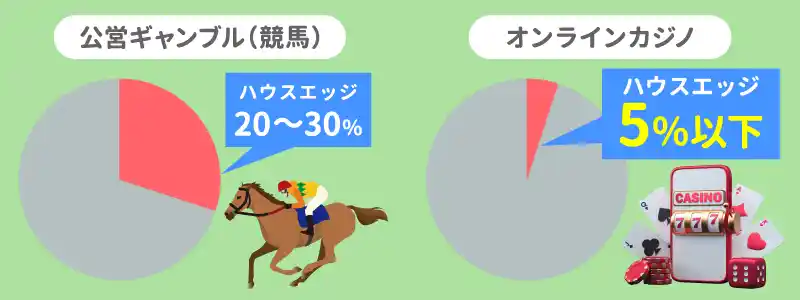
The house edge on many online casino games is also lower than in lotteries and pari-mutuel betting.
In pari-mutuel betting on horse racing, for example, the track’s takeout is considerably higher than the house edge at online casinos.
By comparison, the house edge at online casinos is 5% or less for many games, which means that 95% or more of the money wagered is paid back to players. The house still has the advantage, but players lose less over time than with pari-mutuel betting.
How to Calculate the House Edge in Roulette
The first step is to calculate the game’s RTP. The RTP of a bet is its winning probability multiplied by what this article calls the return multiple: the total amount you get back per unit bet when the bet wins, stake included. For example, a bet that wins 45% of the time and pays 1 to 1 returns 2 times your stake (a $10 bet returns $20), so its RTP is 2 × 45% = 90%.
In games such as baccarat, the payout can depend on the outcome. A bet on the banker, for example, is paid differently when the banker wins and when the hand is a tie. In that case, you multiply each payout by its probability and add the results together. In roulette, a bet either wins or loses, so the calculation is simpler.
Formula for the House Edge
100% − (return multiple) × (number of winning pockets) ÷ (total number of pockets) × 100%
House Edge by Type of Roulette
| Type of roulette | Features | House edge |
|---|---|---|
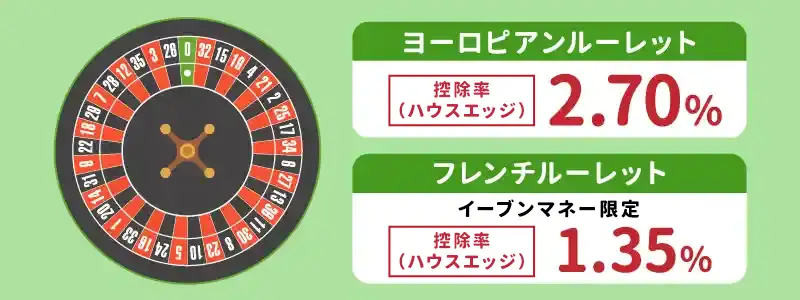
| European roulette | 37 pockets | 2.70% |
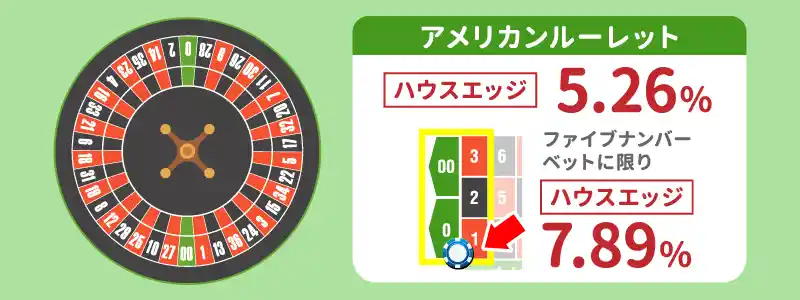
| American roulette | 38 pockets (two zero pockets) | 5.26% |
| French roulette | 37 pockets (special rules) | 2.70% (1.35% on even-money bets) |
The house edge is 2.70% in European roulette, while in American roulette it is 5.26%, about twice as high. Why is there such a large difference between two versions of the same game?
The difference lies in the betting layout and the wheel. A European roulette wheel has 37 pockets: the numbers 1–36 plus a single zero (0). An American roulette wheel has 38 pockets: the numbers 1–36 plus a zero (0) and a double zero (00).
Despite this, both versions pay the same odds on winning bets. A straight-up bet (a bet on a single number) in European roulette, for example, has one winning pocket out of 37 and pays 35 to 1, so a $10 bet wins $350 and returns $360 in total, stake included. In American roulette, the same bet has one winning pocket out of 38, so the probability of winning is lower, and the house edge is higher as a result.
French roulette, like European roulette, has a single green pocket (the 0) and the same 37-pocket wheel. The house edge on standard bets is therefore 2.70%; only the even-money bets, which are covered by special rules, differ.
The house edge in roulette therefore depends on two factors: the number of pockets and whether special rules apply.
House Edge in European Roulette
| Bet | Numbers covered | House edge |
|---|---|---|
| Straight-up bet | 1 | 2.70% |
| Split bet | 2 | |
| Street bet | 3 | |
| Corner bet | 4 | |
| Four-number bet (0, 1, 2, 3) | 4 | |
| Line bet | 6 | |
| Dozen bet | 12 | |
| Column bet | 12 | |
| Red/black | 18 | |
| Odd/even | 18 | |
| High/low | 18 |
In European roulette, the house edge is set at 2.70% on every bet.
This is because in European roulette, (number of pockets covered) × (return multiple) always equals 36. A straight-up bet, for example, covers only one pocket, but its return multiple is 36.
Outside bets such as red or black cover 18 winning pockets with a return multiple of 2, so multiplying the two also gives 36.
Because the house edge is the same across the board, a straight-up bet and an even-money bet have the same expected value, and your choice of bet does not change the house edge.
Formula for European Roulette
100% − (return multiple) × (number of winning pockets) ÷ 37 × 100%
Examples
- Straight-up bet: 100% − 36 (return multiple) × 1 (pocket) ÷ 37 × 100% = 2.70%
- Bet on red: 100% − 2 (return multiple) × 18 (pockets) ÷ 37 × 100% = 2.70%
European roulette has 37 pockets in total. Because (return multiple) × (number of pockets) always equals 36, the RTP is 36/37, or 97.30%, and the house edge is about 2.70% in every case.
House Edge in American Roulette
| Bet | Numbers covered | House edge |
|---|---|---|
| Straight-up bet | 1 | 5.26% |
| Split bet | 2 | |
| Street bet | 3 | |
| Corner bet | 4 | |
| Five-number bet (0, 00, 1, 2, 3) | 5 | 7.89% |
| Line bet | 6 | 5.26% |
| Dozen bet | 12 | |
| Column bet | 12 | |
| Red/black | 18 | |
| Odd/even | 18 | |
| High/low | 18 |
In American roulette, the house edge is 5.26% on almost every bet. As in European roulette, (number of pockets covered) × (return multiple) is set to equal 36. The one exception is the five-number bet: it covers 5 pockets with a return multiple of 7, which gives 5 × 7 = 35 and raises the house edge to 7.89%.
The 0 and 00 are losing pockets for every bet that does not cover them, such as red/black or a dozen bet. The 00, which European roulette does not have, adds another losing pocket and raises the house edge.
Formula for American Roulette
100% − (return multiple) × (number of winning pockets) ÷ 38 × 100%
Examples
- Straight-up bet: 100% − 36 (return multiple) × 1 (pocket) ÷ 38 × 100% = 5.26%
- Bet on red: 100% − 2 (return multiple) × 18 (pockets) ÷ 38 × 100% = 5.26%
American roulette has 38 pockets in total. The RTP is 36/38, or 94.74%, and the house edge is about 5.26%, but the five-number bet has a house edge of 7.89%, making it the worst bet on the table.
House Edge in French Roulette
| Bet | Numbers covered | House edge |
|---|---|---|
| Straight-up bet | 1 | 2.70% |
| Split bet | 2 | |
| Street bet | 3 | |
| Corner bet | 4 | |
| Four-number bet (0, 1, 2, 3) | 4 | |
| Line bet | 6 | |
| Dozen bet | 12 | |
| Column bet | 12 | |
| Red/black | 18 | 1.35% |
| Odd/even | 18 | |
| High/low | 18 |
As mentioned above, French roulette has the same 37 pockets as European roulette, and the house edge on standard bets is also 2.70%.
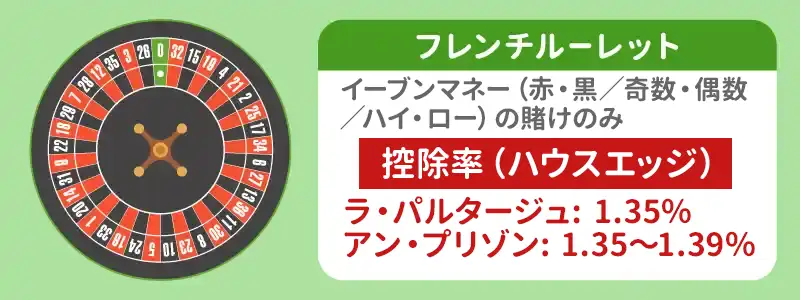
The difference is that French tables use one of two special rules: en prison or la partage. Each applies when the ball lands on 0 and you have an even-money bet on the table. Under la partage, half of your bet is returned immediately. Under en prison, your entire bet is held over to the next spin; if it wins, the full bet is returned, and if it loses, the bet is lost.
The two rules return the money in different ways, but in both cases the expected loss when 0 comes up is cut roughly in half. As a result, the house edge on even-money bets falls to 1.35%, about half of 2.70%. La partage always gives 1.35%, while under en prison the house edge ranges from 1.35% to 1.39%, depending on how the table handles a second 0 while the bet is held.
Unlike European roulette, then, French roulette does not offer the same expected value on every bet: the house edge depends on whether you choose an even-money bet. Even-money bets such as red or black have a lower house edge than inside bets such as a straight-up bet.
In land-based casinos, American roulette is the norm in North America, while European roulette is common in Europe and Asia. French roulette is rarely seen outside a limited number of casinos in Europe. Online casinos also offer French roulette, but some tables use the name without applying the special rules, so check the table rules before you play.
Frequently Asked Questions About the House Edge in Roulette
- What is the difference between the house edge and RTP?
-
The house edge and RTP are opposite concepts, two sides of the same coin. The house edge is the percentage of the money wagered by players that the house keeps, while RTP is the percentage of the money wagered that is paid back to players.
As a result, the higher the house edge, the larger your losses, and the higher the RTP, the lower the cost of playing. The house edge and RTP always add up to exactly 100%.
- Is there a roulette game with no house edge?
-
No roulette game is free of a house edge. Every roulette wheel has a 0, and when the ball lands on it, every bet that does not cover 0 loses, apart from even-money bets under the special rules of French roulette.
In French roulette, however, half of an even-money bet is returned when the ball lands on 0, so the house edge on even-money bets is 1.35%, half of the 2.70% in European roulette. Combining this with promotions such as cashback can reduce your actual losses further, but the house edge itself does not disappear.
Summary: Choosing European Roulette Cuts the House Edge Roughly in Half
The house edge in roulette differs considerably between European and American roulette. European roulette has a house edge of 2.70%, about half that of American roulette.
Unless you have a specific reason to do otherwise, choosing European roulette keeps your losses lower.
French roulette with la partage or en prison lowers the house edge further, but only on even-money bets: to 1.35% under la partage and to 1.35–1.39% under en prison. Other bets, such as the straight-up bet, remain at 2.70%.
Some tables carry the name “French roulette” without applying the special rules. Before you play, check the table rules for la partage or en prison.
In most cases, the expected value is the same whichever bet you choose. Pick a table with a low house edge, set a loss limit in advance, and play within your means.
This site is for adults of legal gambling age (18+, or older where required) who live in countries or regions where online gambling is legal.
Use of this site is subject to our Terms and Conditions.
Gambling involves risk. Only bet what you can afford to lose, and do not use online gambling services where they are illegal.

Bell | Editor of Online Casino Winners Club. Since the site launched in 2003, Bell has written guides to casino game rules, tested betting systems and covered land-based casinos around the world, and still plays the games before writing about them. Bell's core advice: choose the bets with the lowest house edge, and decide in advance how much you are prepared to lose.