

Roulette Flower Bet: How to Place It, Payouts and Hit Rates

The flower bet is a way of placing chips in roulette. You choose one number as the center and place chips on that number and the spots surrounding it. The name comes from the way the chips spread out on the layout like the petals of a flower. The flower bet is used by beginners and experienced players alike.
What You Will Learn
- The flower bet is a way of placing chips that is specific to roulette.
- Chips are placed in nine spots in total, and if the center number hits, the bet returns 144 times the center stake (16 times the total bet).

This article takes about 13 minutes to read.
How to Place the Flower Bet

The flower bet combines straight-up, split and corner bets around one central number.
That may sound complicated, but in practice you simply place chips on one number and the spots around it.
A hit on the center number pays a large amount, and hits on the surrounding numbers also pay, so the flower bet produces smaller swings than a single straight-up bet.
However, the flower bet does not change the house edge. With $1 on each of the nine spots, the expected return is (1 × 144 + 4 × 36 + 4 × 9) ÷ 37 ≈ $8.76. On a total bet of $9, that is a return to player (RTP) of 97.30%, exactly the same as every other bet in European roulette. The only thing that changes is the combination of hit rate and payout – in other words, how much your results fluctuate.
Basic Steps of the Flower Bet
The flower bet is very easy to place once you are used to it, but if you put chips on the wrong numbers, it no longer works as intended, so take care when choosing where to bet.
(1) Choose the Center Number from 10 Possible Numbers

First, choose the number that will be the center of the flower bet. The center must have a betting position on all eight sides, so it has to be a number in the middle column of the layout, excluding 2 and 35 at either end. That leaves 10 candidates: 5, 8, 11, 14, 17, 20, 23, 26, 29 and 32. In this example, we use 20 as the center.
You can bet any amount you like, but remember that your total bet will be nine times the amount on the center. In this example, we place $1 on the center.
(2) Place Bets on the Eight Spots Around the Center

After betting on the center number, place corner and split bets on the eight spots surrounding it.
Always place the same amount on every spot as on the center. With $1 on the center, each surrounding spot also gets $1, for a total bet of $9. If your chips enclose the center number on all sides, the bet is placed correctly.
(3) A Hit on Any of the Nine Spots Pays Out
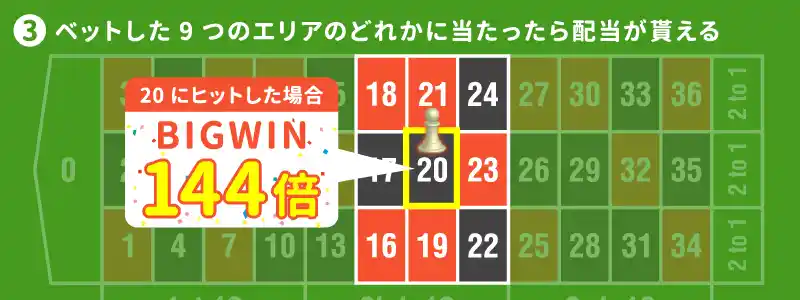
The wheel is spun, and if the ball lands in a pocket you have covered, you are paid. With 20 as the center, any number from 16 to 24 is a hit. Using the $1 example above, a hit on 20 returns $144.
Payouts and Hit Rates of the Flower Bet
With the flower bet, the amount you are paid depends on which pocket the ball lands in, so you need to know how much each pocket returns. Each case is explained below.
Because the flower bet combines several bets, the figures in this section are not given in the usual “x to 1” form. They show the total returned on the winning bets, including the stakes on those bets, as a multiple of the amount on the center number.
Hit on a Corner Number: 9 Times the Center Stake

If the ball lands on one of the corner numbers around the center, the bet returns 9 times the center stake. This happens with a probability of 10.81%.
With 20 as the center, for example, this covers the four pockets 16, 18, 22 and 24. With $1 on the center, you get $9 back, but because your total bet was $9, you break even. The result is effectively a tie, so you can simply continue with the same amount in the next round.
Hit on Two Corners and One Split: 36 Times the Center Stake

If the ball lands on a number directly next to the center, the bet returns 36 times the center stake. This happens with a probability of 10.81%.
With 20 as the center, for example, this covers the four pockets 17, 19, 21 and 23. With $1 on each spot, the two corner bets return $18 and the split bet returns $18, for a total of $36.
Many players assume that nothing comes back unless the center number hits, but one feature of the flower bet is that a hit next to the center also pays well.
Hit on Every Spot: 144 Times the Center Stake
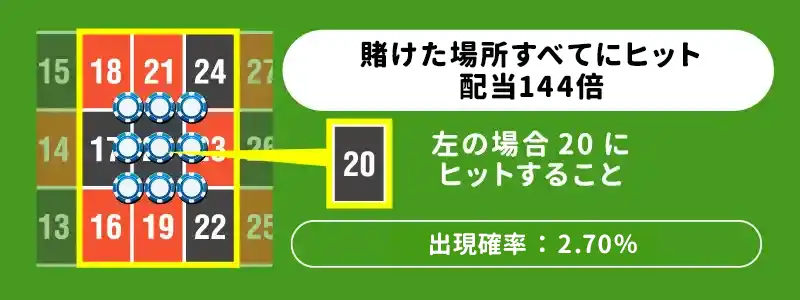
If the ball lands on the center number, the bet returns 144 times the center stake. This happens with a probability of 2.70%.
With $1 on each spot and 20 as the center, the straight-up bet on 20 returns $36, the four split bets return $72 and the four corner bets return $36, for a total of $144. That is 16 times the total bet of $9.
In other words, a corner-number hit only breaks even, a hit next to the center returns 4 times the total bet, and only a center hit returns 16 times. On average, the bet still loses 2.70% of what you stake.
A Simulated Session with the Flower Bet
The simulation below shows a session with $9 bet per round ($1 on each spot).
Betting $9 per round: 14 losses in a row, then a hit on the center number in round 15
| Round | Bet | Result | Running total |
|---|---|---|---|
| 1 | $9 | Loss | −$9 |
| 2 | $9 | Loss | −$18 |
| 3–13 | $9 | Loss | −$27 to −$117 |
| 14 | $9 | Loss | −$126 |
| 15 | $9 | Win (144 times the center stake) | $9 |
In rounds 1 through 14, the ball does not land on any of the nine covered numbers, let alone the center. In round 15, however, the center number hits and the session ends in profit.
Because a hit on the center returns 16 times the total bet, even after 14 misses in a row, a center hit in round 15 still leaves you ahead. After 15 misses in a row, by contrast, a center hit in round 16 only brings you back to exactly even, and if the first center hit comes in round 17 or later, it no longer recovers the total you have bet. In actual play, the corner and split bets also hit fairly often, so your bankroll tends to decline more gradually.
The flower bet is a balanced way to bet, but you still cannot win a large amount unless the center number hits. Because you bet on nine spots at once, your total bet also tends to be high, so strict bankroll management makes it easier to limit your losses.
Advantages of the Flower Bet

The flower bet is popular because it balances the chance of a large payout with a reasonable frequency of hits.
144 Times the Center Stake on a Center Hit, and Partial Returns from the Surrounding Numbers
The main advantage of the flower bet is the size of the return when the center number hits.
Unlike outside bets such as red or black, the flower bet is made up of inside bets, so it pays much more when it wins.
You might think that a single straight-up bet would be better if you are after a large payout. It is true that a straight-up bet pays 35 to 1, so $9 on a single number returns $324 if it hits.
The flower bet, however, pays not only on the center number but also on the adjacent and corner numbers, so it carries less risk than a straight-up bet.
With a straight-up bet, every number except the one you chose is a loss. With the flower bet, the surrounding numbers also pay, so your bankroll declines more gradually.
Even while the center number is not hitting, the surrounding numbers recover part of your losses, so your results swing less over the same number of rounds. The higher hit rate, however, comes with a lower average payout per round, and the long-term expected value is the same as that of a straight-up bet.
Easy for Beginners to Try
The flower bet is very simple to place. You choose a center number and bet the same amount on it and on the spots around it, so even beginners can use it right away.
You do not need to change the amount you bet either, so once you have placed the bet, you can simply choose to repeat your previous bet and use the flower bet again in the next round.
Some experienced players also combine it with a betting system that controls the size of their bets.
A Bet That Stands Out on the Table
The flower bet also stands out visually. In a land-based casino, chips spread out like the petals of a flower catch the eye, and it is not unusual for your chips to draw the attention of other players.
It may appeal to players who enjoy the look of the bet as well as its practical results.
Disadvantages of the Flower Bet
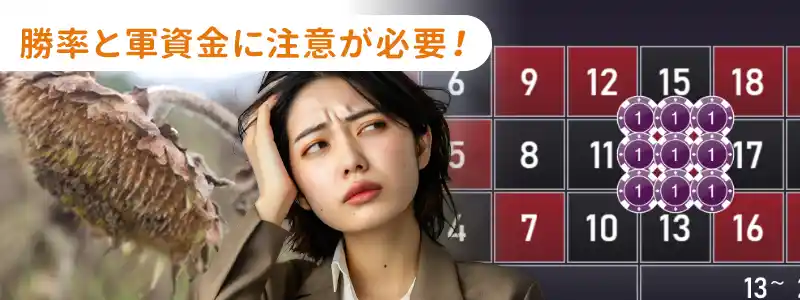
The flower bet pays well when it wins, but the trade-off is a fairly low hit rate. You also have to bet on nine spots at once, so we recommend playing with a bankroll that leaves you some room.
The Hit Rate Is Quite Low
The flower bet hits less often per round than many other bets. A bet on red or black wins 48.65% of the time (slightly under 50% because of the 0). The flower bet, by contrast, pays out with a probability of only 24.32%.
It does hit more often than a straight-up bet, but unless the center number hits, the returns from the surrounding numbers are not enough to keep your bankroll from shrinking.
The probability of hitting the center number is 2.70%, the same as for a straight-up bet. Note that the flower bet is not a way to make a steady profit.
You Need a Reasonable Bankroll
Because you place chips on nine spots in every round, the flower bet can add up to a large total bet.
At a roulette table with a $1 minimum bet, for example, you can start betting on red or black with just $1, but with the flower bet you need to bet at least $9 to start.
On top of that, the hit rate per round is low, so there is a real chance of running out of money before the center number hits even once. Bear in mind that the flower bet requires a reasonable bankroll.
Betting limits (the minimum and maximum bet) also vary from table to table. If you choose a table with a low minimum, such as one that accepts bets from $0.10, you can use the flower bet even with a small bankroll.
How to Play the Flower Bet While Limiting Your Losses

Based on the advantages and risks covered above, this section explains how to approach a session with the flower bet. The flower bet has a low hit rate but can produce a large payout, so it is easiest to manage if you stop as soon as the center number hits.
Best Suited to Short Sessions Because of the Low Hit Rate
As mentioned above, the flower bet has a low hit rate per round.
If you play for a long time, you are therefore likely to run into long losing streaks that can sharply reduce your balance. At $9 per round (one unit), the theoretical loss is 2.70% of the total amount bet, so the average loss is about $24 over 100 rounds and about $243 over 1,000 rounds. When losses pile up, your results can be much worse than these averages.
That makes the flower bet better suited to short sessions. The basic approach is to let hits on the surrounding numbers slow your losses and to stop as soon as the center number hits. Very early in a session, you can also stop as soon as a hit next to the center number puts you in profit.
Setting a stopping point does not change the expected value itself, however. Think of it as a bankroll management rule that caps how much you lose in a single session.
The flower bet suits players who prefer short sessions.
Avoid American Roulette
This applies to every way of betting on roulette: always choose European roulette.
European roulette has the numbers 1–36 plus a single 0 (zero) pocket. There is also American roulette, whose wheel has two such pockets: 0 and 00 (double zero).
When the ball lands in 0 or 00, the flower bet always loses (you can bet on 0 and 00, but the flower bet does not cover them), so the fewer green pockets a wheel has, the lower the house edge. The house edge is 2.70% in European roulette and 5.26% in American roulette, so you lose money about twice as fast on an American wheel.
The flower bet already has a low hit rate, so choose European roulette to get the best conditions you can, and avoid American roulette.
We also do not recommend roulette variants with special rules, such as Lightning Roulette. They can be played, but many of these games pay less when the center number hits, so we recommend standard European roulette whenever possible.
Advanced Variations of the Flower Bet

The flower bet is a way of placing chips on the roulette layout, so it can also be combined with a betting system that raises or lowers the size of your bets. Below are two advanced variations that we have developed.
The Double Flower Method
This method places two flower bets at once, each around its own center number. There must be at least two rows between the two center numbers.
For example, if your first flower is centered on 14, you cannot use 8, 11, 17 or 20 as the second center number, so choose it from the remaining candidates. The two flowers then cover 18 pockets, which raises the hit rate per round to 48.65%. Your total bet also rises to 18 units ($18), however, so even a corner bet hit leaves you with a net loss. The higher hit rate comes with a smaller return per round, and the house edge stays at 2.70%.
The 15-Unit Method
This method combines the flower bet with changes in bet size. Because it raises the stake after losses, it carries more risk than a flat flower bet, so decide your stop-loss limit before you start.
The total amount of one flower bet counts as one unit. For example, if the center bet is $1, one unit is $9. After each flower bet, record −1 if it loses, ±0 if a corner bet hits and +3 if a number adjacent to the center hits.
Keep playing, and when your tally reaches −15, increase your bet by one unit. The center bet becomes $2, for a total bet of $18.
From then on, record −2 for a loss and +6 for an adjacent hit. Each time you fall another 15 units behind, raise your bet by one more unit, and count a loss as −1 × (units bet) and an adjacent hit as +3 × (units bet).
The session ends when the center number hits. The method relies on the fact that a center hit wins exactly 15 units ($135 at $9 per unit), and it raises the bet every time you fall 15 units behind.
Raising your bet does not change the house edge of 2.70% on each round, however; only the size of the swings changes. Because the bet rises by one unit every time you reach −15 units, it grows to $27 per round at the third stage and $45 per round at the fifth, moving closer to the table maximum. Once you reach the table maximum or run out of money, the loss is locked in, so before you start, work out how many stages you can withstand given the table maximum and your bankroll.
Frequently Asked Questions About the Flower Bet
- What other betting systems are there besides the flower bet?
-
Roulette also has many well-known betting systems, which, unlike the flower bet, are rules for raising and lowering the size of your bets.
Examples include the Martingale system, in which you double your bet after every loss so that a single win recovers your losses; the Paroli system, which increases your bets during a winning streak; and the Monte Carlo system, which uses a sequence of numbers to set the size of each bet. None of them changes the house edge.
Summary: The Flower Bet Changes the Swings but Not the House Edge
The flower bet is a way of placing chips in roulette. It is a bet on one number and the eight spots around it, nine positions in total, and it takes its name from the way the chips on the layout look like a flower.
A hit on the center number returns 144 times the center bet (16 times your total bet), and the flower bet also hits more often than a single straight-up bet. For this reason, it is popular as a bet that balances payout size and hit rate.
Spreading your chips across nine positions does not change the house edge, however. It stays at 2.70%, the same as every other bet in European roulette, and only the size of the swings in your results changes. Manage your bankroll carefully as you play, for example by stopping once the center number hits.
This site is for adults of legal gambling age (18+, or older where required) who live in countries or regions where online gambling is legal.
Use of this site is subject to our Terms and Conditions.
Gambling involves risk. Only bet what you can afford to lose, and do not use online gambling services where they are illegal.

Bell | Editor of Online Casino Winners Club. Since the site launched in 2003, Bell has written guides to casino game rules, tested betting systems and covered land-based casinos around the world, and still plays the games before writing about them. Bell's core advice: choose the bets with the lowest house edge, and decide in advance how much you are prepared to lose.