

Baccarat Drawing Rules: When a Third Card Is Dealt (With Chart)

In baccarat, the conditions under which a third card is dealt, known as the third-card rules, differ between the Player hand and the Banker hand, and the rules for the Banker hand are especially complex.
In baccarat, cards are dealt to two hands, called Player and Banker, and you bet on which one will win. “Player” is simply the name of a betting position and does not refer to you. To avoid confusion, this article refers to them as the Player hand and the Banker hand.
Whether a third card is dealt is fixed by the rules, so unlike blackjack, there are no decisions to make.
What You Will Learn
- If the first two cards do not decide the round, the Player hand draws a third card on a total of 5 or less and stands on 6 or more.
- If the first two cards do not decide the round, the Banker hand draws a third card on a total of 2 or less and stands on 7 or more. On a total of 3–6, whether it draws depends on the value of the Player hand’s third card.

This article takes about 11 minutes to read.
When Neither Hand Receives a Third Card

In some situations, the round is decided as soon as the Player hand and the Banker hand have each been dealt two cards. When this happens, neither hand receives a third card and the result is final.
(1) When Either Hand Has a Natural 9 or Natural 8
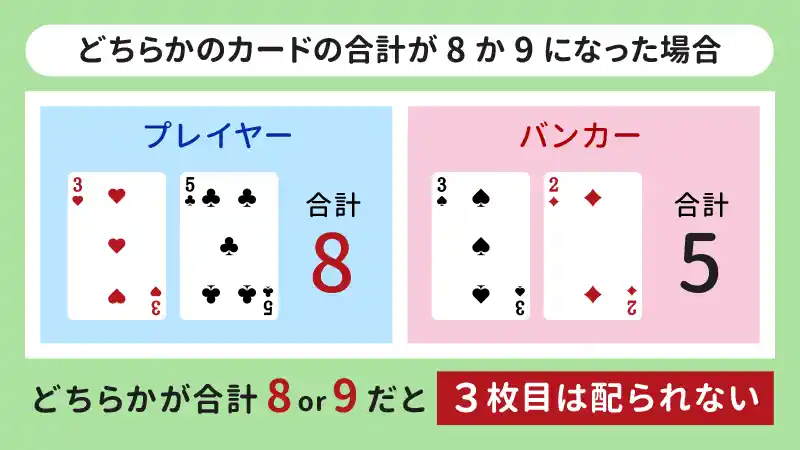
In baccarat, a hand’s value is the last digit of the two-card total. An ace counts as 1, cards 2–9 count at face value, and 10s and face cards count as 0. A hand whose last digit is 9 is called a natural 9, and one whose last digit is 8 is called a natural 8.
If either the Player hand or the Banker hand has a natural 9 or natural 8, the round is decided at that point.
Example: The Player hand has a 6 and a 3, and the Banker hand has a jack and a 2
The Player hand totals 9 and the Banker hand totals 2, so the Player hand wins.
If both hands have the same value (both 8 or both 9), no third card is dealt either. The round is a tie: bets on Player and Banker are returned, and only Tie bets are paid.
(2) When Both Hands Total 6 or 7
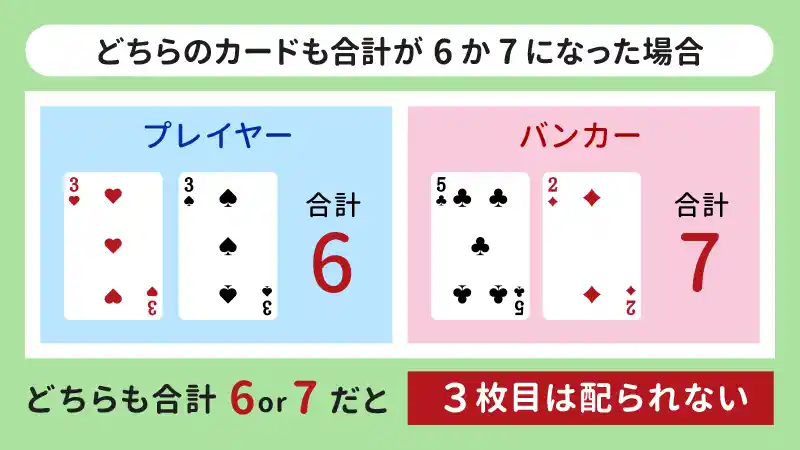
Even without a natural 9 or natural 8, the round can still be decided on two cards. This happens when the last digit of both the Player hand and the Banker hand is either 6 or 7.
Example: The Player hand has an 8 and a 9, and the Banker hand has a Q and a 6
The Player hand totals 7 and the Banker hand totals 6, so the Player hand wins.
If both hands total 6, or both total 7, the round is a tie, and again no third card is dealt.
In short, the round is decided on the first two cards in the following two cases.
- The last digit of the two-card total is 8 or more for either the Player hand or the Banker hand
- The last digit of the two-card total is 6 or 7 for both the Player hand and the Banker hand
When the Player Hand Receives a Third Card
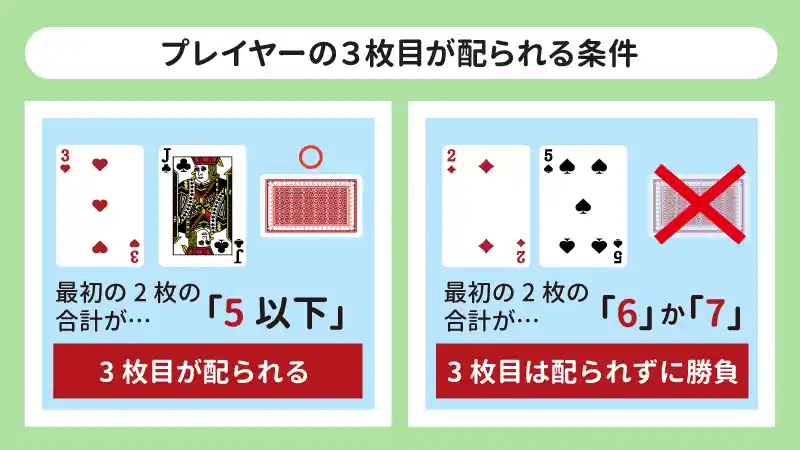
If the round is not decided on the first two cards, the Player hand, the Banker hand or both draw a third card.
The rule for the Player hand is simple: it receives a third card when the last digit of its two-card total is 5 or less. On 6 or more, no third card is dealt and the Player hand’s total is final at that point. Whether the hand draws is fixed by the rules and you have no choice in the matter, so there is no decision here that could change the house edge on your bet.
When the Banker Hand Receives a Third Card

Whether the Banker hand draws generally depends on the Player hand’s third card, so its rules are more complex than the Player hand’s. Because the Banker hand acts second and its rule takes the Player hand’s draw into account, it wins slightly more often. To offset this, a 5% commission is charged on winning Banker bets. In effect, the commission offsets the advantage that the third-card rules give the Banker hand.
How the Banker Hand’s Draw Is Decided

Whether the Banker hand draws a third card depends on two things: the value of the Player hand’s third card and the Banker hand’s two-card total.
Every combination of the Player hand’s third card and the Banker hand’s total is summarized in the quick-reference chart below.
Quick-Reference Chart: When a Third Card Is Dealt in Baccarat
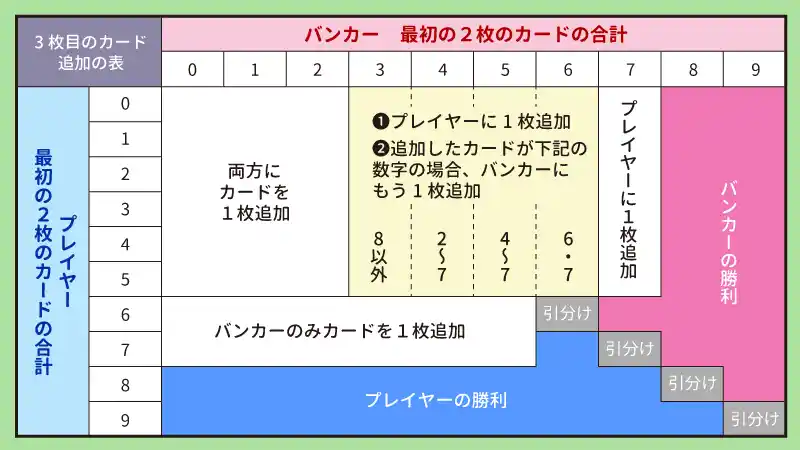
The chart below shows when a third card is dealt in baccarat, organized by the value of the Player hand’s third card and the total of the Banker hand’s first two cards.
The rules are most complex when the Banker hand’s first two cards total 3–6, so refer to this chart until you are familiar with them.
| Banker hand’s two-card total | When the Banker hand draws a third card |
|---|---|
| 0, 1, 2 | Always draws, regardless of the Player hand’s third card |
| 3 | Draws unless the Player hand’s third card is 8 |
| 4 | Draws if the Player hand’s third card is 2–7 |
| 5 | Draws if the Player hand’s third card is 4–7 |
| 6 | Draws if the Player hand’s third card is 6 or 7 |
| 7 | Does not draw |
This chart applies when the Player hand has drawn a third card. When the Player hand does not draw (because it totals 6 or 7), the Banker hand follows the same rule as the Player hand: it draws on a total of 5 or less and stands on 6 or more. In this situation, however, the Banker hand’s total is always 5 or less (if it were 6 or 7, the round would already have been decided on two cards), so in practice it always receives a third card.
The Full Dealing Sequence in Baccarat: Flowchart

- The Player hand and the Banker hand are each dealt two cards.
- If either of the following applies, no third card is dealt and the round is decided on the cards already dealt.
Either the Player hand or the Banker hand has a two-card total whose last digit is 8 or more
Both the Player hand and the Banker hand have a two-card total whose last digit is 6 or 7 - If the round is not decided on the first two cards, the Player hand receives a third card when its total is 5 or less. On 6 or more, no third card is dealt and the Player hand’s total is final.
- Next, the rules determine whether the Banker hand draws. If the Player hand did not draw a third card, the Banker hand always draws one.
- If the Player hand drew a third card, the Banker hand’s draw depends on the combination of its own total and the value of the Player hand’s third card.
The totals of the Player hand and the Banker hand are then final, and the winner is decided.
Worked Examples: When a Third Card Is Dealt in Baccarat
This section walks through four examples: the Player hand drawing and not drawing a third card, and the Banker hand drawing and not drawing one. Each example assumes that the round was not decided on the first two cards, meaning that neither hand had 8 or more and the two hands did not both total 6 or 7.
The Player Hand Receives a Third Card
The rule for the Player hand is very simple: it receives a third card when its two-card total is 5 or less.
- If the Player hand totals 5 or less, it receives a third card
- The rules then determine whether the Banker hand also receives a third card, and the winner is decided
STEP1
The Player and Banker Hands Are Each Dealt Two Cards
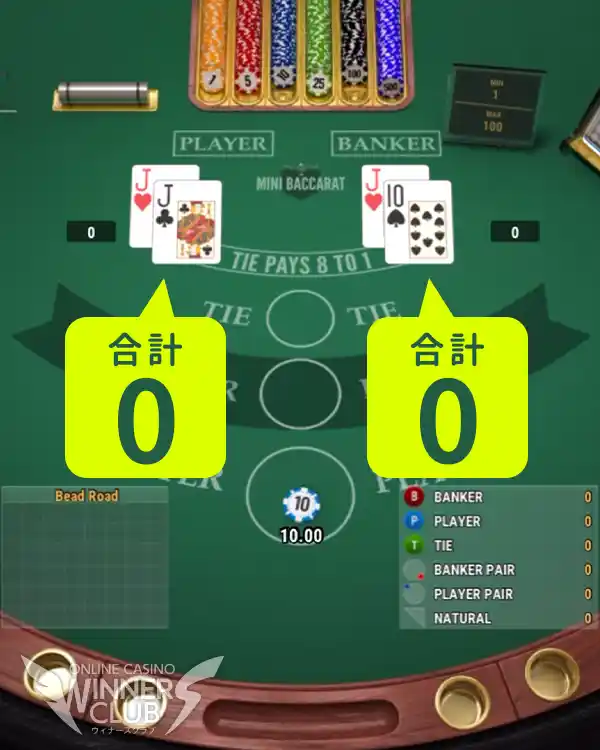
First, the Player hand and the Banker hand are each dealt two cards. If neither of the conditions that decide the round on two cards applies (either hand has 8 or more, or both hands have 6 or 7), the game continues.
In this example, the Player hand and the Banker hand both total 0, so the game continues.
STEP2
The Player Hand Totals 5 or Less, So It Receives a Third Card

When the Player hand totals 5 or less, it receives a third card. Here the third card is a 2, which brings the total to 2.
STEP3
The Winner Is Decided

If the conditions in the quick-reference chart are met, the Banker hand also receives a third card. Here the Player hand’s third card is a 2 and the Banker hand’s first two cards total 0, so the Banker hand draws. Its third card is a 10, which leaves its total at 0, and the Player hand wins.
The Player Hand Does Not Receive a Third Card
The Player hand does not receive a third card when its two-card total is 6 or more.
- If the Player hand totals 6 or more, it does not receive a third card
- The Banker hand always receives a third card, and the winner is decided
STEP1
The Player and Banker Hands Are Each Dealt Two Cards
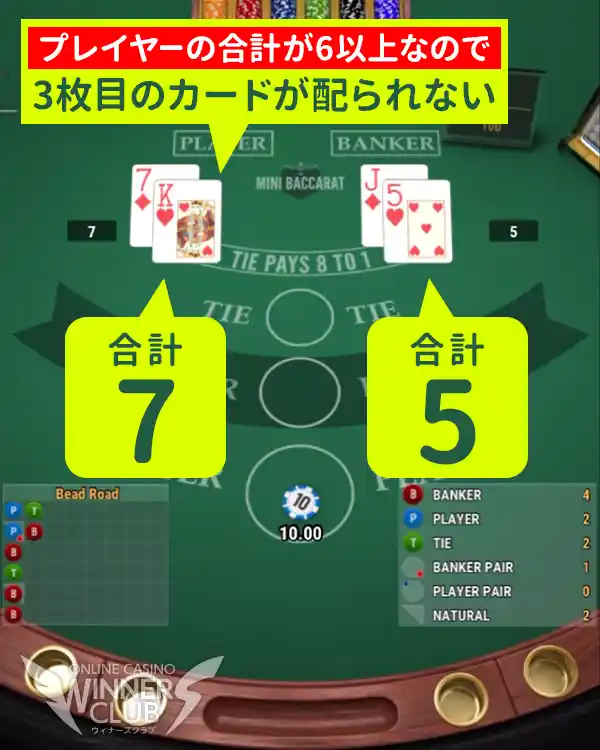
First, the Player hand and the Banker hand are each dealt two cards.
In this example, the Player hand totals 7 and the Banker hand totals 5, so the game continues. Because the Player hand totals 6 or more, it does not receive a third card, and only the Banker hand draws.
STEP2
The Player Hand Totals 6 or More, So the Banker Hand Receives a Third Card
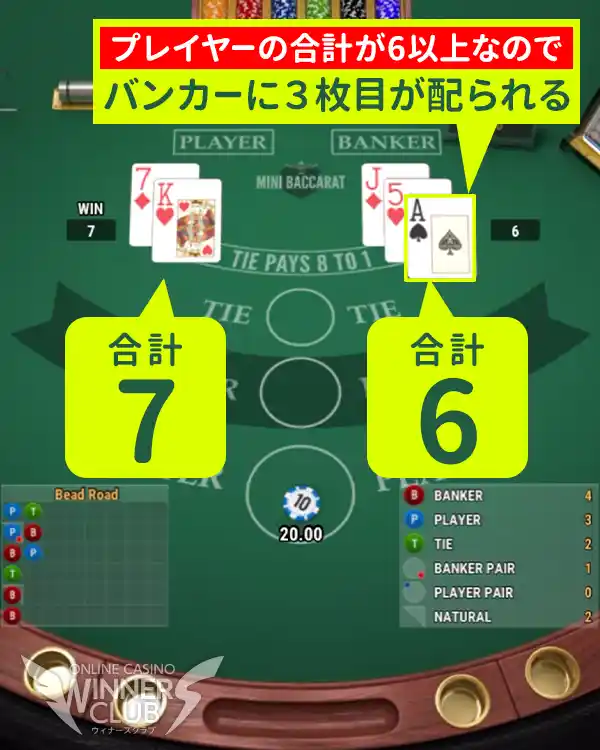
When the Player hand does not receive a third card, the Banker hand always draws. Here the Banker hand’s third card is an ace, which brings its total to 6, and the Player hand wins.
The Banker Hand Receives a Third Card
The situations in which the Banker hand receives a third card are fairly complex. You do not need to memorize them to play at an online casino, but knowing them makes it easier to follow the action as the cards are turned over, especially at a land-based casino.
- If the Player hand totals 5 or less, it receives a third card
- Depending on the Player hand’s third card, the Banker hand may receive a third card, after which the winner is decided
STEP1
The Player and Banker Hands Are Each Dealt Two Cards
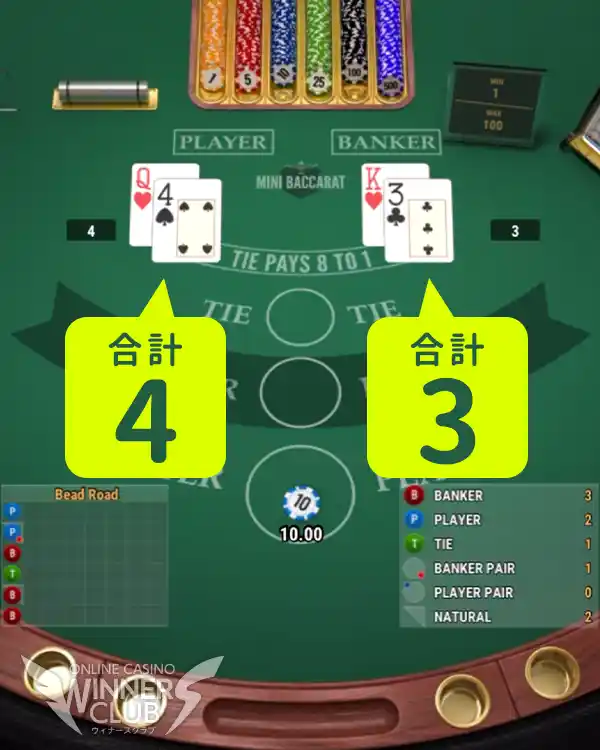
First, the Player hand and the Banker hand are each dealt two cards.
In this example, the Player hand totals 4 and the Banker hand totals 3, so the game continues.
STEP2
The Player Hand Totals 5 or Less, So It Receives a Third Card

When the Player hand totals 5 or less, it receives a third card. Here the third card is a queen, so the total stays at 4.
STEP3
The Banker Hand Receives a Third Card

If the conditions in the quick-reference chart are met, the Banker hand also receives a third card. The Player hand’s third card counts as 0 and the Banker hand’s first two cards total 3, so the Banker hand draws.
Here the Banker hand’s third card is an ace, which brings its total to 4, so the round is a tie.
The Banker Hand Does Not Receive a Third Card
When only the Player hand draws a third card and the Banker hand does not, the Banker hand may win or lose without drawing. For example, when the Player hand’s third card is an 8, the Banker hand stands on any total of 3 or more, so if the Player hand has reached 8 or 9, the Banker hand loses without drawing. This too is fixed by the rules, and you have no say in it.
- If the Player hand totals 5 or less, it receives a third card
- If the rules do not call for the Banker hand to draw, the winner is decided at that point
STEP1
The Player and Banker Hands Are Each Dealt Two Cards

First, the Player hand and the Banker hand are each dealt two cards. In this example, the Player hand totals 2 and the Banker hand totals 7, so the game continues.
STEP2
The Player Hand Totals 5 or Less, So It Receives a Third Card

When the Player hand totals 5 or less, it receives a third card. Here the third card is a 4, which brings the total to 6.
STEP3
The Winner Is Decided

Check the quick-reference chart to see whether the Banker hand also receives a third card. The Player hand’s third card is a 4 and the Banker hand’s first two cards total 7, so no third card is dealt.
The Player hand therefore finishes with 6 and the Banker hand with 7, and the Banker hand wins.
Summary: The Third-Card Rules Are Fixed, and Not Knowing Them Does Not Affect Play or Payouts
Baccarat is a simple game: all you do is predict whether the Player hand or the Banker hand will win. The conditions under which a third card is dealt (the third-card rules) are strictly fixed.
If you are new to baccarat, we recommend remembering the following three basic principles.
- If either hand has 8 or more, or both hands have 6 or 7, the round is decided on the first two cards
- If the round is not decided, the Player hand draws a third card on 5 or less and stands on 6 or more
- If the round is not decided, the Banker hand draws a third card on 2 or less and stands on 7 or more. On 3–6, whether it draws depends on the value of the Player hand’s third card (if the Player hand did not draw a third card, the Banker hand always draws)
In baccarat, the dealer runs the game according to the rules, so not having memorized the conditions has no effect on how the game is played or what you are paid. Note that the game itself still carries a house edge, so over the long run you can expect to lose money.
The next time you play baccarat at a land-based casino or an online casino, compare each round with the rules on this page and enjoy the suspense of watching a single card change the outcome.
This site is for adults of legal gambling age (18+, or older where required) who live in countries or regions where online gambling is legal.
Use of this site is subject to our Terms and Conditions.
Gambling involves risk. Only bet what you can afford to lose, and do not use online gambling services where they are illegal.

Bell | Editor of Online Casino Winners Club. Since the site launched in 2003, Bell has written guides to casino game rules, tested betting systems and covered land-based casinos around the world, and still plays the games before writing about them. Bell's core advice: choose the bets with the lowest house edge, and decide in advance how much you are prepared to lose.