

Live baccarat is one of the most popular live games at online casinos, largely because it gives you the feeling of sitting at a table in a real…
Baccarat Card Counting: How It Works and Why It Barely Helps

Like blackjack, baccarat has a technique known as card counting. By keeping track of the ranks of the cards used in each hand, players try to estimate the composition of the cards that remain.
It may look effective at first glance, but in baccarat the edge gained from counting is very small, and the clear effect that counting can have in blackjack is almost entirely absent. This page explains why.
What You Will Learn
- In baccarat, card counting has only a limited effect.
- Card counting means keeping track of the cards that have been dealt to estimate which cards remain in the shoe.

This article takes about 12 minutes to read.
Contents
Show
What Is Card Counting in Baccarat?

Card counting in baccarat is a technique in which players remember the cards already used and estimate the composition of the remaining cards, trying to identify favorable moments to bet.
In live baccarat, the cards are dealt from a shoe that holds 6–8 decks shuffled together. By noting the rank of each card as it is dealt, players can form a rough picture of the cards still left in the shoe.
Even when the remaining composition is known, it may seem impossible to tell whether the Player hand or the Banker hand will end up closer to 9. The two hands, however, follow different rules for drawing a third card.
In baccarat, cards are dealt to two hands, the Player and the Banker, and you bet on which one will win. “Player” is the name of a betting option, not a reference to you. From here on, we refer to them as the Player hand and the Banker hand.
Because the drawing rules differ, an uneven distribution of cards is thought to shift the winning probabilities of the Player hand and the Banker hand slightly. However, we have found no verifiable source showing which cards, when left in larger numbers, favor which side.
In short, card counting means keeping a record of the composition of the cards left in the shoe. What it tells you is which cards remain, not which side to bet on.
Counting Only Works in Live Baccarat
Baccarat at online casinos comes in two forms: live baccarat and RNG baccarat, in which a computer draws the cards.
In RNG baccarat, the cards are usually drawn at random for each hand. Because there is no shoe, the cards dealt in one hand have no effect on the next.
If you want to try counting, therefore, choose live baccarat. RNG baccarat can be used to practice counting, but only live baccarat lets you track the cards left in a shoe. Choosing live baccarat does not raise the return to player (RTP), however.
- Related Article
-

How It Differs from Card Counting in Blackjack
Blackjack also has a technique called card counting, but counting works in fundamentally different ways in blackjack and in baccarat. There are three main differences.
(1) Whether You Have Any Decisions to Make
In blackjack, you make your own decisions: hit, stand, double down or split. If you know the composition of the remaining cards, you can use that information to change how you play and to bet more when the situation is favorable. In baccarat, whether a third card is drawn is fixed entirely by the rules, leaving you no decisions to make. Even with the information, there is no way to use it.
(2) How Much the Card Composition Affects Expected Value
In blackjack, the more high cards remain, the better your position against the dealer. Several factors combine: a natural (21 on the first two cards) pays 3 to 2, so a $10 bet wins $15, and only the player receives this bonus payout; the dealer busts more often; and doubling down succeeds more often. Together, they move the house edge by a meaningful amount. In baccarat, by contrast, an uneven distribution of cards changes the difference in winning probability between Banker and Player only very slightly, because the two sides are almost symmetrical in structure.
(3) How Large an Edge You Can Actually Gain
Card counting in blackjack can reportedly give the player an edge greater than the house edge when conditions are right, and the casinos’ long history of countermeasures supports this. For baccarat, several mathematical analyses have concluded that favorable situations are extremely rare and that the edge gained is essentially within the margin of error, so the reward does not justify the effort.
In other words, card counting in blackjack depends on a game structure that allows information to be converted into an edge, and baccarat has no way to make that conversion.
Even so, counting the cards as they come out and waiting to see the next one has a certain suspense of its own. It is more realistic to treat counting as a way to enjoy following the play at the table than as a way to improve your chances of winning.
- Related Article
-

Card Counting Basics

The terms covered here are used without further explanation in the rest of this article, so we recommend reading through them first.
Terms Commonly Used in Baccarat Card Counting
Shuffle
In baccarat, the cards used in each hand are placed in a small holder called the discard tray. When the cut card comes out, all the cards left in the shoe are moved to the discard tray, and then the cards are mixed together. This is called the shuffle.
Shuffling procedures vary by casino and by table. A common method is to split the cards into two halves and shuffle them roughly one deck at a time.
Shoe
A shoe is the container that holds the cards after several decks have been shuffled together. It is box-shaped, and the dealer draws the cards from it one at a time to play the game.
Deck
A deck is one set of 52 cards, and the term is also used to count how many sets are in play. There are 13 ranks from A to K, each in four suits (hearts, diamonds, spades and clubs), for a total of 52 cards per deck.
In baccarat, several decks are combined into one shoe. Standard live baccarat games usually use 6 or 8 decks.
Cut card
A cut card is a card inserted into the stack of shuffled cards to mark a dividing point.
In live baccarat, many hands are played from a single shoe. When the cut card appears during a hand, that hand is completed, but no further hands are dealt from that shoe, and it is replaced with another shoe (or the cards are reshuffled and play restarts).
Where the cut card is placed depends on the casino’s operating rules.
Penetration
Penetration is how deep the cut card is placed after the cards have been shuffled and loaded into the shoe.
In other words, it is the percentage of the cards in the shoe that are actually dealt before the next shuffle.
The higher the penetration, the more hands are played from one shoe, which makes it easier to keep a continuous record of the cards.
- Related Article
-

Card Values
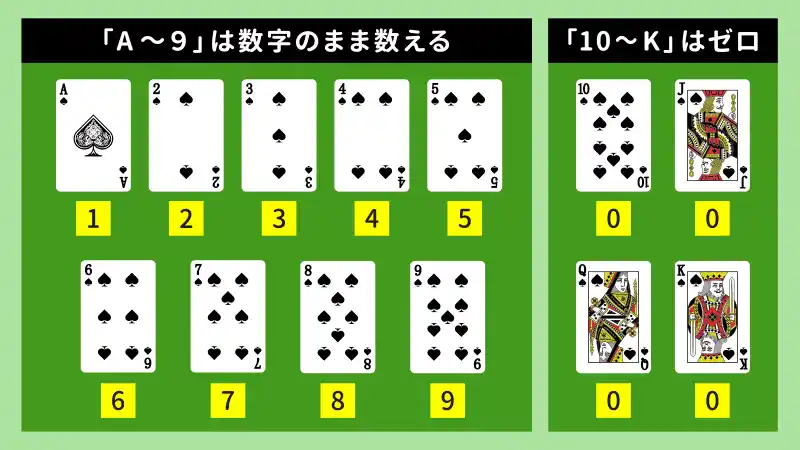
In baccarat, a hand’s value is the last digit of the total of its two or three cards, and the closer that value is to 9, the stronger the hand.
An ace counts as 1, cards 2–9 count at face value, and 10, J, Q and K all count as 0.
Number of Cards with 6 Decks and 8 Decks
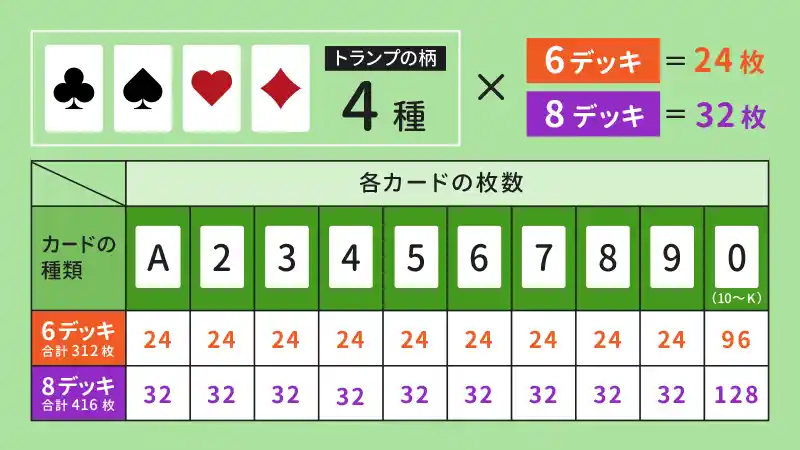
A 6-deck shoe holds 312 cards, and an 8-deck shoe holds 416.
By rank, a 6-deck shoe contains 24 of each card from A to 9 (4 suits × 6) and 96 cards that count as 0 (10 through K). An 8-deck shoe contains 32 of each card from A to 9 (4 suits × 8) and 128 cards that count as 0.
Because a 6-deck shoe holds fewer cards, its composition is more likely to become uneven than that of an 8-deck shoe.
Common Card Counting Methods in Baccarat
There is more than one way to count cards. The most detailed method is counting cards by rank. Try it with pen and paper as a way to enjoy following the play at the table, not as a way to change your chances of winning.
- Counting Cards by Rank
- Counting Cards by Whether They Favor the Player Hand or the Banker Hand
- The Hi-Lo Count System
(1) Counting Cards by Rank

The most accurate method is to count every card that appears, rank by rank. If you keep track of every rank, you know the exact composition of the cards left in the shoe.
Some explanations claim that the Player hand tends to be favored when many 3s and 4s remain, and that the Banker hand tends to be favored when many cards of 6 or higher remain, but we have found no verifiable source for either claim.
(2) Counting Cards by Whether They Favor the Player Hand or the Banker Hand
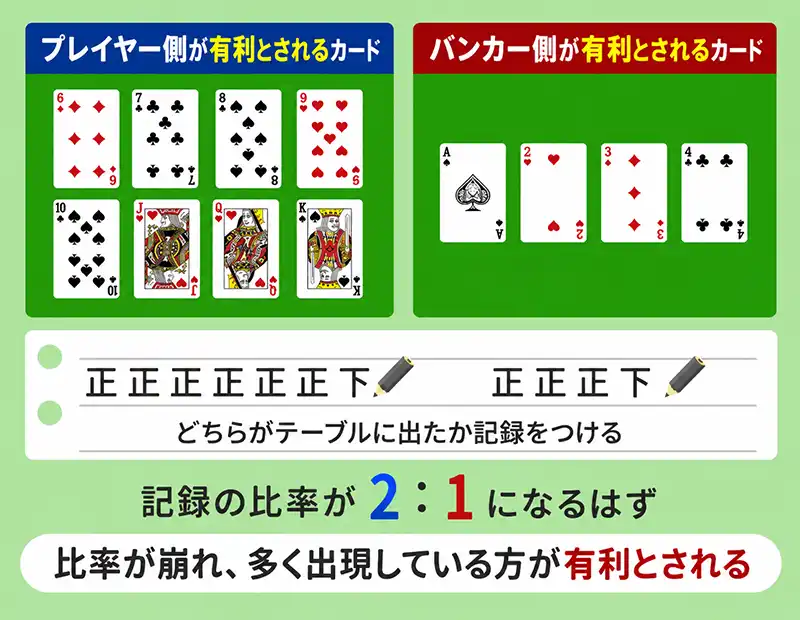
This method sorts the cards into those said to favor the Player hand and those said to favor the Banker hand, and counts each group.
You record how many cards from A to 4 and how many from 6 to K have been dealt. 5s are not counted in either group. There are four ranks from A to 4 and eight ranks from 6 to K, so the two counts in your record should normally stand in a ratio of roughly 1 to 2.
If that ratio is off, you know that the remaining composition of the shoe is uneven. However, that unevenness does not tell you which side to bet on.
Conditions Said to Favor the Player Hand: Many Cards of 4 or Lower Remaining

The Player hand is said to be favored when many cards of 4 or lower remain in the shoe. In your record, this is the case when more than twice as many 6–K cards as A–4 cards have been dealt. However, we have not been able to find a source that supports the size of this effect.
Conditions Said to Favor the Banker Hand: Many Cards of 6 or Higher Remaining

The Banker hand is said to be favored when many cards of 6 or higher remain in the shoe. In your record, this is the case when the number of A–4 cards dealt is more than half the number of 6–K cards dealt. Here too, we have not found a source to support this.
(3) The Hi-Lo Count System

The Hi-Lo count system divides the cards into three groups, +1, 0 and −1, and adjusts a running total whenever certain ranks appear.
Because you only sort the cards into three groups and track the total, it is the simplest counting system to use. However, sources disagree on which side is favored when the total moves in a given direction.
In the baccarat version described here, a 10, J, Q or K counts as +1, and a 2, 3, 4 or 5 counts as −1. All other ranks count as 0 and do not change the total.
For example, if in the first hand the Player receives a 7 and a 2 and the Banker receives a 3 and a Q, the counts are 0, −1, −1 and +1, for a total of −1. The count carries over from one hand to the next, so from hand 2 onward you add each hand’s count to the previous total.
| Hand | Player cards | Banker cards | Count | Running total |
|---|---|---|---|---|
| Hand 1 | 7, 2 | 3, Q | 0 −1 −1 +1 → −1 | −1 |
| Hand 2 | K, 8 | 3, 5 | +1 0 −1 −1 → −1 | −2 |
| … | ||||
| Hand n | J, 10 | 9, K | +1 +1 0 +1 → +3 | +4 |
In this way, each hand’s count is added and the total is carried forward. The total is −2 at the end of hand 2 and +4 at the end of hand n.
A larger swing in the total suggests that the remaining composition of the shoe is more uneven, but the effect of that unevenness on the winning probabilities is very small, and it gives you no basis for deciding which side to bet on.
Points to Keep in Mind When Counting Cards in Baccarat

If you decide to try counting, keep the following points in mind.
Combining counting with a betting system only changes how your bets rise and fall; it does not change the expected value. Rebates and cashback can reduce your net losses, but they have nothing to do with counting and do not remove the house edge. Some practices are also prohibited in certain venues, so check the points below.
Card Counting Is Not Illegal, but Land-Based Casinos Can Refuse Play
In land-based casinos, such as those in Las Vegas and Macau, card counting in baccarat is not illegal, but casinos may refuse play to players they suspect of counting.
Counting in your head cannot be detected, so keeping a mental count will not cause any problems. However, some venues restrict the use of smartphones and other electronic devices at the table, and some also restrict note-taking for counting; in either case you may be asked to leave the table.
Unevenness Appears Only Late in the Shoe and Is Reset by the Shuffle
In 8-deck live baccarat, for example, the shoe starts with a very large number of cards: 32 of each rank, and 128 tens and face cards combined. Even if one or two of a given card are dealt early on, the probability of drawing that card barely changes. The remaining composition becomes more uneven as play goes deeper into the shoe, but even then the difference is not large enough to change which side is the better bet.
Once the cut card comes out, the cards are shuffled and every rank is back to its full count, so the data collected from that shoe becomes worthless at that point. Unevenness only becomes visible during the short stretch from late in the shoe until the cut card appears, and even then its effect on expected value stays within the margin of error.
If you want to try counting, therefore, live baccarat with deep penetration (the cut card placed near the end of the shoe) makes it easier to keep a continuous record. However, this does not make either side a better bet.
Spending too long just watching a table may lead to being asked to leave, and above all it means long stretches of waiting. Some live baccarat tables display detailed results for each hand, so by using that data you can keep a record without watching the table the whole time.
Free Baccarat Card Counting Tools and Apps

Using any of the counting methods covered so far by hand takes considerable effort.
A few simple notes are enough for the Hi-Lo count, but counting every card by rank is hard work. Some players build their own tracking file in a spreadsheet, but that is a lot of work for anyone new to counting.
Another option is to use an app to do the counting.
With an app such as “Baccarat Card Counting” for Android or “BP Card Counter” for iPhone, you only need to enter the cards dealt in each hand, and the app tallies the remaining composition of the shoe. You can also change the number of decks, so keeping a record takes less effort than doing it by hand. However, the results do not tell you which side to bet on.
Summary: Card Counting in Baccarat Has Limited Effect
Card counting in baccarat means recording the ranks of the cards dealt so far and using the cards that remain to try to judge whether the Player hand or the Banker hand will be favored next.
In baccarat, however, uneven card distribution has only a very small effect on the winning probabilities. There is also no way to act on that information through your own choices, as you can by doubling down or taking insurance in blackjack. As a result, any edge gained from counting stays within the margin of error, and you can expect almost no practical benefit.
Counting can be an enjoyable way to learn how the game works, but do not treat it as a winning system. If you want to limit your losses, focus on the decisions you actually control, such as choosing tables with a low house edge and betting on Banker by default. Even so, both of these choices still lose money over the long run.
This site is for adults of legal gambling age (18+, or older where required) who live in countries or regions where online gambling is legal.
Use of this site is subject to our Terms and Conditions.
Gambling involves risk. Only bet what you can afford to lose, and do not use online gambling services where they are illegal.

Bell | Editor of Online Casino Winners Club. Since the site launched in 2003, Bell has written guides to casino game rules, tested betting systems and covered land-based casinos around the world, and still plays the games before writing about them. Bell's core advice: choose the bets with the lowest house edge, and decide in advance how much you are prepared to lose.