

Martingale Strategy: Does It Work? Risks and Test Results

The Martingale system is a betting system with a very simple procedure: if you lose, you double your bet on the next round.
It is often said that the system cannot lose in theory, and that claim has made it one of the best-known betting systems. The theory holds, however, only when both your bankroll and the table limit are infinite.
What You Will Learn
- The Martingale system is a betting system in which you double your bet after each loss, aiming to win one unit.
- Because bankrolls and table limits are finite, a long enough losing streak will always break the system, and it does not change the expected value.

This article takes about 11 minutes to read.
How to Bet with the Martingale System
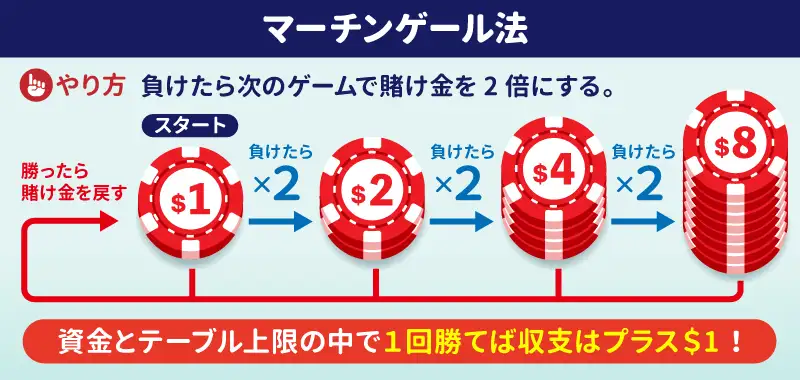
- After a loss, double your bet on the next round
- Keep doubling your bet until you win
- After a win, go back to your original bet
The whole procedure comes down to one rule: double your bet on the next round after a loss. Once you have that down, you know everything you need to use the system.
As long as you can keep raising your bet, a win ends the cycle and leaves you one unit of profit. If you start with a $1 bet, for example, you are $1 ahead at the moment you win.
| Round | Bet | Result | Win/loss | Running total |
|---|---|---|---|---|
| 1 | $1 | Loss | −$1 | −$1 |
| 2 | $2 | Loss | −$2 | −$3 |
| 3 | $4 | Loss | −$4 | −$7 |
| 4 | $8 | Loss | −$8 | −$15 |
| 5 | $16 | Win | +$16 | +$1 |
Casino Games That Suit the Martingale System
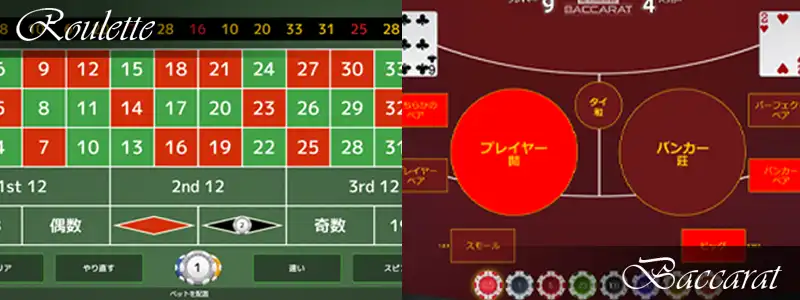
The Martingale system assumes a bet that pays 1 to 1, so a winning $10 bet wins $10. For this reason, it is usually used with bets such as these:
- The even-money bets in roulette: red/black, odd/even and high/low (any bet that covers 18 pockets works)
- The Player bet in baccarat
Guides to doubling systems usually choose the Player bet because a winning Banker bet is charged a 5% commission. It pays 0.95 to 1 (19 to 20), so a $10 bet wins $9.50, and a win does not always recover everything you have lost. In no-commission baccarat, a Banker win on 6 pays half (1 to 2, so a $10 bet wins $5), which raises the house edge on the Banker bet from about 1.06% to about 1.46%. Blackjack is also a poor fit: in some situations the best play is an additional bet such as a double down or a split, and if you skip them in order to keep your bet sequence intact, the return to player (RTP) drops considerably.
The Martingale System in Practice: Our Results and Simulations
These are the results we got when we played roulette and baccarat using the Martingale system.
Example: Three Wins and Seven Losses at Roulette
In this session, we played roulette under the conditions below and finished with 3 wins and 7 losses, a losing record.
- Bet on red at roulette
- Starting bet of $1
- 10 rounds in total
| Round | Bet | Result | Win/loss | Running total | Next step |
|---|---|---|---|---|---|
| 1 | $1 | Loss | −$1 | −$1 | Double the bet: $1 → $2 |
| 2 | $2 | Loss | −$2 | −$3 | Double the bet: $2 → $4 |
| 3 | $4 | Win | +$4 | +$1 | Go back to the starting bet: $1 |
| 4 | $1 | Loss | −$1 | $0 | Double the bet: $1 → $2 |
| 5 | $2 | Win | +$2 | +$2 | Go back to the starting bet: $1 |
| 6 | $1 | Loss | −$1 | +$1 | Double the bet: $1 → $2 |
| 7 | $2 | Loss | −$2 | −$1 | Double the bet: $2 → $4 |
| 8 | $4 | Loss | −$4 | −$5 | Double the bet: $4 → $8 |
| 9 | $8 | Loss | −$8 | −$13 | Double the bet: $8 → $16 |
| 10 | $16 | Win | +$16 | +$3 | Go back to the starting bet: $1 |
The session ended at +$3. We finished ahead despite a 3–7 record because each losing streak was followed by a win while we still had enough money to keep doubling. If the losses had come first in one long streak, the same record could have ended in a loss, so finishing ahead with fewer wins than losses does not mean the system gives you an edge.
When we bet on the Player in baccarat, lost nine times in a row and then won once, the result was again +$1, the size of the starting bet. That single win, however, required a $512 bet. Had we reached the limit of our bankroll or the table limit after the ninth loss, a $511 loss would have been locked in at that point.
The result takes the same shape whatever the game or the order of wins and losses, because the Martingale system is built to leave exactly one unit of the starting bet at the moment you win. What grows is not the profit but the bankroll you need to get there.
Pros and Cons of the Martingale System
Pros of the Martingale System
- The procedure is simple enough for beginners to use right away
- As long as you can keep raising your bet, a single win recovers all the losses in that cycle
- Within a single cycle, you will often lock in a profit of one unit
Cons of the Martingale System
- The longer a losing streak lasts, the more money you need
- Once you reach the table limit (the maximum bet), you cannot continue
- However large your bet grows, a win earns you only one unit
The Martingale system is a betting system with a simple procedure that beginners can handle easily. Because your bet doubles after every loss, though, it is easy to run short of money. And no matter how long the losing streak you recover from, a win earns you only one unit, so the reward is small compared with the risk you take on.
The key point to understand is that the Martingale system does not change the house edge, RTP or overall expected value of the game in any way. Only the swings in your results (the variance) change: the system simply reshapes them into frequent small wins in exchange for occasional large losses. Because both the table limit and your bankroll are finite, if you keep doubling after every loss, at some point you will be unable to place the next bet.
Four Ways to Limit the Risk of the Martingale System

As we have seen, the weakness of the Martingale system lies almost entirely in how quickly the bet grows during a losing streak. Keeping the following four points in mind makes those losses easier to contain.
(1) Know Your Bankroll and How Many Losses in a Row It Can Cover
The Martingale system makes your bet grow rapidly as a losing streak gets longer. Before you start, work out in actual numbers how much money you can use and how many losses in a row that bankroll can cover.
The quick-reference tables below show the total loss and the probability of each losing streak for $1 and $5 starting bets. For other bet sizes, use the formula given in tip (4).
Losses by Losing Streak with a $1 Starting Bet
Note: The probabilities are theoretical values based on a 50% chance of winning each round. In real games they are higher (when betting on red in European roulette, the probability of 10 losses in a row is about 0.13%).
| Losing streak | 3 losses | 4 losses | 5 losses | 6 losses | 7 losses | 8 losses | 9 losses | 10 losses |
|---|---|---|---|---|---|---|---|---|
| Total loss after n losses | $7 | $15 | $31 | $63 | $127 | $255 | $511 | $1,023 |
| Probability | 12.50% | 6.25% | 3.13% | 1.56% | 0.78% | 0.39% | 0.20% | 0.10% |
Losses by Losing Streak with a $5 Starting Bet
Note: The probabilities are based on the same assumption as the table above (theoretical values for a 50% chance of winning).
| Losing streak | 3 losses | 4 losses | 5 losses | 6 losses | 7 losses | 8 losses | 9 losses | 10 losses |
|---|---|---|---|---|---|---|---|---|
| Total loss after n losses | $35 | $75 | $155 | $315 | $635 | $1,275 | $2,555 | $5,115 |
| Probability | 12.50% | 6.25% | 3.13% | 1.56% | 0.78% | 0.39% | 0.20% | 0.10% |
The amounts in these tables are the losses after betting n times and losing every time. To win the money back after n losses, you have to place one more bet, so the bankroll you need is even larger. With a $1 starting bet, surviving 10 losses in a row and recovering takes $2,047, not $1,023.
Even when the chance on any one occasion is small, a long streak is bound to happen if you play long enough. If you keep betting on red in European roulette, the probability of at least one streak of 10 or more losses is about 5.6% over 100 spins, about 46.2% over 1,000 spins and about 95.6% over 5,000 spins.
For the same 10-loss streak, the difference in losses between a $1 and a $5 starting bet is $4,092. Decide before you play how large your starting bet should be relative to your bankroll.
(2) Quit Rather Than Lower Your Bet Partway Through
Once you try doubling your bet after every loss, you will probably find that the bet rises faster than you expected.
When the bet climbs to $8, $16, $32 and beyond just to win $1, you may become too nervous to keep betting.
This applies to any betting system, not only the Martingale: a betting system only works as designed if you bet exactly as planned. If you lower your bet partway through and then win, you do not recover your earlier losses and remain behind overall.
(3) Play at Tables with High Table Limits
Both land-based and online casinos set a table limit (the maximum you can bet on a single round) for each table.
Because your bet doubles with every loss, you reach the limit sooner than you might expect. At a table with a $1,000 maximum and a $10 unit, you cannot place the $1,280 needed for the eighth bet, so a $1,270 loss is locked in after seven losses in a row. Once you reach the limit, you have no way to win back what you have lost.
(4) Set a Stop-Loss Limit in Advance
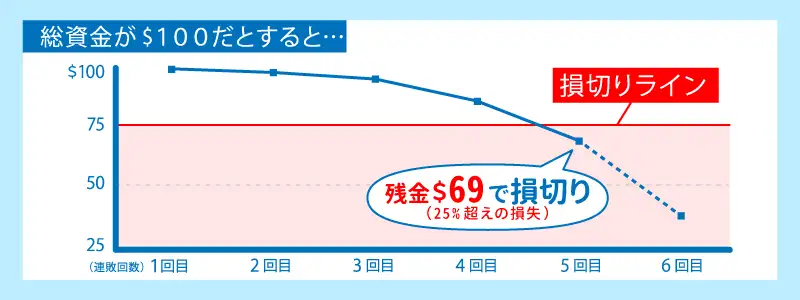
Because both your bankroll and the table limit are finite, a long enough losing streak will always leave you unable to raise your bet at some point. Set a stop-loss limit before that happens.
There is no single correct stop-loss limit, but having one guideline makes the decision mechanical. Here we use a loss of 25% of your bankroll as an example. The total loss can be calculated with the formula below.
Formula for the Total Loss
L = starting bet × (2^n − 1)
(L: total loss, n: number of losses in a row)
For example, with a bankroll of $100 and $1 bets, you stop once your loss reaches 25%, that is,
100 × 0.25 = $25.
Total loss after 1 loss: L = 1 × (2^1 − 1) = $1
Total loss after 2 losses in a row: L = 1 × (2^2 − 1) = $3
Total loss after 3 losses in a row: L = 1 × (2^3 − 1) = $7
Total loss after 4 losses in a row: L = 1 × (2^4 − 1) = $15
Total loss after 5 losses in a row: L = 1 × (2^5 − 1) = $31
Four losses in a row cost $15, while five losses in a row cost $31, more than the $25 that makes up 25% of the bankroll. In this case, stopping after the fourth loss keeps your loss within $25, because the next bet of $16 would take the total past $25 if it lost. Setting a stop-loss limit does not change the expected value itself. Think of it as a money management rule that caps how much you can lose in one session.
A Martingale Variation: Paroli After a Win, Martingale After a Loss
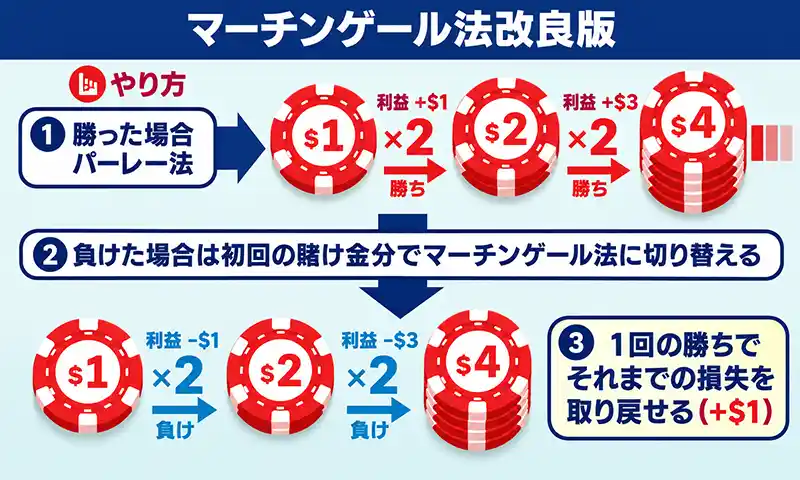
Because the Martingale system is so simple, many players have developed their own variations of it. Variations that target its main weakness, a small gain when you win but a large loss when you lose, are especially common.
The variation we suggest is “Paroli after a win, Martingale after a loss.”
The Paroli system (also called the reverse Martingale) is a betting system that works the opposite way to the Martingale: you double your bet after a win and go back to the starting bet after a loss.
With the combined approach we propose, you double your bet after every win and after every loss, and go back to the starting bet whenever the streak ends.
If a winning streak comes first, one cycle can produce a larger profit; if a losing streak comes first, the loss grows. By setting limits in advance, such as locking in your profit after five wins in a row and cutting your losses after seven losses in a row, you fix how much one cycle can win or lose in either direction. This, too, only changes how your results swing. It does not make winning more likely, and it does not raise the overall expected value.
Frequently Asked Questions About the Martingale System
- What are the drawbacks of the Martingale system?
-
The biggest drawback is that the reward does not match the risk: a single win earns you only one unit, while your losses double with every bet during a losing streak. Raising the starting bet does not remove this drawback. It only increases the bankroll you need in proportion. The only remedy is to decide in advance the maximum number of times you will double your bet, which is a money management rule that sets your own limit on losses.
- What is the opposite of the Martingale system?
-
The opposite is the Paroli system (also called the reverse Martingale). Unlike the Martingale system, it raises the bet after each win. You accept a series of small losses in exchange for a sizable profit when a winning streak comes, so your results swing in the opposite direction to those of the Martingale system.
Summary: The Martingale System Changes How Your Results Swing, Not the Expected Value
The Martingale system is a betting system with very simple steps that you can put into practice right away, and it makes it easy to lock in small profits frequently. It only reshapes how your results swing, though; neither the house edge nor the expected value changes. During a losing streak your bet grows rapidly, and sooner or later you will run into either the limit of your bankroll or the table limit.
If you plan to try the system, do not take the claim that it “cannot lose in theory” at face value. Work out first how many losses in a row your bankroll can cover, and then decide whether to use it at all.
- Martingale Strategy Explained
- D'Alembert Betting System
- Paroli Betting System
- Labouchère Betting System
- Percentage Betting (10% System)
- Oscar's Grind Betting System
- 1-3-2-6 Betting System
- 1-2-3-5 Betting System
- Monte Carlo Betting System
- Cocomo Betting System
This site is for adults of legal gambling age (18+, or older where required) who live in countries or regions where online gambling is legal.
Use of this site is subject to our Terms and Conditions.
Gambling involves risk. Only bet what you can afford to lose, and do not use online gambling services where they are illegal.

Bell | Editor of Online Casino Winners Club. Since the site launched in 2003, Bell has written guides to casino game rules, tested betting systems and covered land-based casinos around the world, and still plays the games before writing about them. Bell's core advice: choose the bets with the lowest house edge, and decide in advance how much you are prepared to lose.