

Monte Carlo Betting System: How It Works, Steps and Examples

The Monte Carlo system is a betting system that uses a sequence of numbers to decide how much to bet. Its name is said to come from Monte Carlo in Monaco. Because the sequence sets each bet, you can follow the steps as written without relying on in-the-moment judgment, which makes the system a good fit for players who prefer a patient, methodical approach.
What You Will Learn
- The Monte Carlo system has a somewhat complex procedure, so you will need to take notes until you are used to it.
- It works best with table game bets that pay 1 to 1 or 2 to 1.

This article takes about 13 minutes to read.
What Is the Monte Carlo System? A Betting System That Sets Bets with a Sequence of Numbers
The Monte Carlo system is a casino betting system, a method of adjusting your bet according to a fixed set of rules. In games such as roulette and baccarat, you raise and lower your bet under set conditions, with the aim of covering your losses and turning them into a profit.
Each bet is calculated from a sequence of numbers before every round, so the method takes some getting used to. It suits online casinos, where you can keep a pen and paper beside you while you play.
Keep in mind that the system does not improve your chances of winning. Each round is an independent event, so the expected value and the house edge stay the same. The only things the system changes are how much your results swing (the variance) and how you manage your bankroll. A cycle is more likely to end in profit when wins come after a run of losses than when you win several times in a row. The system is also not designed to produce results quickly.
No method can guarantee a win at a casino. Think of the Monte Carlo system as one framework for managing your bankroll, in which you follow the correct procedure and keep a record as you go.
How to Use the Monte Carlo System
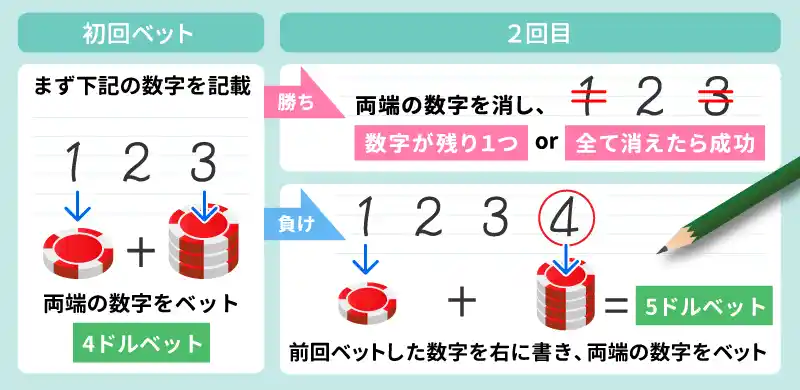
The Monte Carlo system is a betting system that controls the size of your bets with a sequence of numbers. The aim is to recover earlier losses and finish with a profit.
You repeat two rules: cross off both ends on a win, add the bet on a loss. You keep betting until the sequence is empty or only one number is left. If you are ahead at that point, the cycle has succeeded.
Once you understand the procedure, try it out with amounts you can comfortably afford until you are used to it.
Step-by-Step Procedure and How to Record It
The Monte Carlo system is somewhat complex, so we recommend writing it out as you go. At first, the most reliable approach is to keep a pen and paper at hand and record every step.

First, write down the three base numbers 1, 2, 3.
These numbers directly determine your opening bet. If you want a larger unit, you can scale the amounts up while keeping the same ratio, such as 2, 4, 6 or 10, 20, 30. What matters is that the numbers stay in the ratio of 1 unit, 2 units and 3 units.
All of the explanations below use 1, 2, 3 as the starting sequence.

Next, add the first and last numbers of the current sequence to get your next bet. Here, 1 + 3 = 4, so you place a $4 bet on the next round. This number is added to the sequence only if the bet loses.
If this is a bet that pays 2 to 1 and it wins, you cross off two numbers from each end of 1, 2, 3, which leaves no numbers, so the cycle ends here. On a bet that pays 1 to 1, you cross off one number from each end, leaving only 2. With just one number left, the cycle also ends. The difference between the two methods of crossing off is explained below.

Now suppose this bet loses. In that case, add the amount you lost to the right end of the sequence. Adding 4 to 1, 2, 3 gives 1, 2, 3, 4, and the bet for the second round is the sum of the first and last numbers: 1 + 4 = 5.
You then place a $5 bet on the next round.

If that bet also loses, you add 5 in the same way to get 1, 2, 3, 4, 5, and the bet for the third round is 1 + 5 = 6.
If that loses too, you add 6, the sequence becomes 1, 2, 3, 4, 5, 6, and the bet for the fourth round is 1 + 6 = 7.
Suppose this bet finally wins. What you do next depends on the game you are playing and the bet you have placed.
How to Cross Off Numbers After a Win on a 2 to 1 Bet
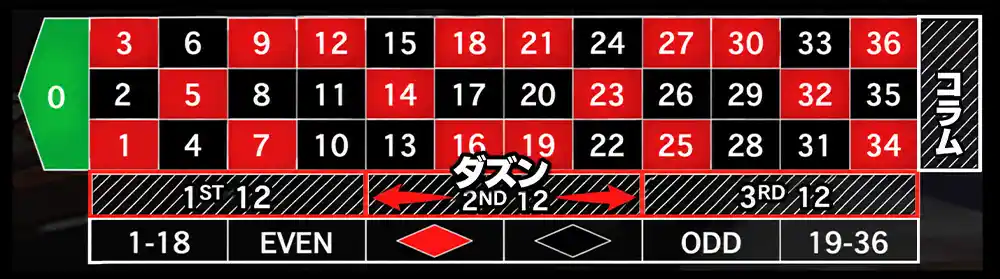
This applies when you have placed a bet that pays 2 to 1, such as a dozen bet or a column bet in roulette.
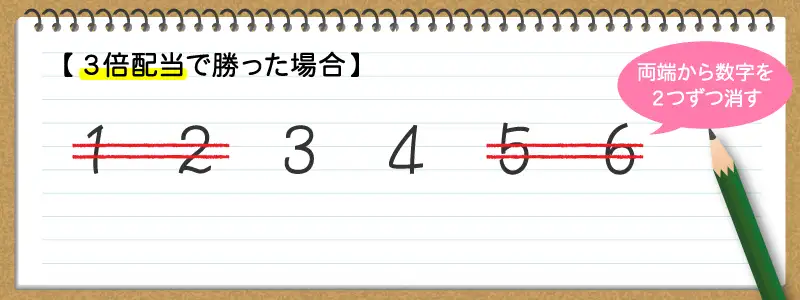
On a bet that pays 2 to 1, cross off two numbers from each end (four in total) of the current sequence. The sequence is 1, 2, 3, 4, 5, 6, so you cross off 1, 2, 5 and 6 and write down 3, 4.
How to Cross Off Numbers After a Win on a 1 to 1 Bet
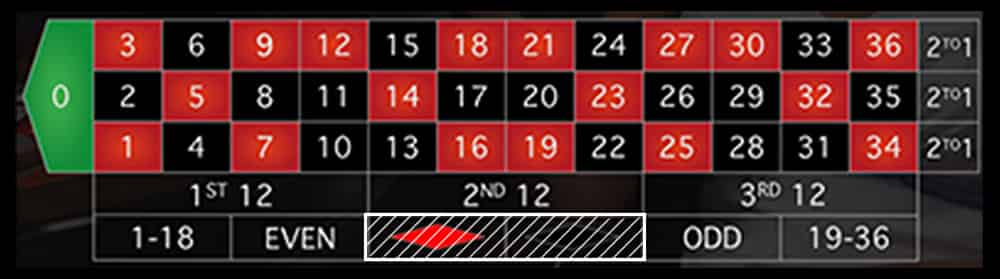
This applies when you have placed a bet that pays 1 to 1, such as red/black in roulette or the Player bet in baccarat.
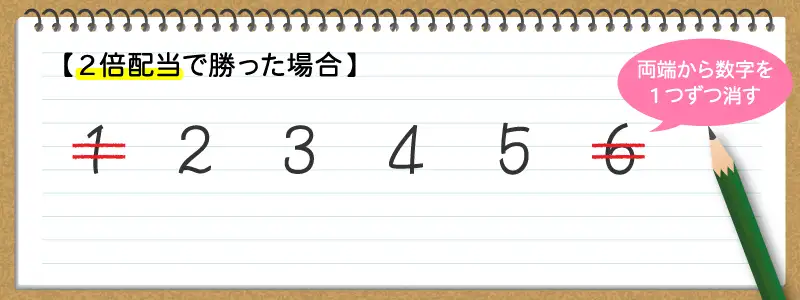
On a bet that pays 1 to 1, cross off one number from each end (two in total) of the current sequence. The sequence is 1, 2, 3, 4, 5, 6, so you cross off 1 and 6 and write down 2, 3, 4, 5.
How a Cycle Ends and When to Cut Your Losses
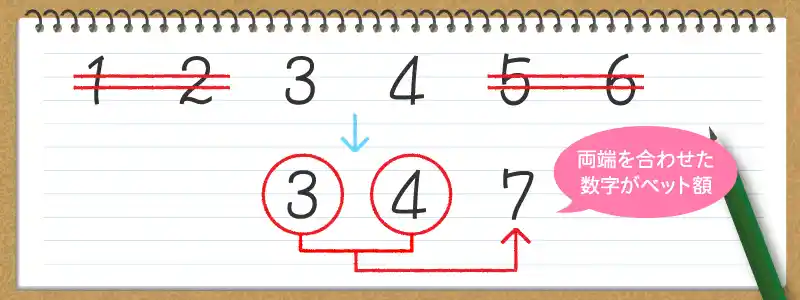
Taking the 2 to 1 bet as an example, the sequence is now 3, 4, so the next bet is the sum of the first and last numbers, 3 + 4 = 7, and if it loses, the sequence becomes 3, 4, 7.
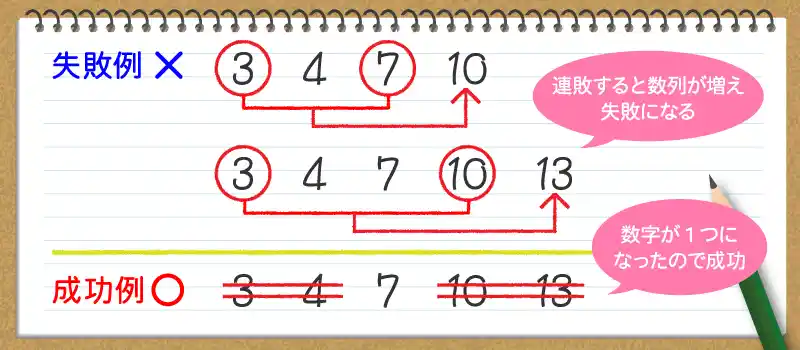
You continue in this way, and one cycle of the Monte Carlo system ends when all the numbers are crossed off or only one is left.
With either a 1 to 1 or a 2 to 1 bet, you finish with a profit if you cross off the entire sequence. If you end the cycle with one number left, however, you may not be ahead. In both cases, a run of losses lengthens the sequence, which drives up your bets and makes your losses larger.
As a guideline, we recommend stopping and accepting the loss once the sequence reaches 10 or more numbers, even if you have not recovered what you are down. Starting from 1, 2, 3, seven losses in a row give you a sequence of 10 numbers and a cumulative loss of 49 units at that point ($49 with a $1 unit, or $490 with a $10 unit). The next bet would be 11 units.
Setting a stop-loss limit does not change the expected value. Think of it as a bankroll management rule that caps how much you can lose in one session. Both the table limit and your bankroll are finite, so the sequence cannot keep growing indefinitely.
Casino Games That Work Well with the Monte Carlo System

To use the Monte Carlo system effectively, you need a game in which a winning bet always pays at the same fixed odds. In practice, this means the system is best suited to table games with a clear win or loss.
In roulette, the dozen bet and the column bet pay 2 to 1, while red/black, odd/even and high/low pay 1 to 1, so you can run the Monte Carlo system on any of these bets.
In baccarat, the Player bet pays 1 to 1, so it can be used as is. The Banker bet has a 5% commission deducted from wins, so it pays 0.95 to 1 (19 to 20), meaning a $10 bet wins $9.50, which does not fit the calculations in the sequence.
In no-commission baccarat, a Banker win on 6 usually pays half (1 to 2), which breaks the requirement that a win always pays at fixed odds. If you use the system in baccarat, bet on Player.
In other games, choose bets that are guaranteed to pay 1 to 1 or 2 to 1 when they win, such as Big/Small in Sic Bo.
Blackjack is not a good fit for the Monte Carlo system. Doubling down or splitting can change your bet in the middle of a hand, so the amount at stake no longer matches the bet set by the sequence.
The system can also be used in live dealer games such as live baccarat and live roulette.
Simulating the Monte Carlo System: 2 to 1 Bets vs. 1 to 1 Bets

As the step-by-step procedure showed, a win crosses off a different number of entries on a 2 to 1 bet than on a 1 to 1 bet. This difference also affects how often you need to win to finish a cycle.
The sequence grows by one number with every loss. A win on a 2 to 1 bet crosses off four numbers, so the sequence stays the same length if you win one bet in every five and gets shorter if you win more often than that. A win on a 1 to 1 bet crosses off two numbers, so the break-even point is one win in every three bets. (Your actual profit or loss depends on the values in the sequence.)
That might make the 2 to 1 bet look easier, but it wins less often. In European roulette, a dozen bet wins 12 times in 37, or 32.43%, while red/black wins 18 times in 37, or 48.65%. Both are above their break-even points, but by different margins, so neither bet is simply better than the other.
Simulation Results for a 2 to 1 Bet
This simulation uses a bet on the first dozen (1–12) in roulette, with the following results: the first three bets lose, the fourth wins, the fifth and sixth lose, and the seventh wins.
The sequence starts with 1, 2, 3.
| Round | Sequence | Bet | Result | Amount returned | Running total | Action after the result | Sequence after the action |
|---|---|---|---|---|---|---|---|
| 1st | 1, 2, 3 | $4 (1 + 3) | Loss | $0 | -$4 | Add the bet (4) to the right end | 1, 2, 3, 4 |
| 2nd | 1, 2, 3, 4 | $5 (1 + 4) | Loss | $0 | -$9 | Add the bet (5) to the right end | 1, 2, 3, 4, 5 |
| 3rd | 1, 2, 3, 4, 5 | $6 (1 + 5) | Loss | $0 | -$15 | Add the bet (6) to the right end | 1, 2, 3, 4, 5, 6 |
| 4th | 1, 2, 3, 4, 5, 6 | $7 (1 + 6) | Win | $21 | -$1 | Cross off two numbers from each end | 3, 4 |
| 5th | 3, 4 | $7 (3 + 4) | Loss | $0 | -$8 | Add the bet (7) to the right end | 3, 4, 7 |
| 6th | 3, 4, 7 | $10 (3 + 7) | Loss | $0 | -$18 | Add the bet (10) to the right end | 3, 4, 7, 10 |
| 7th | 3, 4, 7, 10 | $13 (3 + 10) | Win | $39 | +$8 | Cross off two numbers from each end | No numbers left; the cycle ends |
In this example, only 2 of the 7 bets won and 5 lost, yet the cycle still ended with a profit.
Simulation Results for a 1 to 1 Bet
This simulation uses the Player bet in baccarat, with the following results: the first two bets lose, the third wins, the fourth and fifth lose, and the sixth and seventh win.
| Round | Sequence | Bet | Result | Amount returned | Running total | Action after the result | Sequence after the action |
|---|---|---|---|---|---|---|---|
| 1st | 1, 2, 3 | $4 (1 + 3) | Loss | $0 | -$4 | Add the bet (4) to the right end | 1, 2, 3, 4 |
| 2nd | 1, 2, 3, 4 | $5 (1 + 4) | Loss | $0 | -$9 | Add the bet (5) to the right end | 1, 2, 3, 4, 5 |
| 3rd | 1, 2, 3, 4, 5 | $6 (1 + 5) | Win | $12 | -$3 | Cross off one number from each end | 2, 3, 4 |
| 4th | 2, 3, 4 | $6 (2 + 4) | Loss | $0 | -$9 | Add the bet (6) to the right end | 2, 3, 4, 6 |
| 5th | 2, 3, 4, 6 | $8 (2 + 6) | Loss | $0 | -$17 | Add the bet (8) to the right end | 2, 3, 4, 6, 8 |
| 6th | 2, 3, 4, 6, 8 | $10 (2 + 8) | Win | $20 | -$7 | Cross off one number from each end | 3, 4, 6 |
| 7th | 3, 4, 6 | $9 (3 + 6) | Win | $18 | +$2 | Cross off one number from each end | One number left; the cycle ends |
More bets lost than won, but as the table shows, the cycle ended with a net profit. The idea behind the Monte Carlo system is to aim to recover your losses over a full cycle rather than react to each short run of wins and losses.
Pros and Cons of the Monte Carlo System
Like other betting systems, such as the D’Alembert system and the Martingale system, the Monte Carlo system has both advantages and disadvantages.
It is a negative progression system, which means you raise your bet after a loss, but even during a losing streak your bets rise only gradually.
Advantages of the Monte Carlo System
- Bets rise only gradually after a loss, which helps limit the swings in your results (variance) and how quickly your bankroll shrinks
- The sequence is hard to track in your head, but the system is easy to carry out at an online casino, where you can keep a pen and paper at hand
- Each cycle has a clear end point, so it is easy to decide in advance where to stop
- The sequence sets every bet, so you do not change your bet size on impulse
Disadvantages of the Monte Carlo System
- The system is difficult until you get used to it, and in practice you need a pen and paper or a note-taking app
- A long losing streak takes time to recover from, and you also need a stop-loss limit
- If a cycle ends with one number left, you may not finish ahead
- In rare cases, a casino prohibits the use of betting systems
- Results from a single cycle can swing widely, so the system needs to be used patiently, with bankroll management in place
- A successful cycle earns only a few units, while a failed cycle that you cut short with a stop-loss limit costs dozens of units, so the amounts you can win and lose are not balanced
- If you start with a large unit, your bets can reach the table limit, which can make it hard to recover your losses
How the Monte Carlo System Differs from Monte Carlo Simulation in Mathematics

Note: This section is somewhat technical and has no direct bearing on how the Monte Carlo system is played. If the topic does not interest you, feel free to skip it.
You may have come across the term “Monte Carlo method” in another context. Outside casino gambling, it almost always refers to Monte Carlo simulation, a technique used in mathematics.
Monte Carlo simulation is a technique that uses random numbers to forecast future outcomes. Put simply, it is like rolling a die hundreds of times and basing a prediction on the average result.
Figures such as a company’s annual sales, a stock’s price movements over a month or the number of traffic accidents in a day cannot be known in advance. To forecast them, analysts build their own model from past data.
Drawing on past experience (in the examples above, recent orders from customers or the average age of drivers), they build a model that behaves like a weighted die for the quantity they want to study. A computer program then ‘rolls’ that die hundreds of times and averages the results. This is Monte Carlo simulation.
As this shows, it has no direct connection with the Monte Carlo betting system described in this article.
Keep in mind that each round of a casino game is decided by an independent random draw (a random number generator, or RNG), so past results cannot be used to predict the next one. If you are interested in Monte Carlo simulation as a mathematical technique, try searching for the term.
Summary: The Monte Carlo System Manages Your Results One Cycle at a Time
The Monte Carlo system is a betting system that uses a number sequence to set each bet and aims to recover losses over the course of a full cycle. Unlike doubling systems, it raises bets gradually, so you can keep track of how quickly your bankroll is shrinking as you play.
However, the system changes only the swings in your results (variance) and the way you manage your bankroll. It does not change the game’s house edge or expected value in any way.
If you bet on a dozen in European roulette, the house edge of 2.70% applies, and on the Player bet in baccarat the house edge is about 1.24%, whether or not you use the Monte Carlo system.
As the sequence grows, your bets and the bankroll you need keep rising, while both the table limit and your bankroll are finite. Before you start, decide on your unit size and your stop-loss limit, and play only with a bankroll you can comfortably afford.
- Martingale Strategy Explained
- D'Alembert Betting System
- Paroli Betting System
- Labouchère Betting System
- Percentage Betting (10% System)
- Oscar's Grind Betting System
- 1-3-2-6 Betting System
- 1-2-3-5 Betting System
- Monte Carlo Betting System
- Cocomo Betting System
This site is for adults of legal gambling age (18+, or older where required) who live in countries or regions where online gambling is legal.
Use of this site is subject to our Terms and Conditions.
Gambling involves risk. Only bet what you can afford to lose, and do not use online gambling services where they are illegal.

Bell | Editor of Online Casino Winners Club. Since the site launched in 2003, Bell has written guides to casino game rules, tested betting systems and covered land-based casinos around the world, and still plays the games before writing about them. Bell's core advice: choose the bets with the lowest house edge, and decide in advance how much you are prepared to lose.