

Cocomo Betting System: Roulette Bet Chart, Odds and Stop-Loss

The Cocomo system is a betting system built on a simple rule: after a loss, you increase your next bet. A single win recovers all of the losses up to that point.
It closely resembles the Martingale system, in which you keep doubling your bet until you win. The Cocomo system, however, is designed for bets that pay 2 to 1, and the longer the losing streak, the larger the profit when you finally win.
What You Will Learn
- The Cocomo system recovers all previous losses with a single win, but because it is used on bets that pay 2 to 1, losing streaks are common.
- The bets best suited to the Cocomo system are the column bet and the dozen bet in roulette, both of which pay 2 to 1.

This article takes about 19 minutes to read.
What Is the Cocomo System? How It Works and Its Key Features

Casino betting systems are methods of managing your bankroll by changing your bet size according to fixed rules. Among them, the Cocomo system is one of the simplest and easiest to use.
You place a bet that pays 2 to 1 (a $10 bet wins $20, so you get $30 back including your stake), and after each loss you increase your bet according to a set sequence. Once you win, that single win recovers all of your losses so far, as long as your bankroll and the table limit allow you to keep going.
The system is very similar to the Martingale system, in which you double your bet after each loss. Under the Cocomo system, by contrast, the bet grows by only about 1.6 times, so the bet size rises more gradually.
Because the bet goes up after a loss, the Cocomo system is classed as a negative progression system. It belongs to the same family as the Martingale system and the Monte Carlo system, and it works the opposite way from positive progression systems such as the Paroli system (also called the reverse Martingale), which raise the bet after a win.
How to Bet with the Cocomo System
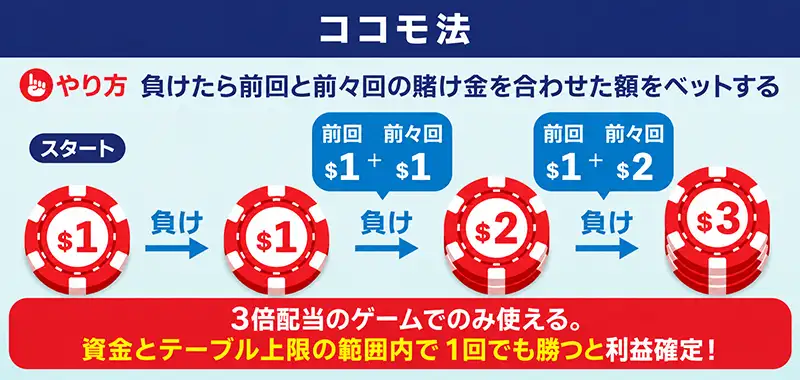
Unlike the Martingale system, the Cocomo system does not simply double your bet. When you are starting out, we recommend keeping a pen and paper handy and writing down how much to bet as you play.
First, set a base bet, called one unit. If the unit is too large, your bets quickly grow into large amounts, so we recommend keeping it at no more than 1/100 of your balance. In the examples below, one unit is $1.
The reason for the 1/100 guideline is that this ratio lets you withstand up to 8 losses in a row and still recover with your 9th bet. After 9 losses in a row, your total loss reaches 88 units, and you can no longer place the 55 units needed for the 10th bet. Nine losses in a row happen often enough in real play; see the chart below and “Losing Streak Probabilities and Stop-Loss Limits for the Cocomo System” for the exact figures.
- Place a $1 bet at roulette.
Whenever you win, at any point in the sequence, the cycle has succeeded. Reset your bet to $1 and start the next cycle. - If you lose, bet $1 again on your 2nd bet.
- After two losses in a row, bet the sum of your previous two bets. Your 3rd bet is $2: the 1st bet ($1) plus the 2nd bet ($1). Your 4th bet is $3: the 2nd bet ($1) plus the 3rd bet ($2).
Working this out in your head is a little tedious, so the chart below shows the bet you need at a glance. Note that the amounts assume a starting bet of $1.
If your bankroll runs out or you reach the table limit before winning once, the Cocomo system fails.
Setting a stop-loss limit, such as quitting if your 10th bet loses, puts a cap on how much you can lose in one cycle.
Cocomo System Bet and Profit Chart
| Losses in a row before this bet | Bet | Loss if this bet loses | Total loss if this bet also loses | Profit if this bet wins | Running total if this bet wins |
|---|---|---|---|---|---|
| First bet | 1 | −1 | −1 | 2 | 2 |
| 1 loss | 1 | −1 | −2 | 2 | 1 |
| 2 losses | 2 | −2 | −4 | 4 | 2 |
| 3 losses | 3 | −3 | −7 | 6 | 2 |
| 4 losses | 5 | −5 | −12 | 10 | 3 |
| 5 losses | 8 | −8 | −20 | 16 | 4 |
| 6 losses | 13 | −13 | −33 | 26 | 6 |
| 7 losses | 21 | −21 | −54 | 42 | 9 |
| 8 losses | 34 | −34 | −88 | 68 | 14 |
| 9 losses | 55 | −55 | −143 | 110 | 22 |
| 10 losses | 89 | −89 | −232 | 178 | 35 |
The chart shows the bets and profits under the Cocomo system with a base bet of $1. All figures are in dollars, and “Profit if this bet wins” is the net win on that bet, which is twice the stake because the bet pays 2 to 1.
Games That Suit the Cocomo System: Bets That Pay 2 to 1
The Cocomo system works only on bets that pay 2 to 1, so relatively few casino games are suitable. The best-known bets with this payout are the column bet and the dozen bet in roulette.
The Column Bet in Roulette
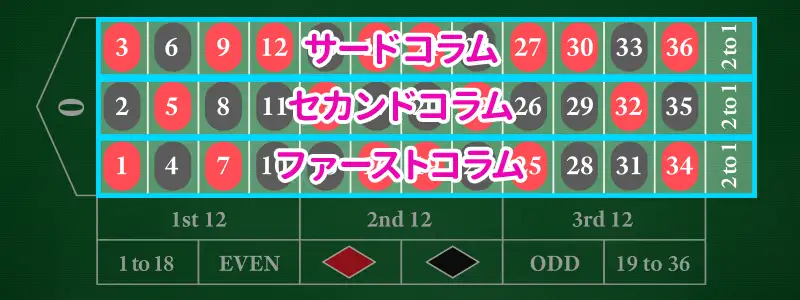
A column bet covers one of the three lines of 12 numbers that run along the length of the roulette layout. You can bet on any of the following three columns.
- First column: 1, 4, 7, 10 … 34
- Second column: 2, 5, 8, 11 … 35
- Third column: 3, 6, 9, 12 … 36
Each column wins about one time in three and pays 2 to 1, so a $10 bet wins $20. This makes the column bet a very good match for the Cocomo system.
To place a column bet, put your chips in the box marked “2 to 1” at the end of the column, on the far right of the layout. For example, to bet on the first column, place your chips in the box to the right of 34.
The Dozen Bet in Roulette
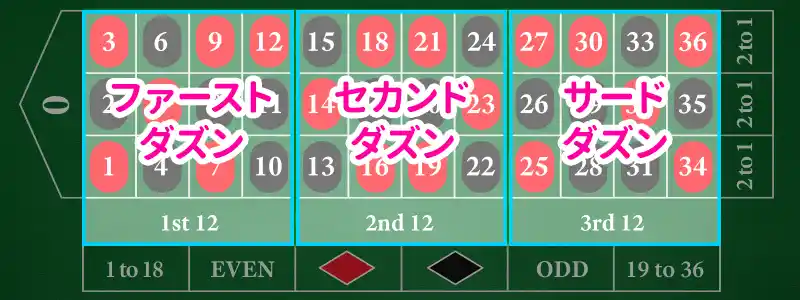
A dozen bet covers one of three blocks of numbers on the roulette layout: the first 12, the middle 12 or the last 12. As the name suggests, each block contains 12 numbers.
- First dozen: 1, 2, 3, 4 … 12
- Second dozen: 13, 14, 15, 16 … 24
- Third dozen: 25, 26, 27, 28 … 36
The probability of winning and the payout are the same as for the column bet, so the dozen bet suits the Cocomo system just as well.
To place a dozen bet, put your chips in the box marked “1st 12” (or “2nd 12” or “3rd 12”) below the block. For example, to bet on the first dozen, place your chips in the box marked “1st 12”.
Can You Use It for Horse Racing or Sports Betting?
The Cocomo system assumes that a winning bet pays exactly 2 to 1. It can be used for sports betting or horse racing, but only on selections where the payout is fixed at decimal odds of 3.00 or higher.
In that case, the chance of winning is well below one in three, so losing streaks build up even more easily, which is a major drawback.
Odds in sports betting also move often, and a price shown as 3.00 may have dropped to 2.50 by the time the bet is confirmed. For these reasons, the system is difficult to use in practice.
Simulation: How Your Balance Moves Under the Cocomo System

Below are two scenarios: 3 wins and 7 losses in 10 bets, and a win after 9 losses in a row. They show how the profit differs between a run in which wins and losses are mixed and a single win after a long losing streak.
Both scenarios use the same betting method, starting bet and number of bets.
- Bets are placed on a column bet in roulette
- The starting bet is $1
- Each simulation runs for 10 bets
3 Wins and 7 Losses in 10 Bets
This result is roughly in line with the win probability of about 32.4%. Bets follow the rules described above: each win ends the cycle, and the next cycle starts again at $1.
| Bet no. | Bet | Result | Win/loss | Running total |
|---|---|---|---|---|
| 1 | $1 | Loss | −$1 | −$1 |
| 2 | $1 | Loss | −$1 | −$2 |
| 3 | $2 | Win | +$4 | +$2 |
| 4 | $1 | Loss | −$1 | +$1 |
| 5 | $1 | Win | +$2 | +$3 |
| 6 | $1 | Loss | −$1 | +$2 |
| 7 | $1 | Loss | −$1 | +$1 |
| 8 | $2 | Loss | −$2 | −$1 |
| 9 | $3 | Loss | −$3 | −$4 |
| 10 | $5 | Win | +$10 | +$6 |
With 3 wins and 7 losses, alternating between wins and losses, the result was a profit of $6. The amount is small, but it is a reasonable result for a $1 starting bet.
The bets never jumped to large amounts, and each cycle had a clear end point.
A Win After 9 Losses in a Row
In this scenario, the first 9 bets lose and the 10th bet wins. Bets follow the rules described above.
| Bet no. | Bet | Result | Win/loss | Running total |
|---|---|---|---|---|
| 1 | $1 | Loss | −$1 | −$1 |
| 2 | $1 | Loss | −$1 | −$2 |
| 3 | $2 | Loss | −$2 | −$4 |
| 4 | $3 | Loss | −$3 | −$7 |
| 5 | $5 | Loss | −$5 | −$12 |
| 6 | $8 | Loss | −$8 | −$20 |
| 7 | $13 | Loss | −$13 | −$33 |
| 8 | $21 | Loss | −$21 | −$54 |
| 9 | $34 | Loss | −$34 | −$88 |
| 10 | $55 | Win | +$110 | +$22 |
Despite a low win rate of 1 win and 9 losses, this scenario produced a profit of $22.
Under the Cocomo system, the longer the losing streak, the larger the profit when you finally win. Keep in mind, however, that the losses built up along the way grow just as much.
You may think you would never lose that many times in a row. In roulette, the probability of 9 losses in a row under the Martingale system is about 0.25% (about once in 400 cycles). Under the Cocomo system, however, the probability of 9 losses in a row is 2.94% (about once in 34 cycles), which is frequent enough to happen in real play.
For this reason, assume that a losing streak will eventually happen and set a stop-loss limit in advance.
What Players Say About the Cocomo System
We looked at social media posts from players who have used the Cocomo system in real play.
Players often mention that the system is easy to start with a small bankroll. Some say that steady play at roulette rarely brings a big win but often adds small gains.
Some players have also calculated how much they got back as a percentage of everything they staked in a cycle that ended in a win, and report figures of around 115%.
Note that a figure like this applies only to a specific cycle that ended in a win. It does not mean that the game’s return to player (RTP) exceeds 100%. The game’s RTP stays the same whatever betting method you use.
The most common negative view is that the profit is small for the effort involved. The Cocomo system makes a meaningful profit only when a win follows a long run of losses, so even a win that finally comes on the 10th bet or later can feel like a small reward compared with other systems such as the Martingale system.
Players who want to win big in a short time tend not to favor it.
Among the posts we checked, there were few negative comments. These are impressions of how the system feels to use, however, and they do not show that it improves your results.
Three Advantages of the Cocomo System

Unlike other betting systems, the Cocomo system is designed for bets that pay 2 to 1. Its bets grow gradually, which makes it easy to manage even with a small bankroll.
- One Win Puts You Back in Profit
- The Longer the Losing Streak, the Bigger the Win
- You Can Use It with a Small Bankroll
One Win Puts You Back in Profit
Under the Cocomo system, a single win ends the cycle and recovers all the losses up to that point. However many times you have lost in a row, your next win puts your overall result back in profit, as long as your bankroll and the table limit hold out. As with the Martingale system, each cycle has a clear end point. This describes only how your balance moves within one cycle, though; it does not improve the game’s expected value or house edge.
There is one difference to keep in mind: the Martingale system is used on bets that win about 50% of the time, while the Cocomo system is used on bets that win about 32.4% of the time. Each bet is less likely to win than under the Martingale system (this is explained in the section on disadvantages).
The Longer the Losing Streak, the Bigger the Win
Under the Cocomo system, the longer your losing streak, the larger the profit a single win brings back.
The flip side is that a win after only a few bets brings almost no profit. A win after 5 losses in a row nets 4 units, and a win after 10 losses in a row nets 35 units, so the profit becomes substantial only after a long run of losses.
In other words, the Cocomo system pays off mainly when a win finally comes after a long losing streak.
You Can Use It with a Small Bankroll
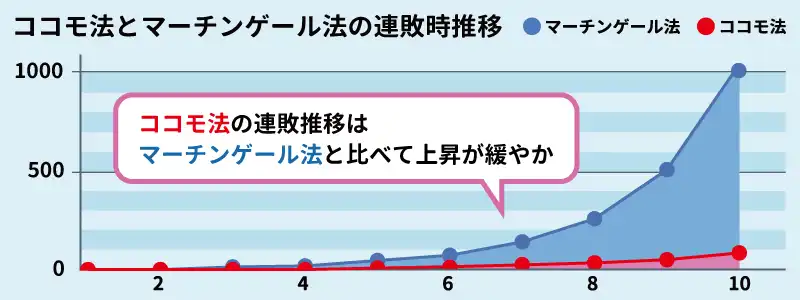
As mentioned above, the Martingale system is another system that recovers your losses with a single win. Both systems raise the bet after a loss, and the graph shows how much the required bet differs between the two after the same number of losses in a row.
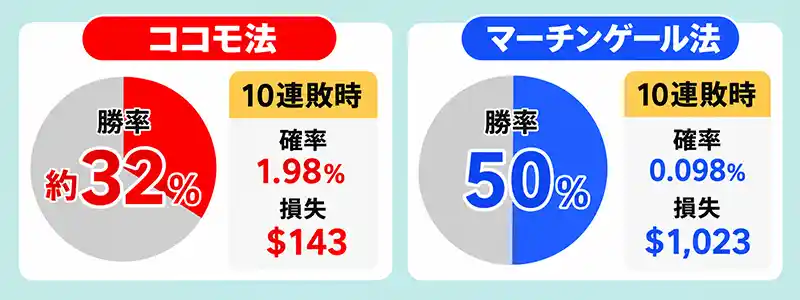
After 10 losses in a row, for example, the Martingale system requires a bet of $1,024, while the Cocomo system needs only $89, less than a tenth as much.
The two systems are used on different bets, one paying 1 to 1 and the other 2 to 1, but for the same number of losses in a row, the Cocomo system lets you keep playing with a smaller bankroll, which keeps your risk lower.
Three Disadvantages of the Cocomo System

The feature that defines the Cocomo system, placing only bets that pay 2 to 1, is also the source of its disadvantages.
- Few Games Are Suitable Because It Needs a 2 to 1 Payout
- A Low Win Rate Makes Losing Streaks Likely
- You Can Easily Reach the Table Limit (Maximum Bet)
Few Games Are Suitable Because It Needs a 2 to 1 Payout
The first drawback is that very few games are suitable for the system.
Bets that pay 1 to 1 are available in many games, such as baccarat, Sic Bo and red/black in roulette. The Cocomo system, by contrast, needs bets that pay 2 to 1, which leaves far fewer options. The suitable games are covered in “Games That Suit the Cocomo System: Bets That Pay 2 to 1” above.
A Low Win Rate Makes Losing Streaks Likely
Bets that pay 1 to 1 win about 50% of the time, but the bets that pay 2 to 1 used with the Cocomo system win only about one time in three. The column bet and the dozen bet in roulette, for example, win about 32.4% of the time.
Because you lose about two bets out of three, losing streaks are more likely than under the Martingale system.
The probabilities of specific losing streaks are listed in the section on losing streak probabilities and stop-loss limits below. Long losing streaks are bound to happen if you play long enough, so starting with a large bet will make the system hard to sustain.
You Can Easily Reach the Table Limit (Maximum Bet)
A high probability of losing streaks also means that your bets tend to grow. Table games and live dealer games have a maximum bet, called the table limit, and you cannot bet more than that amount.
Table limits on bets that pay 2 to 1, such as the column bet and the dozen bet in roulette, are often set low, and once you reach the limit, you cannot continue the Cocomo system. At a table with a $100 limit and a $1 unit, for example, you can still place the $89 needed after 10 losses in a row, but not the $144 needed after 11. Always check the table limit before you start playing.
The Cocomo System Does Not Change the Expected Value or the House Edge
The Cocomo system is designed to recover your losses with a single win, but changing how you size your bets does not change the game’s expected value or house edge in any way.
European roulette has a house edge of 2.70% and an RTP of 97.30%. These figures are the same for the column bet and the dozen bet, whatever amount you bet. As long as each bet has a negative expected value, the total stays negative no matter how many bets you add together.
The only things the Cocomo system can change are the size of the swings in your balance (the variance) and the shape of the distribution of wins and losses. It has no effect on the RTP itself. In practice, the Cocomo system gives you frequent small profits at the cost of occasional large losses.
Both the table limit and your bankroll are finite, so the system’s basic assumption, that you can keep raising your bet through a losing streak, is bound to fail at some point. The Cocomo system is not a way to win. It is a money management framework for deciding in advance how much money will be at stake in a single session.
Losing Streak Probabilities and Stop-Loss Limits for the Cocomo System
| Losses in a row | 1 | 2 | 3 | 4 | 5 | 6 | 7 | 8 | 9 | 10 |
|---|---|---|---|---|---|---|---|---|---|---|
| Probability (%) | 67.57 | 45.65 | 30.85 | 20.84 | 14.08 | 9.52 | 6.43 | 4.34 | 2.94 | 1.98 |
| Losses in a row | 11 | 12 | 13 | 14 | 15 | 16 | 17 | 18 | 19 | 20 |
|---|---|---|---|---|---|---|---|---|---|---|
| Probability (%) | 1.34 | 0.91 | 0.61 | 0.41 | 0.28 | 0.19 | 0.13 | 0.09 | 0.06 | 0.04 |
The tables above show the probability of losing streaks when you use the Cocomo system in European roulette. The probabilities are the same whether you use the column bet or the dozen bet.
The Martingale system and similar systems use bets that win about one time in two. The Cocomo system wins only about one time in three, so the probability of a losing streak does not drop off as quickly as the streak gets longer.
For example, 6 losses in a row happen about 1.83% of the time under the Martingale system, but 9.52% of the time under the Cocomo system, more than five times as often. Even 10 losses in a row have a 1.98% probability, and the probability does not fall below 0.1% until 18 losses in a row.
Within a single cycle, the probability of winning before you reach 10 losses in a row is over 98%, but this applies to one cycle only. A probability of 1.98% means about once every 50 cycles, so if you keep playing, 10 losses in a row are bound to happen eventually. Do not assume the system is safe because long losing streaks are rare.
It is true that bets grow more gradually than under the Martingale system, but this only means that your loss grows by a smaller amount at each step. It does not make the losses themselves go away.
Where to Set Your Stop-Loss Limit
The Cocomo system keeps raising the bet until you win, so a long losing streak will eventually exhaust your balance. For this reason, we recommend setting a stop-loss limit: a number of losses in a row at which you treat the cycle as failed and stop.
The Cocomo system in particular has a lower win rate per bet than the Martingale system, which makes losing streaks more likely. Decide on your stop-loss limit before you start playing.
If you start the Cocomo system with $1 bets, we recommend a stop-loss limit of 7 losses in a row to keep losses small, or 10 losses in a row if your bankroll has some room to spare.
Seven losses in a row happen about once in every 16 cycles. Stopping within this range keeps the amount you can lose in one cycle within a limit you have set in advance.
A stop-loss limit does not change the expected value, however. It is simply a money management rule that caps how much you can lose in one session.
If you stop after 7 losses in a row, your total loss is $33; if you stop after 10, it is $143.
If you have a very large bankroll, you could set the stop-loss limit at 15 losses in a row. However, the bankroll needed reaches $1,596, and 15 losses in a row happen about once in every 360 cycles, so we do not recommend it.
Variations on the Cocomo System
The Cocomo system is essentially a Martingale-style betting system in which bets grow more gradually. It still has several disadvantages, so this section introduces two ways to reduce them.
To Reduce Risk: Delay the First Increase by One Round
Bets still escalate under the Cocomo system, so a long losing streak inevitably leads to a large loss. Delaying the first increase in your bet reduces the loss for the same number of losses in a row.
For example, instead of the usual sequence of $1 in round 1, $1 in round 2 and $2 in round 3, you bet $1 in round 3 as well. From round 4 onward, you raise your bet as usual: $2, $3, $5 and so on.
With this change, a win in round 3 only breaks even, but the total loss after 10 losses in a row falls from $143 to $89.
To Increase Profit: Include the Bet Three Rounds Back
Under the Cocomo system, each bet is the sum of the previous two bets. Adding the bet from the round before those two increases your profit when you win.
For example, with bets of $1 in round 1, $1 in round 2 and $2 in round 3, the standard Cocomo system sets the round 4 bet at $1 + $2 = $3. Under this variation, you bet $1 + $1 + $2 = $4 instead.
Neither variation changes the expected value, however. They only redistribute the swings in your balance, as explained in the section on expected value and the house edge above.
Comparing the Cocomo System with Related Betting Systems
How It Differs from the Martingale System
Like the Cocomo system, the Martingale system raises the bet after every loss and recovers all previous losses with a single win. However, the Martingale system uses bets that pay 1 to 1, so the bet doubles after each loss.
Under the Martingale system, bets rise much more steeply from one round to the next than under the Cocomo system. On the other hand, each bet wins more often, losing streaks are less likely, and the system is easy to use in many games, such as baccarat and Sic Bo.
How It Differs from the Monte Carlo System
The Monte Carlo system is another system that, like the Cocomo system, can be used on bets that pay 2 to 1 (it can also be used on bets that pay 1 to 1). You write down a sequence of numbers according to set rules and bet according to that sequence. The cycle ends when every number in the sequence has been crossed off or only one number is left.
Unlike the Cocomo system, a single win does not guarantee that you are ahead, but bets are less likely to rise sharply during a losing streak. Even so, a long losing streak lengthens the sequence and increases your bets, so you will not always be able to clear the sequence.
Frequently Asked Questions About the Cocomo System
- Do any online casinos prohibit the Cocomo system?
-
Most online casinos allow it. Because the Cocomo system is widely known, however, some casinos do refer to it in their terms and conditions and prohibit it. None of the online casinos we cover on this site prohibits the Cocomo system by name.
- Can I use the Cocomo system in any roulette game?
-
In general, you can use it in any roulette game. In Lightning Roulette, for example, the multipliers do not apply to dozen bets or column bets, so these work as ordinary bets that pay 2 to 1.
American roulette, however, has a higher house edge because it has both a 0 and a 00 pocket. If you use the Cocomo system, European roulette, which has no 00, is the better choice.
French roulette has the la partage rule, under which half of your bet is returned when the ball lands on 0. The rule applies only to even-money bets such as red/black, though, so for the Cocomo system, which uses dozen bets and column bets, French roulette is no different from European roulette.
Summary: The Cocomo System Changes How You Recover Losses, Not the Expected Value
The Cocomo system is a betting system you can use in roulette and other games at online casinos. You raise your bet after each loss according to a set rule, and as long as your bankroll and the table limit allow it, a single win recovers all previous losses.
Compared with the Martingale system, which works in a similar way, bets rise more gradually, and a win after a losing streak can bring a sizable profit. For these reasons, the system is popular with roulette players.
Unlike the Martingale system, however, it uses bets that win less often, so long losing streaks can occur. Always set a stop-loss limit before you play. Changing how you size your bets does not change the expected value or the house edge, so we recommend using the Cocomo system with that in mind, as a framework for managing your bankroll.
- Martingale Strategy Explained
- D'Alembert Betting System
- Paroli Betting System
- Labouchère Betting System
- Percentage Betting (10% System)
- Oscar's Grind Betting System
- 1-3-2-6 Betting System
- 1-2-3-5 Betting System
- Monte Carlo Betting System
- Cocomo Betting System
This site is for adults of legal gambling age (18+, or older where required) who live in countries or regions where online gambling is legal.
Use of this site is subject to our Terms and Conditions.
Gambling involves risk. Only bet what you can afford to lose, and do not use online gambling services where they are illegal.

Bell | Editor of Online Casino Winners Club. Since the site launched in 2003, Bell has written guides to casino game rules, tested betting systems and covered land-based casinos around the world, and still plays the games before writing about them. Bell's core advice: choose the bets with the lowest house edge, and decide in advance how much you are prepared to lose.