

The house edge is, put simply, the casino's share of the money wagered. The lower the house edge, the smaller your losses tend to be over the long…
Baccarat Expected Value: How to Calculate RTP and Lose Less

On this page, “return to player (RTP)” means the percentage of the amount bet that is paid back, and “expected value” means the theoretical gain or loss on a single bet. If the RTP is 98.94%, the expected value is −1.06% of the bet. Baccarat, one of the most popular casino games, has a high RTP compared with lotteries, pari-mutuel horse racing and many other casino games.
This article explains what expected value means, shows how to calculate expected value and RTP, and uses expected value to identify the bets that lose the least over time.
What You Will Learn
- The RTP in baccarat is 98.94% on the Banker bet, 98.76% on the Player bet and 85.64% on the Tie bet.
- The Banker hand wins 45.86% of the time, and the Player hand wins 44.62% of the time.

This article takes about 10 minutes to read.
Contents
Show
What Expected Value Means in Gambling
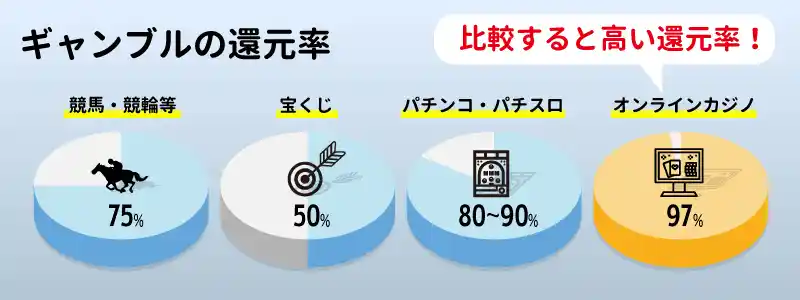
In gambling, expected value is a number that shows how much you theoretically win or lose per bet. When the same figure is expressed as the percentage of the bet that is paid back, it is called the RTP. For example, a game with an RTP of 90% theoretically returns $90 for every $100 bet, so the expected value is −$10 (−10% of the bet).
RTP is fixed by the game’s rules and payouts, so it is the same in RNG baccarat and live baccarat. It does not change with how you play or with how far the dealer has dealt through the shoe (the box from which the cards are dealt).
The benchmark for RTP is 100%. An RTP of exactly 100% means that, in theory, wins and losses even out over the long run. A casino could not operate on those terms, so games with an RTP of 100% or more are almost nonexistent.
The closer the RTP is to 100%, therefore, the lower the house edge the player faces.
The share of the money bet that the casino keeps as profit is called the house edge, and it equals 100% minus the RTP. For example, if the RTP is 98%, the house edge is 2% and the expected value is −2% of the bet.
- Related Article
-

Baccarat Has a Very High RTP

Online casino games generally have higher RTPs than lotteries and pari-mutuel horse racing. That is only a general average across casino games, though, and RTP varies from game to game.
Baccarat’s RTP is relatively high and stable even compared with other casino games. Roulette has an RTP of about 97%, and blackjack can reach about 99% depending on the rules and how you play. Baccarat stands out because it keeps an RTP of about 99% without requiring any special skill.
Comparing RTP Across Casino Games
| Baccarat RTP | About 99% |
|---|---|
| Blackjack RTP | About 99%* |
| Roulette RTP | About 97% |
*The RTP of blackjack varies depending on whether you follow basic strategy and on the table rules, such as whether the dealer hits or stands on soft 17.
How Win Probability and Payouts Determine Baccarat’s RTP
In baccarat, cards are dealt to two hands, called Player and Banker, and you bet on which hand will win. “Player” is simply the name of a bet; it does not refer to you. To keep the two apart, this article refers to them as the Player hand (or Player bet) and the Banker hand (or Banker bet).
| Bet | Win probability | Payout | RTP |
|---|---|---|---|
| Player | 44.62% | 1 to 1 (a $10 bet wins $10) | 98.76% |
| Banker | 45.86% | 1 to 1 minus a 5% commission (a $10 bet wins $9.50) | 98.94% |
| Tie | 9.52% | 8 to 1 (a $10 bet wins $80) | 85.64% |
The Player and Banker bets, which most players choose, both have an RTP of about 99%, so losses over the long run are small. If you play 100 rounds of baccarat at $1 per bet, you lose about $1 on average, whichever of the two you bet on.
RTP depends largely on the combination of win probability and payout. A bet that wins often can still have a lower expected value if its payout is low. Conversely, a bet that wins less often can have a higher expected value if its payout is high enough.
- Related Article
-

How to Calculate Expected Value and RTP in Baccarat
The calculation is straightforward if you take it one step at a time. All you need are the win probabilities and the payouts.
The Formula
Expected value is the expected gain or loss on a single bet, expressed as a percentage of the amount bet. Expected value and RTP in baccarat are calculated as follows.
Expected value (%) = (profit on a win × probability of winning − loss on a loss × probability of losing) ÷ amount bet × 100
RTP (%) = 100 + expected value (%)
The formula is easier to follow with a concrete example.
Suppose you bet $1 on a game that has a 1% chance of returning 90 times your stake and a 99% chance of losing. What is the expected value?
First, the profit on a win is the 90-times return minus your $1 stake, or $89. The loss on a losing bet is the stake itself, or $1. The probability of winning, 1%, is 0.01 as a decimal, and the probability of losing, 99%, is 0.99.
The expected value is therefore:
(89 × 0.01 − 1 × 0.99) ÷ 1 × 100 = −10 (%)
This game has an expected value of −10% and an RTP of 100 − 10 = 90%.
The following subsections apply the same formula to the Player, Banker and Tie bets in baccarat.
Expected Value of the Player Bet
Here is the expected value of a $100 bet on the Player hand.
- A winning Player bet makes a profit of $100, and the Player hand wins 44.62% of the time.
- A losing Player bet loses $100, and the Player hand loses 45.86% of the time (a tie returns the bet, so ties are left out of the calculation).
The expected value is therefore:
(100 × 0.4462 − 100 × 0.4586) ÷ 100 × 100 = −1.24
The Player bet has an expected value of −1.24% and an RTP of about 98.76%.
Expected Value of the Banker Bet
For the Banker bet, this calculation uses the payout of standard commission baccarat. In no-commission baccarat, a winning Banker bet normally pays 1 to 1, but a Banker win with a total of 6 pays 1 to 2, so a $10 bet wins $5.
The Banker hand wins slightly more often than the Player hand, which is why its payout is lower.
Here is the expected value of a $100 bet on the Banker hand.
- A winning Banker bet makes a profit of $95, and the Banker hand wins 45.86% of the time.
- A losing Banker bet loses $100, and the Banker hand loses 44.62% of the time (a tie returns the bet, so ties are left out of the calculation).
The expected value is therefore:
(95 × 0.4586 − 100 × 0.4462) ÷ 100 × 100 ≈ −1.05
The Banker bet has an expected value of about −1.06% and an RTP of about 98.94%.
Expected Value of the Tie Bet
The standard payout on the Tie bet is 8 to 1, and the calculation below assumes this payout. Some games, such as Evolution’s Lightning Baccarat, apply multipliers to the payout when the winning hand contains certain cards, but a 20% fee is added to every bet in return for the multipliers. Their RTP is therefore different, and the figures here do not apply to them.
Here is the expected value of a $100 bet on a tie.
- A winning Tie bet makes a profit of $800, and a tie occurs 9.52% of the time.
- A losing Tie bet loses $100, and the probability of losing is 90.48%.
The expected value is therefore:
(800 × 0.0952 − 100 × 0.9048) ÷ 100 × 100 ≈ −14.32
The Tie bet has an expected value of about −14.36% and an RTP of about 85.64%.
*These calculations use probabilities rounded to two decimal places, so the results differ slightly from the published figures, which are based on the exact probabilities (Banker 45.8597%, Tie 9.5156%). The figures given in the text are the exact values (a house edge of 1.06% and an RTP of 98.94% on the Banker bet, and a house edge of 14.36% on the Tie bet).
Using Expected Value to Keep Your Baccarat Losses Low

The calculations above point to the following approach as the one that keeps the house edge as low as possible:
- Do not place side bets
- Bet on Banker
Betting systems do not change the expected value, but they can help you manage how quickly your bankroll goes down.
- Related Article
-

Side Bets Carry a Higher House Edge
Side bets are optional bets placed in addition to the main bets on Player, Banker and Tie. Because a winning Player or Banker bet pays no more than 1 to 1, high-paying side bets such as the pair bets may look like better value, but they are not.
Player Pair, for example, pays 11 to 1, so a $10 bet wins $110, but it has an RTP of about 89.64%, far below the roughly 98.76% of the Player bet and 98.94% of the Banker bet. Think of side bets as a separate wager with its own, much lower RTP. If you want to keep losses down, the Player or Banker bet is the better choice.
Some games, such as Evolution’s Lightning Baccarat, apply multipliers to payouts, including those on the main bets, when the winning hand contains certain cards. The RTP of these games rests on different assumptions from standard baccarat, so check the official game rules for the actual figures.
Some casinos count side bets toward VIP program requirements, but even so, side bets tend to produce larger losses.
The Banker Bet Loses Less Over the Long Run
The difference is only about 0.18 percentage points, but the Banker bet loses less over the long run than the Player bet. One option, therefore, is to flat bet (bet the same amount every round) on Banker throughout.
The house edge is 1.24% on the Player bet and 1.06% on the Banker bet. In relative terms, the Banker bet’s house edge is about 15% lower than the Player bet’s.
More casinos now offer cashback or rebate deals, but earning a 0.2% rebate requires substantial deposits or betting volume. Viewed in that light, a difference of 0.18 percentage points is not negligible.
Because the Banker bet pays 1 to 1 minus a 5% commission (a $10 bet wins only $9.50), betting systems that rely on recovering all previous losses with a single win do not recover them in full. Under such a doubling system, starting from a 1-unit bet, you remain behind after five or more consecutive losses even if the next bet wins. If you choose Banker, it is better suited to flat betting. The Player bet’s 1 to 1 payout is easier to work with, but over the long run the Banker bet still loses less.
- Related Article
-

Using Betting Systems
With these points in mind, you can use a betting system to manage how your bets rise and fall. A betting system is a money management method that raises or lowers your bet according to set rules, which helps you control how quickly your bankroll is depleted. Keep in mind, however, that a betting system is only a way of sizing your bets and does not change the game’s expected value or RTP.
Betting systems may seem complicated at first, but the steps are simple once you are used to them. Well-known examples include the Martingale system, which doubles the bet after each loss so that a single win recovers the losses, and the Monte Carlo system, which uses a sequence of numbers to decide the bet size.
Because baccarat’s main bets pay about 1 to 1, the game is particularly well suited to managing your bets with a betting system. As noted above, though, the expected value itself does not change, so a betting system is best seen not as a way to win more often but as a way to organize your spending and play for longer. Find an approach that suits you and stay within limits you can afford.
- Related Article
-

Frequently Asked Questions
- Why does the Banker hand win more often in baccarat?
-
The two hands follow different rules for drawing a third card. The Banker hand decides whether to draw only after the Player hand’s third card is known, which gives it a slightly higher chance of winning. The 5% commission is charged to offset that difference, but even with the commission, the Banker bet loses less over the long run.
- How likely is a winning streak in baccarat?
-
Using a win probability of 50.68% with ties excluded, the probability that the Banker hand wins three times in a row is about 13.02% (roughly 1 in 8), and the probability that it wins five times in a row is about 3.34% (roughly 1 in 30). Winning streaks are not easy to come by, but streaks of 3–4 wins are likely enough that you can expect to encounter them if you play casino games regularly.
Summary: Baccarat’s RTP Is About 99%, but You Still Lose Over the Long Run
Baccarat offers one of the best expected values of any casino game, and it compares even more favorably with lotteries and pari-mutuel horse racing. The Player and Banker bets both pay about 1 to 1, and when the hand ends in a tie, those bets are returned, so the game’s RTP is very high.
The Banker bet has the highest RTP at 98.94%, which puts it among the casino bets that lose the least over the long run. Rebate bonuses and similar offers can reduce your actual losses further, but keep in mind that the house edge does not disappear, and even with such offers the RTP does not consistently exceed 100%, which is what you would need to keep winning.
This site is for adults of legal gambling age (18+, or older where required) who live in countries or regions where online gambling is legal.
Use of this site is subject to our Terms and Conditions.
Gambling involves risk. Only bet what you can afford to lose, and do not use online gambling services where they are illegal.

Bell | Editor of Online Casino Winners Club. Since the site launched in 2003, Bell has written guides to casino game rules, tested betting systems and covered land-based casinos around the world, and still plays the games before writing about them. Bell's core advice: choose the bets with the lowest house edge, and decide in advance how much you are prepared to lose.