

Neighbors Bet in Roulette: How It Works and the 4 Call Bets

A neighbors bet places chips according to the order of the numbers on the wheel rather than their position on the betting layout. Because it covers one number together with the numbers on either side of it, it wins more often than a bet on a single number.
However, covering more numbers raises the total bet per spin in proportion, so the house edge stays at 2.70%. The only things you can change are the balance between hit rate and payout and how quickly your bankroll runs down.
What You Will Learn
- A neighbors bet is a way of betting based on the order of the numbers on the wheel.
- The four standard call bets have hit rates of 18.92–45.95% and differ in coverage and the number of chips required, but all have the same expected value.

This article takes about 10 minutes to read.
What Is a Neighbors Bet? The Basics of Betting by Wheel Position
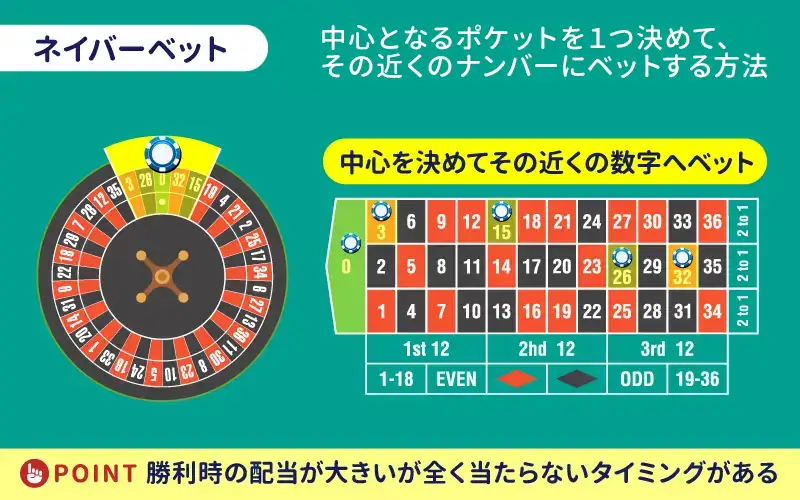
Betting by Physical Position on the Wheel Rather Than by Number
A neighbors bet covers several numbers that sit next to each other on the roulette wheel in a single bet.
An ordinary straight-up bet (a bet on a single number) is based on how the numbers are arranged on the betting layout. A neighbors bet instead looks at the physical arrangement of the numbers on the wheel.
For example, a bet on “17 and two neighbors” covers 17 and the two numbers on each side of it on the wheel, for a total of five numbers bet at once.
This lets you cover a group of numbers that sit together on the wheel, and it is widely used because it can be placed in one step from the racetrack, the oval section of the layout that shows the numbers in wheel order. Each spin is an independent event, however, and past results cannot be used to predict where the ball will land.
Why European Roulette Is Recommended for Neighbors Bets
For neighbors bets, and for any bet that spreads chips across several numbers, European roulette is the better choice. The reason is the house edge.
European roulette has a house edge of 2.70%, while American roulette, which adds a “00” pocket, has a house edge of 5.26%, nearly double.
With a bet like the neighbors bet, which places chips on several numbers every spin, the effect of this difference on your results grows the more you play.
In other words, the same bet loses less on European roulette, with a return to player (RTP) of 97.30%, than on American roulette, at RTP 94.74%. Choosing European over American roulette is one of the few choices a player can make that actually lowers the house edge.
Hit Rate and How Quickly Your Bankroll Runs Down
Take a typical neighbors bet that covers five numbers: a center number and the two numbers on each side of it. A European wheel has 37 pockets, so the chance of winning is about 13.51%, or roughly once every 7–8 spins.
Luck still plays its part, but because the hit rate is higher than that of a straight-up bet on a single number, losing streaks drain your bankroll less sharply.
The Four Call Bets That Cover Sections of the Wheel
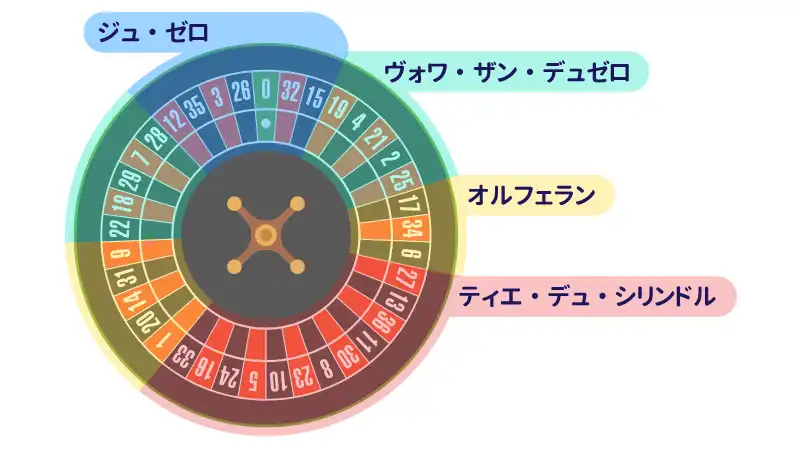
Neighbors bets and call bets both cover numbers that sit next to each other on the wheel. With a neighbors bet, you choose the center number yourself, while a call bet covers a fixed section of the wheel.
With a neighbors bet, you are free to choose the center number and how many numbers on each side to include. The racetrack, however, also offers four fixed bets that cover predefined sections of the wheel, known as call bets or announced bets, and these four are the ones most often used in practice.
Each covers a different range and requires a different number of chips, so the choice depends on whether you care more about the total bet per spin or about how often the bet wins.
The table below compares how many numbers each pattern covers and the hit rate that follows from it. Hit rates are calculated by dividing how many numbers the pattern covers by 37, the total number of pockets on a European wheel.
| Pattern | Numbers covered | Chips required | Hit rate |
|---|---|---|---|
| Voisins du Zéro | 17 | 9 chips | 45.95% |
| Tiers du Cylindre | 12 | 6 chips | 32.43% |
| Orphelins | 8 | 5 chips | 21.62% |
| Jeu Zéro | 7 | 4 chips | 18.92% |
The more numbers a pattern covers, as with Voisins du Zéro, the higher its hit rate. It also needs more chips, and therefore a larger bet, on every spin, so keep in mind that a higher hit rate does not in itself mean a better bet.
Voisins du Zéro: Wide Coverage Around Zero
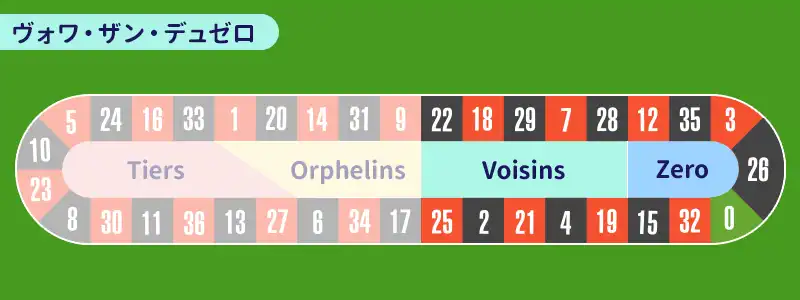
Voisins du Zéro (“neighbors of zero”) is the best-known call bet. It covers a wide section of the wheel centered on 0.
By covering the 17 numbers that run to the left and right of 0, it takes in the whole section of the wheel around zero in a single bet.
The chips are spread across split bets, street bets and corner bets, and this pattern has the highest hit rate of the four.
Because it covers so much of the wheel, however, each win pays less.
Tiers du Cylindre: The Section Opposite Voisins du Zéro
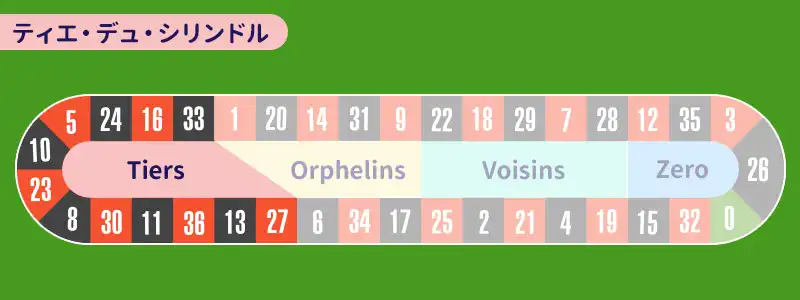
Tiers du Cylindre (“third of the wheel”) covers the section of the wheel on the opposite side from Voisins du Zéro.
It covers the 12 numbers that lie across the wheel from 0 and is made up of six split bets, so it covers a wide range with relatively few chips.
Because it covers a third of the wheel with only a few chips, it is an option when you want to keep the cost per spin down while still winning fairly often.
Orphelins: Filling the Two Remaining Gaps
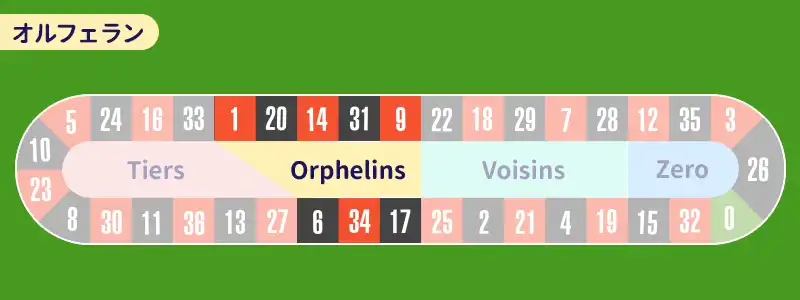
Orphelins (“orphans”) covers the remaining eight numbers that belong to neither Voisins du Zéro nor Tiers du Cylindre.
These eight numbers fall into two separate sections of the wheel: 17, 34 and 6 on one side, and 1, 20, 14, 31 and 9 on the other. The bet consists of four split bets and one straight-up bet, for a total of five chips, which lets you cover both sections at once with only a few chips.
It requires the second-fewest chips after Jeu Zéro and also covers the second-fewest numbers of the four patterns.
Jeu Zéro: The Seven Numbers Next to Zero
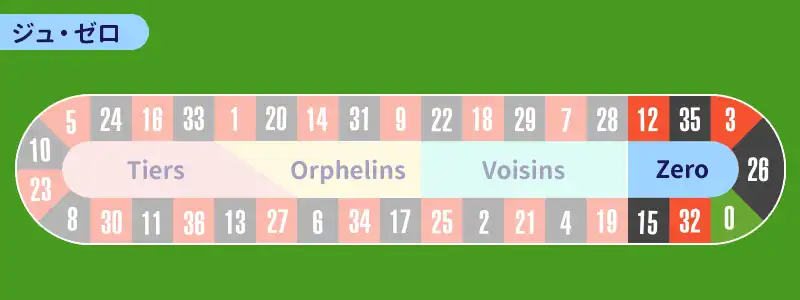
Jeu Zéro (“zero game”) covers only the numbers closest to 0 and has the narrowest range of the four patterns.
Because it covers only the seven numbers next to 0 on the wheel, each win pays more than with Voisins du Zéro, which covers a much wider range.
The bet consists of three split bets and one straight-up bet, so it requires the smallest stake of the four patterns.
The narrower coverage also means it loses more often.
Pros and Cons of Neighbors Bets

A neighbors bet uses the order of the numbers on the wheel to cover a whole area at once, but it is not a guaranteed way to win. Covering a wide range makes results steadier, but it also means more chips and a smaller payout relative to the total bet.
Targeting a narrow range has the opposite effect: each win pays more, but your results swing more when the bet misses.
Pro: A Higher Hit Rate
The main advantage of a neighbors bet is that it turns near misses into wins.
With an ordinary straight-up bet, you lose even if the ball lands right next to your number. With a neighbors bet, you also have chips on the adjacent numbers, so the chance of a win is higher.
Instead of targeting a single point, you cover the area where the ball might land. This does not let you predict where the ball will land, but it does let you set your own hit rate per spin.
The higher chance of winning comes with a larger bet per spin, however, and a win pays only on the one number that hits. The house edge does not go down, so the bet does not improve your overall chances of coming out ahead.
Rather than sticking to a single number and missing again and again, you cover an area and win more often. That is the strength of a neighbors bet.
Pro: One Win Can Cover Several Spins’ Worth of Bets
A defining feature of the neighbors bet is that a single win can recover the bets from several spins.
For example, if you bet $10 on each of five numbers and one of them hits, that number pays 35 to 1, so you get $360 back including the winning $10 chip (36 times its stake). After subtracting the $50 total bet, your net result is +$310.
As noted earlier, the chance of winning per spin is about 13.51%, or about once every 7.4 spins on average. The net profit of $310 from one win equals the total bet for 6.2 spins, so your balance moves up and down relatively gently.
Once every 7–8 spins is only an average, though, and runs of several misses in a row are perfectly normal.
Con: The Total Bet Per Spin Tends to Be Large
One drawback of a neighbors bet is that the amount needed for each spin tends to be large.
An ordinary straight-up bet needs only 1 unit (for example, $10), but a neighbors bet covers several numbers per spin. A bet on a center number and two neighbors on each side needs 5 units (for example, $50), and Voisins du Zéro needs 9 units (for example, $90).
The higher hit rate can feel reassuring, but during a run of misses, your bankroll shrinks quickly, and the bet may not suit long sessions. Set a limit on the total you will bet per spin before you start.
Con: Chip Placement Is More Complicated
Because a neighbors bet covers numbers that are adjacent on the wheel, placing it on the standard betting layout is somewhat complicated.
If you want to bet on “8 and two neighbors,” for example, at a table without a racetrack you need to know the order of the numbers on the wheel and find each of the five matching numbers on the layout separately.
At a table with a racetrack, by contrast, you only have to select the center number to place the bet. If you plan to use neighbors bets, a table with a racetrack is the practical choice.
Bankroll Management and Cautions for Neighbors Bets

A neighbors bet makes it easy to raise your hit rate, but the stakes add up quickly, and a run of losses can run your bankroll down fast.
Balancing Units Per Spin Against Your Bankroll
Because a neighbors bet covers several numbers on each spin, the higher hit rate usually comes with a larger bet per spin.
A losing streak therefore eats into your bankroll quickly, and you risk building up a large loss without noticing. To prevent this, decide in advance the maximum number of units you will bet per spin, based on your total bankroll.
As a guideline, keep the total bet per spin within 5% of your bankroll. With a bankroll of $1,000, for example, limiting yourself to $50 (5 units) per spin means your bankroll would last 20 spins even if every one of them lost.
Thinking in terms of how many units you use per spin, rather than how much you bet on each number, also makes your bankroll management more realistic.
Why Raising Your Bet After a Losing Streak Is Dangerous
When a neighbors bet loses several times in a row, it is tempting to raise the bet in the belief that the next spin is bound to win. Doing so is very risky.
Because a neighbors bet covers several numbers per spin, raising the bet sharply increases the amount you spend on every spin.
Doubling a $50 bet on five numbers takes it to $100, and doubling again takes it to $200, so you reach the table limit (the maximum bet allowed) within a few spins.
During a losing streak, it is also harder to think calmly, and players tend to keep placing bets they cannot afford. As a result, the whole bankroll can be gone within a few spins.
Even after a losing streak, do not raise your bet on impulse, and keep the total bet per spin within the limit you set in advance. If you use a betting system that raises the stake after losses, decide its steps and your stop-loss limit before you start.
Frequently Asked Questions About Neighbors Bets
- How is a neighbors bet different from the so-called “shift bet” system?
-
A neighbors bet covers a center number of your choice together with the numbers on either side of it on the wheel, usually two on each side. You can choose any number as the center.
The “shift bet” system, a betting approach that divides the wheel into four fixed sections, always covers one of those sections.
Both bets use the order of the numbers on the wheel. The difference is that a neighbors bet lets you choose the center number, while the sections in the shift bet system are fixed.
- Can beginners start using neighbors bets right away?
-
On a roulette game with a racetrack, you only have to select the center number to place a bet on it and its neighbors at once, so the bet is not difficult to place. No complicated calculations are needed.
Summary: Neighbors Bets Change the Hit Rate and How Fast Your Bankroll Runs Down, Not the Expected Value
A neighbors bet is a way of betting unique to roulette: it is based on the physical order of the numbers on the wheel and covers a specific area of the wheel in a single bet.
Because it covers one number and the numbers around it at the same time, it hits more often than a single straight-up bet, and your balance moves up and down more gently. The trade-off is a larger bet per spin, and the house edge stays at 2.70%.
Start with the minimum bet, keep the total bet per spin within 5% of your bankroll, and enjoy the game within limits you can afford.
This site is for adults of legal gambling age (18+, or older where required) who live in countries or regions where online gambling is legal.
Use of this site is subject to our Terms and Conditions.
Gambling involves risk. Only bet what you can afford to lose, and do not use online gambling services where they are illegal.

Bell | Editor of Online Casino Winners Club. Since the site launched in 2003, Bell has written guides to casino game rules, tested betting systems and covered land-based casinos around the world, and still plays the games before writing about them. Bell's core advice: choose the bets with the lowest house edge, and decide in advance how much you are prepared to lose.