

"I would like to try baccarat, but I am worried about embarrassing myself if I do not know the terms." "I looked up baccarat online, but the…
How to Play Baccarat: Rules, Card Values and How a Round Works

Baccarat is said to be the casino game in which the largest sums of money change hands, and it is one of the most popular games on the casino floor. Even so, you may feel that baccarat looks a little difficult, or you may hesitate to play because you do not know the rules.
This page explains the basic rules of baccarat, how to play and how a round unfolds. It also covers return to player (RTP), the differences between the available bets and some recommended baccarat games.
What You Will Learn
- Baccarat is a simple game: all you do is predict whether the Player hand or the Banker hand will win.
- When the Banker hand wins, a 5% commission is deducted, so the bet pays 0.95 to 1 instead of 1 to 1: a $10 bet wins $9.50.

This article takes about 18 minutes to read.
Contents
Show
What Kind of Casino Game Is Baccarat?
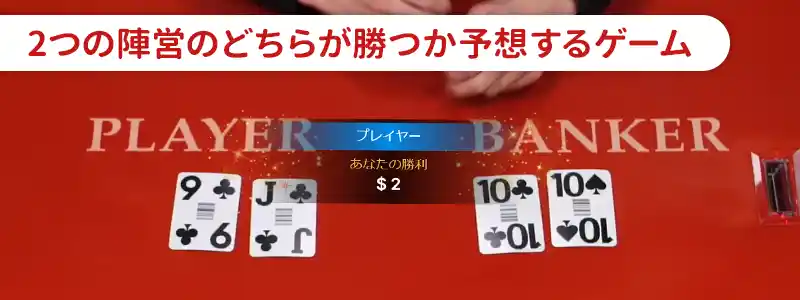
Baccarat is a casino table game played with standard playing cards. The rules are very simple: cards are dealt to two hands, and the stronger hand wins.
The two hands are called Player and Banker, and you bet on which of them will win. “Player” is the name of a betting option, not a reference to you. To keep the distinction clear, this article refers to them as the Player hand and the Banker hand.
Your only decision is which of the two to bet on. Excluding ties, each hand wins roughly half the time, and unlike blackjack, there are no actions to choose during the round, so beginners can play without any difficulty.
That does not mean baccarat is dull, however. The outcome is decided by just a few cards, which creates real tension, and the RTP changes depending on where you bet.
Many tables also have high betting limits, and the game is played by everyone from beginners to high rollers.
History and Origins of Baccarat
There are several theories about the history of baccarat, but the most widely accepted one holds that it derives from a game played with tarot cards by Italian nobles around the 14th century.
The word baccarat is said to mean “zero” in Italian, a reference to the fact that the weakest hand is worth 0 points.
Baccarat, popular in medieval Italy, eventually spread across Europe, mainly to France and Britain. The modern form of the game (punto banco) is said to have taken shape in Cuban casinos in the 1950s and to have been brought to the Sands in Las Vegas in 1959.
Until then, baccarat in Europe was a formal, prestigious game. It was customary to squeeze the cards (turn them up little by little to reveal their value), and the game was far from casual.
In America, however, mini baccarat, which simplified these procedures and lowered the bet amounts, became popular and turned baccarat into a game anyone can enjoy.
Basic Rules of Baccarat
Key Terms to Know
The following terms are used throughout this page without further explanation, so read through them before continuing.
| Term | Meaning |
|---|---|
| Baccarat | Means “zero” in Italian |
| Player | One of the two hands you can bet on (it is dealt its cards first) |
| Banker | One of the two hands you can bet on (it is dealt its cards second) |
| Tie | A round that ends in a draw |
| Suit | Hearts, diamonds, clubs or spades (suits do not affect baccarat) |
| Natural | A hand whose first two cards total 8 or 9 (no third card is drawn, and the round is decided immediately) |
- Related Article
-

Baccarat Equipment
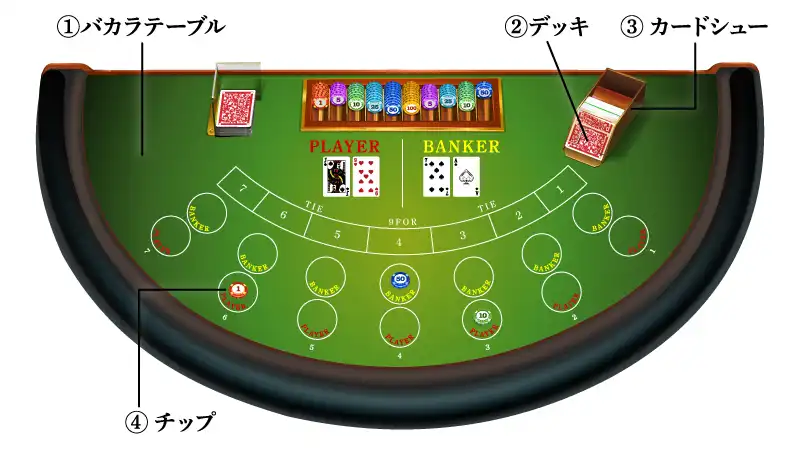
Baccarat does not use much equipment, but knowing how each item is used makes the rules easier to follow when you play.
| Item | Description |
|---|---|
| (1) Baccarat table | The table on which baccarat is played. Each seat has its own betting areas: one for bets on the Player hand, one for bets on the Banker hand and one for Tie and Pair bets. The table also has a place for the shoe, a tray where chips are kept by color and a place for discarding used cards. |
| (2) Deck | A deck is a set of 52 playing cards, with the jokers removed. Baccarat uses 6–8 decks (312–416 cards) shuffled together and placed in a shoe, from which the cards are drawn for each round. |
| (3) Shoe | A container that holds the decks. It has an opening at the front, from which the cards are drawn one at a time for play. A cut card is inserted partway through the shoe (its position depends on the casino’s house rules). When the cut card appears, the current round is the last one before the cards are reshuffled. |
| (4) Chips | Coin-shaped tokens used for betting in the game. The value of each chip is printed in its center. |
How to Play Baccarat and Payouts
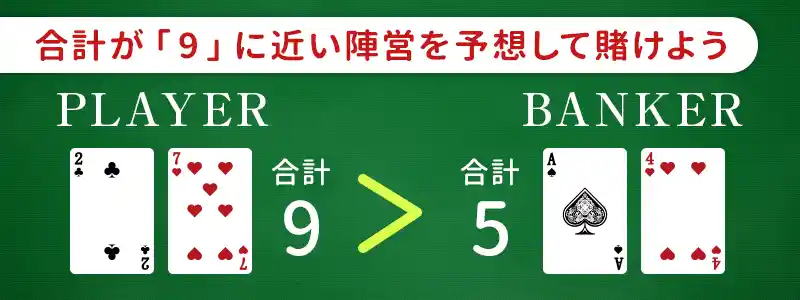
You can bet on either the Player hand or the Banker hand.
In baccarat, the winning hand is the one whose card total has a last digit closer to 9.
Each hand is dealt at least two cards, and a third card may be added to either hand when certain conditions are met. The hand whose two- or three-card total has a last digit closer to 9 wins, and if you bet on that hand, you receive a payout.
A winning bet on the Player hand pays 1 to 1, so a $10 bet wins $10. A winning bet on the Banker hand pays 0.95 to 1, as explained in “The Banker Hand and Commission” below.
How Points Are Counted
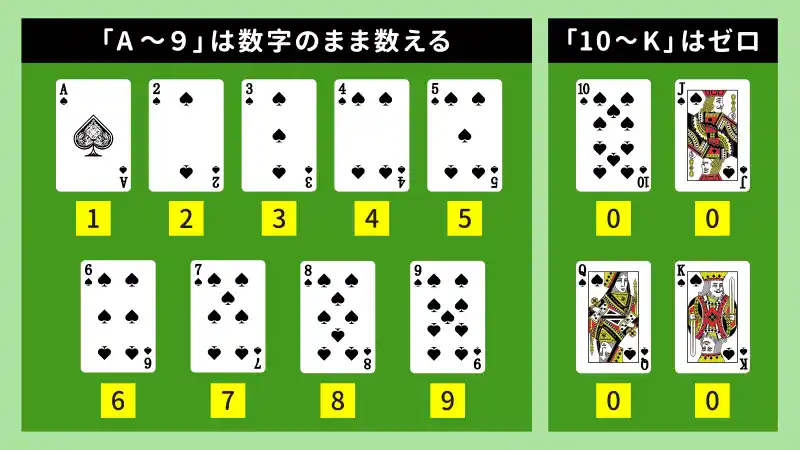
Baccarat is decided by adding up the values of the cards, but points are counted a little differently from the usual way.
Cards 2–9 count at face value, and an ace (A) counts as 1. These are straightforward.
The 10 and the face cards (J, Q and K) all count as 0 in baccarat. Keep in mind that these cards do not change the total.
- 6 and Q: 6 + 0 = 6
- A, K and 9: 1 + 0 + 9 = 10 → only the last digit counts, so the total is 0
The Strongest Hand in Baccarat: Natural 9
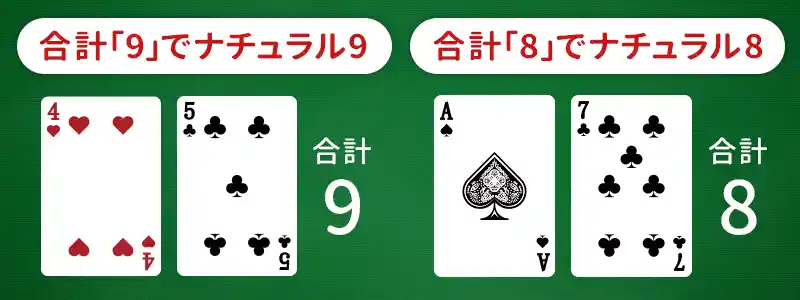
One term to pay particular attention to in baccarat is “natural.” A natural is a hand whose first two cards have a total ending in 8 or 9; no further cards are drawn, and the round is decided.
The strongest hand in baccarat is the natural 9, a two-card total of 9 in either the Player hand or the Banker hand. In baccarat, a total ending in 0 is the weakest and one ending in 9 is the strongest, so a natural 9 wins unless the other hand also has a natural 9.
For example, A and 8, 4 and 5, or 9 and Q make a natural 9.
A two-card total ending in 8, such as 3 and 5 or 9 and 9, is called a natural 8. It also cannot lose unless the other hand has a natural 9.
A Tie When the Player and Banker Totals Are Equal
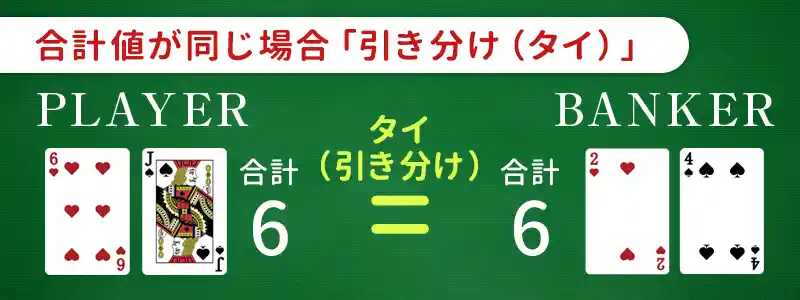
If the Player hand and the Banker hand have the same total when the round is settled, the result is a tie. In a tie, bets on the Player and Banker hands are returned.
You can also bet on a Tie if you expect the round to end in a draw, and a winning Tie bet pays at much higher odds.
For example, if the Player hand has 3 and 4 and the Banker hand has J and 7, both total 7 and the round is a tie.
A tie occurs only when the totals are equal at the moment the round is settled. Equal totals partway through the round do not make a tie.
The Banker Hand and Commission
In baccarat, a winning bet on the Player hand pays 1 to 1, so you get back twice your stake. The Banker hand, however, wins slightly more often than the Player hand, so a winning Banker bet does not pay the full 1 to 1.
In standard baccarat, a 5% commission is deducted when the Banker hand wins, so a winning Banker bet pays 0.95 to 1.
For example, if you bet $10 and win, you get back $19.50 including your original $10, not $20 (you win $9.50 instead of $10). The amount deducted is called the commission, and baccarat played this way is called commission baccarat.
If you want a winning Banker bet to pay 1 to 1 as well, you can choose no-commission baccarat.
In that version, however, a Banker win with a total of 6 pays only half (1 to 2, so a $10 bet wins $5), so it is not a better deal (see “The Player Hand Pays More” below for details).
- Related Article
-

How a Round of Baccarat Is Played
This walkthrough uses screenshots from RNG baccarat, in which a computer deals the cards. The rules are the same in live baccarat.
STEP1
Place Your Bet
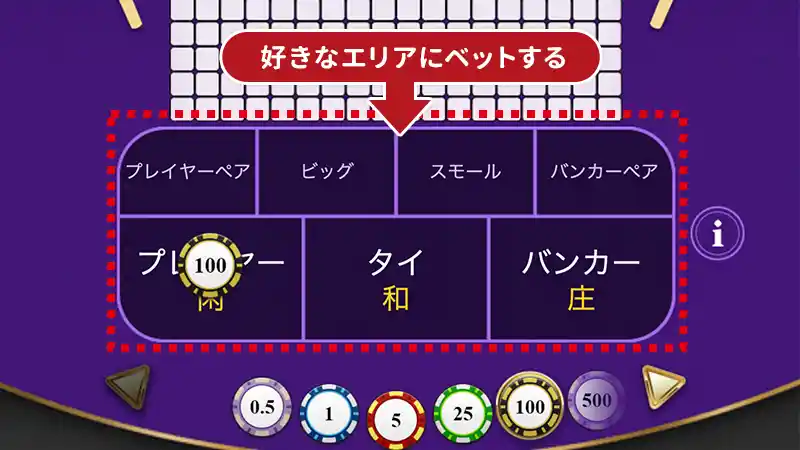
Before the round begins, place your bet on the betting area of your choice.
Most players bet on either Player or Banker, or on a Tie. Some games also offer side bets such as Player Pair and Banker Pair.
STEP2
The Cards Are Dealt
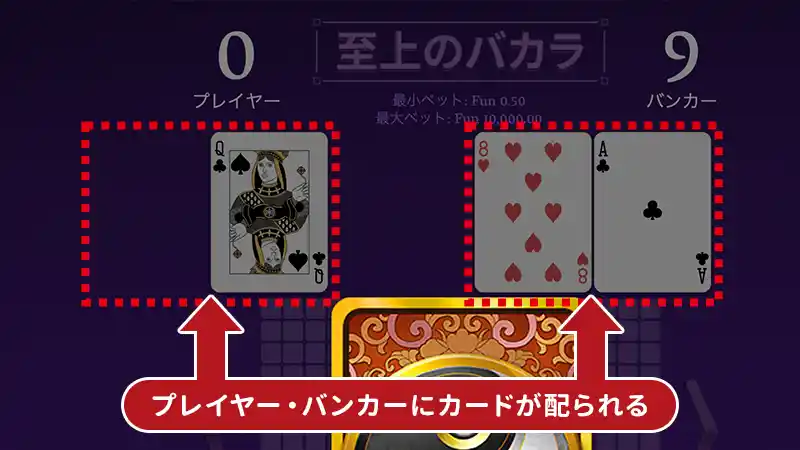
The Player hand and the Banker hand are each dealt two cards, or three when certain conditions are met. The cards in each hand are added up, and the hand whose total has a last digit closer to 9 wins.
STEP3
Winning Bets Are Paid
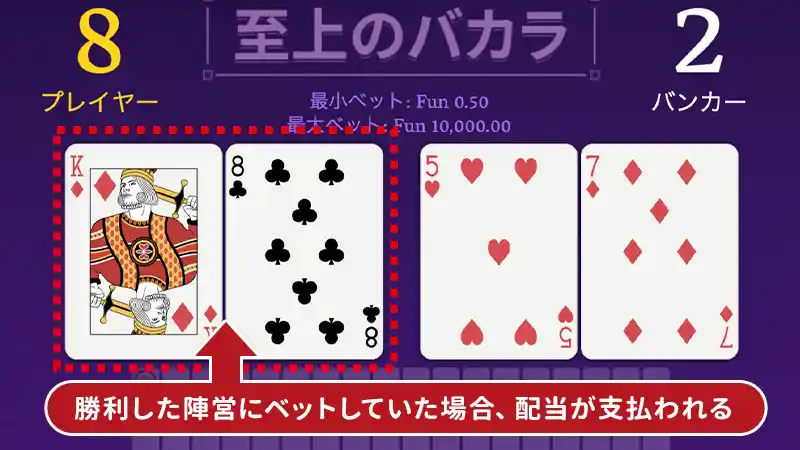
If you bet on the Player hand and it wins, your bet pays 1 to 1, so a $10 bet wins $10. A winning Banker bet pays 0.95 to 1 because of the commission described above.
If the round ends in a tie, bets on both the Player and Banker hands are returned. A winning Tie bet pays 8 to 1, so a $10 bet wins $80 (the payout varies by game). Once all bets are settled, the next round begins.
When a Third Card Is Drawn
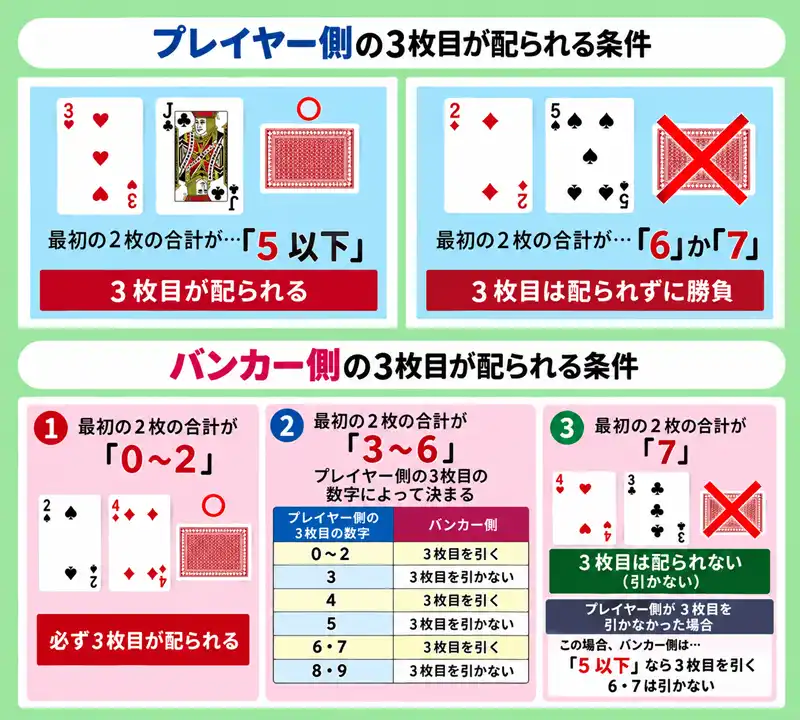
In baccarat, the Player hand and the Banker hand are each dealt two cards to start. If the round is decided by those cards, no more cards are dealt. If it is not, each hand may receive at most one additional card. The conditions for drawing this third card are as follows.
When both hands stay at two cards
- Either the Player hand or the Banker hand has a natural 8 or natural 9
- Both the Player hand and the Banker hand total 6 or more
When the Player hand draws a third card (if the round is not decided by the first two cards)
- The Player hand totals 5 or less
When the Banker hand draws a third card (if the round is not decided by the first two cards)
- If the Banker hand totals 2 or less, it draws regardless of the Player hand’s third card
- If the Player hand did not draw a third card, the Banker hand draws on a total of 5 or less
- If the Player hand drew a third card and the Banker hand totals 3–6, whether the Banker hand draws depends on the value of the Player hand’s third card
For a detailed explanation, see the related article below.
- Related Article
-

How to Keep Your Losses Down in Baccarat
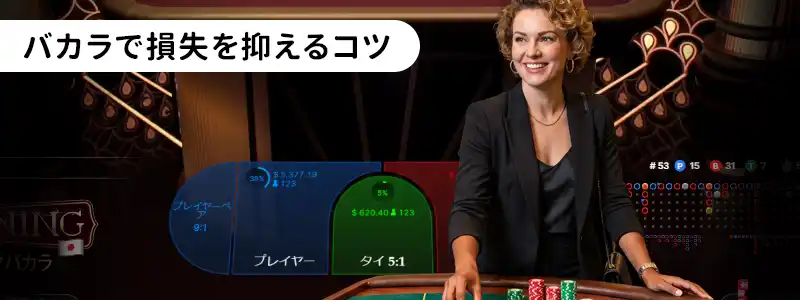
There are a few numbers in baccarat that are worth knowing. If you understand the payout, the return to player (RTP) and the house edge for each betting area, you can tell which bets lose the least.
The Player Hand Pays More
When your bet wins, a bet on the Player hand pays 1 to 1, so a $10 bet wins $10, while a bet on the Banker hand pays only 0.95 to 1.
As explained above, this is because the Banker hand wins slightly more often, so a 5% commission is deducted from winning Banker bets. Even after the commission, however, the Banker bet loses less over the long run.
The difference, then, is that the Player bet is easier to calculate because every win pays exactly 1 to 1 (even money), while the Banker bet loses less over time.
Some online casinos also offer no-commission baccarat tables, where no commission is deducted. At these tables, however, a Banker win with a total of 6 pays only half (1 to 2).
This adjustment raises the house edge on the Banker bet from about 1.06% to about 1.46%, so the absence of a commission does not make it a better deal.
Check the RTP and House Edge
Baccarat has one of the higher RTPs among casino games. Return to player (RTP) is a theoretical figure that shows how much of the money wagered a game pays back on average over the long run. The closer it is to 100%, the more slowly your bankroll shrinks.
RTP is a different measure from the win rate, and a high RTP does not mean you are more likely to win.
| Bet | Return to Player (RTP) | House Edge |
|---|---|---|
| Player | 98.76% | 1.24% |
| Banker | 98.94% | 1.06% |
| Tie | 85.64% | 14.36% |
In baccarat, the Player bet has an RTP of 98.76% and the Banker bet 98.94%, so the Banker bet’s RTP is slightly higher. The difference is 0.18 percentage points: over 500 bets of one unit each, the difference in expected loss is about 0.9 units.
The longer you play, the less the Banker bet loses compared with the Player bet, but the difference is not large enough to decide short-term results.
Many betting systems raise or lower the bet after wins and losses. With such a system, the Player bet makes bankroll calculations simpler, because a win always pays 1 to 1 rather than 0.95 to 1 (19 to 20). The Banker bet still has the higher RTP, though, so this does not mean the Player bet has a lower house edge.
The Tie row in the table shows the figures for a Tie bet that pays 8 to 1, so a $10 bet wins $80. This is the standard Tie payout, and it gives an RTP of about 85.64%.
Some games pay 9 to 1 on a Tie, so a $10 bet wins $90, which lowers the house edge to about 4.84%. That is still far higher than about 1.24% on the Player bet and about 1.06% on the Banker bet.
Should You Avoid Side Bets?
In addition to the Player and Banker hands, baccarat lets you bet on areas known as side bets.
The side bets available vary by game. Examples include the Pair bet, which pays when the first two cards are of the same rank, and the Super 6 side bet, which pays when the Banker hand wins with a total of 6. The Tie bet, a bet on a draw, is one of the main betting areas, but its house edge puts it close to the side bets.
Side bets offer high payouts, but their RTP is much lower. A Pair bet paying 11 to 1 has an RTP of about 89.64%, and a Tie bet paying 8 to 1 about 85.64%, far below 98.76% on the Player bet and 98.94% on the Banker bet. If you want to keep your losses down, avoid side bets.
Some casinos do offer rewards based on the amount you bet on side bets. Promotions of this kind can reduce your net losses somewhat, but they do not remove the house edge.
- Related Article
-

Four Baccarat Strategies for Beginners: None of Them Changes the RTP
Because baccarat is such a simple game, players have come up with many different ways of approaching it. Four of them come up most often in discussions of baccarat: betting systems, card counting, reading the scoreboard and money management.
None of these four methods raises the RTP. RTP is a value built into the game, set by its rules and payouts, so it cannot be changed by the way you bet or the way you keep records.
These methods are simply ways to decide how to use your bankroll in a manner that suits your playing style. They make it easier to avoid situations such as betting everything at once after a run of losses, so you can play baccarat more responsibly.
- Related Article
-

Strategy (1): Using a Betting System
The first method is the betting system. By raising or lowering your bet from round to round depending on the situation, you control the swings in your results (variance) and the rate at which your bankroll shrinks. The probability of winning each round and the overall expected value do not change.
The Martingale system, which doubles the bet after every loss and recovers all previous losses with a single win, is the best-known example. Many other well-known systems exist, such as the Paroli system, which doubles the bet after a win to build profits during a winning streak, and the Monte Carlo system, which uses a sequence of numbers to work out the next bet.
Choose a betting system that fits your approach, for example whether you want to keep the swings small when you lose or are willing to accept some swings in exchange for a chance at larger payouts.
- Related Article
-

Strategy (2): Card Counting and Its Limits
The second method is card counting. By keeping track of the cards that have already been dealt, you try to work out which cards remain in the shoe.
Both hands are judged by the same standard (closest to 9), but the rules for drawing a third card differ slightly. Depending on the composition of the remaining cards, one of the two bets can therefore become slightly favorable in theory.
However, card counting is far less effective in baccarat than in blackjack. Favorable situations arise extremely rarely, and the edge they offer is not enough to overcome the commission, so counting does not make a real difference to your results.
Known counting methods assign +1 or −1 to certain card values, but do not expect a practical edge from them. Think of counting as a way to understand how the game works.
- Related Article
-

Strategy (3): How to Read the Scoreboard and Why It Cannot Predict Results
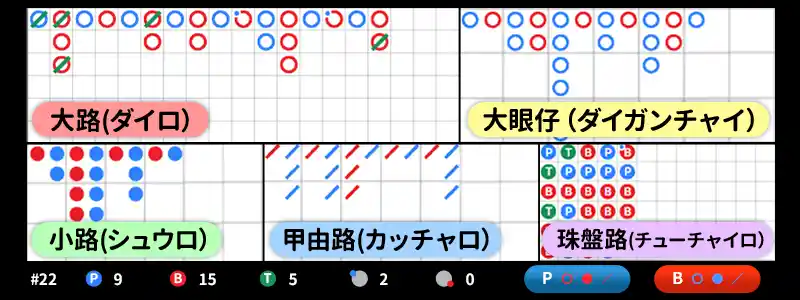
A scoreboard is a record of the results of previous baccarat rounds. By reading it, you can see how many times in a row the Player or Banker hand has won (the Big Road) and whether the pattern of winning streaks has shifted compared with earlier rounds (the Big Eye Boy and other derived roads).
A scoreboard only summarizes past results, and those results have no bearing on future rounds. Some regard reading them for predictions as baseless superstition.
The result of each round is independent, and the next outcome cannot be worked out from past patterns. A scoreboard is simply a record of results; treat it as part of the presentation that adds to the atmosphere of the table.
- Related Article
-

Strategy (4): Proper Money Management
When players lose heavily at online casinos, in baccarat or any other game, the pattern is often the same: a losing streak, gradually larger bets and, finally, a single bet of the entire bankroll that is lost. Money management is the most important factor in keeping your losses down.
If you keep betting, even in small amounts, your VIP tier also rises, and rebates and similar rewards can reduce your net losses. They do not remove the house edge, but your bankroll will last longer than if you keep placing large bets out of proportion to your deposit.
We recommend the following approaches to money management.
Setting a target amount
Before you start, decide how much you want to win before you withdraw. Stopping as soon as you reach the target is best, but if you do keep playing, make sure your balance does not fall back below the target.
Setting a budget (stop-loss limit)
Decide on a stop-loss limit: the amount of losses at which you stop playing.
This assumes that the amount you deposit is one you can afford to lose without affecting your daily life.
Setting a betting unit
A betting unit keeps your stakes consistent. If you have been betting about $1 at a time on roulette and then suddenly bet $100 on baccarat, for example, keeping your roulette bets small achieved nothing.
Set a betting unit at the start and decide that you will not change its size when using a betting system. This prevents sudden jumps in your bet size.
Beware of escalating bets
The Martingale system, for example, doubles the bet after each loss. Even with a starting bet of $1, after 10 losses in a row the next bet is $1,024. Sessions that end with a small profit become more frequent, but the amount lost in a single losing streak rises sharply.
What increases is the size of the swings in your results; the overall expected value stays the same. This is the risk of escalating bets.
If your bankroll is limited, choose your betting system carefully, for example by using the Paroli system, which also escalates bets but funds them with your winnings.
- Related Article
-

Recommended Baccarat Games to Play at Online Casinos
Baccarat comes in two forms: live baccarat, which is run by a real dealer over a live video stream, and RNG baccarat, which is run by a computer.
This section introduces two live baccarat games and one RNG baccarat game.
- Related Article
-

Speed Baccarat / Evolution
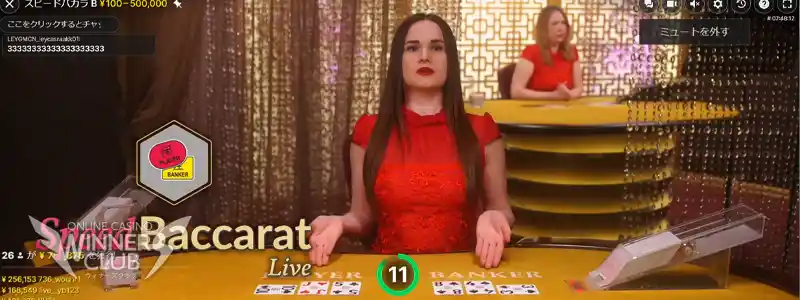
Speed Baccarat, from the major live game provider Evolution, is a standard live baccarat game offered at many online casinos.
Some tables have high maximum bets, and the game suits a wide range of budgets. Several tables are available, but the game is the same at every one of them.
Each round of Speed Baccarat is shorter than in standard baccarat. The betting window is short and the cards are not squeezed when they are revealed, so a round takes only about 27 seconds.
As a result, you can play more rounds in the same amount of time than in standard baccarat. Beginners may find the pace a little hectic, but Speed Baccarat is a good choice if you prefer a fast game.
Baccarat Squeeze / Evolution

Baccarat Squeeze, also from Evolution, is the opposite of Speed Baccarat: a live baccarat game for players who want to take their time over each round.
Fewer tables are available, but the game lets you enjoy watching the result emerge little by little.
In Baccarat Squeeze, the first card of each hand is revealed at the start of the round. The second and any later cards are then revealed by the dealer, who squeezes them.
Because the cards are turned up gradually, it only becomes clear step by step whether the Player hand or the Banker hand has won.
In land-based casinos, squeezing the cards is traditionally a privilege reserved for the player with the largest bet on each side. Baccarat Squeeze lets you experience the squeeze online.
- Related Article
-

Baccarat Supreme / OneTouch

Reading the scoreboard and card counting serve no purpose in RNG baccarat, but the format has its own advantages: there is no betting countdown, so you can play at your own pace, and you can choose the visual presentation to suit your preferences.
One RNG baccarat game we particularly recommend is Baccarat Supreme from OneTouch. Its distinctive feature is that you can squeeze the cards yourself. Being able to enjoy the squeeze described above in RNG baccarat has made the game very popular.
By default, you can squeeze only the cards of the hand you have bet on, but a setting lets you squeeze every card. You can also turn the squeeze feature off and play at a fast pace, as in Speed Baccarat.
The game screen also displays the scoreboard, so you can try out card counting and practice reading the roads. This has no effect on your actual results, but it is a useful way to get used to the screen layout before you start playing live baccarat.
Summary: The Rules Are Simple, and No Method Can Change the RTP
Baccarat is sometimes called the king of casino games and is said to be the game in which the largest sums change hands in a casino.
It is also popular at online casinos. Live baccarat in particular, a live-streamed format in which a real dealer runs the game, is popular enough that tables with high betting limits are offered.
The rules of baccarat are very simple: you only predict whether the Player hand or the Banker hand will win. The way the winner is decided is just as straightforward. The hand whose total of up to three cards has a last digit closer to 9 wins, so beginners can play without difficulty.
Its simplicity has also inspired many methods, but none of them changes the RTP.
Baccarat also has one of the higher RTPs among casino games, and combining it with promotions can reduce your net losses further. Promotions do not remove the house edge, however.
To keep your losses down, start with the Banker and Player bets, which have a low house edge, and treat side bets with caution.
This site is for adults of legal gambling age (18+, or older where required) who live in countries or regions where online gambling is legal.
Use of this site is subject to our Terms and Conditions.
Gambling involves risk. Only bet what you can afford to lose, and do not use online gambling services where they are illegal.

Bell | Editor of Online Casino Winners Club. Since the site launched in 2003, Bell has written guides to casino game rules, tested betting systems and covered land-based casinos around the world, and still plays the games before writing about them. Bell's core advice: choose the bets with the lowest house edge, and decide in advance how much you are prepared to lose.