

Many baccarat strategies and "winning systems" are promoted, and it can be hard to know which one, if any, is worth using. To judge whether a system…
Baccarat Tips: Why You Keep Losing and How to Cut Your Losses

Baccarat has one of the highest return to player (RTP) rates in gambling, and losses are relatively easy to keep small. It still has a house edge, though, so the longer you play, the closer your results, as a share of the total amount wagered, are expected to come to the house edge.
This article reviews the costly mistakes beginners often make and explains, step by step, how to keep your losses down.
What You Will Learn
- Baccarat leaves little room for skill, but basic knowledge and control over your emotions can reduce unnecessary losses.
- The house edge is about 1.06% on the Banker bet and about 1.24% on the Player bet. The Tie bet has a much higher house edge of about 14.36%.

This article takes about 19 minutes to read.
Contents
Show
How Losses Happen in Baccarat and Three Reasons You Keep Losing

Understanding how losses happen is a good first step toward cutting the ones you do not need to take.
In baccarat, cards are dealt to two hands, called Player and Banker, and you bet on which one will win. “Player” is simply the name of a hand and a bet, not you. In this article, “Player” and “Banker” always refer to these two hands and the bets on them.
(1) Baccarat Depends Heavily on Luck and Leaves Little Room for Skill
The first reason is that, no matter how well you know the rules or how much experience you have, the nature of the game leaves little room for skill.
Unlike blackjack, baccarat never asks you to choose an action during the hand. You only pick which hand will win, which makes it a game decided largely by luck.
As a result, you can lose heavily on a day when the results happen to run against you.
(2) The House Edge
Many players think of baccarat as roughly a 50/50 game and know that the Banker hand wins slightly more often than the Player hand. That is broadly correct, but knowing the exact figures makes it easier to work out the risk and return when you use a betting system.
The house edge is the share the casino keeps, and the lower it is, the smaller your losses.
| Bet | House edge |
|---|---|
| Player | 1.24% |
| Banker | 1.06% |
| Tie | 14.36% |
The Player bet has a house edge of 1.24% and the Banker bet 1.06%, so the Banker bet is slightly lower (both figures assume 8 decks and a 5% commission). This does not mean you are more likely to come out ahead on Banker; it only means your money erodes more slowly over time. Either bet loses money in the long run.
The Tie bet and side bets such as pairs have a much higher house edge and should be treated as something entirely different from the Player and Banker bets.
Some games, such as Lightning Baccarat, apply multipliers to the payout when the winning hand contains certain cards. To balance this, their conditions differ from standard baccarat (for example, a fee of 20% of the bet is added on top), so their RTP is a different figure, and we do not quote one here because we have not been able to confirm it. If you want to keep losses down, we do not recommend the Tie bet or side bets.
A 5% Commission Is Charged on Winning Banker Bets
Because the Banker hand wins more often than the Player hand, a 5% commission is charged on winning Banker bets. The bet therefore pays 1 to 1 less the commission, which works out to 19 to 20 (0.95 to 1).
For example, if you bet $100 on Banker and win, a $5 commission is deducted, so you win $95 and get $195 back in total.
If the commission bothers you, No Commission Baccarat is an option. However, a Banker win with a total of 6 pays only half (1 to 2), so a $10 bet wins $5, and the Banker house edge rises from about 1.06% to about 1.46%. That is higher than the Player bet’s 1.24%, so we do not recommend it if you want to keep losses down.
Keep in mind that all of these figures are percentages per hand. They look small for a single hand, but the longer you play and the more you wager in total, the larger your total losses grow in proportion. The house edge applies to the total amount wagered: even with a $1,000 bankroll, if you keep betting until you have wagered $10,000 in total, the house edge works on that full $10,000. However low it is, the house edge takes a steady toll the longer you play. Carrying on carelessly on the grounds that the house edge is low is itself one of the main reasons losses mount in baccarat.
(3) When Ties Are Counted, Neither Hand Wins 50% of the Time
In baccarat, the Player hand wins about 44.62% of the time, the Banker hand wins about 45.86%, and the result is a tie about 9.52% of the time. The Banker hand wins slightly more often because the rules for drawing a third card differ between the two hands.
As noted above, however, the commission on winning Banker bets offsets this difference.
| Bet | Probability |
|---|---|
| Player | 44.62% |
| Banker | 45.86% |
| Tie | 9.52% |
If ties are excluded, the Player hand wins about 49.32% of the time and the Banker hand about 50.68%. Betting systems are often applied to the Player bet, so keep in mind that in that case your chance of winning is slightly below 50%.
Common Traits of Players Who Keep Losing at Baccarat
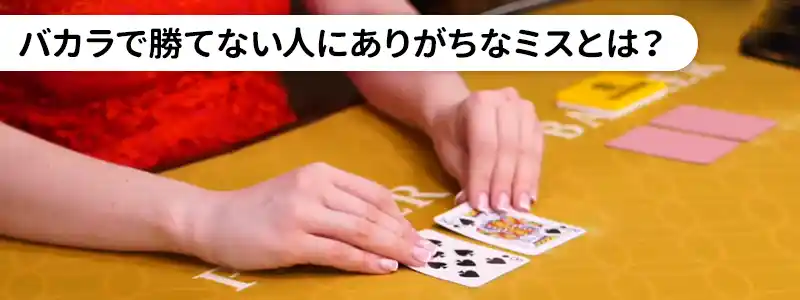
In theory, baccarat has an RTP of about 98.94% (on the Banker bet), which places it among the higher-returning casino games. Even so, many players wonder why they never seem to win.
Excluding ties, you win roughly half the time. If you still keep losing for no apparent reason, or your bankroll runs out quickly, the cause is usually something other than luck, and the same factors come up again and again. This section covers three patterns that losing players often fall into without realizing it.
Not Knowing the Basics of Baccarat Well Enough
If you want to cut unnecessary losses, a solid grasp of baccarat basics is essential.
Do you know the exact win rates for the Player and Banker hands? If you build your betting approach on the assumption that both are “roughly 50%,” your results are likely to differ from what you expect.
The more you know, the better: which of the Player and Banker bets has the higher RTP, how No Commission Baccarat compares, how the Big Road differs from the Big Eye Boy if you follow the scoreboard, and the pros and cons of each betting system if you use one.
Before you plan any strategy, make sure you understand the basics of baccarat.
- Related Article
-

Not Settling on a Playing Style That Suits You
Not everyone who plays baccarat is looking for the same kind of result.
Some want to build profits steadily, some want to aim for big payouts even if they win less often, and some want to use rebate bonuses to reduce their losses. The same player often changes style depending on the situation or mood.
If you use a betting system before settling on a style that suits you, the results may not be what you expected. For example, a player who wants steady gains may choose a high-variance approach and end up with a large loss.
Before you use any method, check whether it suits your own goals.
Losing Your Composure and Betting Until Your Bankroll Is Gone
It is rare to lose from the first hand to the last and see your bankroll disappear in no time. Results usually swing up and down, and at some point you are likely to be ahead. Few players, however, take their profit at that point.
A common pattern goes like this: you keep playing while ahead, the profit disappears, and you feel as if you have lost even though you are not yet below your starting bankroll. You then place reckless bets to win it back and end up using up your entire bankroll.
The remedy comes down to one thing: decide in advance the point at which you will take your profit.
How to Rethink Your Betting When You Keep Losing at Baccarat

Baccarat offers many ways to bet, including betting systems and bets based on the scoreboard. These can change how widely your results swing (the variance) and how quickly your bankroll shrinks. Use them with the understanding that they do not change your chance of winning any single hand or the house edge.
Learn the Roads on the Scoreboard and How to Read Them

In RNG baccarat, the cards for each game are drawn at random, so there is no shoe (the holder that contains the cards) at all.
In live baccarat, by contrast, dozens of hands are dealt from the same shoe holding several decks, so the sequence of results from that shoe is recorded. The charts that summarize this sequence are called roads, and the scoreboard in most live baccarat games displays the following five.
Keep in mind that the scoreboard is only a record of past results and that each game is independent. You cannot use past patterns to predict which hand is more likely to win next.
- Big Road
- Big Eye Boy
- Small Road
- Cockroach Pig
- Bead Plate
The article below explains the baccarat scoreboard in detail. We recommend starting with how to read the Big Road.
- Related Article
-

Look at How Other Players Are Betting
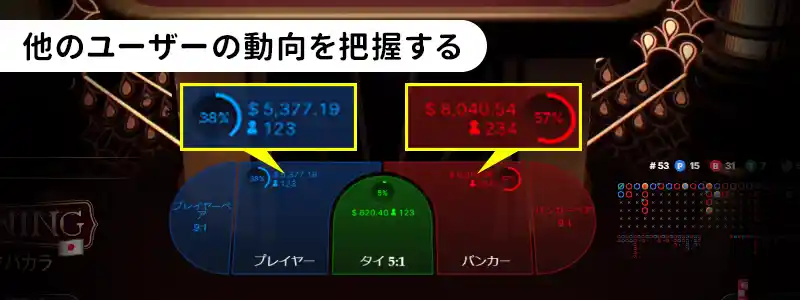
Most live baccarat games show how many players bet on Player and on Banker in each hand and how much was wagered on each.
When the bets on a hand lean heavily to one side, it tells you that many players saw something in that situation that made them favor Player (or Banker).
Bet amounts tend to grow toward the end of a shoe in particular. If you check the scoreboard while asking yourself why the bets lean so heavily to one side, you can sometimes work out which patterns on the scoreboard other players are reacting to. That said, a hand does not become more likely to win just because many people are betting on it.
Use a Betting System to Control Your Bet Size
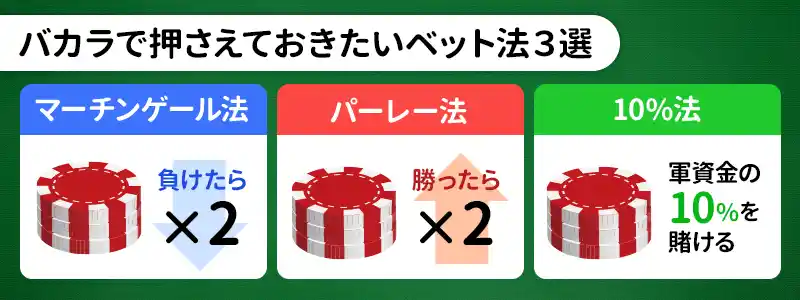
If you are not getting results at baccarat and reading the scoreboard has not helped either, betting systems are worth knowing about.
A betting system raises or lowers your bet according to the situation, which changes the size of your wins and losses. It does not change your chance of winning.
Below, we cover three betting systems with simple steps that are easy to use even the first time. Their simplicity makes them easy to handle, but none of them changes the house edge. All they change is the shape of your results.
- Related Article
-

Martingale System
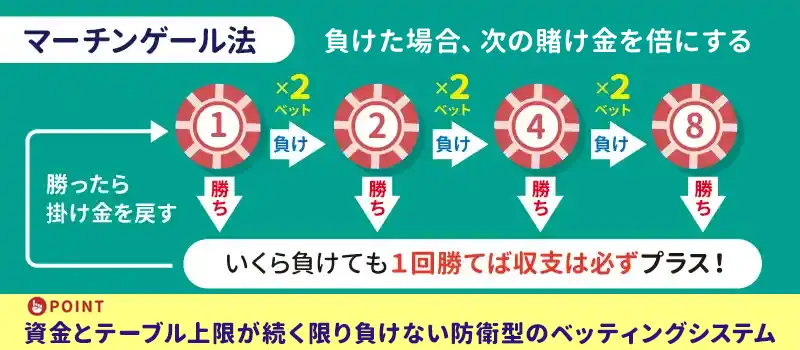
The Martingale system is a very simple method: you double your bet after every loss and return to your original bet after a win. The Player bet pays 1 to 1, so a single win recovers all of your previous losses, and the system is known for letting you finish with a small profit more often. A winning Banker bet pays only 0.95 to 1 after the commission, so after a long losing streak, one win does not fully recover your losses.
Because losses could in theory always be recovered if your bankroll and the betting limit were unlimited, the system is sometimes presented as a “method that cannot lose.” In reality, however, you are limited by the table maximum and your bankroll, and the house edge does not change.
The drawback is that the bet doubles after every loss, so your bankroll can run out sooner than you expect. Another weakness is that your losses can balloon quickly while the profit from a win stays the same.
Starting at $1, the total amount wagered over n consecutive losses is 2 to the nth power minus 1 dollars. After 8 losses in a row, you have wagered $255 in total (the next bet is $256), and after 10 losses in a row, $1,023 (the next bet is $1,024). At a table with a $100 maximum bet, after 7 straight losses you cannot place the next bet of $128, and your $127 loss is locked in.
How to Use the Martingale System
- Bet $1 on Player.
- If you lose, raise your bet to $2. After each further loss, double it again to $4, $8 and so on. When you win, return to $1.
Paroli System
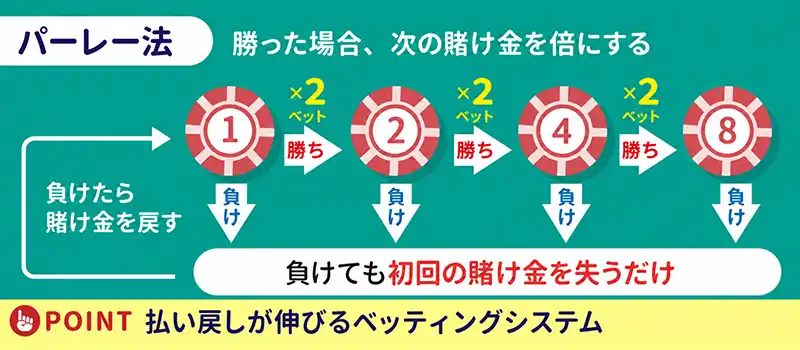
The Paroli system works the opposite way to the Martingale system and is also known as the Reverse Martingale: you raise your bet after a win and return to your original bet after a loss.
Its advantage is that you raise your bet with the winnings from the previous hand, so a loss costs you only your original bet. Your payout also grows sharply with each consecutive win, so taking your profit at a point decided in advance can lead to a large return.
The drawback is that a single loss before you take your profit wipes out all the profit built up over the streak. Always set a point at which you will take your profit (for example, after 3 or 5 wins in a row) before using this system.
How to Use the Paroli System
- Bet $1 on Player.
- If you win, raise your bet to $2. After each further win, double it again to $4, $8 and so on. When you lose, return to $1.
- Decide in advance how many wins in a row you are aiming for, and take your profit when you reach that number.
10% System

The 10% system is very simple: you always bet 10% of your current bankroll.
Its advantage is that your bet rises when you win and falls when you lose, so the stake adjusts automatically to your balance.
The drawback is that your stakes can easily become large: if you deposit $1,000, for example, each bet is $100. In that case, we recommend adjusting the calculation as needed, for example by switching to a 5% system.
How to Use the 10% System
- Suppose you deposit $100. Bet 10% of that amount, $10, on Player.
- If you win, your balance is $110, so bet $11 next. If you lose, your balance is $90, so bet $9 next.
- Continue in the same way, always betting 10% of your current bankroll. Round up any fractions.
Bankroll Management to Keep Your Losses Down in Baccarat

The most important factor in keeping your losses down at baccarat is bankroll management. There is no way to raise your chance of winning any single hand, so you need to think about how to shape your results over the session as a whole.
For that reason, make a plan before you play baccarat, and stick strictly to what you decided once you are at the table.
To make that possible, we recommend building some slack into your plan so that you can keep following your chosen steps even after a run of losses.
Bring a Larger Bankroll and Leave Yourself a Cushion
Suppose your goal is a profit of $100. With a bankroll of only $100, you would need to double it, but with $10,000, a 1% gain would be enough. This does not raise your chance of winning, but we recommend that you keep a comfortable cushion in your bankroll so that you can withstand losing streaks and play according to plan.
Without a cushion, your choice of betting approaches narrows, and a short losing streak can be enough to leave you with no bankroll at all. With a cushion, you can ride out a moderate losing streak.
In particular, the Martingale system is considered relatively manageable if you play with a large bankroll and small bets.
With the Martingale system, a single win recovers your losses, but during a losing streak the bet doubles again and again. Once you reach the table maximum or the limit of your bankroll, the total you have wagered up to that point becomes a locked-in loss. The chance of a long losing streak is never zero, and if you play enough games, one will eventually happen. As long as there is a house edge, this system does not give you a positive expected value in the long run either. Understand that it is not a method that always wins, and always be prepared for the losses a losing streak can bring.
Set a Profit Target and a Loss Limit Before You Start
Not only in baccarat but in any casino game, the most important thing is to decide on a target amount and a budget in advance. Set your profit target and the loss you are willing to accept at the start, and decide that you will take your profit when you reach the target and stop when your losses exceed the limit.
If you reach your target early and still want to keep playing, you may continue as long as you do not drop below the target amount (although, strictly speaking, you should take your profit at that point). If you reach your loss limit, however, always stop.
The levels we recommend are to take your profit at +30% of your deposit and stop at −50%. If you deposit $100, for example, you take your profit at +$30 and stop at −$50. Setting a lower profit target tends to increase the number of sessions you finish ahead. It only makes each win smaller and each loss relatively larger, though, and does not change your overall expected value.
Most important of all is to follow your rules 100% of the time. Even if you follow them 99% of the time and make a profit of 99 units, it means nothing if breaking them the other 1% of the time costs you 100 units. Breaking your rules also undoes all the discipline you have shown so far, so always stick to the rules you have set.
Do Not Raise Your Bets Too High
Be careful not to raise the amount of a single bet too far. Even when the moment feels right, as a guideline we do not recommend betting 20% or more of your deposit at once. If you have deposited $100, we recommend keeping each bet to $20 at most.
The reason is that when your bankroll disappears in an instant, you are likely to make another deposit.
Imagine going all in on Player, only for Banker to show a natural 9 (a total of 9 on the first two cards; in baccarat, a two-card total of 8 or 9 is called a natural), and losing your bankroll in a moment. Few players can then tell themselves “that is enough for today,” and many end up depositing more to try to win it back.
If you use a betting system that raises your bet after a loss, such as the Martingale system or the Monte Carlo system, it may sometimes call for a bet of 20% or more of your deposit. In that case, cut your losses as soon as the system calls for a bet of 20% or more.
For example, if you deposit $100 and start the Martingale system at $1, your bet rises to $2, $4, $8 and $16 during a losing streak. If the $16 bet loses, the next bet would be $32, which exceeds 20% of your deposit. You therefore stop as soon as the $16 bet loses.
The Right Mindset to Keep Your Losses Down in Baccarat

Finally, this section covers the right mindset for playing baccarat. Even when you prepare in advance, you never know how the results will turn out, and that uncertainty is both the danger and the appeal of baccarat.
If your emotions are not steady, you may be ahead at some point in a session and still end it with a loss.
Emotional Control Matters Most
The most important thing is to keep your emotions steady while you play. It is fine to be pleased when you win, but put off dwelling on your losses until later. We recommend focusing on following your steps, as in “I lost, so my next bet is this amount.”
People are said to feel the pain of a loss more strongly than the pleasure of a gain of the same size. This tendency is known as loss aversion and is explained by prospect theory in behavioral economics.
For this reason, make a conscious effort not to get discouraged after a loss. Raising your bet to win back money during a losing run is the one thing you most want to avoid. Calm yourself down and continue the game at a steady pace.
Take Breaks at the Right Times to Clear Your Head
Once you start playing baccarat, it is easy to keep going without a break, and your concentration drops. When it does, you may make mistakes in following your system or overlook your profit target or loss limit, adding losses you did not need to take.
This is also a result of loss aversion: a mistake that increases your losses feels far worse than a mistake that happens to increase your profit.
So take breaks at suitable moments while you play. In baccarat, we recommend taking a break when the shoe runs out, through the shuffle, and for the first few hands of the next shoe.
Once you have refreshed yourself and your head is clear, you will enjoy baccarat more.
Avoid Getting So Absorbed That You Play for Hours
This ties in with the previous point about taking breaks. If you become so absorbed in baccarat that you play for hours, your profit may sometimes keep climbing, but in most cases you will end up with a loss.
Many casinos now raise your VIP level and rebate rate according to the amount you wager, so playing until you reach a wagering target is not wrong in itself. Still, deciding in advance to stop while you are ahead makes it easier to avoid the steady drain on your bankroll that comes with long sessions.
Some casinos let you set a session time limit that logs you out automatically after a set period, and we recommend using it.
Do Not Get Carried Away When You Are Winning
In baccarat, the scoreboard and your betting system sometimes line up well and produce a large profit. The thing to watch out for at that point is getting carried away while you are winning.
Having won so far does not mean you will keep winning.
If you get carried away and start placing side bets with a low RTP, or stop following the betting approach you decided on, your bankroll will gradually shrink. It is very common for players to then raise their bets to win the money back, watch their losses grow even larger and end up losing everything.
On a day when you win big, you may feel bolder than usual, but even then we recommend always leaving with at least half of your peak profit.
For example, if your profit peaked at +$1,000, take your profit once it falls to +$500. The trick is to think of it not as having lost $500 from your peak but as having gained $500 since you deposited.
Be Careful When Drinking, as It Impairs Your Judgment
Playing baccarat while drinking dulls your thinking and judgment, making it more likely that you will misapply your betting system or place bets you did not intend. Drinking also tends to make people feel bolder.
You might deposit a large sum without worrying about losses, lose heavily, and wake up the next day to face those losses with only a hazy memory of what happened.
If your goal is simply to have fun, playing with a drink is one option, but it is safer to avoid alcohol when you need to follow your betting system precisely. Save the drinks until the day’s results are settled.
Frequently Asked Questions About Why You Lose at Baccarat
- I keep losing because I never know when to stop playing baccarat. How should I decide when to quit?
-
The RTP of baccarat stays the same no matter when you stop. Rather than playing until you lose, set your limits in advance: stop once you have won a certain amount, and stop once you have lost a certain amount.
For example, we recommend a plan such as starting with $300, taking your profit if you are up $100, cutting your losses if you are down $150, and stopping after one hour even if neither has happened. If possible, set your profit target lower than your loss limit. This makes it easier to finish a session ahead, which makes sessions less stressful (it does not raise your chance of winning the game itself).
- Are there any bets I should avoid to keep my losses down?
-
If you want to keep your losses down, avoid side bets. The Tie bet and side bets such as the Pair bets have a much lower RTP than the Player and Banker bets.
It often happens that a session would have ended ahead on the main bets alone but ends behind because of the side bets placed on top. Unless a promotion makes them especially favorable, it is wise to avoid side bets.
Summary: Losing at Baccarat Usually Comes Down to Bankroll Management and Bet Choice
Baccarat is a casino game with a high RTP, so if you find that you never seem to win, the cause is more often how you play than bad luck.
Stick to the basics: do not place bets with a low RTP, such as Tie and Pair, and place your bets according to the steps of the betting system you have chosen.
The most important ways to avoid unnecessary losses are to decide on a target amount and a budget in advance, to take your profit or cut your losses at the right time, to avoid chasing losses beyond your plan, and to avoid getting carried away when you are winning.
More and more online casinos now offer rebates, cashback and similar promotions. Using them alongside a casino’s other promotions can help reduce your net losses. These promotions do not remove the house edge, however, and they do not guarantee a long-term profit.
If you play live baccarat often, choosing a casino that offers rebates can reduce your losses at least a little.
This site is for adults of legal gambling age (18+, or older where required) who live in countries or regions where online gambling is legal.
Use of this site is subject to our Terms and Conditions.
Gambling involves risk. Only bet what you can afford to lose, and do not use online gambling services where they are illegal.

Bell | Editor of Online Casino Winners Club. Since the site launched in 2003, Bell has written guides to casino game rules, tested betting systems and covered land-based casinos around the world, and still plays the games before writing about them. Bell's core advice: choose the bets with the lowest house edge, and decide in advance how much you are prepared to lose.