

D'Alembert System: How It Works, Simulations and Stop-Loss Limits

The D’Alembert system is a betting system for table games such as baccarat and roulette. It is a bankroll management method suited to players who want to keep changes in their bet size small from one round to the next.
This article explains, in terms beginners can follow, how to use the D’Alembert system, which games it works well with, how it can be modified and where to set a stop-loss limit.
What You Will Learn
- The D’Alembert system is easiest to use on table game bets that pay 1 to 1 (even money).
- It makes big losses less likely, but it also makes big wins hard to achieve.

This article takes about 19 minutes to read.
What Is the D’Alembert System, Sometimes Called the Best Betting System?
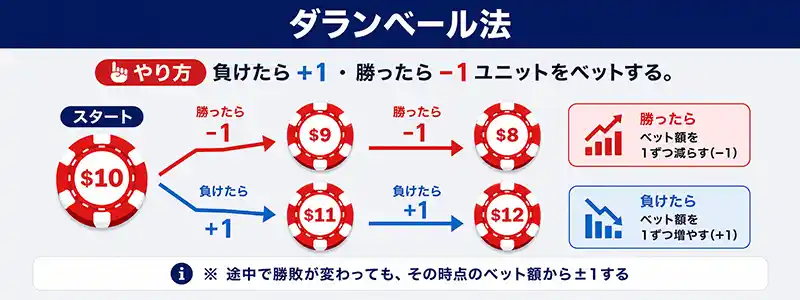
The D’Alembert system, also known as the pyramid system, is a betting system said to be named after Jean le Rond d’Alembert, an 18th-century French mathematician, and based on his ideas about probability.
The method is simple. All you do is lower your bet after a win and raise it after a loss.
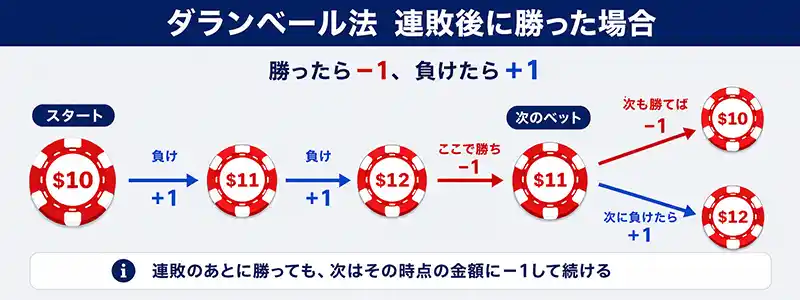
You adjust the bet in this way when you win after a losing streak, as in the image above.
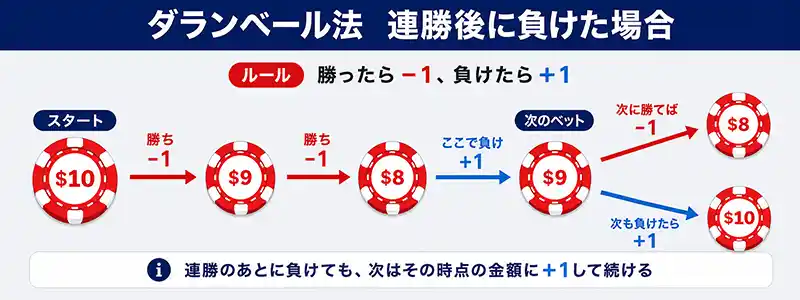
The same applies when you lose after a winning streak, as shown here. You then continue in the same way. The steps are simple, so even beginners can use the system without difficulty.
Because the bet does not grow much even during a losing streak, the swings in your results from round to round stay small, which makes the D’Alembert system easy to manage.
Because the bet rises by only one unit after a loss, it is a defensive betting system, suited to players who want to keep the change from round to round small and play for a long time. It takes time for your balance to recover, but because the balance is unlikely to drop sharply, the D’Alembert system is known as one of the most popular defensive betting systems.
How to Use the D’Alembert System
Compared with other betting systems, the D’Alembert system is easy to apply, and even beginners can manage it without difficulty.
- Decide your starting bet
- Decide the size of one unit
- Raise or lower your next bet based on the result
Step (1): Decide Your Starting Bet
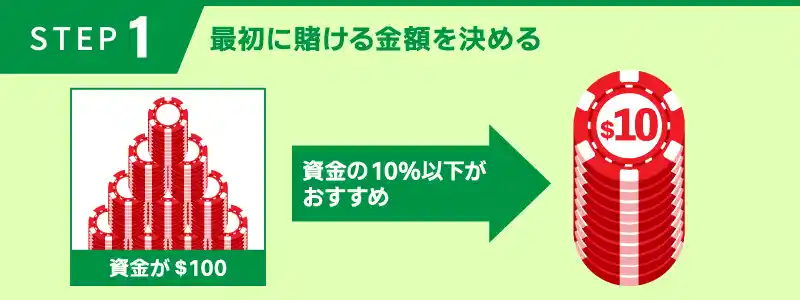
First, decide how much you will bet at the start.
A larger starting bet means larger winnings when you win, but to limit your losses during a losing streak, the starting bet should ideally be 10% or less of your bankroll.
In this example, the starting bet is $10.
Step (2): Decide the Size of One Unit
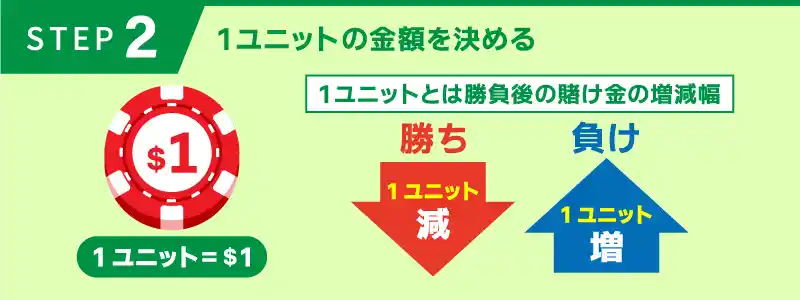
Next, decide the value of one unit. After each round is settled, this is the amount by which your next bet goes up or down.
In this example, one unit is $1 (so the starting bet is 10 units).
Step (3): Raise or Lower Your Next Bet Based on the Result
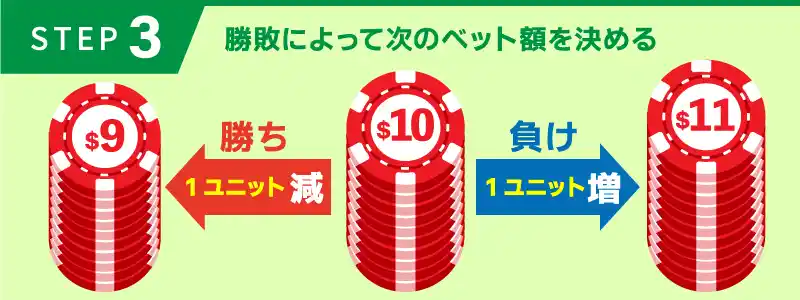
Choose one of the games suited to the D’Alembert system (see the list below) and bet $10. Your bet for the next round then depends on whether you win or lose.
If the round ends in a tie, leave your bet unchanged.
If a winning streak brings your bet down to one unit and it cannot be lowered any further, see the modified version described later in this article.
After a Win: Lower Your Next Bet by One Unit
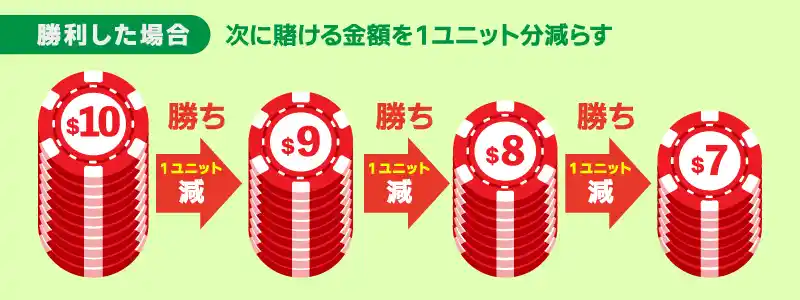
When you win, lower your bet by one unit for the next round. If you bet $10 and win, your next bet is $9.
After a Loss: Raise Your Next Bet by One Unit
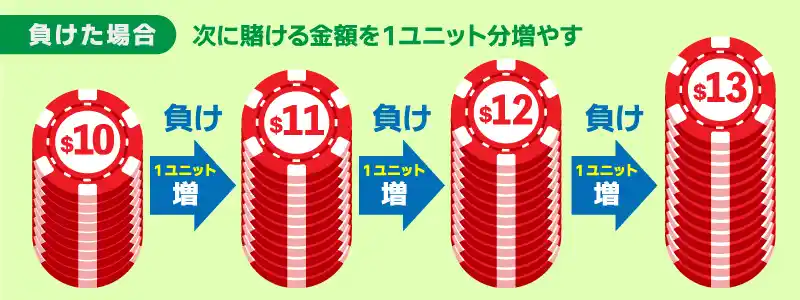
When you lose, raise your bet by one unit for the next round. If you bet $10 and lose, your next bet is $11.
The D’Alembert System Works Best on Bets with About a 50% Chance of Winning That Pay 1 to 1

The D’Alembert system is designed for bets that win about 50% of the time and pay 1 to 1. For this reason, it works well with most table games.
Roulette

To keep your losses down, we recommend playing European roulette. The house edge is 2.70% on European roulette and 5.26% on American roulette. Both pay the same odds, but American roulette has an extra zero pocket (00), which lowers your chance of winning (47.37% versus 48.65% on red/black), and over the long run this leads to larger losses.
Place only even-money bets: red/black, odd/even or high/low. Dozen bets and column bets are also outside bets, but they pay 2 to 1, so they do not fit the unit calculations of the D’Alembert system.
Baccarat

In baccarat, a winning Banker bet at a commission table pays 0.95 to 1 (19 to 20), that is, even money less a 5% commission, so a $10 bet wins $9.50. This breaks the premise of the D’Alembert system that an equal number of wins and losses ends in profit, so we recommend the Player bet. The house edge itself is lowest on the Banker bet with commission (about 1.06%), so note that this recommendation is based on the system’s premise, not on minimizing the house edge. No-commission baccarat pays 1 to 1 on the Banker bet, but the house edge on the Banker bet rises from about 1.06% to about 1.46%, higher than the roughly 1.24% on the Player bet.
Note that in no-commission baccarat, a Banker win on 6 pays half (1 to 2), so a $10 bet wins $5. When this happens, do not count the round as a win or a loss; leave your bet unchanged and move on to the next round.
Blackjack

You can use the D’Alembert system in blackjack, but we do not recommend it. Doubling down and splitting change the bet in the middle of a hand, and a natural blackjack pays different odds.
If you do use it, you need to adjust how you count results. For example, when you place an additional bet and win twice your original bet, count it as two consecutive wins.
A natural blackjack (21 with the first two cards) pays 3 to 2, so a $10 bet wins $15, but count it as one ordinary win.
Sic Bo

In Sic Bo, bet on Big or Small.
The other betting areas pay different odds, so stick to one of these two bets.
D’Alembert System Simulation: How Your Balance Actually Moves
We used the D’Alembert system in actual play to see how the balance moves. The record covers only 10 rounds and does not indicate the expected value.
Test Results on Roulette

First, we tested the D’Alembert system on Evolution’s live roulette under the following conditions.
- Game: Evolution roulette
- Bets on black only
- 10 rounds played
- One unit of $1, starting at 10 units ($10)
| Round | Bet | Result | Win/Loss | Running Total | Action After the Round |
|---|---|---|---|---|---|
| 1 | $10 | Win | +$10 | +$10 | Won, so lower the bet by $1: $10 → $9 |
| 2 | $9 | Loss | -$9 | +$1 | Lost, so raise the bet by $1: $9 → $10 |
| 3 | $10 | Loss | -$10 | -$9 | Lost, so raise the bet by $1: $10 → $11 |
| 4 | $11 | Win | +$11 | +$2 | Won, so lower the bet by $1: $11 → $10 |
| 5 | $10 | Win | +$10 | +$12 | Won, so lower the bet by $1: $10 → $9 |
| 6 | $9 | Loss | -$9 | +$3 | Lost, so raise the bet by $1: $9 → $10 |
| 7 | $10 | Loss | -$10 | -$7 | Lost, so raise the bet by $1: $10 → $11 |
| 8 | $11 | Loss | -$11 | -$18 | Lost, so raise the bet by $1: $11 → $12 |
| 9 | $12 | Win | +$12 | -$6 | Won, so lower the bet by $1: $12 → $11 |
| 10 | $11 | Win | +$11 | +$5 | Won, so lower the bet by $1: $11 → $10 |
In this test, wins and losses came in no particular order. The final record was 5 wins and 5 losses, yet the balance finished $5 ahead.
Each loss followed by a win produces a gain of one unit, so when wins and losses are equal, in theory you finish ahead by half as many units as rounds played.
We ran the same test on baccarat (wins and losses alternating) and Sic Bo (five losses followed by five wins), and both also ended at +$5. This is not a coincidence. Under the D’Alembert system, the result depends only on the number of wins and losses and the final bet size, not on the order in which wins and losses arrive. Whether the five losses come first or wins and losses alternate, 5 wins and 5 losses over 10 rounds give the same result.
This only holds when wins and losses are equal, though. On European roulette, a bet on red or black wins 48.65% of the time, 1.35 percentage points short of 50%. Because of this gap, the house edge takes 2.70% of the amount bet, so the more rounds you play, the more your losses tend to outnumber your wins, and over the long run your results converge on a loss.
When You Lose More Rounds Than You Win but Still Finish Ahead
With a $10 base bet and $1 units, you can be at 11 wins and 12 losses, behind on rounds, and still be $1 ahead.
This follows directly from how the D’Alembert system works: each loss-and-win pair produces a $1 gain, so 12 wins and 12 losses leave you $12 ahead.
What the D’Alembert System Changes and What It Does Not
Using the D’Alembert system does not change a game’s house edge or return to player (RTP) at all. The house edge stays at 2.70% on red/black in European roulette and at about 1.06% on the Banker bet in baccarat, no matter how you size your bets. The longer you play, the more your losses build up at this rate relative to the total amount you bet.
What the D’Alembert system changes is only the size of the swings in your balance (the variance) and the shape of the distribution of results. Because each bet moves up or down by just one unit, your bankroll is less likely to drop sharply, as it can with the Martingale system.
The Maximum Loss to Expect During a Losing Streak
With one unit of $1 and a $10 starting bet, the total loss after n consecutive losses is 10n + n(n − 1) ÷ 2 dollars. That comes to $60 after 5 losses in a row, $145 after 10 and $255 after 15. The probability of losing 10 times in a row on red in European roulette is about 0.13% (roughly 1 in 780), but if you play enough rounds, it will happen.
It takes many more losses to reach the table limit than with the Martingale system, but your bankroll is limited. Decide in advance how much you can afford to lose in one session, and play with a bankroll you are comfortable with.
Advantages and Disadvantages of the D’Alembert System

The advantages and disadvantages of the D’Alembert system both come from the same feature: each bet moves up or down by a fixed one unit. They are easiest to understand as two sides of that feature.
- Advantage: Bets Do Not Rise Sharply During a Losing Streak
- Advantage: You Can Start with a Small Bankroll
- Disadvantage: Big Wins Are Unlikely Even on a Winning Streak
- Disadvantage: Recovering a Deficit Takes an Equal Number of Wins
Advantage: Bets Do Not Rise Sharply During a Losing Streak
The D’Alembert system raises your bet after a loss, but only by one unit. With $1 units, five losses in a row raise your bet by just $5.
Because each loss adds only one unit, the bet rises only gradually during a losing streak. However large your starting bet, the increase per loss stays the same, so a losing streak is less likely to turn into a big loss.
Compare the bets during a losing streak with those of the Martingale system, which doubles the bet after every loss. Both start with a $10 bet.
D’Alembert system: 10→11→12→13→14→15→16→17→18→19…
Martingale system: 10→20→40→80→160→320→640→1,280→2,560→5,120→10,240…
With the Martingale system, the bet after 10 consecutive losses is $10,240, which reaches the table limit at most casinos. With the D’Alembert system, the bet after 10 consecutive losses is only $20, so you will rarely reach the table limit.
Advantage: You Can Start with a Small Bankroll
Because you choose both the starting bet and the unit size yourself, you can adjust how much risk you take.
For example, a $5 starting bet with $1 units lets you start with a bankroll of about $50, and some players try even smaller settings, such as a $1 starting bet with $1 units.
Conversely, by changing the starting bet and the unit size as described in the variations below, you can also set up the system to suit high rollers.
Disadvantage: Big Wins Are Unlikely Even on a Winning Streak
Under the D’Alembert system, your bet shrinks as you keep winning, so you cannot expect big wins. As an extreme example, compare the total profit from a winning streak with that of the Paroli system (also called the reverse Martingale). Both start with a $10 bet.
D’Alembert system: 10→19→27→34→40→45→49→52→54→55
Paroli system: 10→30→70→150→310→630→1,270→2,550→5,110→10,230
As this shows, a winning streak pays relatively little under the D’Alembert system, and you should not expect big wins from it.
Disadvantage: Recovering a Deficit Takes an Equal Number of Wins
Unlike systems such as the Martingale system and the Cocomo system, where a single win completes a cycle, the D’Alembert system gains a little at a time as long as wins and losses are close to even. As a result, it takes some time before your balance moves noticeably.
Of course, your results improve faster if you win more than 50% of the time, but as shown above, even a winning streak does not boost your profit much. That is why setting a profit-lock level in advance is the key to using the D’Alembert system.
If your bet rises too far, further losses could wipe out your bankroll, so we recommend playing with a stop-loss limit in mind as well.
Stop-Loss Limits and When to Stop with the D’Alembert System
The D’Alembert system has no built-in stopping point or stop-loss limit. As a result, you decide when to lock in profits or cut losses.
Our Recommended Stop-Loss Limit: When Losses Exceed Wins by 6 or More
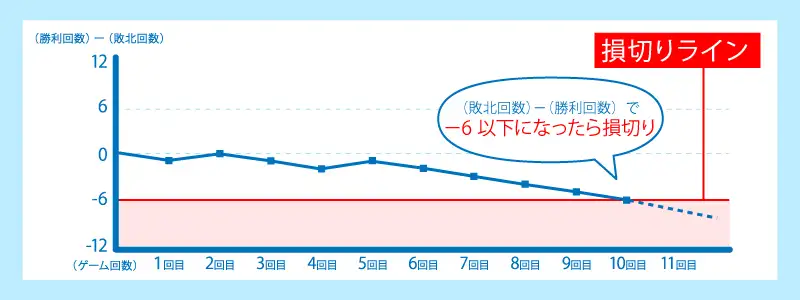
Even after a long losing streak, the D’Alembert system does not raise each bet very much. To finish that cycle ahead, however, you need to string together nearly as many wins to bring wins and losses back to even.
For this reason, once your bet has grown to a certain size, it is a good idea to cut your losses and reset.
The stop-loss limit we recommend is when your losses exceed your wins by 6 or more. At that point, even with a unit of one-tenth of your base bet, your bet has grown to 1.6 times its starting size, and recovering becomes difficult. Reset and start a new cycle. Setting a stop-loss limit does not change the expected value itself; it is a money management rule that caps how much you can lose in one session.
When Should You Stop? Examples of Stopping Points
Here are a few examples.
- When you can no longer lower your bet by one unit
(in the example above, when you win a $1 bet), you can either keep betting one unit or treat the cycle as complete and start a new one. - When your bet has fallen by half or more from the starting bet
(in the example above, when you win a $5 bet), we recommend locking in your profit and starting a new cycle. - When your bet has reached twice the starting bet or more
(in the example above, when you lose a $20 bet), this is a looser threshold than the 6-loss deficit described above (it corresponds to a 10-loss deficit), for players who can tolerate a larger drawdown.
These examples assume one unit of $1 and a starting bet of 10 units ($10). You are free to set your own stop-loss limit and profit-lock level.
D’Alembert System Variations and the Effect of Different Settings

The D’Alembert system is simple, so it does not have many variations. This section looks at one common variation and at what happens when you raise the starting bet or increase the unit size. None of these changes affects the expected value or the house edge. The earlier sections used a $10 starting bet; this section uses a $5 starting bet for the variation (which counts as Test (1)), $10 and $20 for Test (2), and $20 for Test (3).
- Return to the Starting Bet When Your Bet Drops to One Unit
- What Happens When You Raise the Starting Bet
- What Happens When You Increase the Unit Size
Variation: Return to the Starting Bet When Your Bet Drops to One Unit
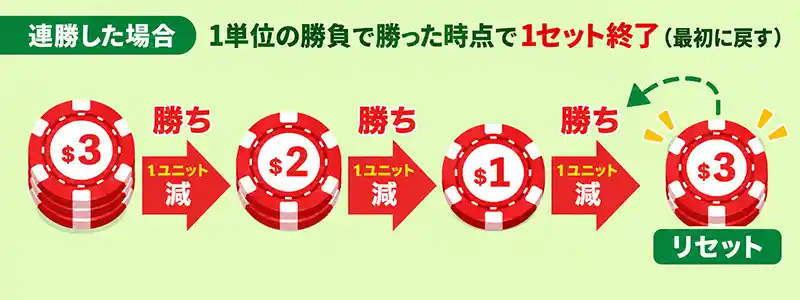
The D’Alembert system has no built-in stopping point. For example, if you start at $5 and lower your bet by $1 after each win, the fifth bet is $1, and from then on it stays at $1 however many times you win, so your profit grows slowly.
One option is to treat a win on a one-unit bet as the end of a cycle and start a new one.
This is known as the modified D’Alembert system. It removes the structural problem of the bet bottoming out during a winning streak, so profits grow faster on a winning streak, but the swings during a losing streak are larger.
| Round | Result | Bet | Modified bet |
Profit | Modified profit |
|---|---|---|---|---|---|
| 1 | Win | $5 | +$5 | ||
| 2 | Win | $4 | +$9 | ||
| 3 | Win | $3 | +$12 | ||
| 4 | Win | $2 | +$14 | ||
| 5 | Win | $1 | +$15 | ||
| 6 | Win | $1 | $5 | +$16 | +$20 |
| 7 | Win | $1 | $4 | +$17 | +$24 |
| 8 | Win | $1 | $3 | +$18 | +$27 |
| 9 | Win | $1 | $2 | +$19 | +$29 |
| 10 | Win | $1 | $1 | +$20 | +$30 |
Note: Shaded cells show where resetting produces more profit than the standard D’Alembert system.
Test (2): What Happens When You Raise the Starting Bet

The D’Alembert system lets you change both the starting bet and the unit size. So how do your results change if you keep the unit at $1 and change only the starting bet?
For example, if you bet on black 100 times in European roulette, black comes up roughly 49 times and red or zero roughly 51 times. Based on this, suppose you finish with 49 wins and 51 losses, and compare a $10 starting bet with a $20 starting bet.
As the simulation above showed, each loss followed by a win yields +$1, so in both cases the 49 wins and 49 losses produce +$49.
With a $10 starting bet
The two extra losses cost $10 + $11 = $21. Subtracting that from $49 leaves a profit of $28.
With a $20 starting bet
The two extra losses cost $20 + $21 = $41. Subtracting that from $49 leaves a profit of $8.
A higher starting bet produces more profit only when you finish with more wins than losses. When losses outnumber wins, as in this example, it reduces your profit (here from $28 to $8), so raising the starting bet by itself does not increase your profit.
Test (3): What Happens When You Increase the Unit Size
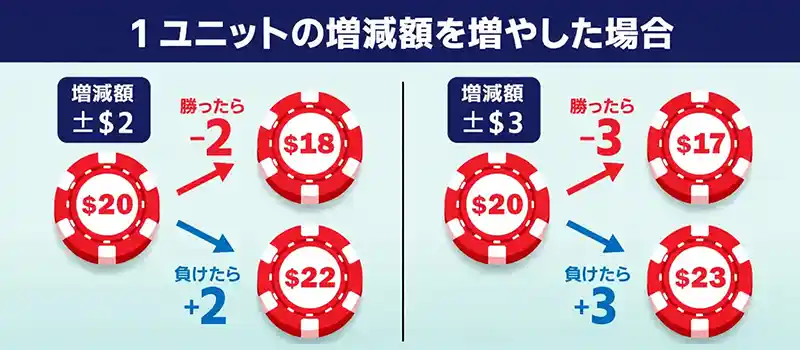
Now suppose your bankroll is $200 and the starting bet is fixed at $20. What happens when the unit size changes?
With the same record of 49 wins and 51 losses, a $1 unit yields a profit of $8, a $2 unit yields $56 and a $3 unit yields $104. At first glance, a larger unit seems to make winning easier, but you also take on more risk.
With a $1 unit, for example, the bet rises 21→22→23… with each loss. After 8 losses in a row, you are down $188 with $12 left, which is not enough to continue. With a larger unit, you reach this limit even sooner.
As this shows, the larger the unit, the fewer consecutive losses it takes to run out of money. As a guideline, keep the unit at no more than about 10% of the starting bet, and work out in advance how many losses in a row you can withstand.
| Consecutive losses | $1 unit | $2 unit | $3 unit |
|---|---|---|---|
| 1 | $20 | $20 | $20 |
| 2 | $41 | $42 | $43 |
| 3 | $63 | $66 | $69 |
| 4 | $86 | $92 | $98 |
| 5 | $110 | $120 | $130 |
| 6 | $135 | $150 | $165 |
| 7 | $161 | $182 | $203 |
| 8 | $188 | $216 | $244 |
| 9 | $216 | $252 | $288 |
Note: In the shaded cells, the total loss exceeds the $200 bankroll, so these rows cannot actually be reached. Play ends one loss earlier, when the next bet can no longer be placed.
How the D’Alembert System Differs from Other Betting Systems
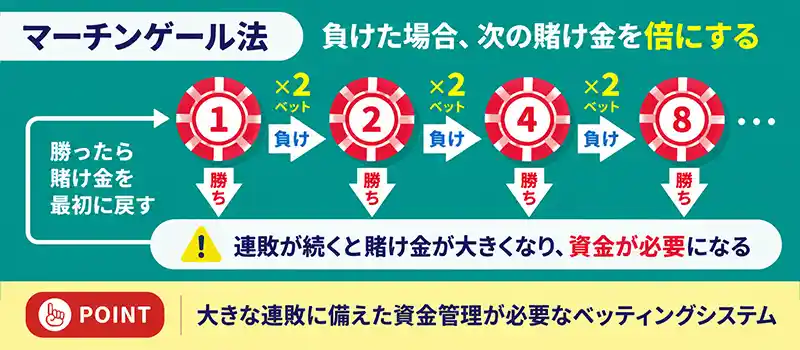
The table below compares the D’Alembert system with three systems that are often confused with it, based on how each one changes the bet. See the individual articles for a full explanation of each system.
| System | After a win | After a loss | Difference from the D’Alembert system |
|---|---|---|---|
| D’Alembert system | Lower by one unit | Raise by one unit | – |
| Martingale system | Return to one unit | Double the bet | Bets rise steeply. A long losing streak reaches the table limit, and the loss is locked in at that point. |
| Oscar’s Grind | Raise by one unit | Keep the same bet | The bet moves in the opposite direction: it goes up after a win. The profit per cycle is fixed at one unit, and bets tend to grow large if a cycle drags on. |
| 10% system | Always 10% of your current balance | As a form of percentage betting, the bet is proportional to your balance, so it shrinks automatically during a losing streak and your bankroll is less likely to run out. | |
As noted earlier, no betting system changes the expected value or the house edge.
Can You Win with the D’Alembert System? What Players Say
We looked at what players who have used the D’Alembert system say about it on social media.
Players who report good results often describe limits of their own. One player reset the sequence after 4 losses in a row and finished with 39 wins and 61 losses, including two runs of 10 straight losses, yet still ended up 19 units ahead. Another played baccarat at a relaxed pace over several days and reported more than doubling the balance set aside for play. That player left any table that was not going well, played about 100 rounds a day at most, set a daily profit target, and if the target was reached during a long streak, kept betting on it until the streak ended.
These players report winning with the D’Alembert system. As long as a losing streak does not run long, you can finish a cycle before your bets grow large.
The first player’s rule of resetting after 4 losses in a row limits the system’s main weakness: the more you lose, the larger your bets become. Without resets, the plain D’Alembert system would show a large loss on a record of 39 wins and 61 losses, so this result comes from combining the system with a reset rule.
Other players report that the system did not work for them. One found that the bet grew noticeably after each loss and the pressure grew with it, and decided the system was not a good fit and planned to try a different one. Another wrote that even when starting with small bets, there came a point when the bet kept growing until the bankroll ran out.
These posts point to one weakness of the D’Alembert system: because the bet rises with each loss, a long losing streak can leave you short of money.
Bets grow more gradually than with doubling systems such as the Martingale system, but 5 or 10 losses in a row can still happen, and over enough rounds they will. If the system is not working for you, consider adjusting the unit size or setting a rule to reset after a losing streak.
One more player described a volatile day and said that without the D’Alembert system, it would probably have ended in a heavy loss.
In other words, the player still lost, but the loss was smaller because of the D’Alembert system.
Unlike high-risk, high-reward systems such as the Martingale system, the D’Alembert system is designed to limit the swings in each round’s result. Because losses tend to be relatively shallow, it is a manageable system for players who are new to betting systems.
Frequently Asked Questions About the D’Alembert System
- Why is the D’Alembert system sometimes called the “best” betting system?
-
Some players call the D’Alembert system the “best” because it finishes ahead on paper when wins and losses are equal, and because heavy losses are less likely than with many other systems. Whether you win and then lose or lose and then win, the bet on the winning round is always the larger one.
In practice, however, the probability of winning each bet is slightly below 50%, so the more rounds you play, the more likely you are to end up with more losses than wins.
Also keep in mind that which system suits you depends on your playing style.
- How large a bankroll do I need to try the D’Alembert system?
-
Unlike the Martingale system, which starts at one unit, the D’Alembert system needs a starting bet several units above the minimum so that it can be lowered after wins. Ideally, you should have a bankroll of at least 10 times your starting bet.
For example, if you start at $10, lower the bet by $1 after a win and raise it by $1 after a loss, a bankroll of about $100, or 10 times the starting bet, is a reasonable guideline. Losing streaks will happen, so you need enough money to cover them.
Summary: The D’Alembert System Keeps the Swings in Your Results Small
The D’Alembert system is a betting system for roulette, baccarat and other table games, including live dealer games. It lowers the bet after a win and raises it after a loss, which makes it a money management method that keeps each round’s swings small.
You choose both the starting bet and the amount added or subtracted after each result. That means the system also works for high rollers, and you can set it up as either low risk, low reward or high risk, high reward.
It does not change the house edge or the RTP, however. Big wins are unlikely, and it takes time to recover after more losses than wins. The system suits players who want to play longer while limiting unnecessary losses.
- Martingale Strategy Explained
- D'Alembert Betting System
- Paroli Betting System
- Labouchère Betting System
- Percentage Betting (10% System)
- Oscar's Grind Betting System
- 1-3-2-6 Betting System
- 1-2-3-5 Betting System
- Monte Carlo Betting System
- Cocomo Betting System
This site is for adults of legal gambling age (18+, or older where required) who live in countries or regions where online gambling is legal.
Use of this site is subject to our Terms and Conditions.
Gambling involves risk. Only bet what you can afford to lose, and do not use online gambling services where they are illegal.

Bell | Editor of Online Casino Winners Club. Since the site launched in 2003, Bell has written guides to casino game rules, tested betting systems and covered land-based casinos around the world, and still plays the games before writing about them. Bell's core advice: choose the bets with the lowest house edge, and decide in advance how much you are prepared to lose.