

Basic strategy is the first thing to learn if you want to play blackjack well. What You Will Learn Basic strategy is the fundamental way to play every…
Card Counting in Blackjack: How It Works and How to Count Cards

Have you ever heard it said that card counting in blackjack is the most powerful strategy in the casino?
Card counting, or simply counting, means keeping track of the cards that have been dealt. It is one of the few techniques that can improve the player’s expected value when the right conditions are in place. Many players first heard of it through films such as Rain Man, which drew attention to a character’s ability to memorize cards, or 21, which is based on the real-life MIT team. Surprisingly few players, however, understand how counting actually works.
What You Will Learn
- Card counting in blackjack is simple in principle, but using it in practice requires repeated drilling in accurate mental arithmetic.
- A count that has turned positive is a signal to consider placing larger bets.
- Counting works best when combined with other strategies, such as basic strategy.
- Counting does not change the return to player (RTP) itself, and it does not guarantee a win.

This article takes about 17 minutes to read.
Contents
Show
What Is Card Counting in Blackjack?
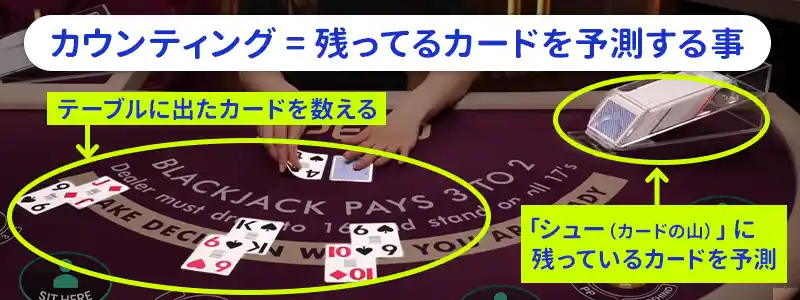
Card counting is a technique for keeping track of the values of the cards that have been dealt in order to estimate whether the remaining cards are weighted toward high or low cards.
The outcome in blackjack depends heavily on how many 10-value cards (10, J, Q and K, all of which count as 10) remain in the shoe. When many of these high cards remain, players are more likely to make strong hands close to 21, and the dealer is more likely to bust (go over 21 and lose).
When the remaining cards are mostly small ones from 2 to 6, the player’s expected value drops. Counting assigns a point value to each card dealt and expresses as a number whether the remaining cards currently favor the player or the dealer.
This lets you bet more when the count favors you and less when it does not, so your play is based on strategy rather than luck alone.
Why Most Land-Based Casinos Do Not Allow Card Counting
The theory of card counting was developed in the 1960s, and casinos have a history of suffering large losses to it. As a result, land-based casinos in Las Vegas and Macau commonly refuse to let suspected counters play. Counting in your head is not prohibited by law; the casino, as a private business, simply declines to let the player continue.
A count kept in your head is hard to detect, but phones are not allowed at the table and taking notes to track cards is not permitted, which makes counting very difficult in practice. A systematic betting pattern can also lead staff to suspect that you are counting. For these reasons, counting in a land-based casino is very difficult in practice. In recent years, more casinos have also introduced continuous shuffling machines (CSMs), which make counting far less effective.
At an online casino, on the other hand, no one can watch how you behave at the table, so no one at the table will notice how you play. There are two points to keep in mind, however.
First, the number of tables where counting can be effective is limited. Second, every bet you place is recorded on the casino’s servers, so you are not actually unobserved. Extreme changes in bet size can lead to account restrictions or forfeited bonuses, so check the terms and conditions in advance.
Four Main Reasons Card Counters Are Spotted
Unusual Swings in Bet Size
Counters bet big when the count is positive and small when it is negative, so their bet sizes swing noticeably. These swings raise suspicion among the surveillance staff watching the cameras and the pit boss on the floor.
Inconsistent Playing Decisions
If a player normally follows basic strategy but deviates from it at certain moments, for example by standing where the chart says to hit, it becomes clear that the player is adjusting their play to the count.
Long Sessions and Behavior Monitoring
Major casinos are known to record players’ behavior using surveillance footage and play histories. A player who keeps winning at the same table for hours may come under scrutiny.
Team Play
Team play, in which several people work together as in the film 21, is especially easy to spot. Several people taking turns joining and leaving a table attracts attention.
Casinos also use the following countermeasures against card counters.
- Reviewing play recorded by surveillance cameras
- Dealers and pit bosses observing player behavior
- Tracking each player’s win rate and changes in bet size
- Checking players against blacklists that share information on known counters
If a casino detects counting, you may be warned to stop, or told to leave the table or the casino. In the worst case, you may be placed on a blacklist and banned from the premises.
How Card Counting in Blackjack Works
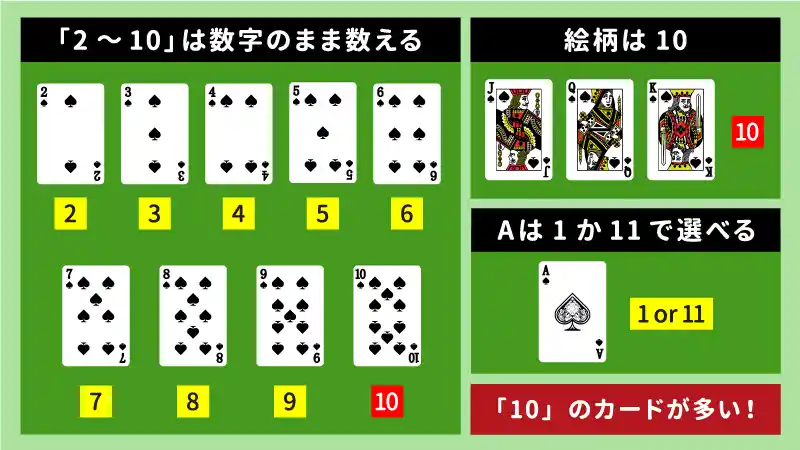
In blackjack, number cards count at face value, all face cards count as 10, and an ace counts as 1 or 11.
10-value cards make up 16 of every 52 cards, more than 30% of the deck. As a result, the outcome in blackjack depends on how many 10-value cards remain in the shoe, and counting is the tool for judging this.
Card Counting Terms in Blackjack
| Shoe | A shoe is a container that holds the playing cards. It is box-shaped, and the dealer draws the cards from it one at a time as the game proceeds. |
|---|---|
| Deck | A deck is a set of 52 playing cards and serves as the unit for describing how many cards are in play. Most blackjack games use 6 or 8 decks. |
| Cut card | A cut card is a card inserted into a stack of shuffled cards to mark a dividing point. In live blackjack, many rounds are dealt from a single shoe. When the cut card appears during a round, play switches to a new shoe once that round is over (in some cases, the entire shoe is reshuffled and used again). |
| Penetration | Penetration is the point at which the cut card is inserted after the cards are shuffled and loaded into the shoe, expressed as a percentage. For example, if the cut card is placed exactly halfway through the shoe, only half the cards are dealt, so the penetration is 50%. |
| Running count | The running count is the simple total of the point values of all the cards dealt so far. It does not take the number of remaining decks into account, so the same value can mean different things depending on how far the game has progressed through the shoe. |
| True count | The true count is the running count divided by the number of decks remaining. It evens out differences in the number of cards left, so you can judge by the same standard at any point in the shoe. |
| Key count | The key count is the threshold value that marks the decision point in counting systems that start from a set initial value, such as Knock-Out. Its value depends on the number of decks. |
Counting Helps You Choose Your Actions
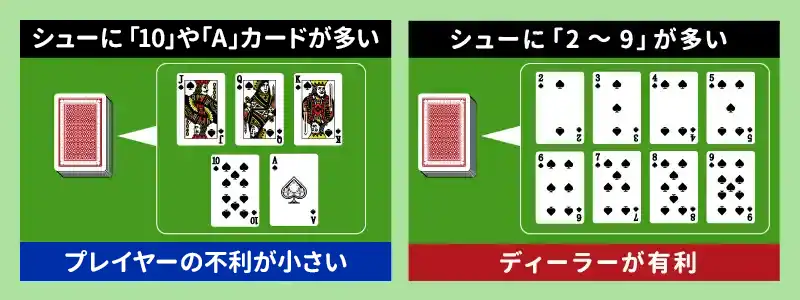
The table below shows how a shoe rich in 10-value cards and aces affects the player, depending on the dealer’s upcard and the player’s hand.
| When many 10-value cards remain | Player: 11 or less / 17 or more | Player: 12–16 |
|---|---|---|
| Dealer: 2–6 | More favorable | More favorable |
| Dealer: 7–A | Even | Less favorable |
Suppose, for example, that the dealer’s upcard is a 2 through 6. If many 10-value cards and aces remain in the shoe, a double down is more likely to succeed when your hand totals 9–11.
With a hand of 13–16 (or 12 against a 4–6), you can stand; when the count is high enough, even 12 against a 2 or 3 can become a stand. The dealer must draw at least one more card on 16 or less, and a dealer hand of 12–16 busts as soon as a 10-value card is drawn. Either way, the situation favors the player.
Hit and Stand Decisions
For hitting and standing, we recommend that you generally follow basic strategy, which gives the highest expected value.
When the count has turned positive, however, some players make adjustments, such as standing where basic strategy calls for a hit to avoid the risk of busting. These adjustments only pay off in a limited number of situations, once the count passes a set threshold. Changing your play by feel, without a fixed threshold, raises the house edge instead of lowering it.
Splitting and Doubling Down
The player wins only about 42% of blackjack rounds (about 8.5% end in a push; the figures vary with the rules), which is by no means high. Blackjack still has one of the highest RTPs among table games because several features work together: a push returns your bet, a natural blackjack pays 3 to 2 (a $10 bet wins $15), and splitting and doubling down let you raise your bet only in favorable situations.
When the count has turned positive, doubling down on 10 or 11 and splitting A,A or 8,8 are especially likely to pay off.
How to Count Cards: The Hi-Lo System
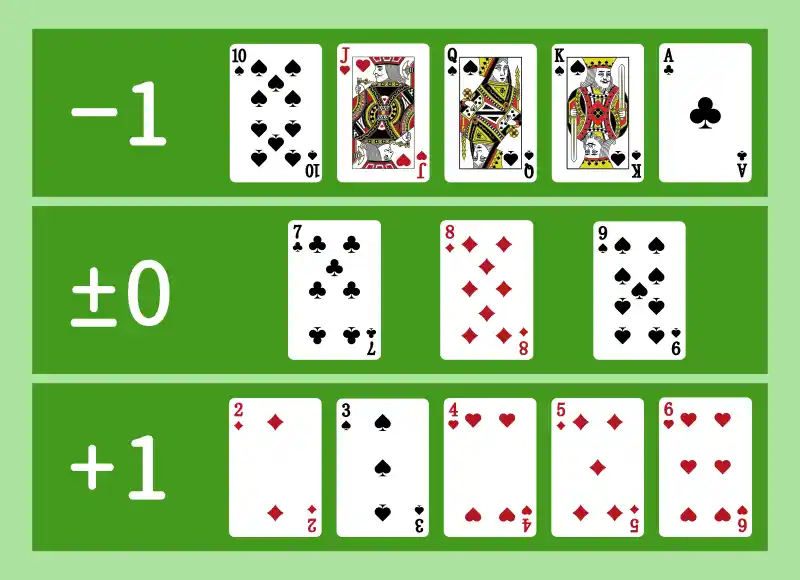
This section covers the Hi-Lo system, the most basic counting method. You only need to remember three count values, yet the system contains all the core ideas that the other methods build on.
At a live blackjack table, you start counting from the beginning of a new shoe.
| Card | Count |
|---|---|
| 10, J, Q, K, A | −1 |
| 7, 8, 9 | 0 |
| 2, 3, 4, 5, 6 | +1 |
Assign each card a value as it appears, using the table above, and keep a running total.
You need to count not only your own hand but also the cards of every other player at the table and the dealer. To keep the count running smoothly, count all the cards as soon as they are dealt, then add each new card as the players act.
Reading the Count: What Changes When It Is Positive or Negative
When the Count Is Negative
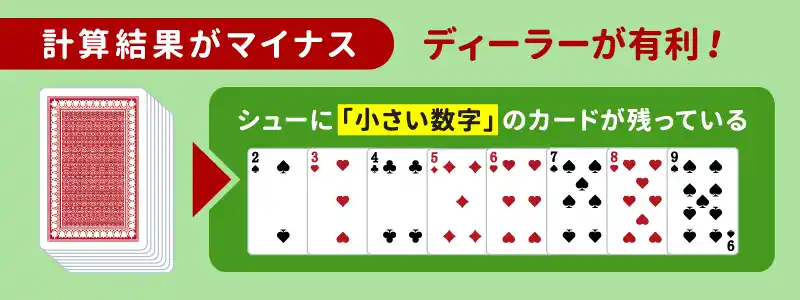
A strongly negative count means that many 10-value cards and aces have already been dealt and that many small cards remain in the shoe. The dealer is more likely to draw small cards and less likely to bust, and the player is less likely to improve a promising hand to a strong total. A negative count therefore means that this is not the time to raise your bets. We also recommend being cautious about hitting and doubling down.
When the Count Is Positive
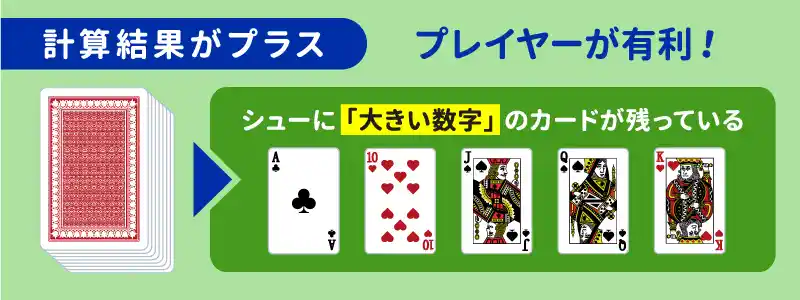
A strongly positive count means that many 10-value cards and aces remain in the shoe. The dealer is more likely to draw high cards and bust, and when the player holds a promising total such as 10 or 11, the hand is more likely to reach 21. A positive count is therefore a signal to consider placing larger bets. Even players who normally flat bet, wagering the same amount every round, can consider raising their bet at this point. It is also a good moment to double down or split, provided the decision matches basic strategy.
Five Card Counting Systems by Skill Level (Beginner to Intermediate and Above)
Of the five systems below, only the casual system is a simplified method that does not use numerical values, and it gives no statistical edge. It is included as a starting point for getting a feel for counting.
- Hi-Lo system (basic)
- Casual system (starting point; a simplified method without actual counting)
- Knock-Out (K-O) system (for beginners)
- Hi-Opt I (for intermediate players and above)
- Red Seven system (for intermediate players and above)
Hi-Lo System (Basic)
The standard method is the Hi-Lo system, covered earlier in this article in “How to Count Cards: The Hi-Lo System.” Cards 2–6 count as +1, 7, 8 and 9 count as 0, and 10, J, Q, K and A count as −1. The further the total swings into positive territory, the more likely the situation is to favor the player. The counting method and table are described above, so we recommend starting your practice with this system.
Casual System (Starting Point; No Actual Counting)
The casual system is a very simple approach in which you keep track of the cards by feel. If it seems that many high cards have been dealt, you play aggressively; if it seems that many low cards have been dealt, you play cautiously.
You may wonder whether such a loose approach can work. In fact, it gives no statistical edge. Card counting only has value when the count is accurate, and as long as you rely on feel, your expected value will not improve.
Even so, it is useful practice for developing a rough sense of whether few or many 10-value cards and aces have been dealt. Treat it as a starting point for players who want to get a feel for counting, and once you are comfortable, move on to the methods introduced below.
Knock-Out (K-O) System (for Beginners)
The Knock-Out (K-O) system is an unbalanced count that starts from an initial value set according to the number of decks. The example here uses 6 decks with an initial count of −20 (the initial value and the decision threshold change with the number of decks).
| Card | Count |
|---|---|
| 10, J, Q, K, A | −1 |
| 8, 9 | 0 |
| 2, 3, 4, 5, 6, 7 | +1 |
With 6 decks, a count above the key count of −4 means that many 10-value cards and aces remain in the shoe. Your expected value on the next hands improves in this situation, which makes it a signal to consider placing larger bets. A count near the key count is neutral, while a count well below it favors the dealer, so play cautiously. The key count depends on the number of decks and is generally given as −6 for 8 decks and +1 for 2 decks.
Hi-Opt I (for Intermediate Players and Above)
Hi-Opt I leaves aces out of the main count, which makes it easier to improve the accuracy of playing decisions such as hitting and standing. Because the main count then carries no information about aces for betting decisions, this section explains the system combined with an ace side count and the true count.
(1) Main Count
Start from a count of 0 and count the cards as follows.
| Card | Count |
|---|---|
| 10, J, Q, K | −1 |
| 2, 7, 8, 9, A | 0 |
| 3, 4, 5, 6 | +1 |
(2) Ace Side Count
Separately from the main count, track the number of aces in each group of 13 cards. If no aces appear in the first 13 cards, add +1 to the main count. If one ace appears, add 0. If two or more appear, subtract the number of aces minus one (for example, −1 for two aces and −2 for three).
(3) True Count
Divide the combined count from steps (1) and (2), which is the running count, by the number of decks remaining in the shoe to get the true count.
One deck has 52 cards, so a 6-deck shoe starts with 312 cards. A 7-deck shoe starts with 364 cards and an 8-deck shoe with 416.
Subtract the number of cards counted so far from the starting total to find the number of cards remaining. Divide that number by 52 to find the decks remaining, then calculate the true count as running count ÷ decks remaining.
Example: 6 decks, 112 cards counted, running count of +10
A 6-deck shoe holds 312 cards, so 312 − 112 = 200 cards remain
Decks remaining: 200 ÷ 52 ≈ 3.8 decks
True count: (+10) ÷ 3.8 ≈ +2.6
The higher the positive value, the more the situation favors the player.
Red Seven System (for Intermediate Players and Above)
The Red Seven system starts from a count of −12 for 6 decks (−14 for 7 decks and −16 for 8 decks), and the cards are counted as follows.
| Card | Count |
|---|---|
| 10, J, Q, K, A | −1 |
| 8, 9 | 0 |
| 7 | Red (diamonds, hearts) +1 / Black (clubs, spades) 0 |
| 2, 3, 4, 5, 6 | +1 |
As the table shows, a red 7 (diamonds or hearts) counts as +1 and a black 7 (clubs or spades) counts as 0. The color matters because a 7 is really worth about +0.5.
Counting 7s by color avoids having to work with decimals. In the Red Seven system, a count above 0 indicates that your expected value on the next hands has improved, which makes it a signal to consider placing larger bets.
Why Card Counting Rarely Works Outside Blackjack
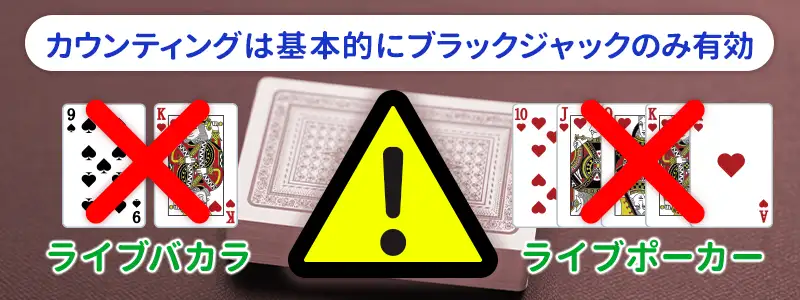
Card counting was developed specifically for blackjack, but the idea of keeping track of the cards remaining in the shoe also comes up in discussions of other card games, such as live baccarat.
However, blackjack is almost the only casino game in which card counting makes a real difference. In baccarat, an uneven mix of remaining cards has little effect on the outcome, favorable situations arise only rarely, and research has found that they do not lead to a practical edge. Keep in mind that in other games, card counting improves the player’s expected value far less than it does in blackjack.
Card Counting and RTP: Key Points to Keep in Mind

Card counting does not change the RTP itself. It is a supporting tool that aims to improve expected value by identifying the occasional favorable situations in which the count turns positive and placing larger bets in those situations.
The RTP of blackjack depends on the rules, but with basic strategy it is around 99.5%, among the highest of any casino game. Put another way, a house edge of about 0.5% (roughly 0.43–0.72% depending on the rules) still remains. RTP is a long-term theoretical value: you can win in the short term even though it is below 100%, and you can lose even when you bet well in favorable situations.
Even if you use card counting correctly and follow basic strategy strictly, it is not a guaranteed way to win, and you can still lose money. Betting systems such as the Martingale only change the size of the swings in your results by raising and lowering your stakes; they do not improve the expected value itself.
How to Practice Card Counting in Blackjack
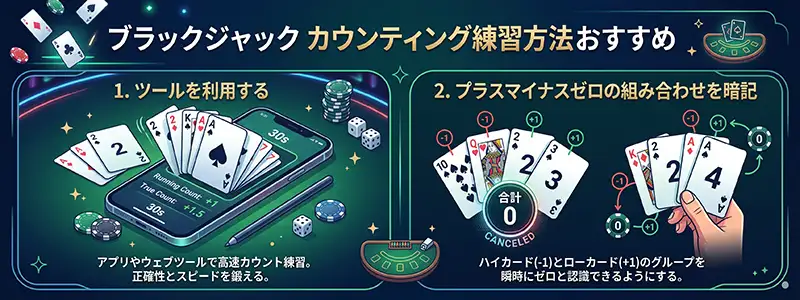
Card counting means keeping track of every card dealt, but doing this across 6–8 decks is extremely difficult. Two approaches make it easier:
- Use a practice tool
- Memorize combinations that cancel out
Use a Practice Tool
A search for terms such as “card counting app” turns up many apps designed to help with card counting.
You simply enter each card as it appears, and the app calculates whether the situation favors the player. This lets you focus on getting a feel for the count without worrying about calculation errors at the practice stage. However, many casinos prohibit the use of external tools and software in their terms and conditions, so as a rule, assume you cannot use them during actual play. Always check each casino’s terms before using one.
Memorize Combinations That Cancel Out
Each blackjack hand starts with two cards, so we recommend ignoring the pair whenever its two count values cancel out to 0.
For example, if you are dealt a K and a 4, the K counts as −1 and the 4 as +1, so the two cards cancel each other out. Memorizing combinations like this reduces the number of cards you need to count.
You can also ignore cards that count as 0 on their own. Practicing with a real deck of playing cards will help you improve faster.
Blackjack Strategies to Use Alongside Card Counting
Card counting is only useful when it is built on basic strategy, which forms the foundation for every decision. Casinos have also introduced countermeasures such as reducing penetration, so gaining an edge through card counting alone has become difficult.
Choose the Best Action with Basic Strategy
The chart below shows the hard-hand section of the standard basic strategy chart (8 decks, dealer stands on soft 17 (a hand totaling 17 with an ace counted as 11, e.g. A + 6), double down allowed on any first two cards, no doubling after splitting, no surrender).
- HHit
- SStand
- DDouble down
| Player | Dealer’s upcard | |||||||||
|---|---|---|---|---|---|---|---|---|---|---|
| 2 | 3 | 4 | 5 | 6 | 7 | 8 | 9 | 10 | A | |
| 5–8 | H | H | H | H | H | H | H | H | H | H |
| 9 | H | D | D | D | D | H | H | H | H | H |
| 10 | D | D | D | D | D | D | D | D | H | H |
| 11 | D | D | D | D | D | D | D | D | D | H |
| 12 | H | H | S | S | S | H | H | H | H | H |
| 13 | S | S | S | S | S | H | H | H | H | H |
| 14 | S | S | S | S | S | H | H | H | H | H |
| 15 | S | S | S | S | S | H | H | H | H | H |
| 16 | S | S | S | S | S | H | H | H | H | H |
| 17–20 | S | S | S | S | S | S | S | S | S | S |
Basic strategy is the mathematically optimal set of decisions for every hand in blackjack. It sets out the best action for each combination of the player’s hand and the dealer’s upcard; for example, if your hand totals 10 and the dealer’s upcard is an 8, you double down.
Whether or not you know basic strategy affects how much you lose over the long term. For this reason, we recommend learning basic strategy first.
Once you are comfortable with it, you can use basic strategy as your foundation and adjust your actions according to the count.
- Related Article
-

What Was the MIT Blackjack Team, the Inspiration for the Movie 21?

The MIT Blackjack Team was a card counting team formed by students at the Massachusetts Institute of Technology (MIT). The team is reported to have made large profits at casinos in Las Vegas and elsewhere from the 1980s through the 1990s.
The team’s story was told in the book Bringing Down the House and became widely known through the 2008 movie 21, which was based on the book.
Frequently Asked Questions About Blackjack Card Counting
- When was card counting invented?
-
Card counting is generally considered to have become widely known after the mathematician Edward O. Thorp set out the theory systematically in his 1962 book Beat the Dealer.
- Does card counting work in live blackjack?
-
In live blackjack, card counting works only at tables that deal deep into the shoe before reshuffling. It cannot be used in RNG blackjack, where a computer determines the cards, because the cards are shuffled before every round and the remaining cards never become unbalanced.
Counting cards in RNG blackjack therefore tells you nothing about which cards are likely to come next.
RNG blackjack has no time limit, however, which makes it useful for practicing the counting process itself. If you practice counting in free-play versions of the game, you will be able to keep the count without hesitation when you move to a live blackjack table.
Summary: Card Counting Helps You Spot Favorable Situations but Does Not Guarantee a Win
Card counting is one technique for reading the imbalance in the cards left in the shoe and identifying situations that statistically tend to favor the player.
These are the key points to keep in mind if you want to use card counting.
- The more 10-value cards and aces remain in the shoe, the more likely the player is to get a blackjack and the dealer is to bust, so the game tends to favor the player.
- If card counting lets you identify the moments when the expected value tips in your favor, you can improve your results by betting more in those situations.
- Online casinos make it easy to practice at your own pace, but card counting is effective only at live blackjack tables that deal deep into the shoe before reshuffling, and there are few such tables. Keep in mind as well that your betting history is recorded.
To get started, a sensible order is to learn basic strategy first and then practice the Hi-Lo system repeatedly in free-play RNG blackjack.
This site is for adults of legal gambling age (18+, or older where required) who live in countries or regions where online gambling is legal.
Use of this site is subject to our Terms and Conditions.
Gambling involves risk. Only bet what you can afford to lose, and do not use online gambling services where they are illegal.

Bell | Editor of Online Casino Winners Club. Since the site launched in 2003, Bell has written guides to casino game rules, tested betting systems and covered land-based casinos around the world, and still plays the games before writing about them. Bell's core advice: choose the bets with the lowest house edge, and decide in advance how much you are prepared to lose.