

It is tempting to hope that blackjack has some secret trick that guarantees a win. Casinos are businesses, however, and no magic system lets anyone…
Blackjack House Edge and Expected Value: RTP vs. Win Rate

Among casino games, blackjack offers the most room for strategy. To beat the dealer, players can choose from a range of actions such as hit, stand and double down.
Played according to basic strategy, blackjack has a return to player (RTP) of around 99.5%, which gives it one of the lowest house edges of any casino game. Learning basic strategy is the most direct way to keep your losses down in blackjack.
What You Will Learn
- In gambling, expected value is the average profit or loss you can expect relative to the amount bet on one hand.
- Played according to basic strategy, blackjack has an RTP of around 99.5% and a house edge of less than 1%.

This article takes about 11 minutes to read.
Contents
Show
Expected Value vs. Win Rate in Blackjack: Which Matters More?

Expected value and win rate (the probability of winning a hand, sometimes called the win percentage) are closely related concepts in gambling. Both relate to how likely you are to profit, but strictly speaking they measure different things.
In most casino games, a higher win rate also means a higher expected value, so there is little need to distinguish between the two.
In blackjack, though, an action that raises your expected value does not necessarily raise your win rate. That is why the two need to be clearly distinguished.
The Difference Between Expected Value and Win Rate
In gambling, expected value is a figure that shows how much profit (or loss) you can expect relative to the amount bet on one hand. If the value is positive, the player has the edge; if it is negative, the house (the casino) has the edge.
Expected value is calculated with the following formula.
Expected value (%) = (profit when winning × probability of winning − loss when losing × probability of losing) ÷ bet amount × 100
For example, suppose a $10,000 bet has a 60% chance of returning $20,000 and a 40% chance of returning nothing. The expected value is then calculated as follows:
(10,000 × 0.6 − 10,000 × 0.4) ÷ 10,000 × 100 = +20 (%)
The result shows that this bet has a high expected value.
Win rate, by contrast, is the probability of winning a hand. If you win 7 out of 10 hands, for example, your win rate for that session is 70%.
Win rate in this sense is simply the probability of winning a hand: a win counts as one win however much you win, and a loss counts as one loss however much you lose.
The Difference Between RTP and House Edge
So far we have talked about expected value. In casino terminology, the average amount paid back to players as a percentage of the amount bet is called the return to player (RTP), and that is the term we use from here on.
Players place money on a bet and receive a payout depending on the result. The percentage of the total amount bet that the casino pays back is the RTP.
For example, if a game is designed so that $10,000 in bets returns an average of $8,000 over the long run, its RTP is 80%. Keep in mind that this is a long-term theoretical figure, and the results of a single round, or even ten, can differ widely from it.
The house edge, by contrast, is the casino’s share. Put simply, it is 100% minus the RTP.
If a player bets $10,000 and gets back 80%, the house edge is 100% minus 80%, or 20%.
As a rule, the house edge never falls below 0%. Gambling operators are businesses, and games are designed to favor the house so that operators can cover their costs. Because RTP and house edge add up to 100%, RTP cannot exceed 100% as long as the house edge is greater than 0% (there are exceptions, such as card counting in blackjack, where the expected value can temporarily turn positive in limited situations).
To Keep Losses Down, Go by Expected Value, Not Win Rate
In blackjack, focusing on expected value rather than win rate keeps your long-term losses lower.
Doubling down, for example, lowers your win rate. You receive only one more card, so you cannot keep hitting even if that card leaves you with an awkward total. However, the benefit of doubling your bet in favorable situations outweighs the drop in how often you win, so overall the expected value is higher.
When you play according to basic strategy, you win about 42% of hands. RTP still comes close to 100% because actions such as doubling down and splitting let you get more out of favorable situations.
Basic strategy lists the action with the highest expected value, not the one with the highest chance of winning, because that is the most effective way to keep losses down over the long run. When choosing an action, go by expected value, not by your chance of winning.
Comparing the RTP of Blackjack and Other Forms of Gambling

Blackjack requires you to make your own decisions. For that reason, some players assume they would be better off with a game that is easier to play and still offers a good return.
Blackjack, however, has one of the highest RTPs among common forms of gambling: higher than lotteries, horse racing and sports betting, and higher than most other casino games.
Comparing Blackjack with Lotteries and Horse Racing
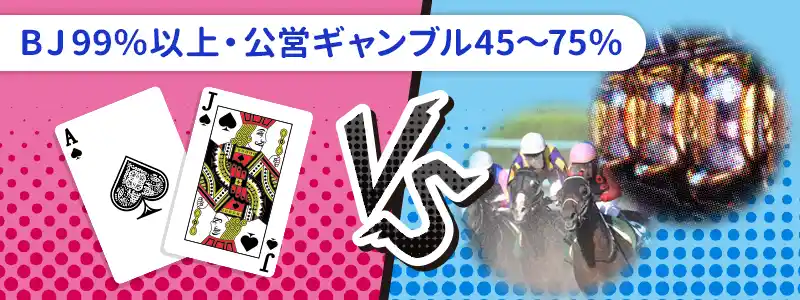
Lotteries generally return around 50–70% of ticket sales as prizes, and pari-mutuel horse racing returns roughly 75–85% of the money wagered after the track’s takeout.
These forms of gambling have substantial costs built in. Part of lottery revenue goes to public projects, for example, and horse racing revenue covers the running of racetracks and the prize money for races. It is common to spend far more on lottery tickets than you ever get back; the smallest prizes usually only return the price of a ticket.
To put this in concrete terms: if you keep playing a game with an RTP of 97%, in theory you lose about 3% of everything you wager over the long run.
Blackjack, by contrast, has an RTP of around 99.5% when played according to basic strategy. With a house edge of less than 1%, it offers exceptionally favorable odds for the player.
Comparing Blackjack with Other Casino Games

Even among casino games, which tend to have relatively high RTPs, blackjack stands out. European roulette has an RTP of 97.30% and the banker bet in baccarat about 98.94%, while blackjack played according to basic strategy reaches around 99.5%.
Casinos can operate on thin margins, but games with an RTP above 100% do not exist in principle. Online casinos also have staff costs and pay fees to game providers, so their games are designed to leave part of the money wagered with the operator.
Blackjack is no exception: its overall RTP never exceeds 100%. Only when card counting shows that many 10-value cards (10, J, Q and K) remain in the shoe can the player’s expected value temporarily turn positive.
This makes blackjack one of the few casino games in which the house edge can disappear, though only when the composition of the shoe is right.
Expected Value in Blackjack Varies by Table Rules

Not every blackjack table runs under the same conditions. Rules differ not only in named variants such as Blackjack Switch and Pontoon but also from table to table within standard blackjack.
These rule differences raise or lower the house edge slightly. In a game where the house edge is under 1%, even a difference of 0.1 percentage points has a considerable relative effect.
The list below covers common rules that differ from the standard ones. We recommend checking these conditions before you play.
- Number of decks: Compared with 8 decks, single-deck blackjack lowers the house edge by 0.48 percentage points, 2 decks by 0.19 points and 4 decks by 0.06 points
- Dealer on soft 17 (a 17 that counts an ace as 11): A rule requiring the dealer to hit (H17) raises the house edge by 0.22 points, so a table where the dealer stands (S17) has the lower house edge
- Double down rules: Tables that do not allow doubling after splitting (no DAS) add 0.14 points to the house edge. Tables that allow doubling down only on totals of 9, 10 or 11 also have a higher house edge than tables that allow doubling on any hand
- Resplitting: Tables that allow splitting into no more than 2 hands add 0.10 points to the house edge. The baseline is a table that allows splitting into up to 4 hands
- Surrender: Late surrender lowers the house edge by about 0.08 points, and full early surrender by about 0.63 points (about 0.39 points if early surrender is allowed only against an ace)
More Decks Mean a Higher House Edge and Lower Expected Value
As noted above, the more decks a game uses, the higher the house edge. Compared with single-deck blackjack, 8 decks raise the house edge by 0.48 points. Why is this?
Many factors raise or lower expected value, but the effect of a larger number of decks shows most clearly when you double down.
Basic strategy usually recommends doubling down when your hand totals 9–11. So when is a player dealt a total of 9–11? It happens when neither of the first two cards is a high card.
Examples include a 3 and a 7 for a total of 10, or a 5 and a 6 for a total of 11. Neither hand contains a 10-value card.
In a single-deck game, two low cards are already out, so the proportion of 10-value cards among the remaining cards is relatively higher. This raises the chance that a double down succeeds.
With more decks, however, the total number of cards is larger, so the effect of two low cards being removed is diluted almost to nothing. Because the chance of drawing a 10-value card does not rise, the expected value is lower than in a single-deck game.
Today, single-deck blackjack is rarely offered, and most games use 6–8 decks. More decks slightly increase how often pairs are dealt, but this does not make up the difference in house edge.
How to Keep Losses Down in Blackjack

The methods below are most effective when combined, and together they reduce your effective losses further than any one of them alone.
- Related Article
-

Use Basic Strategy to Reach an RTP in the 99% Range
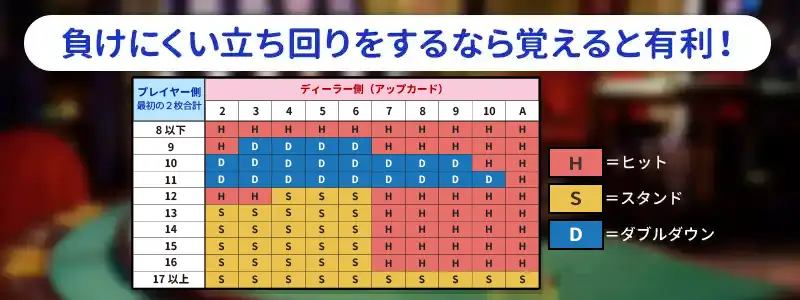
As noted above, basic strategy is a chart showing the action with the highest expected value for every combination of player hand and dealer upcard.
Following basic strategy brings the theoretical RTP to around 99.5%. By choosing actions based on expected value rather than win rate, you keep long-term losses to a minimum.
Basic strategy can only bring you up to the table’s theoretical RTP in the 99% range. Card counting, explained next, does not change the RTP of the game itself, but in the limited situations where it actually works, it lets you bet more when the odds favor you, so your return on the money you actually wager can rise above that figure.
- Related Article
-

Know When Card Counting Works
Card counting is a technique of keeping track of the cards already played in order to judge whether more high cards or more low cards remain in the shoe.
When many 10-value cards remain in the shoe, the dealer is more likely to bust when required to hit a total of 12–16, and the player is more likely to be dealt a blackjack, so the player’s expected value can turn positive in those situations. This applies, however, only to games dealt from a real-card shoe that is dealt deep before it is reshuffled. Land-based casinos may deal that deep, but they turn away players they suspect of counting. In RNG blackjack, which is reshuffled after every hand, at tables that use continuous shuffling machines, and at online live tables that reshuffle early in the shoe, counting rarely produces a practical edge.
There are several counting systems, but they all assign plus or minus values to the cards as they are dealt, and a higher positive count means a better position for the player. See our card counting guide for a detailed explanation of how to count.
When the house edge shrinks, adjusting your bet size and double-down decisions accordingly may reduce long-term losses further.
When the remaining cards are unbalanced, some decisions have to depart from basic strategy. Only players who can identify the best action on the spot can take advantage of this temporary edge.
As a Rule, Do Not Take Insurance

Insurance is a bet you can place when the dealer’s upcard is an ace. You put up half of your original bet as a hedge against a dealer blackjack.
If the dealer has a blackjack, insurance pays 2 to 1 and offsets the loss on the main bet: with a $10 main bet, a $5 insurance bet wins $10. Otherwise, you lose only the insurance bet. In an 8-deck game, the probability of the insurance bet winning is about 30.8%, which is not high enough to justify a 2 to 1 payout. On its own, insurance has an RTP of about 92.5% and an expected value of about −7.5%.
The correct play, then, is not to take insurance. Basic strategy never calls for insurance, so declining it is the best choice in terms of expected value.
Make Use of Rebate Bonuses at Online Casinos

Alongside basic strategy, it is worth making use of rebate bonuses (a percentage of everything you wager returned to you, win or lose).
Rebate bonuses return an amount based on how much you bet, regardless of whether you win or lose. Because blackjack has a high RTP, combining it with a rebate bonus makes it easier to reduce your effective losses.
Suppose, for example, you play blackjack with an RTP of 99.5% at a casino that offers a 1% rebate on live casino wagers. The theoretical loss is 0.5%, so on a simple calculation the rebate exceeds that loss. In practice, however, rebate conditions such as eligible games, caps and withdrawal requirements apply, so the amount you actually receive will be lower. A rebate does not change the game’s RTP, nor does it remove the house edge. Combining it with cashback on losses, VIP programs and similar offers can reduce your effective losses further.
In recent years, more online casinos have focused on live games, and many now make rebate bonuses a central feature. If you plan to play blackjack regularly, rebate terms are worth including in your criteria for choosing where to play.
Summary: Play by Expected Value, Not Win Rate, to Keep Blackjack Losses to a Minimum
In blackjack, expected value does not necessarily rise when your win rate does. Sometimes the right choice is an action that lowers your win rate, but consistently choosing the play with the highest expected value keeps your long-term losses down.
Played according to basic strategy, blackjack has an RTP of around 99.5%. Under the right conditions, such as card counting at a table dealt deep into the shoe or rebate bonuses, your effective losses can come close to zero. These are conditional exceptions, however, and they do not mean you will always win. Even so, blackjack has one of the lowest house edges of any casino game, which makes it worth learning properly and playing with patience.
This site is for adults of legal gambling age (18+, or older where required) who live in countries or regions where online gambling is legal.
Use of this site is subject to our Terms and Conditions.
Gambling involves risk. Only bet what you can afford to lose, and do not use online gambling services where they are illegal.

Bell | Editor of Online Casino Winners Club. Since the site launched in 2003, Bell has written guides to casino game rules, tested betting systems and covered land-based casinos around the world, and still plays the games before writing about them. Bell's core advice: choose the bets with the lowest house edge, and decide in advance how much you are prepared to lose.