

Basic strategy is the first thing to learn if you want to play blackjack well. What You Will Learn Basic strategy is the fundamental way to play every…
Blackjack Odds: Chances of Getting 21, Bust Rates and Pairs

Blackjack is known as a casino game with a strong strategic element. A player who follows basic strategy can reach a return to player (RTP) of around 99.5%, and knowing the probabilities behind the game helps you understand that strategy more deeply.
For example, the probability of being dealt a blackjack with your first two cards is about 4.8%, or roughly once in every 21 hands. Understanding the probabilities in blackjack shows you why hitting or standing is the right choice in a given situation, and that in turn makes basic strategy easier to follow.
What You Will Learn
- The probability that a player is dealt a natural blackjack is about 4.8%.
- The dealer’s bust rate ranges from 11.5% to 42.3%, depending on the upcard.
- Insurance wins about 30.8% of the time, short of the break-even point of about 33.3%, so its expected value is negative.

This article takes about 13 minutes to read.
Contents
Show
Understanding the Key Probabilities in Blackjack
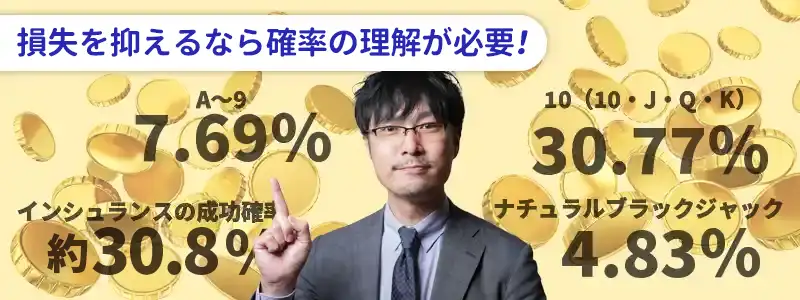
If you want to avoid unnecessary losses in blackjack, we recommend learning the probabilities behind the game as well as basic strategy.
Under standard conditions (8 decks, the dealer stands on soft 17 – a 17 that counts an ace as 11 – and blackjack pays 3 to 2), blackjack played according to basic strategy reaches an RTP of around 99.5%. Combined with card counting, the theoretical expected value can turn positive, but only in certain rare situations when the composition of the remaining cards is favorable. In RNG blackjack, and at online live tables where the cards are reshuffled after only a small part of the shoe has been dealt, this edge is almost never available. Whether the expected value has turned positive cannot be judged at a glance; it depends on having an accurate picture of the situation at the table. Building that picture requires a working knowledge of the key probabilities in blackjack, and without it, making correct decisions is difficult.
If you are not yet familiar with blackjack, start by learning the rules in the “Blackjack Beginner’s Guide” at the end of this article.
Basic Strategy Is Built on Probability
The table below shows the hard-hand section of the standard basic strategy chart (8 decks, dealer stands on soft 17, double down allowed on any first two cards, no doubling after splitting, no surrender).
- HHit
- SStand
- DDouble down
| Player | Dealer’s upcard | |||||||||
|---|---|---|---|---|---|---|---|---|---|---|
| 2 | 3 | 4 | 5 | 6 | 7 | 8 | 9 | 10 | A | |
| 5–8 | H | H | H | H | H | H | H | H | H | H |
| 9 | H | D | D | D | D | H | H | H | H | H |
| 10 | D | D | D | D | D | D | D | D | H | H |
| 11 | D | D | D | D | D | D | D | D | D | H |
| 12 | H | H | S | S | S | H | H | H | H | H |
| 13 | S | S | S | S | S | H | H | H | H | H |
| 14 | S | S | S | S | S | H | H | H | H | H |
| 15 | S | S | S | S | S | H | H | H | H | H |
| 16 | S | S | S | S | S | H | H | H | H | H |
| 17–20 | S | S | S | S | S | S | S | S | S | S |
Basic strategy, widely known as the foundation of blackjack, is itself built on probability theory.
For each specific situation, such as a player hand of 9 against a dealer upcard of 5, the expected value of every available action (hit, stand, double down, split and, where offered, surrender) is calculated, and the action with the highest expected value becomes the recommended play; in this example, that is double down. Basic strategy is the collection of these conclusions.
- Related Article
-

Probability of Drawing a Specific Card in Blackjack
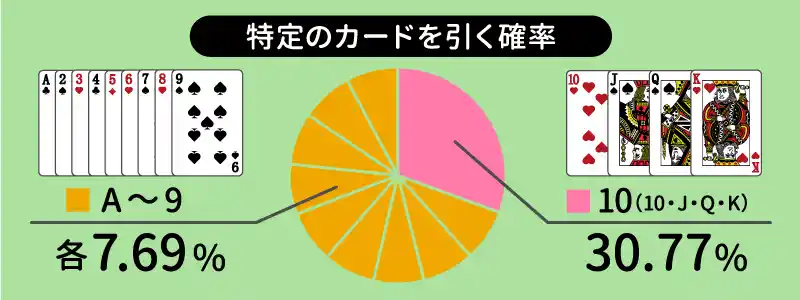
In blackjack dealt from a shoe, the probability of each card does not stay fixed. It changes depending on which cards have already been dealt. In RNG blackjack, the cards are reshuffled after every round, so each round is an independent event and cards dealt earlier have no effect on the probabilities in the next round.
- Related Article
-

Any Rank from A to 9: About 7.69%
The probability of drawing one specific rank from A to 9 (for example, a 7) is about 7.69%.
A standard 52-card deck contains four cards of each rank, one in each of the four suits: spades, clubs, diamonds and hearts.
The probability that the first card drawn is a specific rank is therefore 4 ÷ 52 = 0.07692…, or 7.69%.
Now suppose the first card is an A, and consider the probability that the second card is also an A. Three aces remain among 51 cards, so the probability is 3 ÷ 51 = 0.05882…, or 5.88%.
Keep in mind that the probability changes considerably depending on the cards remaining.
10-Value Cards (10, J, Q, K): About 30.77%
The probability of drawing a 10-value card is about 30.77%.
As noted above, each rank has four cards. There are four ranks of 10-value cards (10, J, Q and K), so a deck contains 4 × 4 = 16 of them.
The probability that the first card drawn is a 10-value card is therefore 16 ÷ 52 = 0.30769…, or 30.77%.
Likewise, if the first card is a 10-value card, the probability that the second is also a 10-value card is 15 ÷ 51 = 29.41%.
Because there are far more 10-value cards than cards of any other rank, their probability rarely shifts much, even as more rounds are played. That said, when much of the shoe has been dealt and a high proportion of 10-value cards remains, the house edge tends to be lower.
Probability of Making 21 in Blackjack

A total of 21 with the first two cards is called a natural blackjack, and the probability of being dealt one depends on the number of decks in the game. This section also covers the probability of reaching exactly 21 with a single hit.
Natural Blackjack: About 4.8%
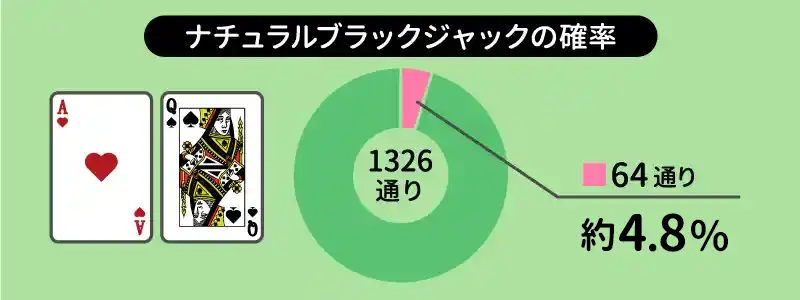
A natural blackjack is a hand in which the first two cards dealt are an A and a 10-value card. The probability of this hand can be calculated as follows.
Single deck (52 cards)
There are C(52, 2) = 1,326 possible combinations of the first two cards, and 4 × 16 = 64 of them make a blackjack. The probability of a natural blackjack is therefore 64 ÷ 1,326 = 0.04827…, or about 4.83% (roughly once in every 21 hands).
8 decks (416 cards)
An 8-deck shoe contains 416 cards in total, including 32 aces and 128 10-value cards. There are C(416, 2) = 86,320 possible combinations of the first two cards, and 32 × 128 = 4,096 of them make a blackjack. The probability of a natural blackjack is therefore 4,096 ÷ 86,320 = 0.04745…, or about 4.75%, so the probability falls slightly as the number of decks increases.
A natural blackjack generally pays 3 to 2. With a $100 bet, for example, a winning blackjack wins $150, and you get $250 back in total, including your original bet. Although it comes only about once in every 21 hands, it pays more than an ordinary win at 1 to 1, where a $100 bet wins $100, and this makes it an important part of the expected value of blackjack.
Some tables, however, set the blackjack payout at 6 to 5, in which case a $100 bet wins only $120. This payout alone raises the house edge by about 1.39 percentage points, so always check that blackjack pays 3 to 2 when choosing a table.
The Probability of Making 21 with One Hit Depends on Your Hand
The figures below show the probability that one additional card brings the hand to exactly 21, not the probability that the hand eventually reaches 21. For example, you might hit on 12, draw a 2 and then a 7 to make 21. That hand did reach 21 from 12, but it is not included in the probabilities in the table below.
| Hand | Probability of making 21 with one hit |
|---|---|
| 9 or less | Cannot make 21 |
| 10 | About 7.69% |
| 11 | About 30.77% |
| 12–20 | About 7.69% |
For simplicity, these probabilities are approximations calculated on the assumption that all 52 cards remain. In practice, your own cards and the other players’ cards are already on the table, so the actual figures vary slightly.
With a hand of 9 or less, no single card can bring the total to 21; at least two more cards are needed. On 10, only an A makes 21, and on 11, any 10-value card does. From 12 to 20, exactly one rank makes 21: a 9 on 12, an 8 on 13 and so on. The probability on 11 is far higher than the rest because a deck contains 16 10-value cards.
On a hand of 11, doubling down makes 21 more than 30% of the time, and even if the hand does not reach 21, it cannot bust. This makes 11 the situation in which doubling down has the highest expected value. Likewise, on a hand of 10, doubling down produces a total of 20 or more close to 40% of the time, and the hand cannot bust, so 10 has the next-highest expected value after 11.
Probability of Busting in Blackjack

In blackjack, a player who busts loses regardless of the dealer’s total, and a dealer who busts loses to every player who has not busted. Knowing the probability of busting is therefore very important.
If you adjust your play to the situation – standing when a hit is likely to bust you, and not hitting unnecessarily when the dealer is likely to bust – you will avoid more unnecessary losses and your results will come closer to the game’s theoretical RTP.
Probability of the Player Busting
You generally want to avoid busting, but when your hand is in a weak position, you sometimes have to accept that risk and draw.
The table below covers hard hands. Soft hands, which contain an ace counted as 11, can all be treated as falling in the “11 or less” row.
| Hand | Probability of busting with one hit |
|---|---|
| 11 or less | Cannot bust |
| 12 | 30.77% |
| 13 | 38.46% |
| 14 | 46.15% |
| 15 | 53.85% |
| 16 | 61.54% |
| 17 | 69.23% |
| 18 | 76.92% |
| 19 | 84.62% |
| 20 | 92.31% |
A hard hand of 11 or less can never bust, but at 12 the probability jumps straight to over 30%.
On 12, only a 10-value card busts the hand, and as explained earlier, the probability of drawing one is 30.77%, which is why the figure is this high. From there, each additional point raises the risk of busting by 7.69 percentage points, and above 17 the probability of busting exceeds 70%. On 17 or more, therefore, hitting is riskier than standing whatever the dealer’s upcard.
Hands of 12–16 also carry considerable risk, so when the dealer’s upcard is weak (likely to bust), standing has the higher expected value. When the upcard is strong, however, you need to hit despite the risk.
Probability of the Dealer Busting
The dealer must hit on 16 or less and stand on 17 or more, so this is the probability that the dealer’s hand fails to finish on 17–21 and busts instead. The figures below assume 8 decks and a dealer who stands on soft 17 (S17). At tables where the dealer hits soft 17 (H17), the figures differ slightly. The figures for 10-value cards and the ace count hands in which the dealer makes a blackjack as “not busting.” Once the dealer has checked the hole card and confirmed there is no blackjack, the probability rises to about 23.0% for a 10-value upcard and about 16.7% for an ace.
The figures also include cases in which the dealer hits, still has 16 or less, draws again and then busts. For example, an upcard of 4 followed by a 5, a 6 and then a K counts as a bust with a 4 upcard.
| Upcard | Probability of eventually busting |
|---|---|
| 2 | 35.4% |
| 3 | 37.4% |
| 4 | 39.6% |
| 5 | 41.8% |
| 6 | 42.3% |
| 7 | 26.2% |
| 8 | 24.4% |
| 9 | 22.9% |
| 10, J, Q, K | 21.2% |
| A | 11.5% |
The dealer busts often with an upcard of 2–6, and with a 5 or 6, the bust rate exceeds 40%. With an upcard of 6 or less, the dealer rarely reaches 17 with two cards and usually has to draw a third card or more. Each additional draw adds to the chance of busting.
From 7 upward, however, the probability of busting drops sharply. If the next card is a 10-value card, the dealer reaches 17 or more and stands, so with these upcards the dealer often stands on two cards and busts less often. The ace is a special case. Its figure includes hands in which the dealer makes a natural blackjack, and because an ace counted as 11 can be recounted as 1 if the total goes over 21, the dealer cannot bust on the next card drawn. Together, these factors pull the ace’s bust rate down considerably.
When the dealer’s upcard is an ace, the dealer’s bust rate is at its lowest and the situation tends to favor the house, so following basic strategy to limit your losses is especially important.
Probability of Being Dealt a Pair in Blackjack
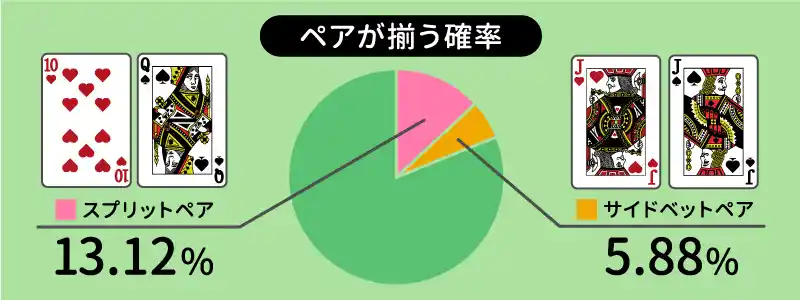
The word “pair” has two meanings in blackjack. The first is a pair that can be split, which also includes any two 10-value cards (such as J and K, or 10 and Q). The second is a pair that qualifies for a side bet. In this case, two 10-value cards do not count unless they are the same rank.
Probability of a Pair That Can Be Split (Single Deck)
- First, count the possible combinations of the two cards dealt. The first card can be any of the 52 cards and the second any of the remaining 51.
The order of the two cards does not matter, however, so the number of combinations is 52 × 51 ÷ 2 = 1,326. - Next, consider the case in which both cards are aces. The first card can be any of the 4 aces and the second any of the 3 remaining aces. Again, the order does not matter, so the number of combinations is 4 × 3 ÷ 2 = 6.
The same calculation applies to each rank from A to 9, so the number of combinations for A through 9 is 6 × 9 = 54. - Next, consider the combinations in which both cards are 10-value cards (10, J, Q or K). There are four ranks with four cards each, so the first card can be any of 4 × 4 = 16 cards and the second any of the 15 remaining cards among those 16. Again, the order does not matter, so the number of combinations is 16 × 15 ÷ 2 = 120.
The probability is the number of pair combinations (54 + 120) divided by the total number of combinations (1,326): 174 ÷ 1,326 = 0.13122…, or 13.12%.
Probability of a Pair That Qualifies for a Side Bet (Single Deck)
- As with splitting, there are 1,326 possible combinations of the two cards dealt, and 6 combinations of two cards for each rank.
- A pair for a side bet must consist of two cards of the same rank, so only the 13 ranks from A to K are counted, giving 6 × 13 = 78 combinations.
Unlike with splitting, two 10-value cards of different ranks (such as J and K) do not count. - The probability is (2) divided by (1): 78 ÷ 1,326 = 0.05882…, or 5.88%. This accounts for the difference between 13.12% and 5.88%.
Probability of Winning an Insurance Bet in Blackjack
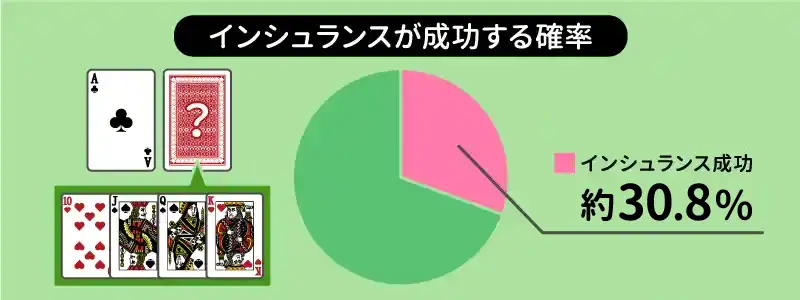
Insurance is a bet you can place when the dealer’s upcard is an ace. You bet half of your original bet as insurance against the dealer having a blackjack.
If the dealer’s hole card is a 10-value card, the insurance bet wins and pays 2 to 1, so with a $10 main bet, a $5 insurance bet wins $10. The main bet loses, but the insurance payout offsets that loss, and you break even overall.
An insurance bet wins when the dealer’s hole card is a 10, J, Q or K. Because the ace upcard is already on the table, the calculation has to use the remaining 51 cards. The probability of winning the insurance bet is therefore 16 ÷ 51 = about 31.4% (single deck) and 128 ÷ 415 = about 30.8% (8 decks).
At these probabilities, insurance has a negative expected value. Because insurance pays 2 to 1, the break-even point is one in three (about 33.3%), but the actual probability of winning is only about 30.8% in an 8-deck game. The expected value is about −5.9% with a single deck and about −7.5% with 8 decks. Unless card counting tells you that many 10-value cards remain, basic strategy says that as a rule you should not take insurance.
- Related Article
-

Frequently Asked Questions About Blackjack Probability
- What are the chances of getting a blackjack (21) with the first two cards?
-
The probability of being dealt a natural blackjack varies slightly with the number of decks in use. A common rule of thumb is about 4.8%, or roughly once every 21 hands.
- Should you always split a pair?
-
No. Splitting helps in some situations and hurts in others, so you should not split every pair. Splitting gives you two hands, but it also doubles the amount you have at stake.
Under standard rules, basic strategy says to always split a pair of aces or a pair of 8s, and never to split a pair of 10s or a pair of 5s. Under the standard chart, which does not allow doubling down after splitting, a pair of 4s is not split either. For the correct play with each pair, see our separate article on splitting.
Summary: Knowing the Probabilities Helps You Understand Basic Strategy
Blackjack is often seen as a casino game in which memorizing basic strategy is all you need, but basic strategy itself is built on probability, and the composition of the remaining cards changes constantly as the game progresses.
In some situations, when card counting gives you an accurate picture of the cards left in the shoe, an action other than the one basic strategy recommends can have a higher expected value. To recognize those situations, however, you first need to understand the theoretical probabilities. Over the long run, playing by the probabilities rather than by intuition makes a large difference in how much you lose.
You do not need to memorize everything, but two figures bear directly on your choice of action and are worth knowing: the probability of a natural blackjack and the dealer’s bust rate.
Keep in mind, however, that the figures in this article assume a full deck. As cards are dealt and the composition of the remaining cards shifts, the probabilities can change significantly. Understand the theoretical probabilities, but do not rely on them blindly.
This site is for adults of legal gambling age (18+, or older where required) who live in countries or regions where online gambling is legal.
Use of this site is subject to our Terms and Conditions.
Gambling involves risk. Only bet what you can afford to lose, and do not use online gambling services where they are illegal.

Bell | Editor of Online Casino Winners Club. Since the site launched in 2003, Bell has written guides to casino game rules, tested betting systems and covered land-based casinos around the world, and still plays the games before writing about them. Bell's core advice: choose the bets with the lowest house edge, and decide in advance how much you are prepared to lose.