

Basic strategy is the first thing to learn if you want to play blackjack well. What You Will Learn Basic strategy is the fundamental way to play every…
Double Down in Blackjack: What It Is and When to Use It

To double down means to add a bet equal to your original bet, doubling your stake, on the condition that you receive only one more card. Doubling down makes your results swing more from round to round, but if you use it only in situations with a high expected value, it keeps your expected loss low.
Many players hesitate to double down because they are afraid of losing, or they miss the opportunities when it is correct. Used only in the situations that basic strategy recommends, doubling down keeps you from giving up value in favorable hands. Used outside those situations, it simply doubles your losses.
What You Will Learn
- When a double down in blackjack wins, your profit is twice your original bet.
- Following basic strategy lets you limit doubling down to situations with a high expected value.

This article takes about 10 minutes to read.
Contents
Show
What Is a Double Down in Blackjack?
Besides hit and stand, blackjack has several other actions that affect your expected value. Of these, the double down lowers your expected loss when you use it only in favorable situations.
To double down means to double your original bet in exchange for being limited to one more card.
- Advantage: A winning hand pays twice your original bet (you get back four times your original bet in total). With a $10 original bet, you win $20 and get $40 back.
- Disadvantage: You can draw only one more card.
Why Double Down Despite the Risk?
Being limited to one card may seem risky.
Consider the odds, though. In blackjack, the player wins about 42% of hands, loses about 49% and pushes about 8.5% (the figures do not add up to 100% due to rounding), so even when you play correctly, the game remains slightly in the house’s favor.
The house edge cannot be eliminated entirely, but doubling down is an effective way to avoid giving up value in favorable hands and play the game at a house edge as close as possible to its theoretical minimum.
Double Down Rules
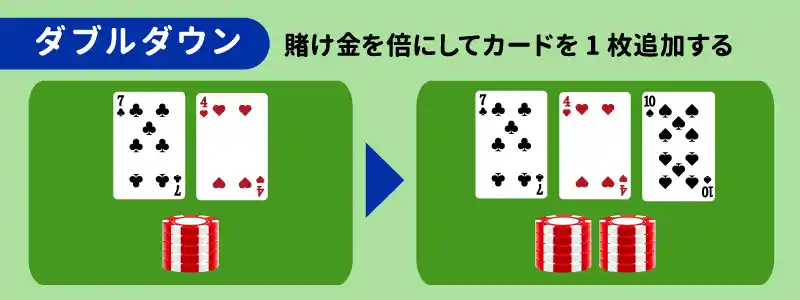
When you can double down depends on the table. Some tables allow it only when your first two cards total 9–11, while others allow it on any hand. Evolution’s live blackjack, which runs a large number of tables, places no restriction on the total as long as you double on your first two cards. Some games, such as Play’n GO’s RNG blackjack, limit it to totals of 9–11. Some casinos also allow you to double down on hands after a split. Check the in-game rules before you sit down.
When you double down, you add a bet equal to your original bet and receive exactly one more card. After that, you cannot take any further action, such as drawing another card. The hand is then settled as usual. If you win, your total bet, including the added amount (twice your original bet), is paid 1 to 1, so you get back four times your original bet, a profit of twice your original bet. With a $10 original bet, your $20 total bet wins $20, and you get $40 back.
Bankroll Needed to Double Down and How It Works
You cannot double down if your balance is smaller than the amount you need to add, so you should avoid going all in (betting your entire balance) in blackjack. If you split and then double down on both hands, you need four times your original bet, so your original bet should be no more than 25% of your balance. This is only an upper limit that ensures every action stays available to you. Changing your bet size does not change the return to player (RTP) or the house edge. To limit the risk of losing your entire bankroll, however, a conservative guideline is to keep each bet to about 1% of your bankroll.
1. Place Your Bet
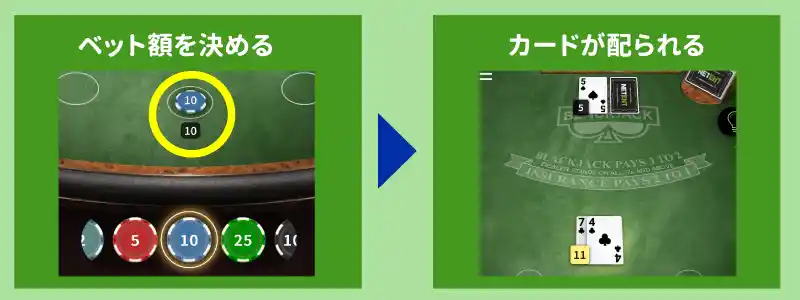
Start by placing your bet as usual. The dealer then deals the cards: you receive two cards, and the dealer shows one upcard.
2. Choose Double Down and Add to Your Bet
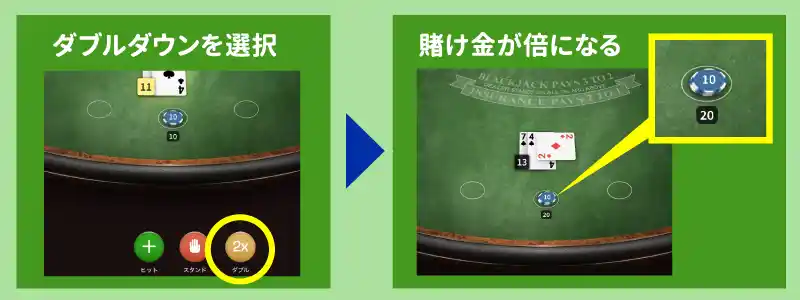
You can double down only as your first action. If you hit first, you cannot double down afterward.
The button varies from game to game, but it is usually labeled “2x” or “Double.” When you select it, a bet equal to your original bet is added automatically, and you are dealt one card.
At a land-based casino, you signal a double down by placing chips equal to your original bet next to your original chips. Some casinos also ask you to hold up one finger, but the etiquette varies by table, so ask the dealer if you are unsure.
3. Draw One Card to Settle the Hand
The one card you draw completes your hand, and all that remains is to wait while the dealer hits on 16 or less and stands on 17 or more. If you have not busted, the hand is settled as usual.
When Doubling Down Has a High Expected Value
You can double down whenever the table rules allow it, but doing so in the wrong situations only increases your losses. Learning when to double down is the most direct way to keep the house edge in blackjack as low as possible.
Double Down According to Basic Strategy
The chart below shows the hard-hand section of the standard chart (8 decks, dealer stands on soft 17, double down allowed on any first two cards, no doubling after splitting, no surrender). A soft 17 is a 17 in which an ace is counted as 11.
- HHit
- SStand
- DDouble down
| Player | Dealer’s upcard | |||||||||
|---|---|---|---|---|---|---|---|---|---|---|
| 2 | 3 | 4 | 5 | 6 | 7 | 8 | 9 | 10 | A | |
| 5–8 | H | H | H | H | H | H | H | H | H | H |
| 9 | H | D | D | D | D | H | H | H | H | H |
| 10 | D | D | D | D | D | D | D | D | H | H |
| 11 | D | D | D | D | D | D | D | D | D | H |
| 12 | H | H | S | S | S | H | H | H | H | H |
| 13 | S | S | S | S | S | H | H | H | H | H |
| 14 | S | S | S | S | S | H | H | H | H | H |
| 15 | S | S | S | S | S | H | H | H | H | H |
| 16 | S | S | S | S | S | H | H | H | H | H |
| 17–20 | S | S | S | S | S | S | S | S | S | S |
The most important principle is to double down according to a basic strategy chart.
A basic strategy chart is a table that shows the action with the highest expected value for each combination of the player’s hand and the dealer’s upcard.
The chart lists actions such as hit, stand, double down and split. By playing exactly as it indicates, you choose the option with the highest expected value in every situation.
| H (Hit) | Draw one card |
|---|---|
| S (Stand) | Take no more cards and play the hand as it is |
| D (Double down) | Double your bet and receive exactly one more card |
| P (Split) | If your first two cards are of the same rank, split them into two hands and draw cards to each (some tables also allow you to split any two 10-value cards: 10, J, Q or K) |
| R (Surrender) | Forfeit half your bet and end the hand |
Some of the actions on the chart may seem counterintuitive, though. The most common examples are covered below.
- Related Article
-

When Your Hand Totals 9, 10 or 11
When your hand totals 9, 10 or 11, doubling down often has a higher expected value than hitting, depending on the dealer’s upcard. A basic fact of blackjack is that 10-value cards (10, J, Q, K) are the most common cards in the shoe. All four ranks count as 10, so the probability that the next card is a 10-value card is over 30%. When your first two cards total 9–11, you have a good chance of reaching 19–21, so these are situations where increasing your bet carries only a small disadvantage.
With a hand of 9, 10 or 11, we recommend doubling down when the dealer’s upcard is as follows.
- Hand of 9 → dealer’s upcard is 3–6
- Hand of 10 → dealer’s upcard is 2–9
- Hand of 11 → dealer’s upcard is anything but an A (2–10, J, Q, K)
When Your Hand Includes an Ace
Of the hands on which basic strategy calls for a double down, soft hands are the most counterintuitive. A soft hand is one in which an ace can be counted as 11 without busting. A hand with no ace, or one in which the ace cannot be counted as 11, is called a hard hand.
For example, with A + 4, basic strategy calls for a double down when the dealer’s upcard is 4–6. A + 4 is a weak total of 15, so doubling down hardly seems like the best play.
There are two reasons. First, when the dealer’s upcard is 4–6, the dealer is more likely to bust. Under standard conditions, with 8 decks and the dealer standing on soft 17, the dealer busts 21.2% of the time with a 10 upcard, compared with 39.6% with a 4, 41.8% with a 5 and 42.3% with a 6. (The figure for a 10 includes hands in which the dealer has blackjack. Once the dealer has checked the face-down card, called the hole card, for blackjack, it is about 23.0%.)
If you draw a 10 to A + 4, the ace counts as 1 and you have a hard 15. With a dealer upcard of 4–6, the correct play on that hand is to stand anyway, so you would not need another card. Basic strategy therefore recommends doubling on these soft hands for two reasons: being limited to one card costs you little, and the dealer has a high chance of busting.
The situations in which to double down on a hand that includes an ace are as follows.
- A + 2 or A + 3 → dealer’s upcard is 5–6
- A + 4 or A + 5 → dealer’s upcard is 4–6
- A + 6 or A + 7 → dealer’s upcard is 3–6
When the Dealer’s Upcard Is 3–6
Finally, here is when to double down based on the dealer’s upcard. When the upcard is 3–6, the dealer is more likely to bust than with any other upcard.
With a 3, the dealer’s bust probability is 37.4%, which, like the figures for 4–6 above, is higher than for the other upcards. An upcard of 3–6 is therefore a situation in which doubling down tends to have a higher expected value.
If you bust, however, you lose even if the dealer also busts. For that reason, double down only on hands that cannot bust with one more card (hard 11 or less, or soft hands). The specific combinations are those listed above for hard 9–11 and for soft hands.
Benefits and Risks of Doubling Down
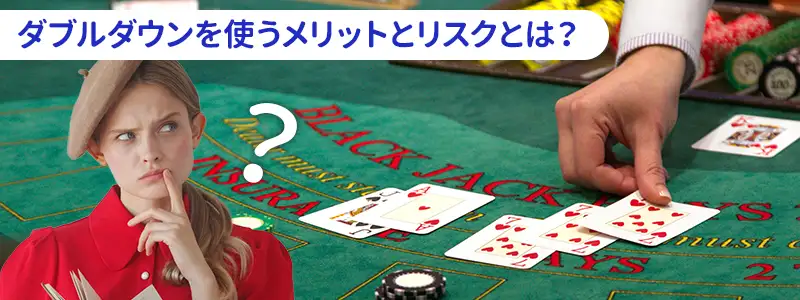
The benefit of doubling down in blackjack is that, by raising your bet only in situations with a high expected value, you can keep your overall losses lower.
The risk of doubling down is that your bet is doubled. If you double down and win, your winnings are doubled, but if you lose, your loss is doubled as well. For that reason, limit it to the combinations of hand and upcard on which basic strategy calls for it.
Frequently Asked Questions About Doubling Down
- What is the difference between doubling down and hitting?
-
Doubling down and hitting are both actions available to the player in blackjack. To double down, you double your bet after your first two cards are dealt and receive exactly one more card. It is most effective in favorable situations, such as when your total is 9–11.
To hit, you draw another card without changing your bet. You can hit as many times as you like as long as your total is 20 or less.
- Can I double down after splitting?
-
It depends on the table. Evolution’s live blackjack, which runs a large number of tables, does not allow doubling after splitting (DAS). At tables that allow DAS, the house edge is about 0.14 percentage points lower (slightly less when you can split only once), so check the table rules before you sit down.
Summary: Double Your Bet Only in Favorable Situations
Doubling down in blackjack is not simply a gamble. It is one of the actions, backed by probability, that keep your expected loss down.
- The key to limiting losses: The player wins less often than the dealer, so raising your bet only in favorable situations is the realistic way to keep your overall losses small.
- Overcoming the psychological barrier: Raising the bet takes nerve for a beginner, but when you use it in the situations basic strategy specifies, it becomes an action with a high expected value rather than a reckless bet.
- Making consistent decisions: Doubling down correctly is the first step toward moving beyond luck-based play and making decisions on a sound basis.
Doubling down is an action that pays off only in a limited number of situations, such as when your total is 10 or 11. A practical approach is to keep a note of the hard 9–11 and soft-hand conditions nearby, so that you can double down without hesitation when, and only when, one of those combinations comes up.
This site is for adults of legal gambling age (18+, or older where required) who live in countries or regions where online gambling is legal.
Use of this site is subject to our Terms and Conditions.
Gambling involves risk. Only bet what you can afford to lose, and do not use online gambling services where they are illegal.

Bell | Editor of Online Casino Winners Club. Since the site launched in 2003, Bell has written guides to casino game rules, tested betting systems and covered land-based casinos around the world, and still plays the games before writing about them. Bell's core advice: choose the bets with the lowest house edge, and decide in advance how much you are prepared to lose.