

A split is an action you can take when your first two cards are a pair (two cards of the same rank): you separate them and play each card as its own…
Ace in Blackjack: How It Counts as 1 or 11 and How to Play It

In blackjack, the ace (A) is the most powerful card. It is the only card that can count as either 1 or 11, and paired with a 10-value card (10, J, Q or K) it makes a natural blackjack, the best hand in the game.
A hand that contains an ace therefore tends to give the player a better expected return. When the dealer’s upcard is an ace, however, the situation favors the house, and you often need to hit weak totals rather than count on the dealer busting.
What You Will Learn
- The ace is the most powerful card in blackjack and can count as 1 or 11.
- When you are dealt an ace, check the soft-hand section of the strategy chart.

This article takes about 9 minutes to read.
Contents
Show
How the Ace Counts in Blackjack
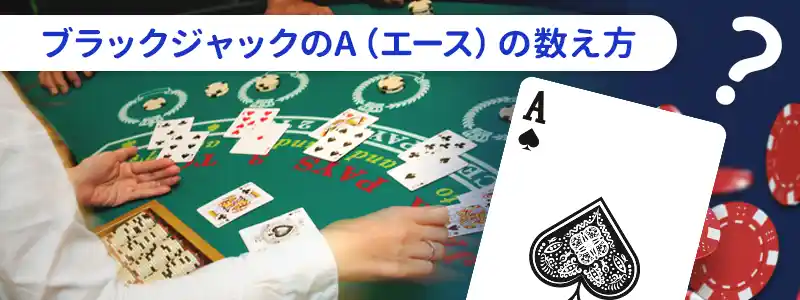
Cards 2–10 count at face value, and the J, Q and K each count as 10. The ace is different: it can be counted in two ways, and set rules determine which value applies in each hand.
When an Ace Counts as 1 or 11
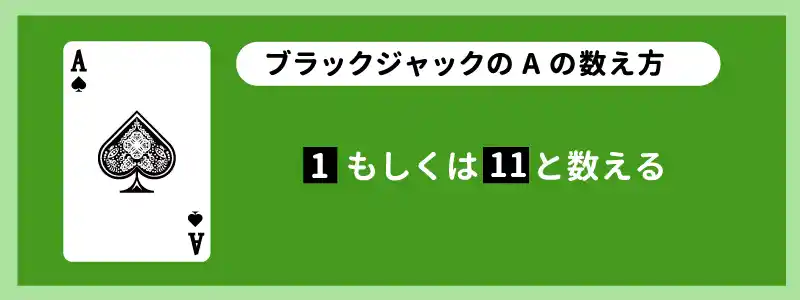
An ace counts as either 1 or 11, whichever is better for the hand. In practice, the ace counts as 11 unless that would bust the hand, in which case it counts as 1.
Hands Where the Ace Can Count as Either 1 or 11
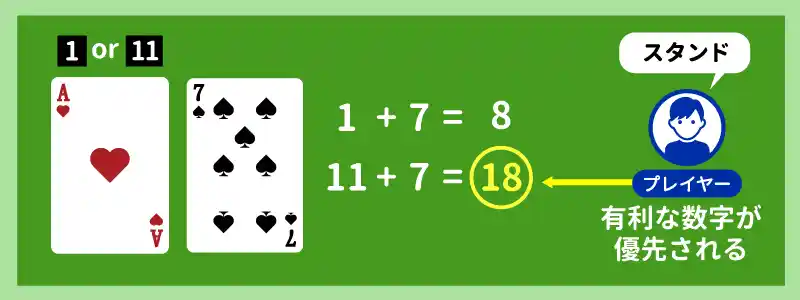
With A + 7, for example, the hand totals 8 if the ace counts as 1, or 18 if it counts as 11. For this reason, online blackjack games usually display both totals, as in “8 / 18.”
If you stand, the hand automatically counts as 18. The dealer’s hand is counted the same way, so a dealer holding A + 7 has 18.
Hands Where the Ace’s Value Is Set Automatically

When the ace automatically counts as 1
Suppose you hit on A + 7 and draw a 5. Counting the ace as 11 would give 11 + 7 + 5 = 23, a bust, so the ace counts as 1 and the hand totals 13. Whenever counting the ace as 11 would bust the hand, it counts as 1.
When the ace automatically counts as 11
If counting the ace as 11 makes the total 21, the ace always counts as 11. With A + 7 + 3, for example, the hand could in principle total either 1 + 7 + 3 = 11 or 11 + 7 + 3 = 21, but in most games the hand is treated as 21 and stands.
The same applies when the first two cards form a natural blackjack. A hand such as A + J could total either 11 or 21, but it is automatically a natural blackjack, so you cannot hit, double down or take any other action.
Hands with Two or More Aces
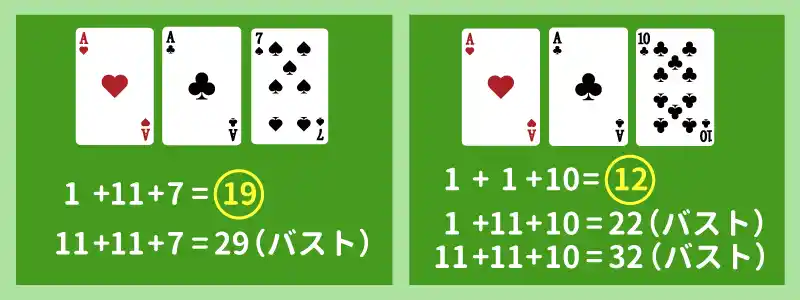
When a hand contains two or more aces, no two of them can count as 11, because 11 + 11 = 22 is always a bust. Depending on the rest of the hand, there are two possible cases.
One Ace Counts as 11, the Other as 1
With A + A + 7, for example, counting one ace as 11 and the other as 1 gives 11 + 1 + 7 = 19. If you stand at this point, the hand counts as 19. If you hit instead and draw a high card, both aces then count as 1, so the total is recalculated as 1 + 1 + 7 = 9 plus the new card, and the hand does not bust.
Both Aces Count as 1
With A + A + 10, for example, even counting just one ace as 11 gives 11 + 1 + 10 = 22, a bust. In this case, both aces count as 1 and the hand totals 1 + 1 + 10 = 12.
How to Play Hands with an Ace: Soft Hand Strategy
The chart below shows the soft-hand section of the standard chart (8 decks, dealer stands on soft 17 (an ace counted as 11 plus 6), double down allowed on any first two cards, no doubling after splitting, no surrender).
- HHit
- SStand
- DDouble down
- DsDouble down (stand if not allowed)
- PSplit
| Soft | Dealer’s upcard | |||||||||
|---|---|---|---|---|---|---|---|---|---|---|
| 2 | 3 | 4 | 5 | 6 | 7 | 8 | 9 | 10 | A | |
| A,2 | H | H | H | D | D | H | H | H | H | H |
| A,3 | H | H | H | D | D | H | H | H | H | H |
| A,4 | H | H | D | D | D | H | H | H | H | H |
| A,5 | H | H | D | D | D | H | H | H | H | H |
| A,6 | H | D | D | D | D | H | H | H | H | H |
| A,7 | S | Ds | Ds | Ds | Ds | S | S | H | H | H |
| A,8 | S | S | S | S | S | S | S | S | S | S |
| A,9 | S | S | S | S | S | S | S | S | S | S |
A hand in which the ace can be counted as 11 is called a soft hand. It is distinguished from a hard hand, which either has no ace or can count its ace only as 1. The name comes from the fact that the ace can count as 1 or 11, so the total is flexible, or “soft.”
A soft hand cannot bust when it takes one more card, so you can play it more aggressively than a hard hand. How aggressively depends on the strength of the hand and the dealer’s upcard, however, and as the examples below show, standing is sometimes the correct play.
When the dealer’s upcard is a 5 or 6, for example, basic strategy calls for doubling down on every hand from A + 2 to A + 7, a clear sign that these are situations for aggressive play. A + 8 (soft 19) and A + 9 (soft 20) are already strong hands, and since doubling down adds only one card, there is little to gain from trying to improve them, so standing is the better play. A + A (soft 12) should be split rather than doubled.
Some charts, however, call for doubling down on A + 8 against a dealer 6, and finer decisions like this vary with the table rules. Check a strategy chart that matches the rules of the table you play at.
Note that once the ace can count only as 1, because counting it as 11 would bust the hand, the hand is treated as a hard hand.
Two Reasons the Ace Is the Most Powerful Card in Blackjack

The ace can count as either 1 or 11. Beyond that, it strengthens your hand in two ways.
It Can Make a Natural Blackjack, the Best Hand
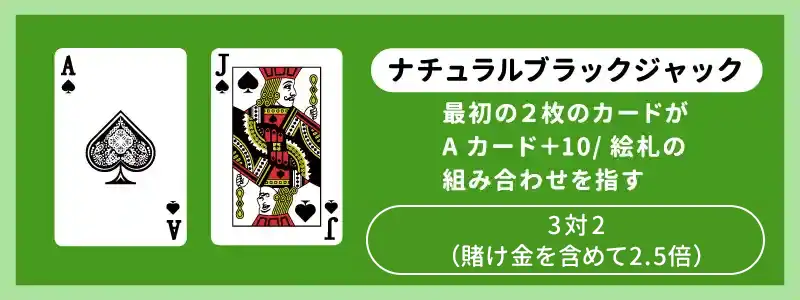
A natural blackjack is a hand whose first two cards are an ace and a 10-value card.
A natural blackjack always wins unless the dealer also has one, and it pays 3 to 2, so a $10 bet wins $15. An ordinary win pays 1 to 1, so a $10 bet wins $10. A natural therefore pays more than any other winning hand.
If your first card is an ace, you need only a 10-value card as your second card to make a natural blackjack. An 8-deck shoe holds 416 cards, 128 of which are 10-value cards, and with the ace already dealt, 415 cards remain. Given that the first card is an ace, the probability that the second card completes a natural blackjack is therefore about 30.8%.
A natural blackjack also forms when the first card is a 10-value card and the second is an ace, and in that order the probability that the second card is an ace is about 7.7%. The two figures differ only because the shoe contains different numbers of aces and 10-value cards; neither order makes a natural more likely. Combining both orders, the probability of being dealt a natural blackjack is about 4.8%, or roughly once every 21 hands.
Splitting Is the Better Play with a Pair of Aces
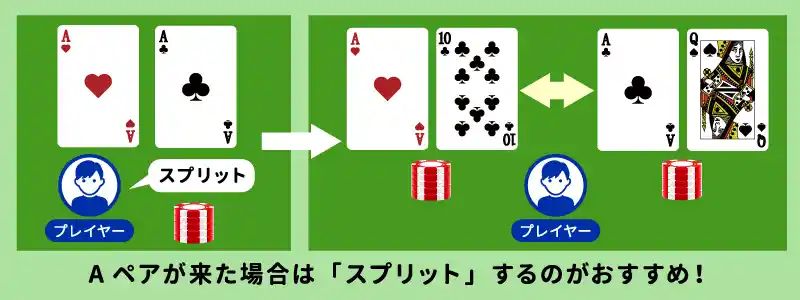
If you are dealt two aces, you can split them, separating them into two hands that are played separately.
For a pair of aces, the standard chart calls for splitting whatever the dealer’s upcard is. Do not consider any other action; always split.
The next card is more likely to be a 10-value card than any other rank, so splitting aces gives each hand a chance to make 21 with an ace and a 10-value card.
However, many tables apply special rules to split aces. Each ace receives only one more card, and if an ace and a 10-value card make 21, it counts as an ordinary 21 and does not pay 3 to 2.
Even after accounting for the expected value lost to these restrictions, splitting a pair of aces is still considered the better play.
- Related Article
-

How to Play When the Dealer Shows an Ace
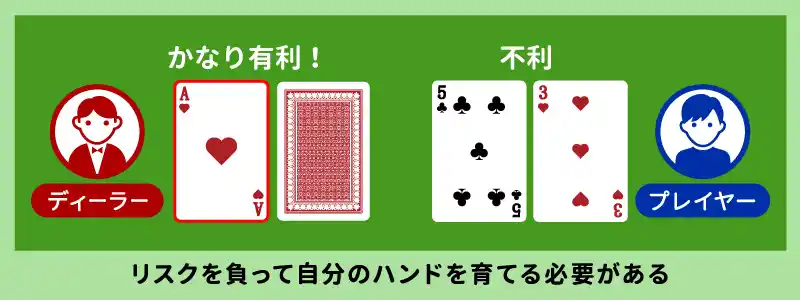
The dealer starts with two cards. The first is dealt face up and is called the upcard, and the second, dealt face down, is the hole card. When the upcard is an ace, the player is in a difficult position.
The dealer has a high chance of a natural blackjack, about 30.8% in an 8-deck game. Even when the dealer does not have one, the dealer rarely busts with an ace showing.
When the dealer’s first card is an ace, the dealer busts about 11.5% of the time. This figure assumes 8 decks and a dealer who stands on soft 17, and it treats a dealer natural blackjack as a non-bust outcome. Once the dealer is known not to have a natural, the figure rises to about 16.7%. Either way, it is the lowest bust rate of any upcard, so players need to accept some risk to improve their own hands. A hard 16, for example, busts about 61.5% of the time when it takes one more card, but against a dealer ace, where a dealer bust is unlikely, hitting is the correct play unless surrender is available. For the exact play in each situation, follow a basic strategy chart.
Should You Take Insurance?
When the dealer’s upcard is an ace, you can place a bet called insurance.
Insurance is a bet separate from the main bet, and you can bet up to half of your main bet on it. If the dealer does have a natural blackjack, the insurance bet pays 2 to 1, so with a $10 main bet, a $5 insurance bet wins $10. If you bet the full half, this payout exactly offsets the loss on the main bet, and you break even on the round. If the dealer does not have a natural blackjack, you lose the insurance bet, and play then continues as usual. On its own, the insurance bet has an expected value of about −7.5% (8 decks), so as a rule it should not be taken.
For more on whether to take insurance, see the article below.
- Related Article
-

Frequently Asked Questions About the Ace in Blackjack
- Why is the ace such an important card in blackjack?
-
The ace is the most flexible card in blackjack and the only card that can count as either 1 or 11. A hand that includes an ace gives you more options, and an ace is also essential for a natural blackjack.
- Should you always split a pair of aces?
-
Yes, at standard tables where the dealer takes a hole card. Basic strategy calls for splitting a pair of aces against every dealer upcard. Splitting doubles your total bet, but the chance to make 21 on two hands is considered to outweigh that cost. Splitting is also the correct play when the dealer’s upcard is an ace. The exception is a game in which the dealer takes no hole card, such as European BlackJack MH, where you hit A,A against an ace.
- How can you make the most of an ace in blackjack?
-
A hand in which the ace can count as 11 is a soft hand, so you make your decisions from the soft-hand chart rather than the hard-hand chart. Keep the soft-hand section of a basic strategy chart in front of you while you play.
Summary: Use the Soft-Hand Chart for Hands with an Ace
The ace is the most powerful card, counting as either 1 or 11. Combined with a 10-value card, it makes a natural blackjack, so it matters far more than any other card.
When you hold an ace, follow the soft-hand chart to judge when to play aggressively and when to hold back. When the dealer shows an ace, do not rely on a dealer bust. Accept some risk and improve your own hand.
A soft hand can be played flexibly, depending on the situation. Playing hands that include an ace according to basic strategy helps you get closer to the best expected value the game allows. Keep in mind, however, that basic strategy only identifies the best decision in each situation. It does not remove blackjack’s house edge or guarantee a win.
This site is for adults of legal gambling age (18+, or older where required) who live in countries or regions where online gambling is legal.
Use of this site is subject to our Terms and Conditions.
Gambling involves risk. Only bet what you can afford to lose, and do not use online gambling services where they are illegal.

Bell | Editor of Online Casino Winners Club. Since the site launched in 2003, Bell has written guides to casino game rules, tested betting systems and covered land-based casinos around the world, and still plays the games before writing about them. Bell's core advice: choose the bets with the lowest house edge, and decide in advance how much you are prepared to lose.