

A split is an action you can take when your first two cards are a pair (two cards of the same rank): you separate them and play each card as its own…
Blackjack Basic Strategy Charts and RTP Generator by Table Rules

Basic strategy is the first thing to learn if you want to play blackjack well.
What You Will Learn
- Basic strategy is the fundamental way to play every blackjack hand.
- The strategy chart has three parts, for hard hands, soft hands and pairs, and you use the one that matches your hand.
- The chart shows the best action for every situation, whether you hold a total of 10 or 11, a soft hand or a pair of aces.

This article takes about 20 minutes to read.
Contents
Show
Basic Strategy Chart and RTP Generator
Strategy Generator
Choose the game you play, or set the number of decks, double down conditions and other rules, to calculate the optimal basic strategy chart and theoretical return to player (RTP) for those rules. The tool uses exact combinatorial analysis, including card removal effects, not simulation.
Few live tables offer surrender. One confirmed example is Ezugi’s VIP Blackjack with Surrender (late surrender). Early surrender is almost never offered today, even at land-based casinos.
Advanced Settings
Theoretical RTP
—
When played with basic strategy
House edge
—
Expected loss per hand
Provider’s published RTP
—
—
Calculated on the server. New rule combinations take a few seconds.
Never take insurance or even money, under any rules. Unless you count cards, their expected value is negative.
What Is Blackjack Basic Strategy?
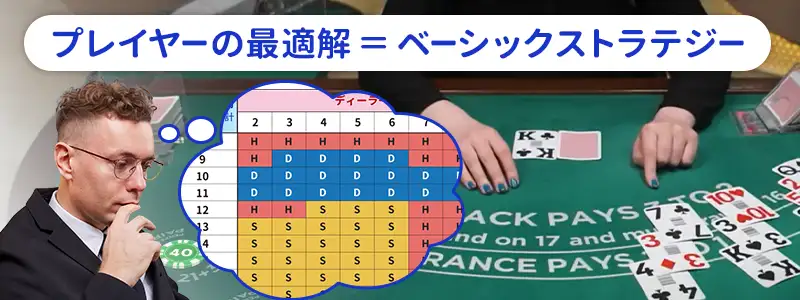
Blackjack, a card game widely available at online casinos, is one in which the player's decisions affect the outcome. Players decide whether to hit, stand, double down or split.
For every combination of your hand and the dealer's upcard, the action with the highest expected value has already been worked out. Basic strategy is the complete set of these optimal plays.
However, following basic strategy does not reduce the house edge to zero. Think of basic strategy not as a way to start winning, but as a way to keep the house edge as low as possible.
Whether you can consult a chart while playing depends on the casino. Some land-based casinos allow printed strategy cards, but smartphones and other electronic devices are generally prohibited at the table. At an online casino, by contrast, you can check the chart freely while you play.
How to Read the Basic Strategy Chart
The chart below shows basic strategy for the following rules: 8 decks, the dealer stands on soft 17 (S17; a soft 17 is a 17 in which an ace counts as 11), no doubling after splitting (no DAS), no surrender, and double down allowed on any first two cards. Evolution's live blackjack, which is widely offered at online casinos, uses these rules. In the rest of this article, we refer to this chart as the "standard chart."
- HHit
- SStand
- DDouble down
- DsDouble down (stand if not allowed)
- PSplit
| Player | Dealer's upcard | |||||||||
|---|---|---|---|---|---|---|---|---|---|---|
| 2 | 3 | 4 | 5 | 6 | 7 | 8 | 9 | 10 | A | |
| 5–8 | H | H | H | H | H | H | H | H | H | H |
| 9 | H | D | D | D | D | H | H | H | H | H |
| 10 | D | D | D | D | D | D | D | D | H | H |
| 11 | D | D | D | D | D | D | D | D | D | H |
| 12 | H | H | S | S | S | H | H | H | H | H |
| 13 | S | S | S | S | S | H | H | H | H | H |
| 14 | S | S | S | S | S | H | H | H | H | H |
| 15 | S | S | S | S | S | H | H | H | H | H |
| 16 | S | S | S | S | S | H | H | H | H | H |
| 17–20 | S | S | S | S | S | S | S | S | S | S |
| A,2 | H | H | H | D | D | H | H | H | H | H |
| A,3 | H | H | H | D | D | H | H | H | H | H |
| A,4 | H | H | D | D | D | H | H | H | H | H |
| A,5 | H | H | D | D | D | H | H | H | H | H |
| A,6 | H | D | D | D | D | H | H | H | H | H |
| A,7 | S | Ds | Ds | Ds | Ds | S | S | H | H | H |
| A,8 | S | S | S | S | S | S | S | S | S | S |
| A,9 | S | S | S | S | S | S | S | S | S | S |
| 2,2 | H | H | P | P | P | P | H | H | H | H |
| 3,3 | H | H | P | P | P | P | H | H | H | H |
| 4,4 | H | H | H | H | H | H | H | H | H | H |
| 5,5 | D | D | D | D | D | D | D | D | H | H |
| 6,6 | H | P | P | P | P | H | H | H | H | H |
| 7,7 | P | P | P | P | P | P | H | H | H | H |
| 8,8 | P | P | P | P | P | P | P | P | P | P |
| 9,9 | P | P | P | P | P | S | P | P | S | S |
| 10,10 | S | S | S | S | S | S | S | S | S | S |
| A,A | P | P | P | P | P | P | P | P | P | P |
The rule terms are defined as follows.
- 8 decks: Eight standard 52-card decks are shuffled together
- S17: The dealer stands on soft 17
- No DAS: You cannot double down after splitting
- No surrender: You cannot surrender (give up your hand)
- Double down: Allowed on any first two cards, regardless of the total
Strategy charts use abbreviations for the actions, so we recommend learning them before you start.
| Abbreviation | Action |
|---|---|
| H (Hit) | Draw one more card |
| S (Stand) | Take no more cards and play the hand as it is |
| D (Double down) | Double your bet and receive exactly one more card |
| P (Split) | When your first two cards are of the same rank, separate them into two hands and draw cards to each |
| R (Surrender) | Forfeit half of your bet, keep the other half and end the hand. (Not included in the chart above; how to play at tables that offer surrender is explained later.) |
How to Use Basic Strategy
The three charts below divide the standard chart by hand type. All of them assume the same rules as Evolution's live blackjack: 8 decks, S17, double down allowed on any first two cards, no DAS and no surrender.
Hard Hand Strategy Chart: No Ace, or an Ace Counted as 1
- HHit
- SStand
- DDouble down
- DsDouble down (stand if not allowed)
- PSplit
| Hard | Dealer's upcard | |||||||||
|---|---|---|---|---|---|---|---|---|---|---|
| 2 | 3 | 4 | 5 | 6 | 7 | 8 | 9 | 10 | A | |
| 5 | H | H | H | H | H | H | H | H | H | H |
| 6 | H | H | H | H | H | H | H | H | H | H |
| 7 | H | H | H | H | H | H | H | H | H | H |
| 8 | H | H | H | H | H | H | H | H | H | H |
| 9 | H | D | D | D | D | H | H | H | H | H |
| 10 | D | D | D | D | D | D | D | D | H | H |
| 11 | D | D | D | D | D | D | D | D | D | H |
| 12 | H | H | S | S | S | H | H | H | H | H |
| 13 | S | S | S | S | S | H | H | H | H | H |
| 14 | S | S | S | S | S | H | H | H | H | H |
| 15 | S | S | S | S | S | H | H | H | H | H |
| 16 | S | S | S | S | S | H | H | H | H | H |
| 17–20 | S | S | S | S | S | S | S | S | S | S |
Use the hard hand chart for hands that contain no ace, and for hands with an ace that can only count as 1 because counting it as 11 would bust the hand.
Find the cell where your hand and the dealer's upcard intersect, and take the action shown there, using the abbreviations explained above.
If you stand or double down, your turn ends at that point. If you hit, check the chart again with your new total to find the next action.
Hard Hand Example
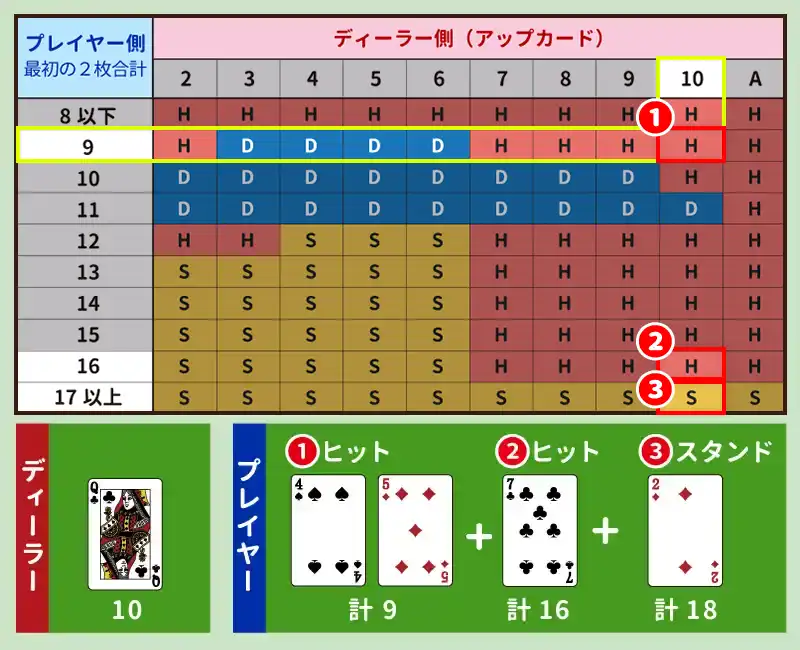
Suppose you hold a 4 and a 5, and the dealer's upcard is a Q. Your hand totals 9 and the upcard counts as 10, so you hit.
Your third card is a 7. Your hand is now 16 against a 10, so you hit again, as the chart indicates.
Your fourth card is a 2. Your hand is now 18 (17 or more), so you stand, and your turn is complete.
Soft Hand Strategy Chart: When an Ace Can Count as 11
- HHit
- SStand
- DDouble down
- DsDouble down (stand if not allowed)
- PSplit
| Soft | Dealer's upcard | |||||||||
|---|---|---|---|---|---|---|---|---|---|---|
| 2 | 3 | 4 | 5 | 6 | 7 | 8 | 9 | 10 | A | |
| A,2 | H | H | H | D | D | H | H | H | H | H |
| A,3 | H | H | H | D | D | H | H | H | H | H |
| A,4 | H | H | D | D | D | H | H | H | H | H |
| A,5 | H | H | D | D | D | H | H | H | H | H |
| A,6 | H | D | D | D | D | H | H | H | H | H |
| A,7 | S | Ds | Ds | Ds | Ds | S | S | H | H | H |
| A,8 | S | S | S | S | S | S | S | S | S | S |
| A,9 | S | S | S | S | S | S | S | S | S | S |
Use the soft hand chart for hands in which an ace can count as 11 without busting, except for A,A.
A soft hand cannot bust on the next card: if that card takes the total over 21, the ace simply counts as 1 instead of 11. For this reason, soft hands offer more situations than hard hands in which hitting or doubling down is correct.
Use the soft hand chart only while the ace can still count as 11. Once additional cards mean the ace can only count as 1, switch to the hard hand chart.
Soft Hand Example
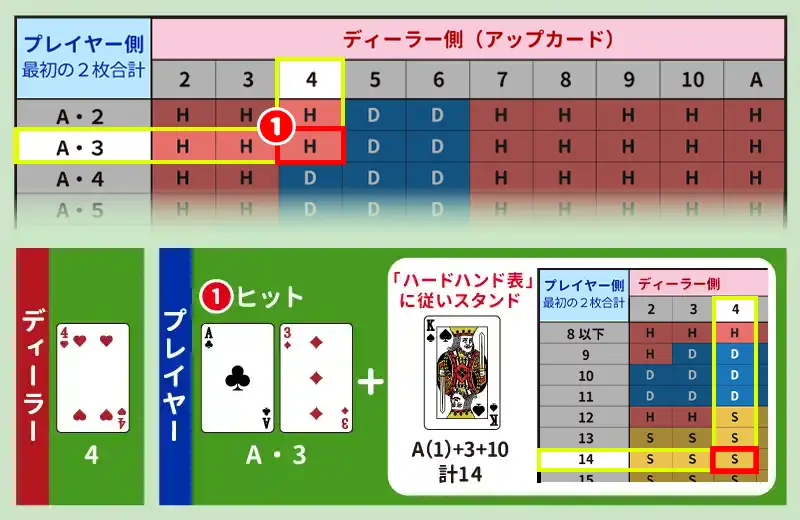
Suppose you hold an A and a 3, and the dealer's upcard is a 4. Following the chart, you hit.
Your third card is a K. Your total is now 14: A (1) + 3 + K (10). At this point you switch to the hard hand chart, which says to stand, and your turn is complete.
Split Strategy Chart: When Your First Two Cards Are the Same Rank
- HHit
- SStand
- DDouble down
- DsDouble down (stand if not allowed)
- PSplit
| Pair | Dealer's upcard | |||||||||
|---|---|---|---|---|---|---|---|---|---|---|
| 2 | 3 | 4 | 5 | 6 | 7 | 8 | 9 | 10 | A | |
| 2,2 | H | H | P | P | P | P | H | H | H | H |
| 3,3 | H | H | P | P | P | P | H | H | H | H |
| 4,4 | H | H | H | H | H | H | H | H | H | H |
| 5,5 | D | D | D | D | D | D | D | D | H | H |
| 6,6 | H | P | P | P | P | H | H | H | H | H |
| 7,7 | P | P | P | P | P | P | H | H | H | H |
| 8,8 | P | P | P | P | P | P | P | P | P | P |
| 9,9 | P | P | P | P | P | S | P | P | S | S |
| 10,10 | S | S | S | S | S | S | S | S | S | S |
| A,A | P | P | P | P | P | P | P | P | P | P |
When your hand consists of two cards of the same rank, check the split chart. You can play the two cards together as one hand, or separate them and play two hands. Some tables also allow you to split two 10-value cards (10, J, Q, K) of different ranks, but that means breaking up a total of 20, so standing is the correct play.
This does not mean you should split every pair. Many pairs should not be split and are instead played according to the hard hand chart, so do not rely on instinct.
After splitting, use the soft hand and hard hand charts to decide how to play each new hand.
Split Example
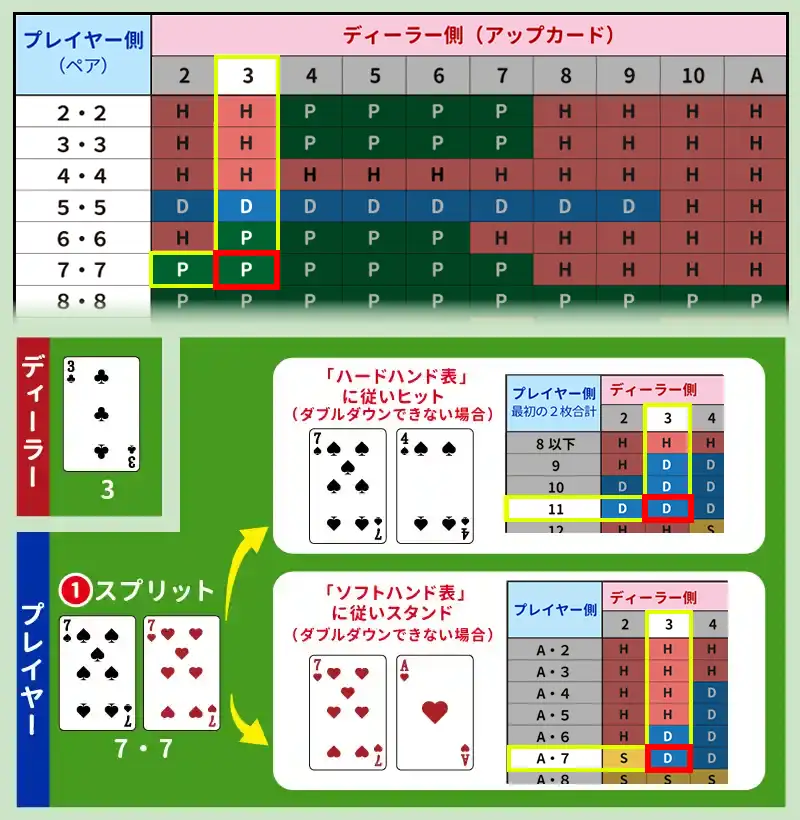
Suppose your hand is 7,7 and the dealer's upcard is a 3. The strategy chart says to split.
You draw a 4 to one hand and an A to the other, giving you two hands: 7,4 and 7,A.
At a table that allows DAS, you would double down on 7,4 according to the hard hand chart and double down on 7,A according to the soft hand chart. At a table without DAS, as assumed in the standard chart, you hit 7,4 and stand on 7,A.
- Related Article
-

Strategy When Doubling After Splitting (DAS) Is Allowed
This split chart applies to the following rules: 8 decks, S17, double down allowed on any first two cards, DAS allowed and no surrender. The seven boxed cells differ from the no-DAS chart. The changes affect four pairs (2,2, 3,3, 4,4 and 6,6), and the strategy for hard and soft hands stays the same.
- HHit
- SStand
- DDouble down
- DsDouble down (stand if not allowed)
- PSplit
- BoxChanged from no DAS
| Pair | Dealer's upcard | |||||||||
|---|---|---|---|---|---|---|---|---|---|---|
| 2 | 3 | 4 | 5 | 6 | 7 | 8 | 9 | 10 | A | |
| 2,2 | P | P | P | P | P | P | H | H | H | H |
| 3,3 | P | P | P | P | P | P | H | H | H | H |
| 4,4 | H | H | H | P | P | H | H | H | H | H |
| 5,5 | D | D | D | D | D | D | D | D | H | H |
| 6,6 | P | P | P | P | P | H | H | H | H | H |
| 7,7 | P | P | P | P | P | P | H | H | H | H |
| 8,8 | P | P | P | P | P | P | P | P | P | P |
| 9,9 | P | P | P | P | P | S | P | P | S | S |
| 10,10 | S | S | S | S | S | S | S | S | S | S |
| A,A | P | P | P | P | P | P | P | P | P | P |
The seven changed cells are listed below.
| Your hand | Dealer's upcard | No DAS | DAS allowed |
|---|---|---|---|
| 2,2 | 2 or 3 | Hit | Split |
| 3,3 | 2 or 3 | Hit | Split |
| 4,4 | 5 or 6 | Hit | Split |
| 6,6 | 2 | Hit | Split |
Late Surrender Basic Strategy
There are two types of surrender, and the correct plays differ between them: early surrender, which lets you give up your hand before the dealer checks for blackjack, and late surrender, which lets you do so only after the check.
This section covers late surrender, which lets you give up your hand and keep half of your bet once the dealer has confirmed that they do not have blackjack. The chart below is the complete chart for 8 decks, S17, double down allowed on any first two cards, DAS allowed and late surrender. The four boxed cells differ from the no-surrender chart, and the seven cells that change with DAS are already included. Surrender is available only on your first two cards, so you cannot surrender after hitting.
- HHit
- SStand
- DDouble down
- DsDouble down (stand if not allowed)
- PSplit
- RSurrender
- BoxChanged from no surrender
| Player | Dealer's upcard | |||||||||
|---|---|---|---|---|---|---|---|---|---|---|
| 2 | 3 | 4 | 5 | 6 | 7 | 8 | 9 | 10 | A | |
| 5–7 | H | H | H | H | H | H | H | H | H | H |
| 8 | H | H | H | H | H | H | H | H | H | H |
| 9 | H | D | D | D | D | H | H | H | H | H |
| 10 | D | D | D | D | D | D | D | D | H | H |
| 11 | D | D | D | D | D | D | D | D | D | H |
| 12 | H | H | S | S | S | H | H | H | H | H |
| 13 | S | S | S | S | S | H | H | H | H | H |
| 14 | S | S | S | S | S | H | H | H | H | H |
| 15 | S | S | S | S | S | H | H | H | R | H |
| 16 | S | S | S | S | S | H | H | R | R | R |
| 17 | S | S | S | S | S | S | S | S | S | S |
| 18–20 | S | S | S | S | S | S | S | S | S | S |
| A,2 | H | H | H | D | D | H | H | H | H | H |
| A,3 | H | H | H | D | D | H | H | H | H | H |
| A,4 | H | H | D | D | D | H | H | H | H | H |
| A,5 | H | H | D | D | D | H | H | H | H | H |
| A,6 | H | D | D | D | D | H | H | H | H | H |
| A,7 | S | Ds | Ds | Ds | Ds | S | S | H | H | H |
| A,8 | S | S | S | S | S | S | S | S | S | S |
| A,9 | S | S | S | S | S | S | S | S | S | S |
| 2,2 | P | P | P | P | P | P | H | H | H | H |
| 3,3 | P | P | P | P | P | P | H | H | H | H |
| 4,4 | H | H | H | P | P | H | H | H | H | H |
| 5,5 | D | D | D | D | D | D | D | D | H | H |
| 6,6 | P | P | P | P | P | H | H | H | H | H |
| 7,7 | P | P | P | P | P | P | H | H | H | H |
| 8,8 | P | P | P | P | P | P | P | P | P | P |
| 9,9 | P | P | P | P | P | S | P | P | S | S |
| 10,10 | S | S | S | S | S | S | S | S | S | S |
| A,A | P | P | P | P | P | P | P | P | P | P |
At a late surrender table, there are only four situations in which you should surrender.
| Your hand | Dealer's upcard | Action |
|---|---|---|
| Hard 15 | 10 | Surrender |
| Hard 16 (except 8,8) | 9 | Surrender |
| Hard 16 (except 8,8) | 10 | Surrender |
| Hard 16 (except 8,8) | A | Surrender |
| All other hands | — | Play according to the chart |
Although it also totals 16, 8,8 should be split, not surrendered. Soft hands are never surrendered. At H17 tables, where the dealer hits soft 17, three more surrenders are added: hard 15 against an A, hard 17 against an A, and 8,8 against an A. However, the major live dealer tables use S17, so these usually do not apply.
Late surrender lowers the house edge by about 0.08 percentage points (8 decks, S17; about 0.09 percentage points under H17). The effect is small because there are only four situations in which you surrender.
Early Surrender Basic Strategy (Against an Ace Only)
The chart below assumes 8 decks, S17, double down allowed on any first two cards, no DAS, and early surrender available only when the dealer's upcard is an ace. The 11 boxed cells differ from the no-surrender chart, and all of the changes are in the A column.
- HHit
- SStand
- DDouble down
- DsDouble down (stand if not allowed)
- PSplit
- RSurrender
- RsSurrender (stand if not allowed)
- BoxChanged from no surrender
| Player | Dealer's upcard | |||||||||
|---|---|---|---|---|---|---|---|---|---|---|
| 2 | 3 | 4 | 5 | 6 | 7 | 8 | 9 | 10 | A | |
| 5–7 | H | H | H | H | H | H | H | H | H | R |
| 8 | H | H | H | H | H | H | H | H | H | H |
| 9 | H | D | D | D | D | H | H | H | H | H |
| 10 | D | D | D | D | D | D | D | D | H | H |
| 11 | D | D | D | D | D | D | D | D | D | H |
| 12 | H | H | S | S | S | H | H | H | H | R |
| 13 | S | S | S | S | S | H | H | H | H | R |
| 14 | S | S | S | S | S | H | H | H | H | R |
| 15 | S | S | S | S | S | H | H | H | H | R |
| 16 | S | S | S | S | S | H | H | H | H | R |
| 17 | S | S | S | S | S | S | S | S | S | Rs |
| 18–20 | S | S | S | S | S | S | S | S | S | S |
| A,2 | H | H | H | D | D | H | H | H | H | H |
| A,3 | H | H | H | D | D | H | H | H | H | H |
| A,4 | H | H | D | D | D | H | H | H | H | H |
| A,5 | H | H | D | D | D | H | H | H | H | H |
| A,6 | H | D | D | D | D | H | H | H | H | H |
| A,7 | S | Ds | Ds | Ds | Ds | S | S | H | H | H |
| A,8 | S | S | S | S | S | S | S | S | S | S |
| A,9 | S | S | S | S | S | S | S | S | S | S |
| 2,2 | H | H | P | P | P | P | H | H | H | H |
| 3,3 | H | H | P | P | P | P | H | H | H | R |
| 4,4 | H | H | H | H | H | H | H | H | H | H |
| 5,5 | D | D | D | D | D | D | D | D | H | H |
| 6,6 | H | P | P | P | P | H | H | H | H | R |
| 7,7 | P | P | P | P | P | P | H | H | H | R |
| 8,8 | P | P | P | P | P | P | P | P | P | R |
| 9,9 | P | P | P | P | P | S | P | P | S | S |
| 10,10 | S | S | S | S | S | S | S | S | S | S |
| A,A | P | P | P | P | P | P | P | P | P | P |
When early surrender is available against an ace, surrender the following hands.
| Your hand | When the dealer's upcard is an A |
|---|---|
| Hard 5, 6 or 7 | Surrender |
| Hard 12–17 | Surrender |
| 3,3 / 6,6 / 7,7 / 8,8 | Surrender |
| All other hands | Play according to the chart |
8,8 is otherwise always split, but when the dealer shows an ace and early surrender is available, surrendering loses less than splitting. Soft hands are never surrendered.
With early surrender against an ace only, as in the chart above, the house edge drops by about 0.39 percentage points. The full version, which allows early surrender against both an ace and a 10-value card, lowers it by about 0.63 percentage points (0.39 against an ace and 0.24 against a 10-value card). Both figures assume 8 decks and S17.
- Related Article
-

Easy Ways to Memorize Basic Strategy

Memorizing all of basic strategy from scratch takes considerable effort.
The rules of thumb below do not cover the entire strategy chart, but they help you learn the general decisions for the most common hands.
All of them are guidelines based on the standard chart, which assumes no surrender and no DAS, the same rules as Evolution's main tables. For soft hands and for pairs other than A,A and 8,8, check the chart each time.
- If your hand is 8 or less, hit regardless of the upcard
- If your hand is 17 or more, stand regardless of the upcard
- If your hand is 9, 10 or 11, consider doubling down
- If your hand is 13 or more and the dealer shows 6 or less, stand
- If your hand is A,A or 8,8, split regardless of the upcard
If Your Hand Is 8 or Less, Hit Regardless of the Upcard
If your hand totals 8 or less, hit regardless of the dealer's upcard.
With a hand of 8, doubling down and drawing the best possible card, an A, still only gets you to 19, so the expected value does not justify doubling your bet. At the same time, one more card cannot bust you, so there is no reason to stand. For these reasons, you hit on 8 or less.
If Your Hand Is 17 or More, Stand Regardless of the Upcard
If your hand totals 17 or more and contains no ace, stand regardless of the dealer's upcard.
If you hit a 17, only an A, 2, 3 or 4 keeps you at 21 or less, a probability of about 30.8%. In other words, you will bust roughly 70% of the time.
Even when the dealer shows a 10-value card or an A, the expected loss from hitting is greater than the expected loss from standing. Standing remains the least costly choice against a strong upcard.
If Your Hand Is 9, 10 or 11, Consider Doubling Down
When your hand totals 9, 10 or 11, doubling down becomes an option. With a total of 11 or less, no card can bust you.
With 10 or 11 in particular, drawing a 10-value card gives you 20 or 21, so you can win either by making a high total or by the dealer busting.
Specifically, doubling down has the higher expected value on 10 unless the upcard is a 10-value card or an A, and on 11 unless the upcard is an A.
A total of 9 is also a candidate for doubling down. It is not as strong as 10 or 11, but doubling down has the higher expected value when the dealer's upcard is a weak 3–6.
If Your Hand Is 13 or More and the Dealer Shows 6 or Less, Stand
When your hand is 12–16, whether you should hit or stand depends on the dealer's upcard.
The combination most worth remembering is a hand of 13 or more against a dealer upcard of 6 or less. In this situation, standing has the higher expected value.
This rule, however, applies only to hard hands. With a soft hand, in which an ace can count as 11, doubling down or hitting may be correct against the same upcards, so always check the soft hand chart.
There are two ways to win in blackjack:
- Your total is higher than the dealer's without going over 21
- The dealer busts while you have not busted
In this situation, you are relying on the second way to win: the dealer busting. With a hand of 13–16, your chance of busting on the next card is about 38–62%. When the upcard is 6 or less, the dealer busts about 35–42% of the time (8 decks, S17), so standing has the higher expected value. A hand of 12 is different: hit against a 2 or 3, and stand against 4–6.
When the dealer's upcard is 7 or higher, you should generally hit.
If Your Hand Is A,A or 8,8, Split Regardless of the Upcard
The split chart is fairly hard to memorize, but some pairs are played the same way regardless of the upcard. These are A,A and 8,8.
Split A,A or 8,8 whatever the dealer's upcard. After splitting aces, an ace and a 10-value card count as 21, not as a blackjack, and under the usual rule each ace receives only one more card, after which the hand must stand.
Some tables allow you to hit after splitting aces, but either way splitting has the higher expected value.
Left together, 8,8 makes 16, one of the weakest hands, so splitting the 8s has the higher expected value. Under the standard chart, the only exception is when the dealer shows an ace at a table that offers early surrender, as described above. Games in which the dealer takes no hole card, such as European BlackJack MH, have further exceptions, covered in our guide to online blackjack games.
Pairs other than A,A and 8,8 are played according to the dealer's upcard. For example, 2,2, 3,3 and 7,7 are generally split only when the dealer's upcard is 7 or lower (for 2,2 and 3,3, only against 4–7); otherwise you hit (or take whatever action the hard hand chart shows).
Some other hands also have a fixed action regardless of the upcard; for example, you always stand on two 10-value cards. The most efficient approach is to memorize these straightforward hands first.
Combining Basic Strategy with Other Methods: The Relationship to RTP

Basic strategy shows the optimal way to play the game, but it does not raise the return to player (RTP) above 100%. As long as the RTP does not exceed 100%, a house edge always remains.
The house edge is built into the rules and payouts and cannot be eliminated, so basic strategy alone cannot produce a long-term profit.
Basic strategy can be combined with other methods. Betting systems, for example, which raise or lower your bet according to the situation at the table, do not change the expected value itself, but they can be used to manage the ups and downs of your bankroll.
Card counting, which keeps track of the cards already dealt to gauge which cards remain, is a method for identifying favorable situations and adjusting your bets accordingly.
RNG blackjack, however, reshuffles after every hand, and online live tables also shuffle before much of the shoe has been dealt, so card counting rarely produces a practical advantage online.
Cashback and similar loss-rebate offers from casinos do not change the expected value of the game either, but they can reduce your net losses. They do not eliminate the house edge.
If your goal is to keep losses down, use basic strategy to avoid costly mistakes and combine it with cashback offers that have lenient wagering requirements.
- Related Article
-

Frequently Asked Questions About Blackjack Basic Strategy
- What is basic strategy in blackjack?
-
Basic strategy is a chart of the optimal action for each combination of the dealer's upcard and your hand: its total, whether it is a pair and whether it is a soft hand. Following it keeps your long-term results close to the expected value the game offers with optimal play.
- Does basic strategy guarantee that I will win?
-
No, there is no guarantee that you will win, because the house edge always remains. Compared with playing without a plan, however, basic strategy clearly reduces your losses over the long run.
Summary: Basic Strategy Is the Foundation for Avoiding Unnecessary Losses
Basic strategy is the fundamental way to play blackjack and the first thing to learn. By choosing the right action for your hand and the dealer's upcard, you keep your results close to the game's expected value. It does not guarantee a win, but it reduces unnecessary losses over the long run.
Land-based casinos generally prohibit smartphones and other electronic devices at the table, but at an online casino you can play with a strategy chart at hand. Even beginners can start using it today.
Basic strategy can also be combined with other methods, such as card counting and betting systems. Because combining methods increases the number of decisions you have to make at once, we recommend learning basic strategy first.
This site is for adults of legal gambling age (18+, or older where required) who live in countries or regions where online gambling is legal.
Use of this site is subject to our Terms and Conditions.
Gambling involves risk. Only bet what you can afford to lose, and do not use online gambling services where they are illegal.

Bell | Editor of Online Casino Winners Club. Since the site launched in 2003, Bell has written guides to casino game rules, tested betting systems and covered land-based casinos around the world, and still plays the games before writing about them. Bell's core advice: choose the bets with the lowest house edge, and decide in advance how much you are prepared to lose.